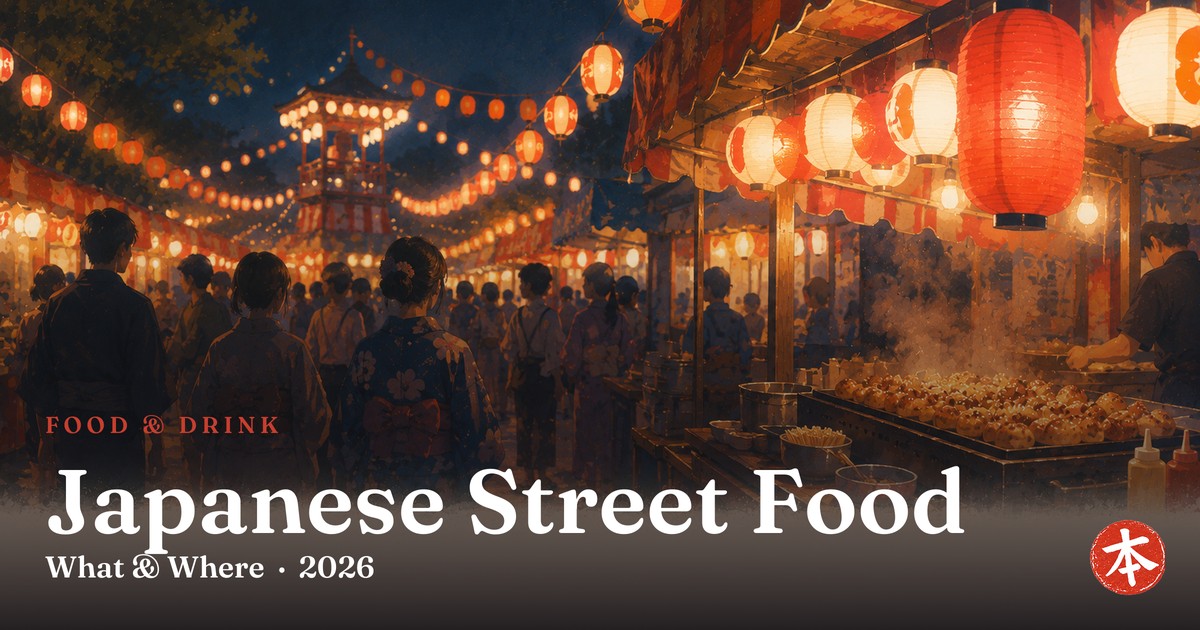
Here's the thing nobody tells you: Japan has phenomenal street food, but almost none of it is actually on the street. If you land expecting Bangkok-style food carts on every corner, you'll wonder where everyone eats. The answer is that Japanese street food lives in specific places — market streets, temple approaches, festival stalls, shopping arcades and department-store food halls — and once you know where to look, it's everywhere, cheap, and very good.
(Street food is the daytime version; the evening belongs to the izakaya — and if you want a genuinely local night out, a baseball game costs less than dinner.)
This guide covers what to eat, where to find it in Tokyo, Osaka and Kyoto, what it costs, and the one etiquette rule — eating while walking — that trips up more visitors than anything else.
Japanese street food at a glance
| Where it lives | Market streets, temple approaches, festival (matsuri) stalls, shopping arcades, depachika food halls, konbini |
|---|---|
| Typical price | Roughly ¥200–700 per item; festival stalls ~¥300–800 (as of 2026) |
| Payment | Cash first — many stalls are still cash-only; keep coins and small bills |
| The etiquette rule | Don't eat while walking in crowded streets — buy, step aside, eat by the stall |
| Trash | Few public bins: hand rubbish back to the vendor or carry a small bag |
| Best hunting grounds | Ameyoko & Asakusa (Tokyo) · Dotonbori & Kuromon (Osaka) · Nishiki (Kyoto) |
What counts as Japanese street food?
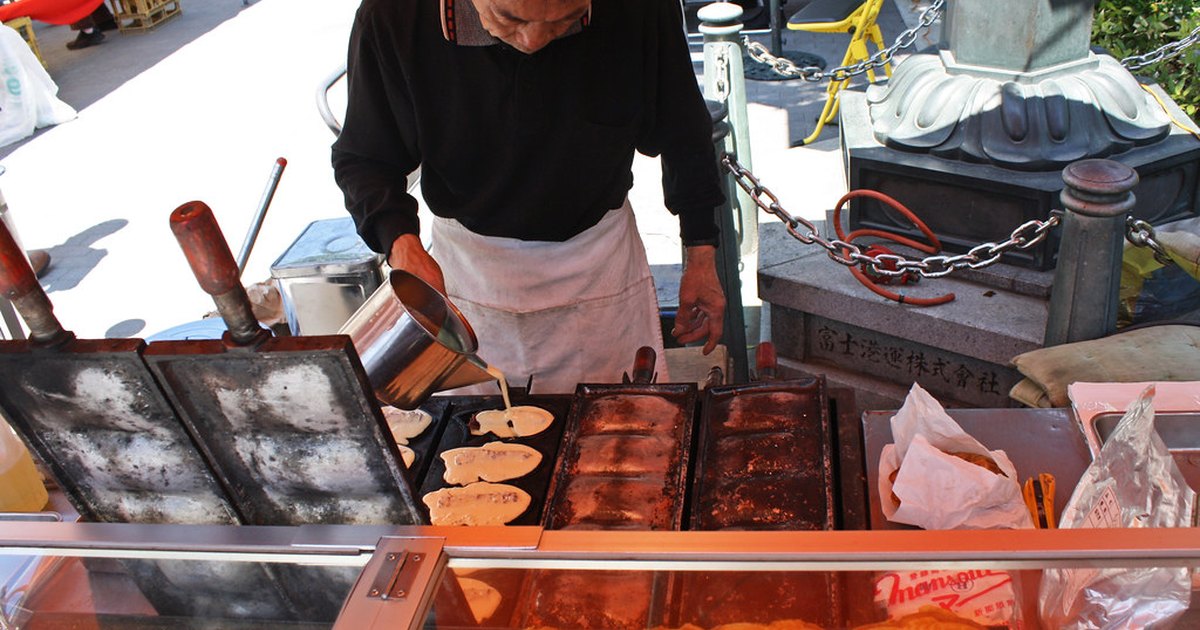
The classics fall into a few families. Griddle food: takoyaki (octopus balls — molten inside, be patient), okonomiyaki, yakisoba. Things on sticks: yakitori, dango (sweet rice dumplings), grilled squid, wagyu skewers in tourist districts. Sweets: taiyaki (the fish-shaped pastry filled with red bean or custard), imagawayaki, ningyo-yaki in Asakusa, melonpan, and the Harajuku crepe. Seasonal: yaki-imo (roast sweet potato) trucks in winter, kakigori (shaved ice) in summer, and the whole universe of festival-stall food — karaage, candied fruit, chocolate bananas — that appears wherever a matsuri does.
Two more places count, even if they don't look like "street" food. Depachika — the basement food halls of department stores — are effectively indoor street-food markets with samples and single-serve portions. And the konbini deserves honorary status: fried chicken, oden in winter, onigiri around the clock. For the snack-shopping side of this (KitKats, regional flavors, souvenir sweets), see our Don Quijote guide.
Where to find it: Tokyo
Ameyoko (Ueno)
The closest Tokyo gets to a true open-air street-food market: a railway-arch market street with kebab stands, grilled seafood, cut fruit on sticks and enough energy to feel like a different country from the quiet residential Tokyo two stops away. Go hungry, graze widely.
Nakamise-dori (Asakusa)
The 250-meter approach to Sensoji temple, lined with stalls selling ningyo-yaki, fresh melonpan, senbei rice crackers and age-manju (fried buns). Touristy? Completely. Also genuinely good, and the etiquette here is a live demonstration: locals buy, step to the side of the stall, eat, and hand the wrapper back.
Takeshita Street (Harajuku) and Tsukiji Outer Market
Takeshita is the sweet tooth's stop — crepes above all. Tsukiji Outer Market is the seafood one: tamagoyaki on a stick, grilled scallops, uni, tuna bowls. Go in the morning; many stalls wind down by early afternoon. If ramen is what you're actually hungry for, we've mapped the best bowls nearby in our Shibuya ramen guide.
Where to find it: Osaka and Kyoto
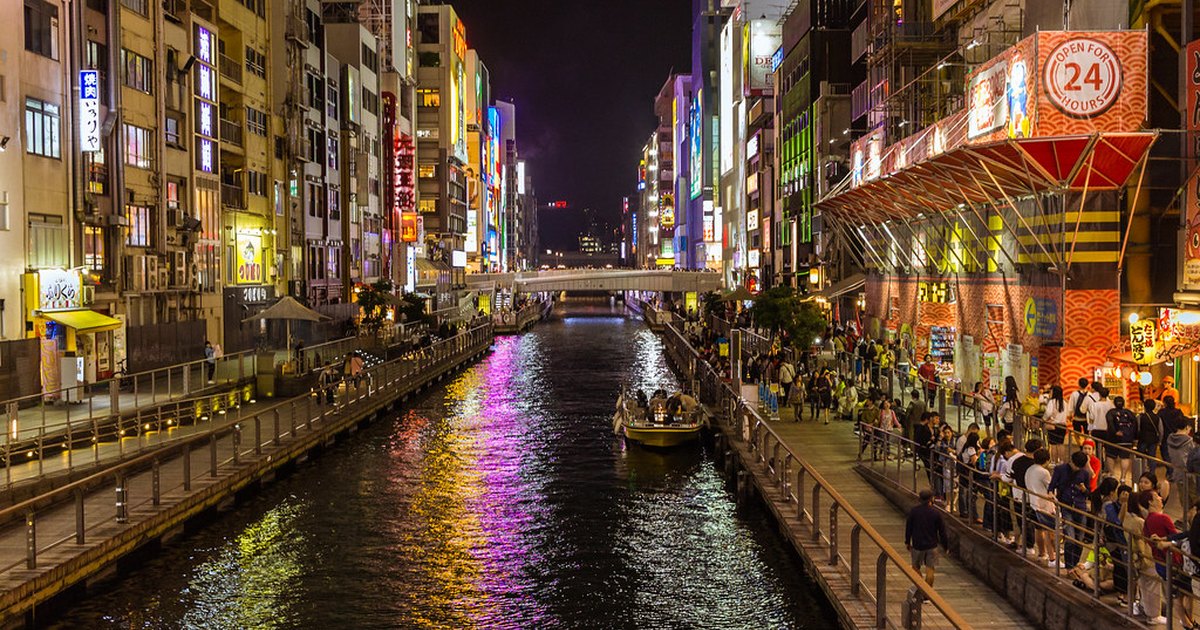
Osaka is Japan's street-food capital — the local phrase kuidaore roughly means "eat yourself broke." Dotonbori is the neon showcase: takoyaki flagships, gyoza, kushikatsu (deep-fried skewers — one dip only in the communal sauce, it's the house rule everywhere). Kuromon Market nearby is calmer and more seafood-driven.
Kyoto's Nishiki Market — 400 meters, ~130 shops, the city's kitchen for centuries — is dense with yuba, tofu doughnuts, tamagoyaki and pickle stalls. It's also the place where the etiquette rule below is official policy, so read on before you go.
The etiquette rule: eating while walking
The default that works everywhere: buy, step aside, eat it there, hand the wrapper back. You'll notice it's what everyone around you is doing. It also solves the no-trash-can problem automatically, and vendors genuinely appreciate it — several sweet stalls in Asakusa keep a little tray of toothpicks and a bin precisely because the expectation is that you eat on the spot.
Festival stalls: street food at full volume
If your trip overlaps a matsuri (festival), drop your plans and go — festival yatai are Japanese street food in its natural habitat: rows of stalls selling yakisoba, karaage, chocolate bananas, candied apples, grilled corn and kakigori late into the evening. Summer is peak season, and fireworks nights are the biggest of all. Stalls are overwhelmingly cash-only, lines move fast, and prices run a touch higher than markets (~¥300–800). Spring works too: hanami season fills the big parks with food stalls — our cherry blossom guide covers the spots, and our month-by-month Tokyo guide covers the timing.
Practical tips
- Carry cash. ¥2,000–3,000 in small bills and coins covers a serious market graze. Card and QR acceptance is growing but patchy (as of 2026).
- Bring a small bag for rubbish. Public bins are rare; vendors take back their own packaging.
- Mornings for markets, evenings for festivals. Tsukiji and Kuromon peak before noon; matsuri stalls come alive after dark.
- Queue = quality more reliably than in most countries. A ten-person line at a takoyaki stand is a recommendation, not a warning.
- Sit-down alternative: when you want a table and a conveyor belt instead of a stall, that's a different guide — see conveyor-belt sushi in Tokyo and our Kura Sushi walkthrough.
(Eat first, drink after: Golden Gai is 280 tiny bars that serve almost no food, with a seat charge on top of every drink.)
(Eating without meat or fish here is harder than it looks — most stock is made with bonito. See the vegetarian guide, built on the government's own instructions to restaurants.)
(Ten minutes' walk west of Asakusa's food stalls is Kappabashi, the kitchen-tool street — where the restaurants themselves shop for knives, pots and the plastic food in every window.)
(For the morning end of Tokyo eating — ¥330 gyudon breakfasts, grilled-fish teishoku and the official market timing that proves the "Tsukiji at 6 a.m." advice backwards — see our Japanese breakfast guide.)
(For the deep dive on the octopus balls specifically — Gindaco's official prices, the Odaiba floor with five Osaka masters, and the fake-branch myth — see our takoyaki guide.)
(For the sit-down griddle branch of the family — okonomiyaki, monjayaki and Tsukishima's 50-shop street — see our Tokyo okonomiyaki guide.)
FAQ
Is street food in Japan safe to eat?
Is it illegal to eat while walking in Japan?
How much does street food cost in Japan?
Where is the best street food in Tokyo?
Why are there so few trash cans in Japan?
Do street food stalls in Japan take credit cards?
Bottom line (2026) — Japan has incredible street food — it just does not live on the street the way it does in Bangkok. Look inside markets, festival stalls, shopping streets and food halls, and follow the one etiquette rule most visitors get wrong: do not eat while walking.
Sources
Etiquette rules checked against primary sources, July 29, 2026: Kamakura City's "Ordinance on Improving Manners in Public Places" (enacted April 2019 — a manners request, explicitly not a prohibition, per the city's own commentary) and Nishiki Market's official visitor guidance (kyoto-nishiki.or.jp — eat in front of the shop, no walking while eating, return rubbish to the shop). Price ranges are typical figures compiled from Japanese market and festival reporting and will vary by stall and season.
Some links on this page may be affiliate links, which means we may earn a commission if you book or buy through them — at no extra cost to you. See our affiliate disclosure.
Tokyo to Osaka, Tokyo to Kyushu, Tokyo to Hokkaido — day by day — plus seven places most visitors never reach.
- 12 pages, 80 photographs, every stop linked to its guide
- Every price and opening hour read from the official page
- Re-issued monthly, so it does not go stale in your inbox
Free. One email a month, plus the rare change that matters. Unsubscribe with one click in any email. By subscribing you agree to our privacy policy.