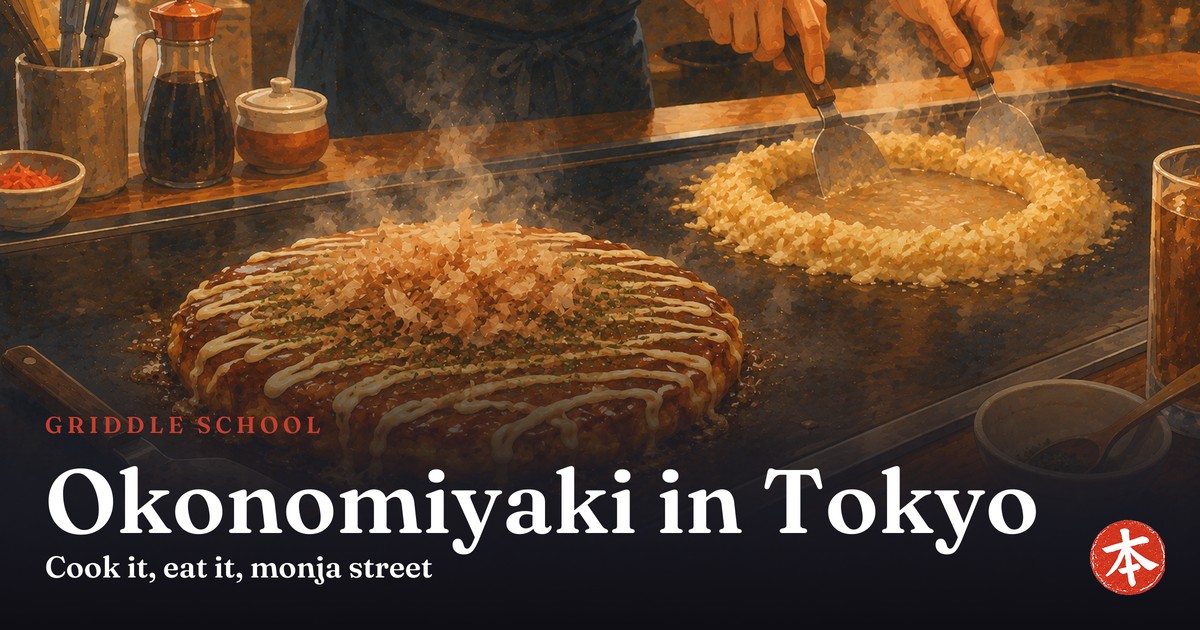
Tokyo does the savory pancake three ways, and picking wrong is the only real mistake. There's the cook-it-yourself school — a griddle in your table, batter in a bowl, and dinner doubles as a cooking class. There's the Osaka professional school, where a griddle-master hands you perfection and you just eat. And there's monjayaki — Tokyo's own runnier, weirder, arguably more fun cousin, with an entire street in Tsukishima dedicated to it: about 50 shops by the local association's official count, one subway exit apart. Here's how the three differ, what they cost by official menus, and where each one lives.
Tokyo okonomiyaki at a glance
| Style | Where | Official prices |
|---|---|---|
| Cook it yourself | Sakura-tei, Harajuku (Jingumae 3-20-1) · 11:00–23:00, no closing days | Singles ¥1,300–¥1,550 · AYCE lunch ¥2,200/90 min · dinner ¥4,500/120 min w/ drinks |
| Pro-cooked, Osaka-style | Botejyu, Shibuya (3 min from station) · 11:00–23:00 (LO 22:00), open daily | Menu at shop · company founded 1946 in Osaka (its own history) |
| Monjayaki street | Tsukishima Nishinaka-dori — exit 7, Tsukishima Sta. | ~50 association shops · souvenir monja ¥1,000–¥1,200 |
Monja, made properly — the ring, the pour, the mash, the tiny spatulas:
Which style should you actually choose?
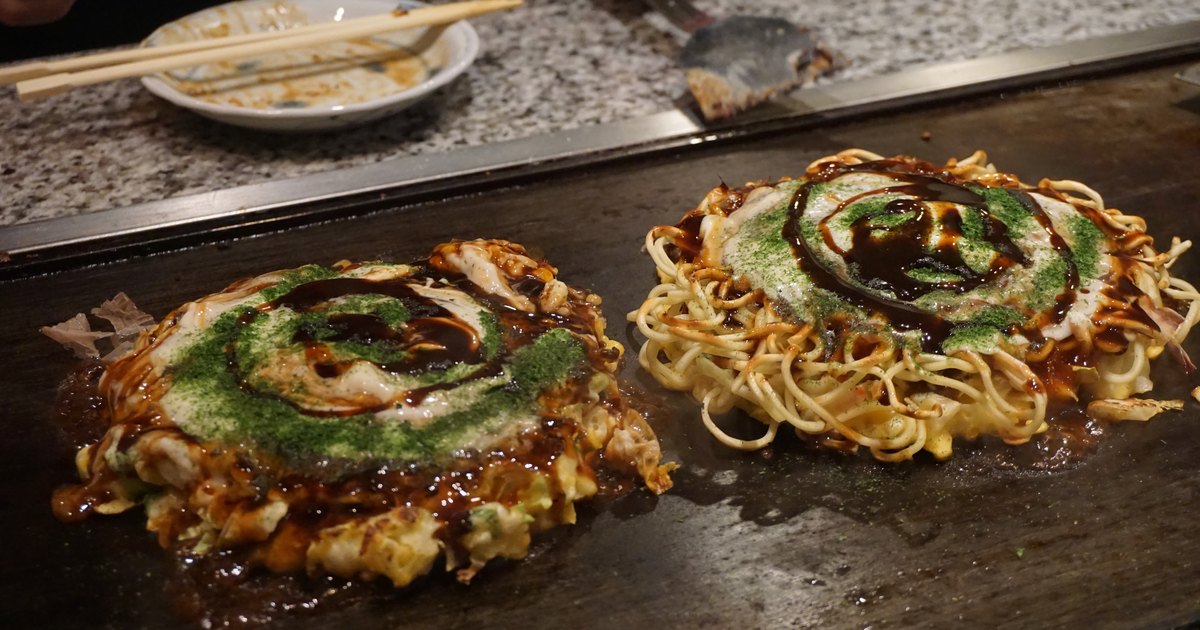
Are you here to cook, to eat, or to play?
To cook: Sakura-tei, five minutes from Meiji-jingumae Station behind the Design Festa gallery, is built for first-timers — officially self-service ("Chef: You"), with an English menu and English-speaking staff, open 11:00–23:00 year-round. Order the classic monja (¥1,300) and a seafood okonomiyaki (¥1,320) and learn both formats in one sitting. One house rule worth knowing from its official pages: large amounts of leftover food draw an extra charge — portion your ambition. To eat: Botejyu's Shibuya shop does the Kansai orthodoxy — the company traces itself to 1946 Osaka and claims the okonomiyaki-mayonnaise pairing as its own invention — cooked entirely by pros, three minutes from Shibuya Station, no closing days. To play: Tsukishima. Take the Yurakucho or Oedo Line, surface at exit 7, and Nishinaka-dori's monja shops start immediately.
Monja Street: how a one-street food district works
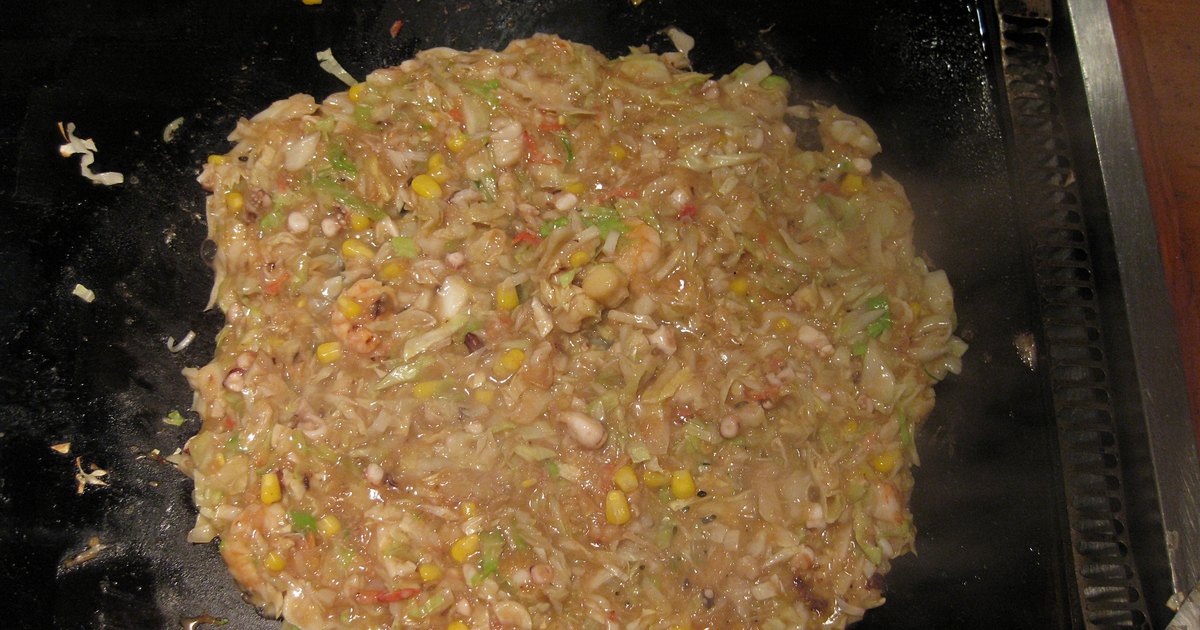
What should a first-timer order — and mash?
The Tsukishima Monja Promotion Association counts about 50 member shops (48 in its official directory) along one shopping street and its alleys — names like Kondo Honten, Hazama, Oshio, Monkichi and Ebisuya anchor the lists. The format: order a monja — mentaiko-mochi is the gateway drug — and either build it yourself (ring of cabbage and fillings, pour the broth into the middle, mash and spread) or ask staff to do the first one. Eat it off the griddle with the little spatula, edge-crisp bits first. The association answers phone inquiries 11:00–20:00 (Correction, September 29, 2026: an earlier version called these office hours; the association lists them as phone reception hours), sells meal vouchers usable across member shops, and its official shop even ships souvenir monja kits (¥1,000–¥1,200). In July 2026 the street's Kusaichi summer market came back after eight years — the association announced it on its front page — a reminder this is a working neighborhood shopping street that happens to be delicious. It pairs naturally with our wider street-food guide and the DIY Tokyo food-tour route.
The honest cautions: what we won't print
Why is the most famous shop missing from this guide?
Two things every English okonomiyaki article gets wrong, per the official record. First, Sometaro in Asakusa — the atmospheric old-house institution — has no official website: the domain that guides link to is a parked page, meaning every printed schedule and price for it is unverifiable secondhand data. Go if the pilgrimage calls you, but call ahead; we won't print hours we can't source. Second, origin claims: Botejyu's mayonnaise story is its own official history, and monja's genesis is folk history — neither is a fact we'd state flatly. What is verifiable: the prices, addresses and hours above, all read from operators' own pages this week. For an evening that starts with a griddle and ends somewhere smokier, our izakaya guide — seat charges explained — is the natural next stop.
When should you go — and how long does a griddle dinner take?
Why does timing matter more here than at other restaurants?
Budget more time than a normal restaurant: the griddle is the kitchen, and a two-pancake, one-monja session runs 60–90 minutes whether you cook or watch. On Monja Street, weekend evenings stack lines outside the famous names from about 18:00 — a weekday 17:00 start walks straight in, and lunch is the sleeper move since most shops fire the same menu. Sakura-tei's all-you-can-eat clock (90 minutes at lunch, 120 at dinner) starts when you sit, so arrive hungry, not fashionably late. Tsukishima also stacks neatly into a bigger day: the street is two stops from Ginza on the Yurakucho Line and one stop from the Toyosu market side of town, which makes monja the natural dinner after a market morning and a department-store afternoon. And if you're building the whole day around eating — the correct decision — the griddle course slots in as the sit-down anchor between street snacks and a nightcap.
One last calibration for group size: griddle tables seat four to six comfortably, and monja is genuinely better with three or more sets of spatulas working the iron — solo diners are welcome everywhere but do more cooking per bite. Couples should order one dish at a time and share the griddle real estate; six-packs of friends can run two dishes in parallel and turn dinner into a relay. However you split it, the iron stays hot until the last scrape.
(Going to the source of the Hiroshima style? Our Hiroshima map guide gets you around the city on a flat 240-yen tram fare.)
FAQ
What’s the difference between okonomiyaki and monjayaki?
Do I have to cook it myself?
How much does okonomiyaki cost in Tokyo?
Where is Monja Street, exactly?
Which shop on Monja Street should I pick?
Is there a good vegetarian okonomiyaki option?
What is Botejyu’s claim to fame?
What about Sometaro in Asakusa — every guide mentions it?
Is there a takeout version worth bringing home?
Bottom line (2026) — Tokyo’s okonomiyaki splits three ways: cook-it-yourself griddle joints like Harajuku’s Sakura-tei (all-you-can-eat from ¥2,200), Osaka-style pros like Botejyu who cook for you, and Tsukishima’s Monja Street — about 50 association shops one subway exit apart via Exit 7. Sakura-tei publishes English support and a leftover-charge notice on its official pages.
Sources
Monja Street shop count, exit-7 directions, association phone hours, meal vouchers, souvenir prices and the Kusaichi revival: the Tsukishima Monja Promotion Association's official site and shop directory. Sakura-tei address, hours, self-cook system, English support, all-you-can-eat and single-item prices, and the leftover-charge notice: Sakura-tei's official Japanese and English pages. Botejyu's founding history, mayonnaise claim, and Shibuya shop details: the BOTEJYU Group's official history and shop pages. All read on August 17, 2026. Sometaro publishes no official information and none is quoted. The embedded video is by its creator.
Tokyo to Osaka, Tokyo to Kyushu, Tokyo to Hokkaido — day by day — plus seven places most visitors never reach.
- 12 pages, 80 photographs, every stop linked to its guide
- Every price and opening hour read from the official page
- Re-issued monthly, so it does not go stale in your inbox
Free. One email a month, plus the rare change that matters. Unsubscribe with one click in any email. By subscribing you agree to our privacy policy.