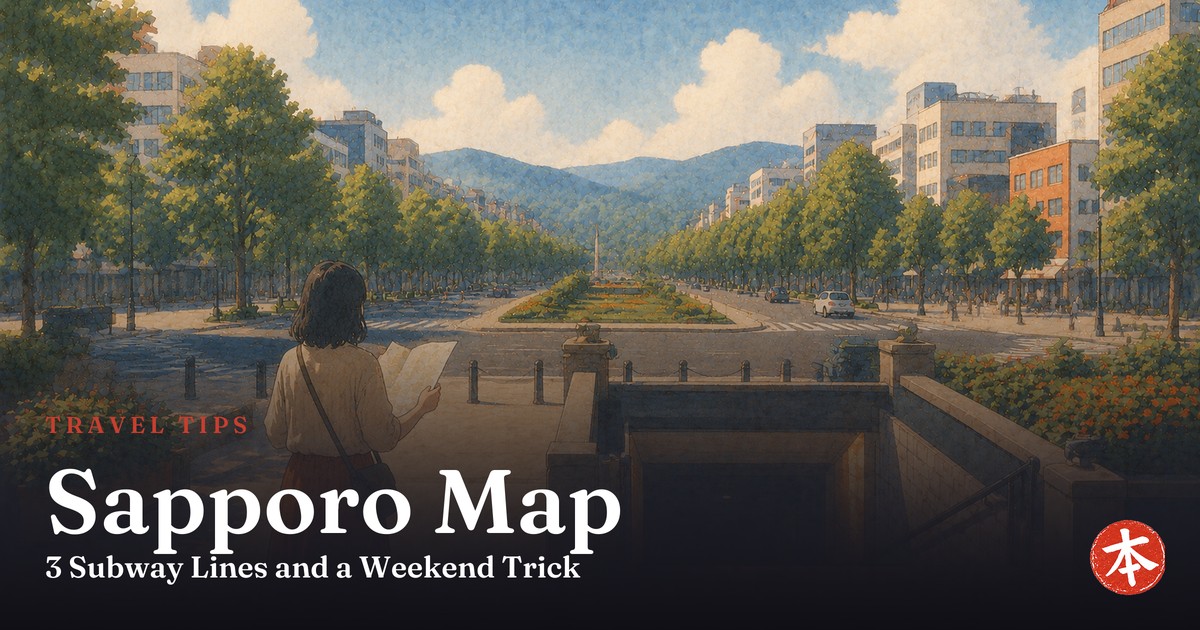
Sapporo is a grid city, not a maze — modeled on Kyoto, addressed by North/South blocks and West-numbered avenues, and stitched together by one 3-line subway, one streetcar loop and three bus operators. Nearly all of it crosses under one station: Odori. Learn that one geometry and the transit system stops feeling foreign — one subway ride plus walking covers most days downtown. This page is the practical map: which pass wins on which day, when the ¥520 Donichika ticket pays for itself in three rides, and the four ways to get from the airport to a downtown hotel.
How Sapporo's transit actually works
One grid, one hub, four layers
Sapporo's downtown is a Kyoto-style grid — addresses read as "North X, West Y," and the numbers are literally the block count from a fixed point. On top of that grid sit four transport layers: the subway (three lines, all meeting at Odori); the streetcar (a single loop through the west side); the buses (three companies covering everything the rails miss); and — the layer no other Japanese city has quite like this — the Chikaho underground walkway, linking Sapporo Station south through Odori toward Susukino without you ever leaving the concourse. In winter that fourth layer effectively doubles as free public transit.
The subway: three lines, one Odori
| Line | Color | Direction | Meets at |
|---|---|---|---|
| Namboku Line | Green | Runs north–south, the oldest line | Sapporo · Odori · Susukino |
| Tozai Line | Orange | Runs east–west across the center | Odori · Nishi 11-chome · Bus Center-mae |
| Toho Line | Sky Blue | Runs the eastern arc | Sapporo · Odori · Hosui-Susukino |
The official operating window is approximately 6:00 to 24:00, with roughly two to three minutes between adjacent stations — a subway ride between the three central hubs (Sapporo, Odori, Susukino) is under five minutes end to end. Fares are distance-based, roughly ¥210 to ¥380 for adults per single ride, with children at half. That range covers everywhere a first-time tourist is likely to go; the exact fare is shown at the ticket machine and on the official fare calculator. Fares are subject to change, so confirm on the day. If you take three or more subway rides on a weekend, the Donichika ticket below is the easier math.
One-day passes: when Donichika wins, when it doesn't
The pass-vs-IC-card matrix
| Your day | Best default | Why |
|---|---|---|
| Weekend / national holiday, 3+ subway rides | Donichika ¥520 (adult) / ¥260 (child) | Two normal rides already run close to the pass price; three rides put you clearly ahead |
| Weekday, 3+ subway rides in one day | Regular 1-Day Subway Pass, or IC card | Donichika is not sold on weekdays; check the current regular one-day fare at the machine |
| 1–2 rides in a day, mixed subway + bus + streetcar | IC card (SAPICA, Suica, Kitaca or compatible) | You avoid buying a pass you won't break even on, and it works across all three modes |
| Multi-day stay, riding daily | SAPICA | ~10% points on every ride plus automatic transfer discounts — the math beats one-day passes over a week |
IC cards: SAPICA, Kitaca, or the Suica you already have
Sapporo is one of the friendlier IC-card cities: the official list of cards accepted on subways, buses and the streetcar covers SAPICA, Kitaca (JR Hokkaido), Suica (JR East), PASMO, manaca, TOICA, PiTaPa, ICOCA, Hayakaken, nimoca and SUGOCA. In other words, if you already have an IC card from a previous Japan trip, do not buy a new one. If this is your first trip and you are staying a week or more, SAPICA is the local pick: 10% of each fare returns as points, which the reader deducts automatically once you have enough to cover a ride, and transfer discounts apply automatically. The purchase price is ¥2,000, of which ¥1,500 is usable for fare and ¥500 is a deposit. Kitaca works in the SAPICA area, but does not earn the 10% points. And the asymmetry worth knowing: SAPICA cannot be used in the coverage areas of other cards, so a Suica travels further nationally. If you want the full IC card explainer, our Suica guide walks through the national card most travelers buy first.
The streetcar: a single loop for the west side
The Sapporo Streetcar is unusual for a Japanese city — a single circular loop, running from about 6:00 to 23:00, through Nishi-Yon-Chome, Susukino and around the west of the downtown grid. It is the useful mode for reaching the base of Mt. Moiwa Ropeway (Ropeway Iriguchi stop) and for a slow orbit on a cold afternoon. On fares, the sources disagree: the sapporo.travel tourism site lists around ¥200 for adults (¥100 for children) with a 1-Day Streetcar Pass at ¥500 (children ¥250), while third-party references cite ¥230 for a single ride, which likely reflects a more recent adjustment. Check the on-vehicle display on the day; SAPICA, Kitaca and Suica all work.
Buses: three companies, one important airport route
Extensive local buses fill in whatever the subway and streetcar do not reach, run by three operators: Hokkaido Chuo Bus, JR Hokkaido Bus and Jotetsu Bus. Fares can be paid in cash or with SAPICA, Kitaca or Suica IC cards. Route numbers and timetables change year to year — we deliberately don't print them here; the three operators' English pages are the source of truth. The most important single route is the airport line: Chuo Bus and Hokuto Kotsu Bus operate coaches from New Chitose Airport to central Sapporo every 10 to 15 minutes, taking approximately 70 minutes, no transfer required. Buy at the Chuo Bus or Hokuto Kotsu Bus counters on the first floor of the domestic terminal, or at the transportation information counter of the international terminal.
New Chitose Airport to downtown: four options, four situations
| Option | Time | Cost / notes | Best for |
|---|---|---|---|
| JR Rapid Airport train | Approx. 37–40 min to Sapporo Station | Frequent departures; check current fare on the JR Hokkaido site | Solo travelers, light luggage, tight schedule |
| Airport coach (Chuo Bus / Hokuto Kotsu) | Approx. 70 min | Every 10–15 min; guaranteed seat, no transfer | Heavy luggage, jet-lagged, prefer one-shot ride to hotel area |
| Regular taxi | Around 60 min | 10,000–13,000 yen + expressway | Late arrival, 3–4 adults sharing, worst weather |
| Fixed-price taxi | Around 60 min | From ¥7,000; booking required + expressway extra | Predictable cost, worth pre-booking for airport transfers |
Two things to keep in mind: heavy snow can push both bus and taxi times well past the numbers above, while the train remains largely unaffected; and if you are transiting Sapporo on your way to Niseko, our Niseko map and Tokyo-to-Niseko access guide cover onward legs. For staying online at the airport and on the train, the same practical rules apply as anywhere in Japan — see our Japan eSIM guide for what activates before you land.
Chikaho: the underground layer that changes winter
The Sapporo Ekimae-dori Underground Walkway — locally called Chikaho — runs beneath the main north-south avenue, linking the Sapporo Station area with Odori and continuing on toward Susukino. In practice it is a de facto fourth mode of transport in the downtown grid: free, weather-proof and connecting the three central hubs on foot. In winter, this is why locals often skip a one-stop subway ride: it is faster to walk it under the street. Hours vary by section — check the signage on the day. If your itinerary is heavy on Sapporo Station, Odori Park and Susukino, plan to walk more than you ride.
Taxis: the meter, the apps, the airport fixed rate
For short intracity hops and late nights out of Susukino, taxis are practical. Sapporo's official tourism site publishes a base fare of ¥670 up to 1,463 meters, then ¥80 for each additional 276 meters — fares are periodically revised, so treat that as a reference and confirm on the meter. Booking apps such as GO and Uber cover Sapporo. For the airport run, the fixed-price service from ¥7,000 (some companies) is often the sensible choice for four adults with heavy luggage, versus 10,000 to 13,000 yen on a regular meter — book ahead, and note that expressway tolls are extra either way.
Common mistakes, and neighborhoods the subway can't reach
Five mistakes worth avoiding
Buying a Donichika on a weekday — you cannot; it is only sold for weekends, holidays and December 29 to January 3. Assuming the streetcar reaches the whole city — it is a single western loop, not a network. Treating Kitaca as a Suica substitute for points — Kitaca does not earn the SAPICA points. Booking a "taxi to downtown" without asking about the fixed rate — the ¥7,000 option undercuts the meter for airport transfers. Underestimating winter — heavy snow can delay buses; the subway is unaffected.
Sights the subway alone won't get you to
Some of Sapporo's best-known spots need a bus or streetcar leg from the nearest subway station: Mt. Moiwa Ropeway (reached via the streetcar loop and then a shuttle), Hitsujigaoka Observation Hill (bus from Fukuzumi Station on the Toho Line), and Moerenuma Park (bus from Kanjo-dori Higashi Station on the Toho Line). Route numbers move around and we do not print them: the three bus operators' English timetables are what to check on the day. If more than half of your list sits off the subway grid, an IC card that spans all three modes will do more work than any subway-only pass.
FAQ
How does Sapporo’s public transport actually fit together?
What is the Donichika Ticket, and is it worth it?
SAPICA, Kitaca or Suica — which IC card should I actually buy?
How do I get from New Chitose Airport to a downtown Sapporo hotel?
Which is faster in the snow — the subway, the bus or a taxi?
What is Chikaho, and why does everyone in Sapporo use it in winter?
Which famous Sapporo spots can I NOT reach by subway alone?
How much does a Sapporo subway ride cost?
What about the streetcar — how does it work and how much is it?
Are Sapporo taxis a reasonable option for tourists?
Is one day enough to see Sapporo by public transport?
How does Sapporo’s transit compare to Tokyo’s or Osaka’s for a first-time visitor?
Bottom line (2026) — Sapporo is a grid: three subway lines, one streetcar loop on the west side, three bus operators and the underground Chikaho walkway, all meeting under Odori Station. IC-card acceptance covers SAPICA, Kitaca and Suica across subway, bus and streetcar, and the weekend-only Donichika Ticket pays for itself in about three rides.
Sources
Line count, colors, operating hours, fare ranges, Donichika Ticket eligibility, IC card acceptance list and SAPICA rules, streetcar operating window and single-ride fare, three-operator bus system, taxi base fare, and the airport-access breakdown (train, bus, regular taxi, fixed-price taxi): Sapporo City's official tourism site (sapporo.travel), the New Chitose Airport official site, and the Sapporo Municipal Transportation Bureau fare pages. Streetcar fare discrepancy noted: sapporo.travel lists around ¥200 while third-party references list ¥230 — the higher figure likely reflects a more recent adjustment; confirm the current fare at the on-vehicle display on the day. All read on August 26, 2026. Prices and hours change; the JR Rapid Airport current ticket price was not available in an officially quotable form at the time of writing — confirm on the JR Hokkaido site. The embedded video is by its creator.
Tokyo to Osaka, Tokyo to Kyushu, Tokyo to Hokkaido — day by day — plus seven places most visitors never reach.
- 12 pages, 80 photographs, every stop linked to its guide
- Every price and opening hour read from the official page
- Re-issued monthly, so it does not go stale in your inbox
Free. One email a month, plus the rare change that matters. Unsubscribe with one click in any email. By subscribing you agree to our privacy policy.