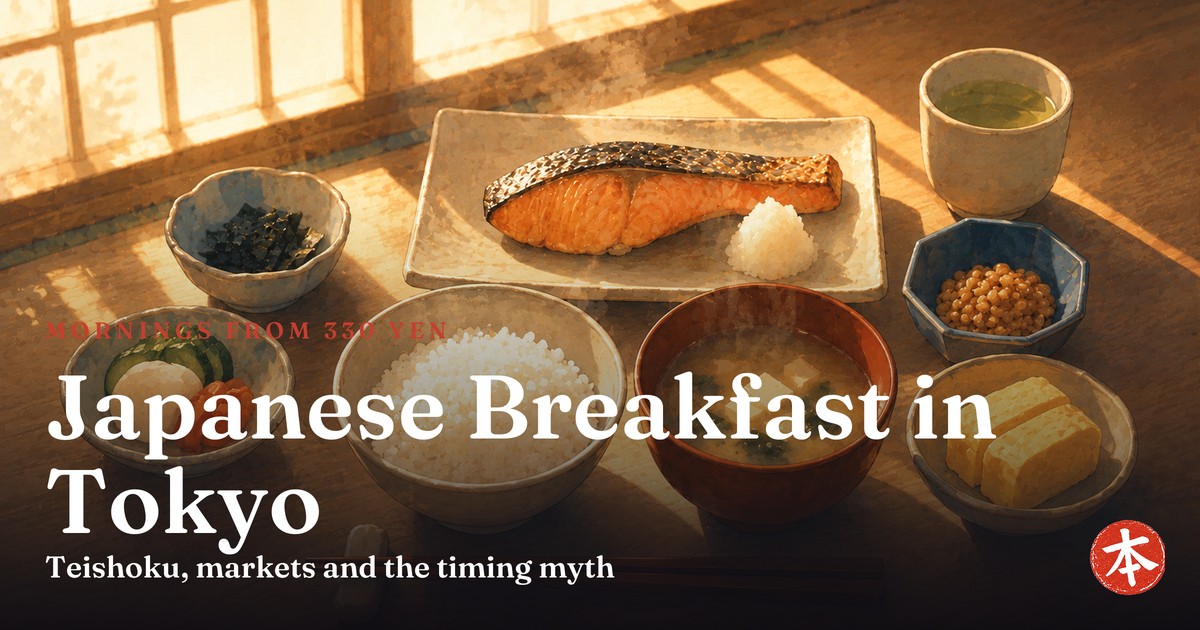
Tokyo does breakfast better than almost any city on earth, and cheaper than your hotel's coffee: a full grilled-fish teishoku with free rice refills for ¥440, a raw-egg-over-rice set for ¥330 at 4 a.m., free Nagoya-style toast with any coffee until 11. The catch is that the rules — hours, prices, which chain even serves mornings — live on Japanese official pages, and the English internet has been guessing. This guide replaces the guesses.
Tokyo breakfast at a glance
| Style | Where | Official price / hours |
|---|---|---|
| Gyudon-chain morning sets | Sukiya · Yoshinoya · Matsuya | ¥330–630 · 4:00–11:00 (Matsuya from 5:00) · 🚨 Sukiya adds +7% before 5 a.m. |
| Teishoku (set-meal) breakfast | Yayoiken (selected stores) | ¥440–600, 6 sets, free rice refills · 5:00–11:00 at 24h stores |
| Charcoal-grilled fish | Shinpachi Shokudo (61 of 66 shops) | Prices at the store · some shops from 4:00–7:00 |
| Kissaten morning | Komeda Coffee | Drink price + free toast & topping, open–11:00 |
| Market morning | Tsukiji outer · Toyosu | 🚨 Tsukiji tourist hours officially 9:00–14:00 · Toyosu closed Sun/holidays/rest days |
A visual tour of what the chain-breakfast landscape actually looks like, chain by chain:
The gyudon chains: Japan's 4 a.m. breakfast machine
Who serves what, at which price?
The beef-bowl chains moonlight as Japan's cheapest breakfast institution, and the official menus split neatly. Sukiya (4:00–11:00) runs four families — mazenokke mix bowls, tamago-kake raw-egg rice from ¥330, fried-egg and grilled-fish sets — with two official quirks: prices rose on July 8, 2026 (old guides are pre-hike), and orders between 4 and 5 a.m. carry an official 7% late-night surcharge. Yoshinoya (4:00–11:00) fields fourteen official breakfast items — natto set ¥430, grilled-fish ¥530, the loaded toku-asa teishoku ¥630 — officially dine-in only, with free rice refills at participating stores. Matsuya (5:00–11:00) counters with the sausage-egg set at ¥530, a choose-your-side system, and a ¥350 tamago-kake gohan for purists. All three hand you the ticket-machine ordering ritual as a bonus cultural experience.
The teishoku route: Yayoiken (and the Ootoya myth)
Yayoiken is the official chain answer to "a proper Japanese breakfast, assembled": six official morning sets — natto ¥440, shirasu-oroshi ¥460, mini sukiyaki ¥540, egg-and-wiener ¥550, grilled salmon ¥580, grilled mackerel ¥600 — all with officially free rice refills (pick the barley-mix rice and refills stay white-rice only, per the official fine print). Hours run 5:00–11:00 at 24-hour stores, and the official caveat that matters: breakfast is a selected-stores program, so check the store page first. And the correction this article exists to make: Ootoya — the teishoku chain every guide recommends — publishes no breakfast service at all on its official site. Dinner institution, yes; morning stop, officially no.
The grilled-fish specialist: Shinpachi Shokudo
For the postcard version — fish over charcoal, rice, miso soup, a raw egg if you're brave — Shinpachi Shokudo is the chain built around it, and around himono: salt-cured, semi-dried fish whose concentrated flavor is the traditional breakfast style (the official name literally says "charcoal-grilled himono set meals" — not just "grilled fish"). Officially, 61 of its 66 listed shops serve the morning menu — morning salmon, mackerel cultural-dry, sardine, and a pork-belly-and-fried-egg set — with hours that respect jet lag: Nishi-Shinjuku from 7:00, the Seibu-Shinjuku shop from 4:00. The official site publishes no prices (and notes menus vary by store), so read the board — expect chain-breakfast territory, not restaurant pricing. Everything but the draft beer is officially takeout-able, which says something about its clientele's schedules.
The kissaten morning: Komeda's free-toast ritual
Nagoya exported one great breakfast idea to Tokyo: the morning service. At Komeda Coffee, officially from open until 11:00, any drink order comes with free bread — thick-cut toast or a soft roll — plus one topping of your choice: boiled egg, egg paste, or the gloriously Nagoyan ogura anko (sweet red-bean paste on buttered toast; trust it). The drink is the only mandatory spend, and Komeda officially prices drinks by store, so we quote none. Morning-only paid sides (¥170–300: yogurt with honey, coleslaw, mini salad) round it into a real meal. It's the slowest, most smoke-and-newspaper-scented breakfast in this guide, and the most Japanese-daily-life one.
The market morning: what the official hours actually say
Tsukiji: go at 9, not 6
The classic advice — "beat the crowds, Tsukiji at dawn" — reads the market backwards, per its own official calendar. The outer market designates 6:00–9:00 as the business-purchasing window (restaurant buyers with carts and no patience for photos) and 9:00–14:00 as normal selling hours. Show up at 9:00–10:00 and you get open stalls, tourist-ready portions and functioning queues — the official structure, not a compromise. Some shops close on the wholesale market's rest days, so glance at the official calendar. What to actually eat there — tamagoyaki skewers, tuna bowls, strawberry daifuku — is mapped in our street-food guide.
Toyosu: the real market, with real rules
The wholesale market itself (auctions included) lives at Toyosu now, and the metropolitan government's official rules are precise: the visitor passage — restaurants and shops included — runs 5:00–17:00, the whole complex is closed to visitors on Sundays, holidays and market rest days, and eating in the corridors is officially banned (the sushi counters exist for a reason). The famous early-morning sushi breakfast at the market restaurants is real — just pair it with the official rest-day calendar, not a blog's.
Building your breakfast week
A sane Tokyo rotation: gyudon or Yayoiken speed-breakfasts on sightseeing days (they exist because Japan commutes early), one slow Komeda morning, one market morning timed by the official calendars above, and one hotel-free day where breakfast is a convenience-store onigiri eaten wrong and enjoyed anyway. Morning curry is genuinely on the chain menus if you've gone native — see our curry guide — and if the teishoku format wins you over, our cooking-class guide covers schools that teach you to build the set yourself.
(For a rice-ball breakfast: our onigiri in Tokyo guide includes Onigiri Bongo in Otsuka, where two onigiri with tofu miso soup are 900 yen on weekdays from 9:00 to 14:00.)
(For a sweeter morning: our souffle pancakes in Tokyo guide notes that FLIPPER’S opens at 9:00 at four of its five Tokyo shops, and that bills opens at 8:30.)
FAQ
What is a traditional Japanese breakfast?
What’s the cheapest real breakfast in Tokyo?
What time does breakfast start and end at the chains?
What is the Komeda morning, and is it really free?
Should I go to Tsukiji or Toyosu for a market breakfast?
Where can I get a grilled-fish breakfast like a salaryman?
Do any teishoku chains skip breakfast?
Is rice really refill-free at breakfast?
How much should I budget for breakfast in Tokyo?
Bottom line (2026) — A real Japanese breakfast in Tokyo costs less than hotel coffee: gyudon-chain morning sets from ¥330 (from 4 a.m., with Sukiya’s 7% 4–5 a.m. surcharge), Yayoiken grilled-fish teishoku with free rice refills from ¥440, and Komeda’s Nagoya-style free toast with any drink until 11:00. Yayoiken lists six breakfast sets with tax-included prices; Yoshinoya bans takeout on the morning menu.
Sources
Yayoiken: the official Tokyo menu pages (six breakfast sets with tax-included prices, the free-refill and barley-rice rules, the selected-stores and 5:00–11:00 notes, quoted from the official fine print). Sukiya, Yoshinoya, Matsuya: official morning-menu pages (prices, 4:00/5:00–11:00 windows, Yoshinoya's no-takeout rule, Sukiya's 4–5 a.m. 7% surcharge) plus Sukiya's official July 3, 2026 price-revision release. Shinpachi Shokudo: the official site (himono naming, menu lineup, per-store hours, the 61-of-66 breakfast-store count tallied from the official store list, and the no-published-prices reality). Komeda: the official morning-service page (free bread + three toppings, until 11:00, per-store pricing). Markets: the Tokyo Metropolitan wholesale-market official pages (Toyosu visitor hours, closure and no-eating rules) and the Tsukiji outer market's official calendar (the 6:00–9:00 business window and 9:00–14:00 selling hours). Ootoya: official site checked — no breakfast program exists to cite. All read August 10, 2026. The embedded video is by its creator.
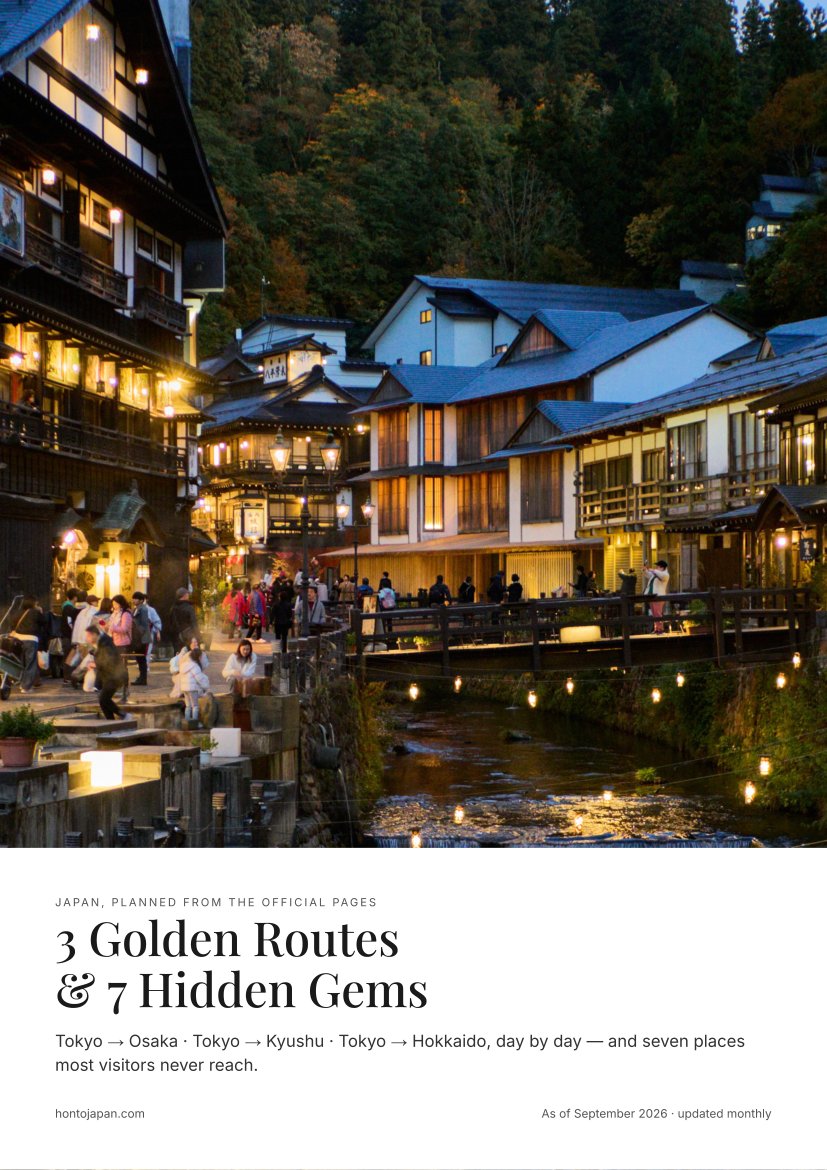
Tokyo to Osaka, Tokyo to Kyushu, Tokyo to Hokkaido — day by day — plus seven places most visitors never reach.
- 12 pages, 80 photographs, every stop linked to its guide
- Every price and opening hour read from the official page
- Re-issued monthly, so it does not go stale in your inbox
Free. One email a month, plus the rare change that matters. Unsubscribe with one click in any email. By subscribing you agree to our privacy policy.