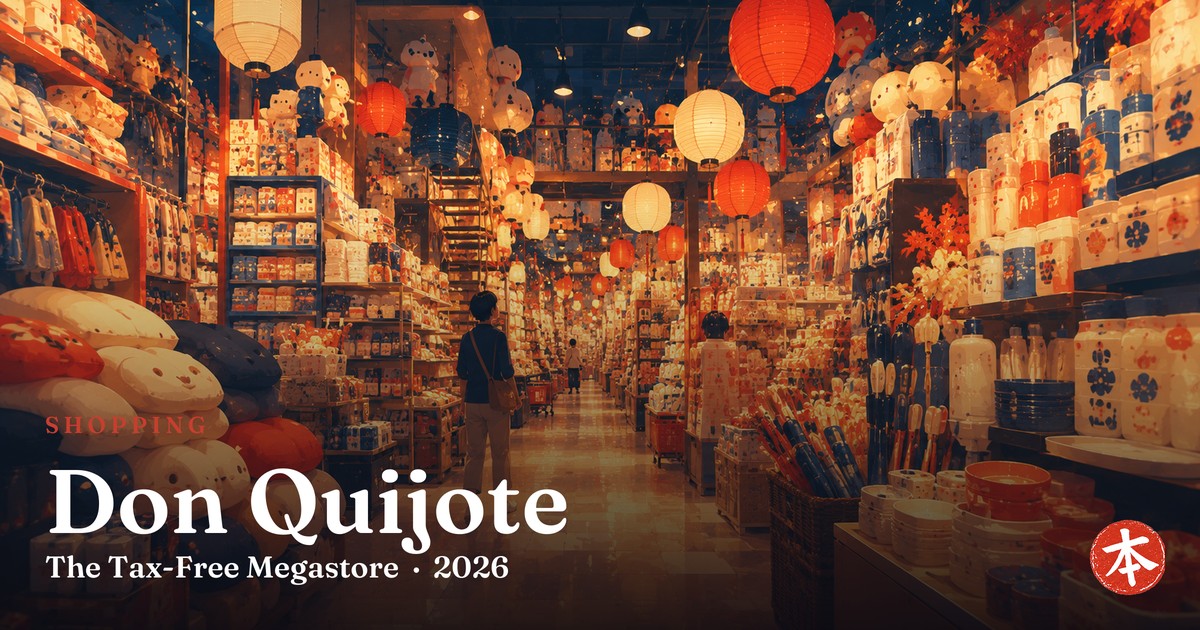
Don Quijote — known to everyone in Japan simply as Donki (ドンキ) — is the country’s most chaotic, most addictive discount store, and one of the single best souvenir stops a foreign visitor can make. Cosmetics, snacks, Kit Kats, character goods, electronics, quirky gadgets and genuinely good food are crammed floor-to-ceiling into a maze that stays open late into the night. Many stores are open 24 hours or until the early morning.
(Hunting the single best-value thing to carry home? It isn't electronics — see our Japanese stationery guide.)
Here’s the honest version: it is tax-free for tourists, cheap, and deliberately designed to make you lose track of time and money. This guide covers the part that actually trips foreign shoppers up — how the tax-free process works (and the big rule change coming November 1, 2026), when to go, how to survive the maze, and — the question everyone asks — exactly what to buy and what to skip.
Everything below is compiled from official Don Quijote information and Japan’s tax-free rules, cross-checked against multiple first-hand Japanese shopping reports, current as of July 2026.
Don Quijote at a glance
| What it is | Japan’s biggest discount-store chain — snacks, cosmetics, souvenirs, electronics, gadgets and more, all under one roof |
|---|---|
| Local name | Donki (ドンキ). Larger branches are “MEGA Don Quijote” |
| Hours | Many stores open 24 hours or until ~3–5am — a rare late-night option in Japan |
| Tax-free | Yes, for tourists spending ¥5,000+ (pre-tax) with your original passport — but the system changes on Nov 1, 2026 (see below) |
| Payment | Cash and all major cards / IC / QR pay accepted. No membership needed to shop |
| Best buys | Kit Kats & snacks, cosmetics, Jyonetsu Kakaku (情熱価格) own-brand, character goods, quirky souvenirs |
| Heads-up | The layout is an intentional maze — budget more time (and money) than you think |
What exactly is Don Quijote — and why is it such a maze?
If you walk into a Donki looking for one thing and walk out 40 minutes later with a basket you didn’t plan, that is not an accident. It’s the design. Don Quijote is run by Pan Pacific International Holdings (PPIH), a retail group with annual sales above ¥2 trillion, and the chaos is its signature strategy.
Two ideas explain the whole experience. The first is “compression display” (atsushuku chinretsu): instead of keeping stock in a back room, Donki shrinks the warehouse to almost nothing and piles everything onto the shop floor — roughly five times the product density of a normal store, stacked to the ceiling and topped with loud handwritten price tags. More products in view means more things you never meant to buy.
The second is store-level autonomy. Head office doesn’t dictate the shelves — individual staff choose what to stock, how to price it and how to pile it up. That’s why no two Don Quijotes are the same, and why the company openly calls a visit a “treasure hunt.” Their own concept is Convenience + Discount + Amusement: they treat shopping as a night-time leisure activity, not an errand.
A clear breakdown of why the store is deliberately built as a maze (Japanese, but the visuals of the compression-display aisles tell the story on their own):
Tax-free shopping at Don Quijote (and the big Nov 2026 change)
This is the part worth getting right, because it’s where foreign shoppers lose money or time. As a tourist you can shop tax-free (skipping Japan’s 10% consumption tax), and here is how it currently works.
The rules right now (until October 31, 2026)
- Who qualifies: foreign visitors on “Temporary Visitor” status who have been in Japan less than six months.
- Minimum spend: ¥5,000 or more (excluding tax) in a single day at one store. General goods and consumables can be combined to reach ¥5,000.
- Passport: you must show your original passport at purchase — a photo or copy is not accepted.
- How: pay at a regular register, then take your receipt to the tax-free / customer service counter (larger stores have a dedicated one). Consumables are sealed in a bag you shouldn’t open until you leave Japan.
- Consumables cap: currently ¥5,000–¥500,000 pre-tax per day.
(Shopping on either side of that date? Our free Japan tax refund checker tells you which system applies to your purchase date, whether you reach the ¥5,000 minimum, and, under the new rules, your deadline and where to do the customs check.)
Stack a tourist coupon on top (most visitors miss this)
Tax-free isn’t the only discount. Don Quijote runs a tourist discount coupon that stacks on top of the tax exemption — and most first-time visitors never hear about it:
- Spend over ¥10,000 (excl. tax): 10% tax-free + 5% off.
- Spend over ¥30,000 (excl. tax): 10% tax-free + 7% off.
- Valid at roughly 600 stores nationwide — show it at the register with your passport.
Get the Don Quijote coupon →
Affiliate link — see disclosure. The coupon itself is free to obtain.
Stores also run their own promotions via the majica app, but for a short-stay visitor the tax-free + tourist coupon combo is the reliable win.
When to go: embrace the late night
Donki’s superpower for travelers is its hours. In a country where most shops close by 8pm, many Don Quijote branches are open 24 hours or until 3–5am — perfect for jet lag, a post-dinner souvenir run, or killing time before an early flight.
It’s no coincidence that Donki leans into the night. The company has said its busiest hours run from around 10pm to past midnight, and overseas visitors are a huge part of that late crowd. Reported figures put average foreign-tourist spend far above domestic shoppers per visit — the late-night treasure-hunt is doing exactly what it was designed to do. Going late also means lighter crowds and shorter tax-free counter lines than the daytime peak.
What to buy at Don Quijote
The genuine question every visitor has. Based on what Japanese shoppers actually rate, these are the categories that punch above their price — most of it well under ¥1,000.
Snacks & souvenirs (the easy wins)
- Kit Kats and Japanese-flavor chocolate — the classic edible souvenir, usually cheaper here than at the airport.
- HARIBO gummies — the small bags get heavily discounted (Star Mix as low as ~¥50 at some branches).
- Korean nori (seaweed) and roasted-sesame products — repeat top-sellers; the sesame line alone is a runaway hit.
- Baked sweet potato (yaki-imo) products — Japanese shoppers rate Donki’s yaki-imo lineup unusually high for the price.
- Jyonetsu Kakaku (情熱価格) — Donki’s own private brand. Its wieners/sausages and nut mixes are perennial favorites, and the packaging makes fun, cheap gifts.
A staff-picked ranking of Donki’s most popular products — a great scan of what’s actually worth grabbing (Japanese):
Cosmetics & beauty
- Sheet masks and skincare — huge wall of options, frequently discounted; a light, cheap souvenir to buy in bulk.
- Popular treatments and cleansers (e.g. Fino, Rosette lines) are often cheapest at Donki, sometimes with an extra coupon.
- Korean and trend cosmetics — the “kirakira” sparkly makeup and Korean beauty section is a magnet, especially for younger shoppers.
Character goods, gadgets & the weird stuff
- Character & collectible goods — from trendy sticker crazes to plush and stationery; the mix changes constantly.
- Quirky home & beauty gadgets — viral cleaning tools, hair accessories, massagers; the “what even is this” aisle is half the fun.
- Donpen merch — the blue penguin mascot is Donki’s own icon and makes a very “only in Japan” souvenir.
A big, fun Donki haul (43 items) that captures the range and the treasure-hunt feel — food, beauty and gadgets in one basket:
What to skip (let’s be honest)
Not everything at Donki is a win, and part of shopping smart is knowing what to leave on the shelf. Japanese shoppers are candid about the misses:
- Large appliances (fridges, washers) and cheap electronics/earphones — the price looks great, but warranty and after-service are weak. For anything you need to last, a proper electronics retailer is safer.
- Some ultra-cheap own-brand food — a few private-brand items (certain curries, the cheapest bulk meat, some “challenge” super-spicy snacks) get poor reviews. Stick to the rated categories above.
- Knock-off-style beauty tools and giant cheap makeup palettes — lots of colors, but many shades go unused; buy a few proven items instead.
A frank “what to buy vs. what to avoid” rundown from regular Donki shoppers (Japanese):
Tips for foreign visitors
- Budget more time than you think. The maze is designed to slow you down. If you’re on a schedule, know your target sections before you go in.
- Bring your passport if you want tax-free — the original, not a photo. And remember the process changes on Nov 1, 2026 (pay first, refund at the airport).
- Go late. Late-night visits mean fewer crowds and shorter tax-free lines. Check your branch’s hours — not every store is 24h.
- Cashless is fine. Cards, IC cards and QR payments are widely accepted; no membership is needed just to shop.
- Each store is different. If you loved one Donki, another branch will have a completely different lineup — that’s the treasure hunt, not a bug.
- Pair it with the rest of your trip. Many big branches sit near major stations and attractions — an easy add-on to, say, a shopping day around the Pokémon Centers in Tokyo.
(For secondhand rather than new — manga, figures, doujinshi, vintage toys — see our Mandarake guide. Note it doesn't open until noon.)
(For the other kind of Japanese impulse spending, see game centers — and note nothing in a crane machine is worth more than about ¥1,000 retail.)
(Donki's cheap-goods sibling is the ¥110 world of Daiso — two official Tokyo flagships, sister ¥300 brands, and a tax-free situation its official site never mentions.)
(The other chain worth knowing for tax-free is the convenience store — our Japanese 7-Eleven guide covers its duty-free rules, and why Seven Bank publishes no ATM fee anywhere.)
(February fills these shelves with seasonal chocolate: our Valentine’s Day in Japan guide explains giri, honmei and the March 14 reply day, and where the custom came from.)
FAQ
Is Don Quijote tax-free for tourists?
What should I buy at Don Quijote?
Is Don Quijote open 24 hours?
Do I need a membership or the majica app to shop?
Why is Don Quijote so messy and hard to navigate?
Is Don Quijote a good place to buy electronics?
Bottom line (2026) — Don Quijote is tax-free for tourists (skipping Japan’s 10% consumption tax) and stays open late in a country where most shops close by 8pm. A big November 2026 tax-free reform changes how the process works, so check the current rules before you shop. Most of the categories worth buying come in well under ¥1,000.
Sources & further watching
Compiled and cross-checked from official Don Quijote (PPIH) tax-free information, Japan’s 2026 tax-free reform, and first-hand shopping videos by Japanese creators. This deep-dive on the business behind the chaos is a great watch if you want to understand why Donki works the way it does:
Tax-free rules, hours, coupon terms and product line-ups are as of July 2026 and change frequently — the November 1, 2026 tax-free reform in particular changes the refund process. Always confirm current details before your visit. This article contains affiliate links: if you buy through them, we may earn a small commission at no extra cost to you — see our affiliate disclosure. We only recommend what we’d genuinely suggest to a friend visiting Japan.
Tokyo to Osaka, Tokyo to Kyushu, Tokyo to Hokkaido — day by day — plus seven places most visitors never reach.
- 12 pages, 80 photographs, every stop linked to its guide
- Every price and opening hour read from the official page
- Re-issued monthly, so it does not go stale in your inbox
Free. One email a month, plus the rare change that matters. Unsubscribe with one click in any email. By subscribing you agree to our privacy policy.