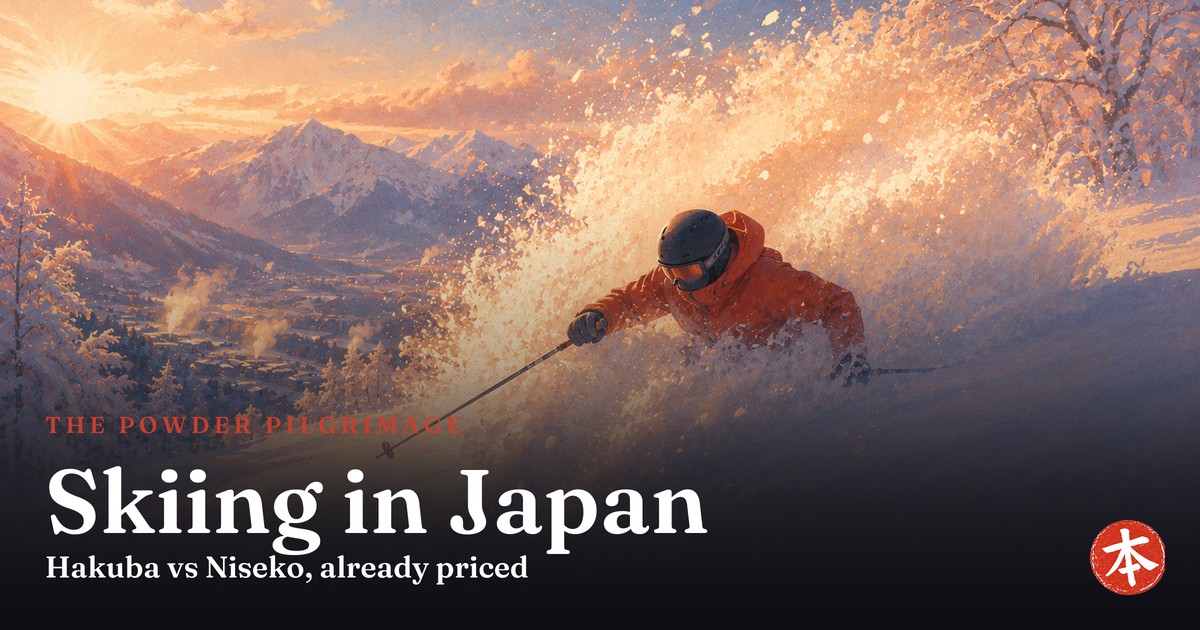
Japan skiing is a pilgrimage for one reason — the snow. Meters upon meters of the lightest powder on Earth, falling on two very different kingdoms: Hakuba, the Olympic valley three hours from Tokyo, and Niseko, Hokkaido's international powder capital. This hub links all seven Honto snow guides — and lands in a season where, unusually, 2026–27 prices are already published.
Japan snow at a glance
| Question | Guide |
|---|---|
| The Nagano giant | Hakuba ski guide · getting there · lift passes (¥11,100/day, 2026–27) |
| The Hokkaido powder capital | Niseko ski guide · getting there · the four-resort map + 2026–27 passes |
| The rest-day icon | Snow Monkey Park — onsen macaques near the Hakuba orbit |
Choosing your kingdom
Niseko powder, filmed by a Hokkaido local rather than a marketing team. If you are trying to work out whether the snow really is different enough to justify the flight north, this is the honest version of the answer.
Powder purity or mountain variety?
Niseko is the powder bet: Hokkaido's Siberian storm track delivers the most consistent deep snow in the skiing world, wrapped in an international resort culture — but it's officially four resorts on one volcano across two towns, and booking the wrong base is the classic error our map guide exists to prevent. Hakuba is the mountains bet: ten resorts under one pass, real alpine terrain, and Tokyo access fast enough for a long weekend — the access guide covers the under-3-hour route and this year's suspended airport buses. Deciding factor for many: pass mechanics. Hakuba's multi-day passes officially work on flexible windows (rest days free); Niseko's are consecutive-only. Relaxed itineraries lean Hakuba; ski-every-day powder hunts lean Niseko.
The 2026–27 numbers, already out
What can I actually budget today?
Both areas published early this year. Hakuba Valley: all-mountain day pass ¥11,100, multi-day passes valid across flexible windows, Epic Pass holders getting a free 5-consecutive-day ticket — full tables in the lift pass guide. Niseko United: peak day pass ¥13,500, season pass ¥184,400, all four resorts planning to open November 28, 2026 — details in the Niseko guide. Transport is bookable too: the Niseko airport bus's 2026–27 season (¥6,000 one way) is already on sale, per the access guide. Winter timetables still pending (Hakuba's buses, valley shuttles) get logged in the Changes Tracker as they publish.
The access decision, honestly
How different are the two journeys really?
Structurally different. Hakuba is a land journey: shinkansen to Nagano plus an express bus, officially as fast as about 2 hours 50 minutes — with the caveats our access guide documents (the winter bus timetable publishes late, the airport directs are currently suspended, and night buses refuse ski bags). Niseko is an air journey: roughly 90 minutes Haneda to New Chitose, then a reserved resort bus about 2.5 hours — a relay the access guide maps down to the official 45-minute connection rule. Net door-to-door they land surprisingly close; the real difference is failure modes. Trains shrug off storms that ground planes; planes shrug off the highway closures that stop buses. Powder chasing means weather, and weather means having read the access guide before the storm reads it for you.
What a week actually costs, order-of-magnitude
Where does the money go?
With 2026–27 lift prices published, the skeleton is priceable today: a six-day Hakuba lift budget runs about ¥63,900 on the valley pass ladder, Niseko's peak-season equivalent lands higher (its 7-day is ¥91,500) — full tables in the Hakuba and Niseko guides. Transport is the small line (a few tens of thousands of yen round trip either way); lodging is the big one, swinging tenfold between a Happo pension and a Hirafu chalet in January. The honest budgeting order: fix your week, price the bed first, and let the lift pass — the one cost that's already published and won't surprise you — anchor the rest.
The rest-day playbook
Japan ski trips earn their legend off the slopes too: onsen nights, mountain-town izakaya, and — in the Hakuba orbit — the snow monkeys of Jigokudani, the world's only primates who commute to a hot spring. Kusatsu's steaming yubatake (guide) makes a fine bookend for a Nagano-side trip. Build one rest day per four ski days; the powder will still be there — that's the whole point of Japan. And if the trip skews Nagano, remember the flexible Hakuba pass makes the monkey day genuinely free of lift-ticket guilt: the multi-day window simply keeps waiting while you watch macaques poach themselves in a mountain spring. Niseko's rest-day equivalents are gentler — onsen-hopping between the four bases and the Kutchan izakaya scene — but the principle holds at both kingdoms: the trips people rave about for years are the ones that left room for Japan around the skiing. Nobody flies home talking about their eighth consecutive groomer lap; they talk about the monkeys, the midnight ramen and the stranger who taught them the onsen etiquette.
Gear, lessons and the family question
Rent or bring — and can the kids come?
Rent, for most: both areas run full rental fleets with current-season gear, and the baggage rules our access guides document (no skis on night buses; airline bag fees) often erase the savings of bringing your own. Lessons in English are a genuine strength of both areas — Niseko's international schools especially — and childcare exists at the major bases, which is why Japan has quietly become the family powder destination: gentle greens, patient instructors, onsen for the evenings and vending-machine hot chocolate for morale. The one family-planning rule that matters: book lessons and childcare with the accommodation, months out, for peak weeks — they sell out before the beds do. Day-by-day flexibility is what the flexible Hakuba pass windows were made for when small legs need a rest day.
FAQ
Hakuba or Niseko — which should I choose?
How do I get to the snow from Tokyo?
What do lift passes cost for 2026–27?
What’s the difference between Niseko’s four resorts?
When does the 2026–27 season start?
Can beginners handle Japan’s powder resorts?
Is the Epic Pass worth bringing to Japan?
What about the snow monkeys?
Do the buses and shuttles really require planning?
How far ahead should I book a Japan ski trip?
Bottom line (2026–27) — Japan powder planning starts early: Hakuba’s ¥11,100 valley pass and Niseko’s ¥13,500 peak pass are already published for 2026–27, and the airport bus is on sale. This hub links all seven Honto snow guides — resorts, access, passes and the snow monkeys — with prices sourced verbatim from the operators’ official pages.
Sources
All pass prices, dates and transport facts above are drawn from the linked guides, which source the resorts' and operators' official pages with verbatim quotes and as-of dates (2026–27 figures verified in the raw official pages). Hub compiled August 12, 2026.
Some links on this page may be affiliate links, which means we may earn a commission if you book or buy through them — at no extra cost to you. See our affiliate disclosure.
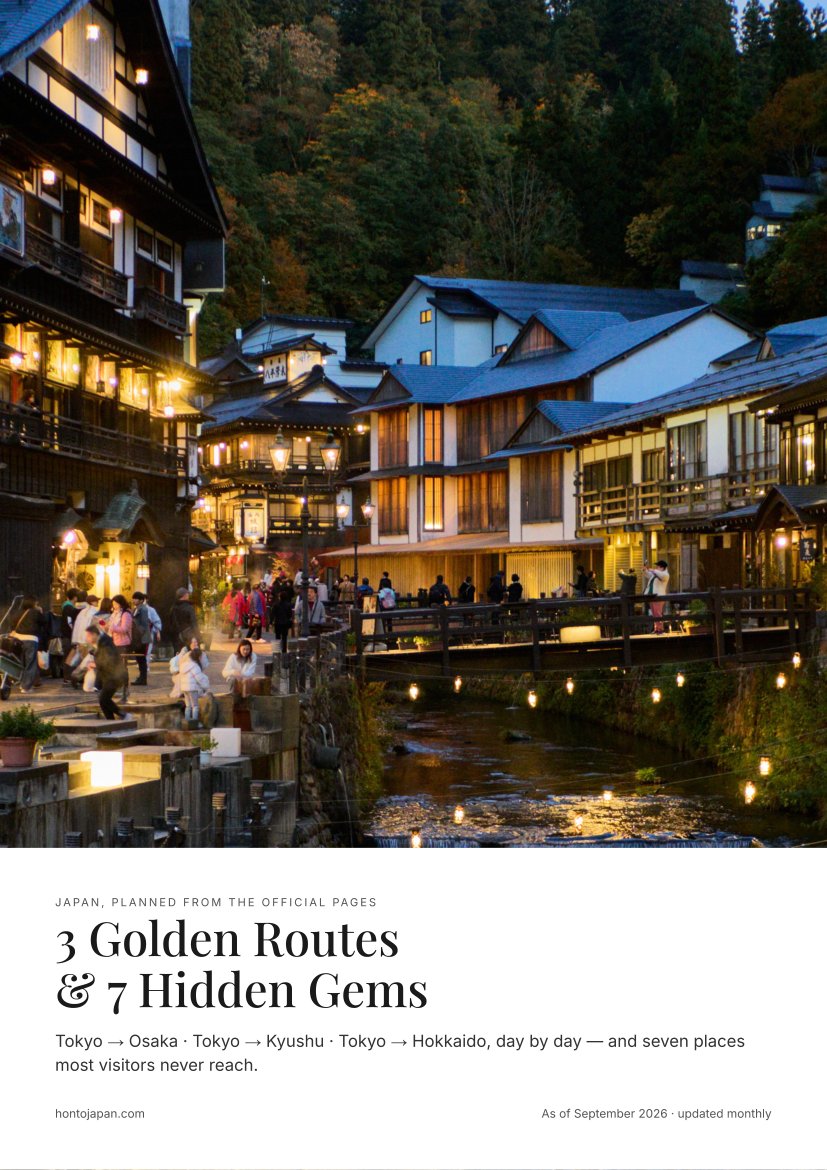
Tokyo to Osaka, Tokyo to Kyushu, Tokyo to Hokkaido — day by day — plus seven places most visitors never reach.
- 12 pages, 80 photographs, every stop linked to its guide
- Every price and opening hour read from the official page
- Re-issued monthly, so it does not go stale in your inbox
Free. One email a month, plus the rare change that matters. Unsubscribe with one click in any email. By subscribing you agree to our privacy policy.