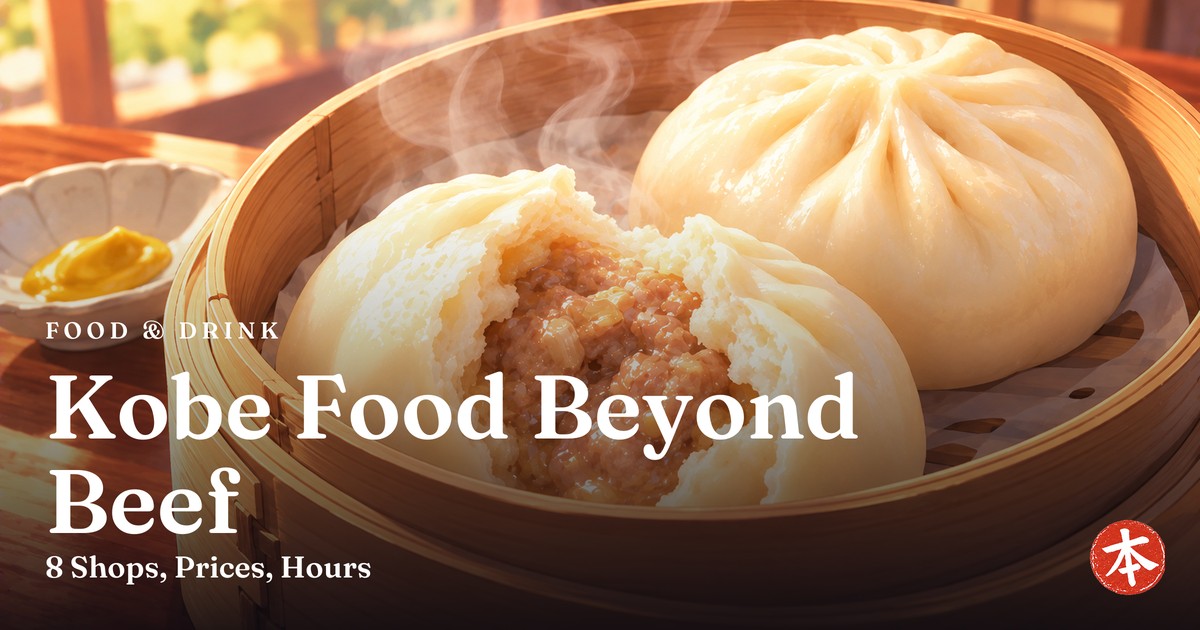
Kobe food is more than Kobe beef. A short walk from Motomachi Station, Nankinmachi, Kobe’s Chinatown, sells pork buns at 5 for 600 yen at Roshoki, fried xiaolongbao at 3 for 450 yen at YUNYUN and miso-sauce gyoza at 6 for 550 yen at Ganso Gyozaen, all with tax. Add sobameshi from the Nagata district, akashiyaki from the neighboring city of Akashi, and Motomachi’s old sweet shops.
This page reports only what each shop says on its own website, plus Kobe’s official tourism and city pages: prices, hours, closing days and house rules. It is not a ranking. The practical surprises: Roshoki moves to a new shop on November 11, 2026; Nankinmachi asks you to take your trash back to the stall; one akashiyaki shop is open only four days a week and will not let two adults share a serving; and Gyozaen’s 100 percent Kobe beef and vegetable gyoza are weekday evenings only. For the beef itself, see our Kobe beef guide.
Kobe food at a glance
| Shop | Area | What to eat | Price, per the site | Hours | Note |
|---|---|---|---|---|---|
| Roshoki | Nankinmachi | Pork buns | 5 for 600 yen; 10 for 1,200 yen | 10:00 to 18:30, until sold out | New shop from Nov 11 |
| YUNYUN | Nankinmachi | Fried xiaolongbao | 3 for 450 yen | 11:00 to 18:00 | Allergens marked in English |
| Ganso Gyozaen | Nankinmachi | Gyoza with miso sauce | 6 for 550 yen | Lunch and dinner; closed Mon | No smoking |
| Nagata Tanksuji | Sannomiya, Nankinmachi | Sobameshi, bokkake | Not published | Varies by shop | Cards at Nankinmachi shop |
| Akashiyaki Yokoi | Akashi | Akashiyaki | 10 for 800 yen | 10:00 to 15:00, Mon, Fri, Sat, Sun only | No sharing between two adults |
| Honke Kimuraya | Akashi | Akashiyaki (tamagoyaki) | 1,300 yen | 10:00 to about 17:00; last orders about 16:30 | Closed days posted monthly |
| Kobe Fugetsudo | Motomachi | Gaufres, hotcakes | Gaufres from 702 yen | Tearoom 11:00 to 18:00 | Closed 2nd, 4th Tue |
| Kannonya | Motomachi | Warm Danish cheesecake | Not published | 10:30 to 21:00 | Single pieces at Shin-Kobe |
Prices as of October 5, 2026, with tax where the shop says so. A pork bun and a tearoom hotcake set are different things, so the table is not a like-for-like comparison. Check the official site before you go.
What to know before eating in Kobe
What about Kobe beef?
Kobe beef is why many visitors come, and it has its own rules about what can carry the name. We cover those, and what to order, in our Kobe beef guide. This page is about everything else Kobe eats; the one crossover is Gyozaen, which mixes Kobe beef into its gyoza.
Where is Nankinmachi, and how big is it?
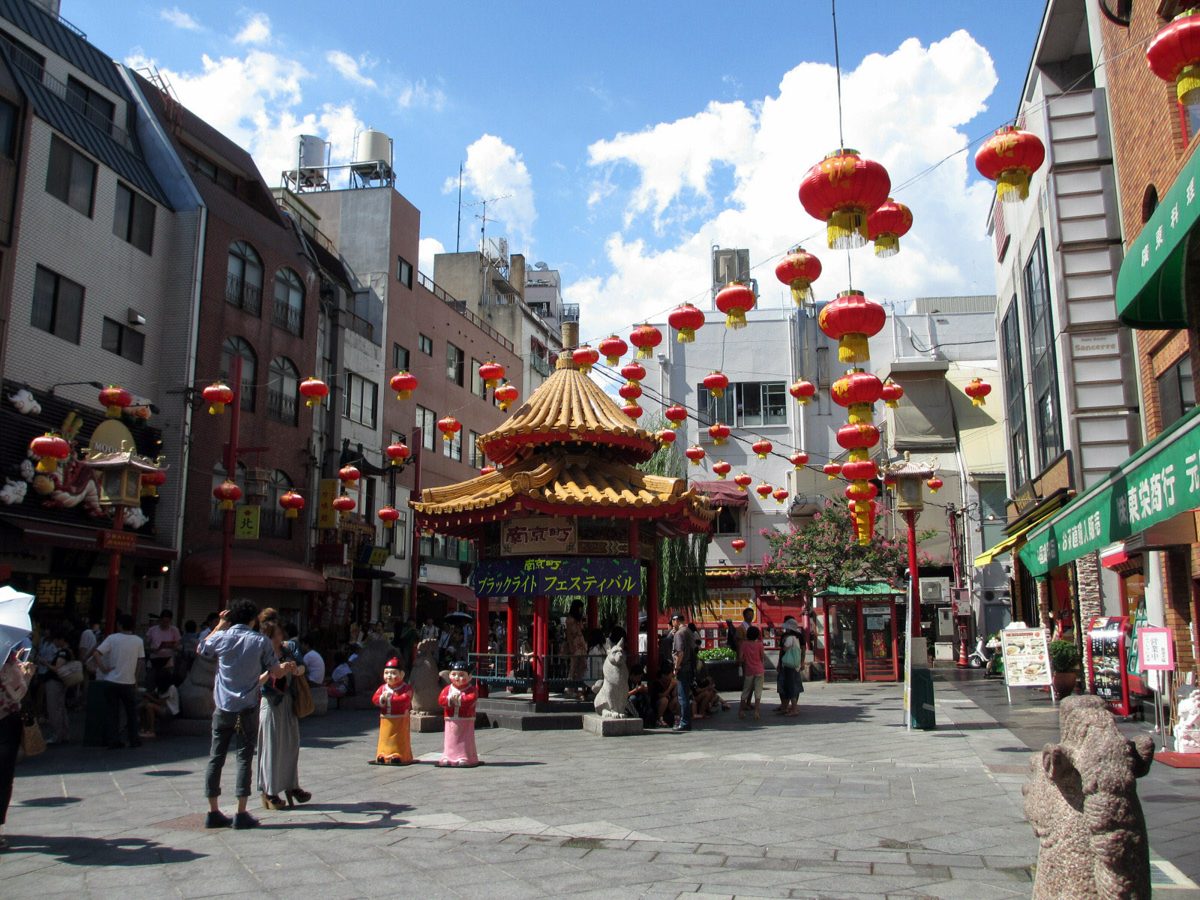
Nankinmachi, Kobe’s Chinatown, lies south of JR and Hanshin Motomachi Station. Its shopping street association says it covers about 270 meters east to west and 110 meters north to south, so you can walk it end to end in minutes, and counts it among Japan’s three major Chinatowns with Yokohama and Nagasaki. It has no parking of its own. For which station to use, see our Kobe map guide.
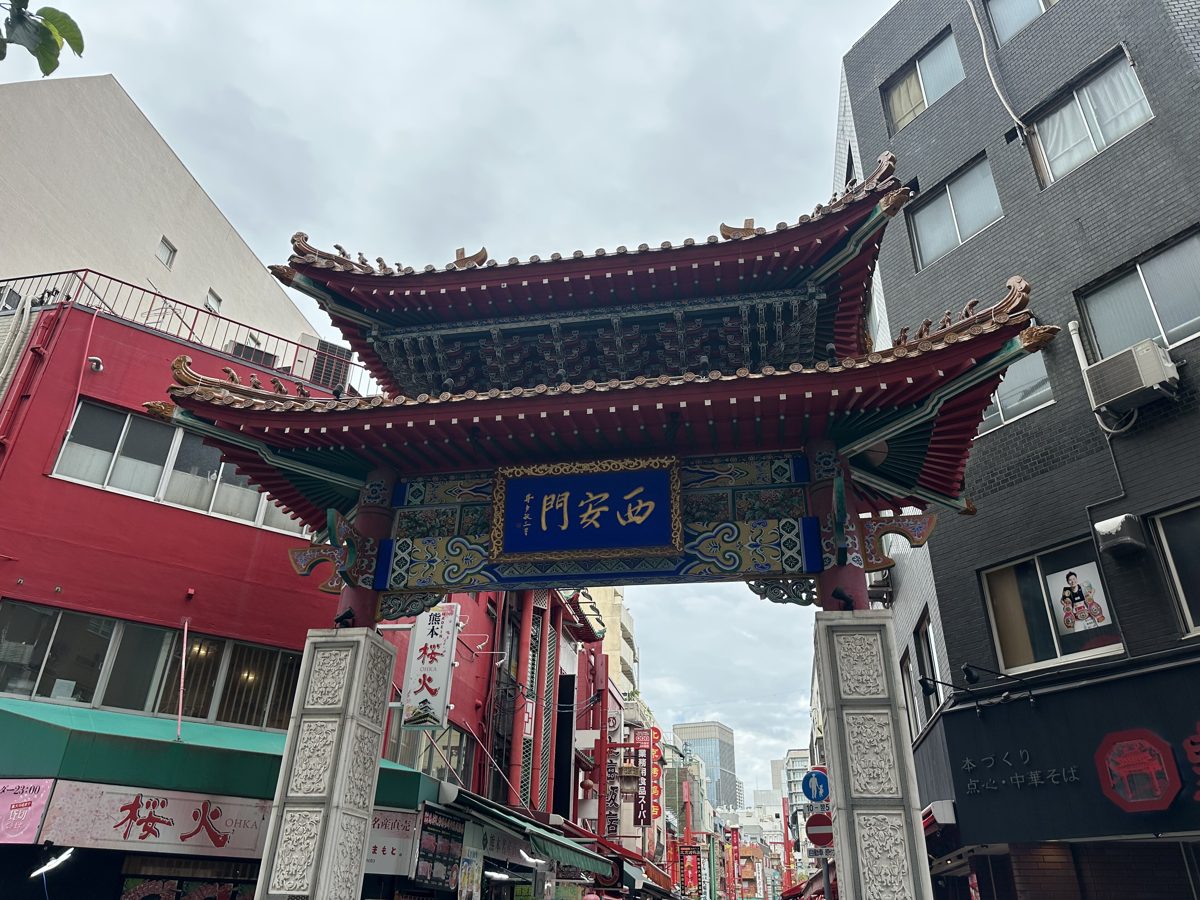
The association says Chinese merchants settled here after Kobe’s port opened to foreign trade: China then had no treaty with Japan, so they could not live in the foreign settlement and opened general stores, pork shops and restaurants just west of it. The area burned in the 1945 air raids; shop owners founded the association in 1977 to revive it, and the Choanmon gate was completed in 1985.
Where do I put my trash in Nankinmachi?
Nankinmachi holds the Spring Festival, the Mid-Autumn Festival and a Lantern Fair each year. Feel KOBE notes that mooncakes and douhua, a soft soy-milk sweet, are sold here all year round. For street food elsewhere in Japan, see our Japanese street food guide.
Is Akashi part of Kobe?
No. Akashi is a separate city west of Kobe, and its two akashiyaki shops below are there, not in central Kobe. We could not confirm train times or fares on an official page, so check them with the rail operator before you go. The Akashi Tourism Association lists dozens of shops under akashiyaki (tamagoyaki).
Nankinmachi street food in Kobe
Roshoki: pork buns since 1915, 5 for 600 yen
Roshoki calls itself the original pork bun shop. Its history page says its founder, from Ningbo in Zhejiang, came to Japan in 1915 and opened what it describes as Japan’s first pork bun specialty shop in Nankinmachi, reworking the Tianjin baozi into a bun with a name and taste familiar to Japanese customers. Its buns are 5 for 600 yen or 10 for 1,200 yen, with tax, since October 1, 2024, up from 6 for 600 yen and 10 for 1,000 yen (as of October 2026; price notice). The site gives prices only in those units, not per bun.
Its counter page says each staff member can wrap 13 buns a minute and that it makes 13,000 a day. On weekends and holidays, it says, a long line forms from opening, with an average wait of 30 minutes to an hour. Its own quieter times are weekdays 10:00 to 11:00 and 17:25 to 18:15, and it adds that rainy weekdays are a good bet.
Until then, the shop is at Motomachi-dori 1-3-7, five minutes on foot from Motomachi Station, open 10:00 to 18:30, closing early when sold out. Its shop page lists irregular closing days; its October notice says it is open every day this month and sells shiitake pork buns on select days. Roshoki does not list payment methods on its site.
YUNYUN: fried xiaolongbao, 3 for 450 yen
YUNYUN, run by the rice-noodle maker Kenmin Foods, began in 1985 as a Chinese fast-food shop inspired by food courts in the United States and Hong Kong. It launched its fried xiaolongbao, the Shanghai pan-fried bun, in 2009 and moved across the street in November 2017. Its Nankinmachi menu PDF, updated June 1, 2026, lists them at 3 for 450 yen, 6 for 900 yen, or 150 yen per extra bun (as of October 2026; Nankinmachi menu PDF).
Fujian fried rice noodles, made from the company’s own rice noodles, are 450 yen, as are lu rou fan, beef brisket rice, soupless dan dan noodles and Tainan danzai noodles. The menu says prices include tax and are the same for eating in or take-out. Each dish carries English allergen marks such as wheat, milk, egg and peanut; the menu lists the eight specified allergens and asks guests with allergies to talk to staff.
The shop is at Sakaemachi-dori 1-3-17, about 100 meters west of the Choanmon gate and 50 meters east of Nankinmachi Square, and opens 11:00 to 18:00, with irregular closing days. Its site links to an online booking page. YUNYUN does not list payment methods on its site.
Ganso Gyozaen: gyoza with miso sauce since 1951
Ganso Gyozaen opened in 1951; its founder was inspired by gyoza and jajamen he ate in Manchuria and Shandong. Its menu tells you how to eat them: add vinegar and soy sauce to its secret miso sauce. The sauce uses no garlic, and grated garlic is on the table. The shop calls itself the birthplace of miso-sauce gyoza and says it is the only shop in Japan with Kobe beef in its gyoza filling; those are its own claims. For gyoza in the capital, see our gyoza in Tokyo guide.
Its signature grilled gyoza, 6 for 550 yen with tax, has Kobe beef making up 9.1 percent of the filling and is fried in 100 percent peanut oil (as of October 2026; menu). Boiled gyoza, also six, are 550 yen, and deep-fried gyoza, five, are 550 yen, eaten with natural rock salt. Jajamen, flat noodles with spicy meat miso, is 900 yen. A set of gyoza, rice and soup is 850 yen at weekday lunch only, until sold out.
It is at Sakaemachi-dori 2-8-11, five minutes from Motomachi Station, with 38 seats, all no-smoking. Hours are 11:45 to 15:00 and 17:00 to 20:30, both last orders; it is closed on Mondays, opening on a holiday Monday and closing the next day instead. It takes bookings only for weekday evenings from 17:00, and not on the day in principle; at lunch and on weekends it seats guests lining up at the door first. Gyozaen does not list payment methods on its site.
Sobameshi and bokkake: Nagata food in central Kobe
What are sobameshi and bokkake?
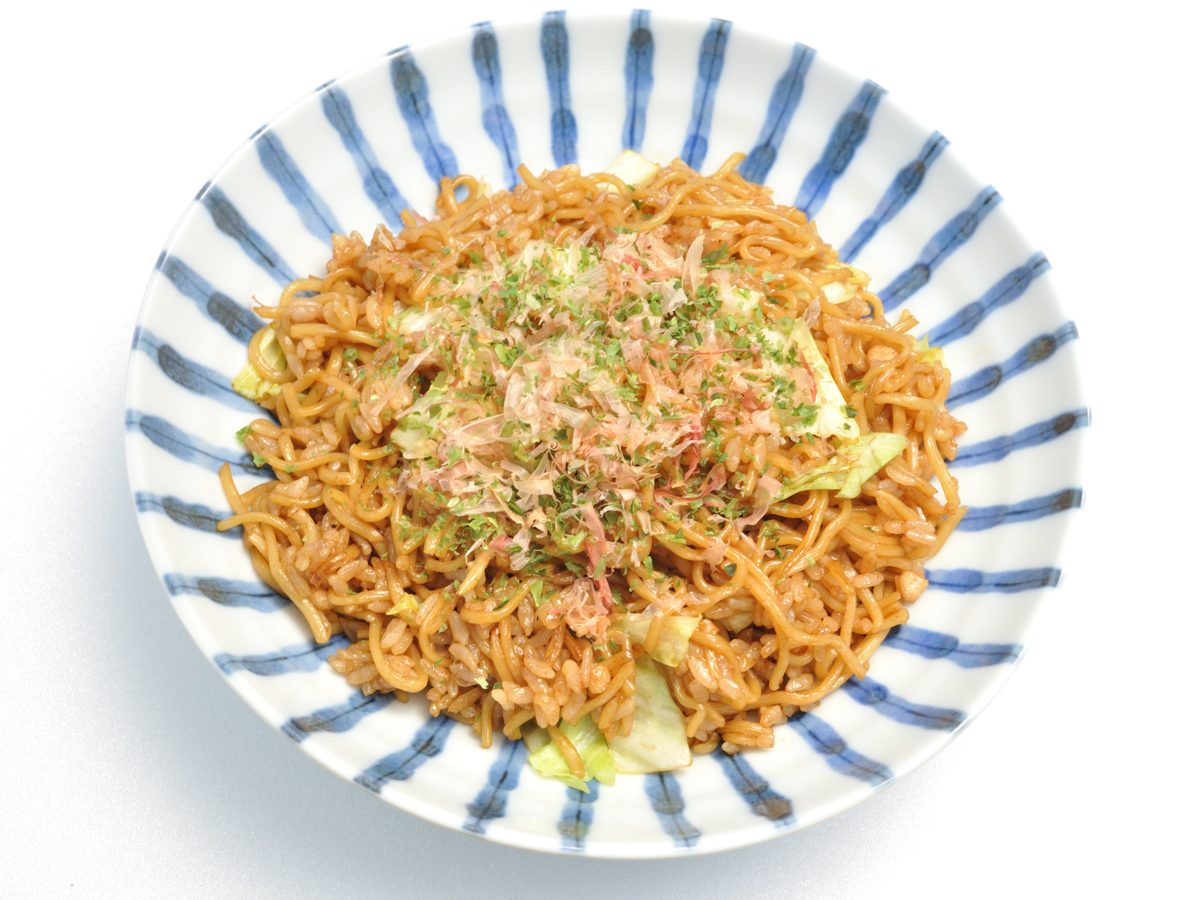
Feel KOBE describes sobameshi as sauce yakisoba and rice chopped finely and mixed, sometimes topped with seafood or kimchi. The City of Kobe’s Nagata Ward says it is said to have been born when women working in Nagata’s synthetic-shoe factories had their rice reheated at okonomiyaki shops and mixed with noodles. Bokkake is beef tendon and konnyaku stewed sweet and savory, and the ward says the name is said to come from a word for pouring over.
The ward adds that Shin-Nagata is said to have one of the highest concentrations of okonomiyaki shops in Japan, with Chinese, Korean, Vietnamese and Myanmar food too. Feel KOBE features Okonomiyaki Aomori in Nagata for its story as the shop where sobameshi began. Feel KOBE also notes that bokkake is called sujikon at some shops, so menu names vary.
Nagata Tanksuji: sobameshi in Sannomiya and Nankinmachi
Nagata Tanksuji specializes in soba-yaki, sobameshi and modan-yaki, with a menu shared across its shops. It aims for a loose, separate-grain sobameshi and recommends bokkake sobameshi, made with beef tendon from 100 percent Japanese black wagyu simmered for over half a day. Other versions include Akashi octopus, offal, curry and aburakasu, which it explains as offal fried slowly until the fat renders out and it turns crisp. Its site publishes no prices, and the menu notes that prices may have changed.
The Sannomiya Sanplaza main shop, in the basement of Sanplaza, Sannomiya-cho 1-8-1, opens 11:00 to 22:00, last order 21:30, but only 11:00 to 15:00 on Tuesdays, and takes no bookings except for private hire. The Motomachi Nankinmachi shop, at Motomachi-dori 2-2-14, is right behind Roshoki; it opens 17:00 to 23:00 on weekdays, 12:00 to 23:00 on Saturdays and days before and after public holidays, and 12:00 to 22:00 on Sundays and holidays, and closes on Tuesdays (as of October 2026; shop page).
Akashiyaki: Kobe’s neighbor and its egg dumplings
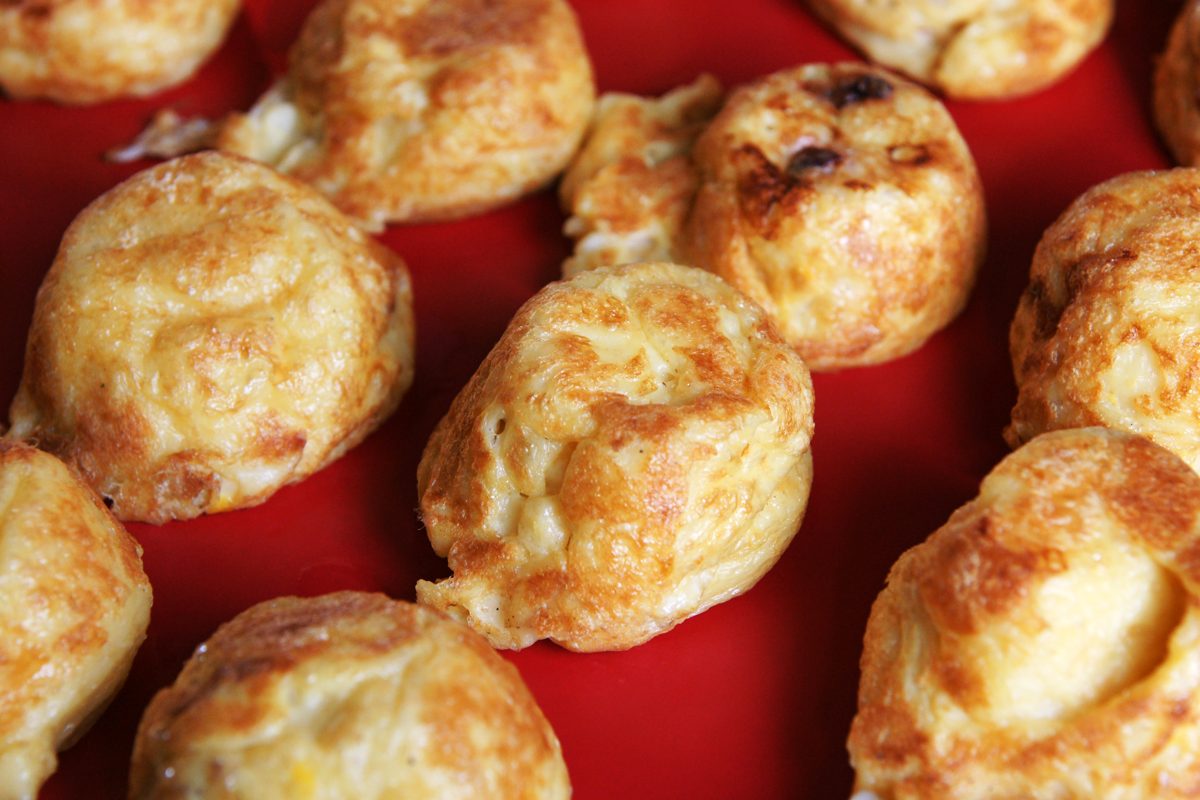
How is akashiyaki different from takoyaki?
Akashiyaki Yokoi sets out the difference on its own page. Akashiyaki has only octopus inside, a batter that is mainly egg, a round but flatter shape, a copper pan, and is eaten cooled in cold dashi. Takoyaki has octopus with green onion, red pickled ginger and more, a batter that is mainly flour, a ball shape and an iron pan. Yokoi says that in Akashi the dashi was served to cool the freshly cooked akashiyaki, so its own dashi is light and cold, and you do not have to dip at all.
Akashiyaki Yokoi: 10 for 800 yen, four days a week
Yokoi says it has served almost the same taste since it opened in 1952. A serving of 10 akashiyaki is 800 yen to eat in, and a take-out pack of 10 is also 800 yen (as of October 2026; menu); the site does not say whether tax is included. Each order is mixed and cooked in a copper pan after you order, so expect about five minutes. It is inside the Uonotana market at Honmachi 1-1-13, Akashi, and takes inquiries by phone only. It does not sell by mail order; it ships only for customers who order at the shop.
Honke Kimuraya: tamagoyaki, 1,300 yen
Honke Kimuraya calls its dish tamagoyaki, made with octopus bought fresh every morning, kelp from southern Hokkaido and salt from Ako, with no preservatives. It raised its tamagoyaki from 1,200 yen to 1,300 yen on January 1, 2026 (as of October 2026; official site). The notice does not state how many pieces come in a serving, and the site does not say whether tax is included.
It is at Kajiyamachi 5-23, Akashi, and opens 10:00 to about 17:00, every day of the week including weekends and holidays, until the day’s batter runs out. For the time being, short of staff, it takes last orders around 16:30, and it has about ten fewer seats, so waits can be long. Closing days are posted monthly on its site; October 2026 lists the 13th, 19th, 26th and 27th still to come. Take-out should be eaten within three hours because it uses raw egg and octopus. The shop asks guests not to talk loudly. Kimuraya does not list payment methods for eating in.
Kobe sweets in Motomachi
Kobe Fugetsudo: gaufres since 1927, in a shop from 1897
Feel KOBE says Kobe’s Western sweet shops began with Kobe Fugetsudo, opened in Motomachi in 1897, and that in the Taisho era foreign residents brought their own traditions, giving rise to names such as Freundlieb, Morozoff and Juchheim. Fugetsudo says it opened on December 12, 1897, at its present site, Motomachi-dori 3-3-10. Around 1926 a customer back from abroad brought French baked sweets and suggested making them in Japan; its gaufre, thin wafers sandwiching cream, went on sale in 1927.
Gaufres start at 702 yen with tax (as of October 2026; shop items). Sold only at the Motomachi main shop, in limited numbers, are Sanchome no Ringo-chan at 486 yen, take-out only, and Gaufnya at 216 yen. In the tearoom, a hand-baked hotcake with coffee or tea is 1,210 yen, anmitsu with hojicha 935 yen, special anmitsu 1,320 yen, stone-oven coffee 660 yen and cream soda 770 yen; a seasonal parfait served from August 26, 2026, is 1,980 yen (as of October 2026; tearoom menu). A lunch set of nyumen noodles and red bean rice, 1,650 yen, is served from 11:30.
The shop sells sweets 10:00 to 18:00, and the tearoom opens 11:00 to 18:00, last order 17:30. Both close on the second and fourth Tuesdays and on January 1 and 2; if a Tuesday is a public holiday, it closes on the Wednesday instead. It is no-smoking at every seat all day, three minutes from Hanshin Motomachi Station and five from the west exit of JR Motomachi. Fugetsudo does not list payment methods on its site.
Kannonya: warm Danish cheesecake since 1975
Kannonya, a coffee and cheesecake shop, opened its Motomachi main shop in 1975. Its cheesecake uses an original blend of raw cheese imported from Denmark, and the shop describes warming it in a toaster oven so the cheese melts and stretches. It says the founder’s predecessor was devoted to Kannon, and a Kannon statue sits in the main shop. Its site publishes no in-store prices.
The main shop, at Motomachi-dori 3-9-23, two minutes from JR or Hanshin Motomachi, opens 10:30 to 21:00 and closes only on New Year’s Day, with 58 seats. Leaving by bullet train, its JR Shin-Kobe Station shop in Entree Marche opens 9:00 to 21:30 every day and sells single pieces. Kannonya also lists a Kobe Airport shop on the second-floor departure lobby as a place to buy it. Kannonya does not list payment methods on its site. If you are choosing a base, our Hotel Okura Kobe guide covers one harborside option.
What does Kobe food cost?
Kobe food prices, as published
| Shop | Main item | Other prices | Tax, per the site |
|---|---|---|---|
| Roshoki | Pork buns 5 for 600 yen; 10 for 1,200 yen | Not sold per bun on the site | Included |
| YUNYUN | Fried xiaolongbao 3 for 450 yen | Rice noodles and rice dishes 450 yen | Included; same eat-in or take-out |
| Ganso Gyozaen | Grilled gyoza 6 for 550 yen | 100 percent Kobe beef gyoza 2,200 yen, weekday evenings | Included |
| Akashiyaki Yokoi | 10 for 800 yen | Take-out pack 800 yen | Not stated |
| Honke Kimuraya | Tamagoyaki 1,300 yen | Pieces not stated | Not stated |
| Kobe Fugetsudo | Gaufres from 702 yen | Hotcake with drink 1,210 yen | Included |
| Nagata Tanksuji, Kannonya | Not published | Not published | — |
Which Kobe food prices are recent?
Kimuraya’s price dates from January 2026, YUNYUN’s menu PDF from June 2026 and Fugetsudo’s seasonal parfait from August 2026. Roshoki’s prices date from October 2024. Gyozaen and Yokoi do not date their menus.
Paying, booking and eating with dietary needs in Kobe
Can I pay by card?
Only Nagata Tanksuji’s Nankinmachi shop states it, listing credit cards, transit IC cards and PayPay. The other seven shops, and Tanksuji’s Sannomiya shop, do not list payment methods on their sites, so carry cash.
Can I book?
Gyozaen takes bookings for weekday evenings from 17:00 only. Tanksuji’s Sannomiya shop takes none except for private hire. YUNYUN links to an online booking page, and Kimuraya takes take-out orders by phone. The others do not describe booking.
Is there anything for vegetarians or allergies?
Gyozaen’s vegetable gyoza uses no meat or animal-based seasonings, but is served only on weekday evenings. YUNYUN marks allergens such as wheat, milk, egg and peanut in English on its menu. Gyozaen fries its grilled gyoza in peanut oil.
Which Kobe food stop suits you?
For a bag of pork buns from 1915, Roshoki, on a weekday morning, and at its new shop after November 11. For crisp fried xiaolongbao with English allergen marks, YUNYUN. For miso-sauce gyoza, or vegetable gyoza on a weekday evening, Gyozaen. For sobameshi without going to Nagata, Tanksuji, behind Roshoki. For akashiyaki, Yokoi from Friday to Monday or Kimuraya before 16:30. For gaufres and a hotcake in a tearoom, Kobe Fugetsudo, and for warm cheesecake, Kannonya, or a single piece at Shin-Kobe.
Frequently asked questions
What food is Kobe known for besides Kobe beef?
How much are Roshoki pork buns in Kobe?
Where do I put my trash when eating in Nankinmachi?
What is sobameshi?
What is the difference between akashiyaki and takoyaki?
When is Akashiyaki Yokoi open?
Can I pay by card at Kobe food shops?
Is there vegetarian food in Nankinmachi?
Bottom line (2026): Beyond the beef, Kobe’s Nankinmachi sells pork buns at 5 for 600 yen at Roshoki, which moves to a new shop on November 11, 2026, and miso-sauce gyoza at 6 for 550 yen at Gyozaen. Take street-food trash back to the stall. Akashiyaki Yokoi in Akashi is 800 yen for 10, open only Monday, Friday, Saturday and Sunday.
Sources
Every price and rule on this page is from the shops’ own websites, including menu images and PDFs on those sites, plus the Nankinmachi association, the City of Kobe, Feel KOBE and the Akashi Tourism Association: Nankinmachi Shopping Street Association, Nankinmachi about, Nankinmachi access, City of Kobe, Nagata Ward: food town, Feel KOBE: Nagata sobameshi and sujiyaki, Feel KOBE: Kobe sweets, Akashi Tourism Association: akashiyaki, Roshoki, Roshoki shop information, Roshoki history, Roshoki counter, Roshoki October 2026 notice, Roshoki price revision notice, YUNYUN, About YUNYUN, YUNYUN Nankinmachi menu PDF, Ganso Gyozaen, Ganso Gyozaen menu, Ganso Gyozaen access, Nagata Tanksuji, Nagata Tanksuji menu, Nagata Tanksuji shops, Akashiyaki Yokoi, Akashiyaki Yokoi menu, Akashiyaki Yokoi shop information, Akashiyaki Yokoi: akashiyaki and takoyaki, Honke Kimuraya, Kobe Fugetsudo main shop, Kobe Fugetsudo shop items, Kobe Fugetsudo tearoom menu, Kobe Fugetsudo gaufre story, Kobe Fugetsudo history, Kannonya, Kannonya shops, About Kannonya, Kannonya on Danish cheese, Kannonya products, all read on October 5, 2026. Menus, prices and hours change, so confirm on the official site before you go.
Some links on this page may be affiliate links, which means we may earn a commission if you book or buy through them — at no extra cost to you. See our affiliate disclosure.
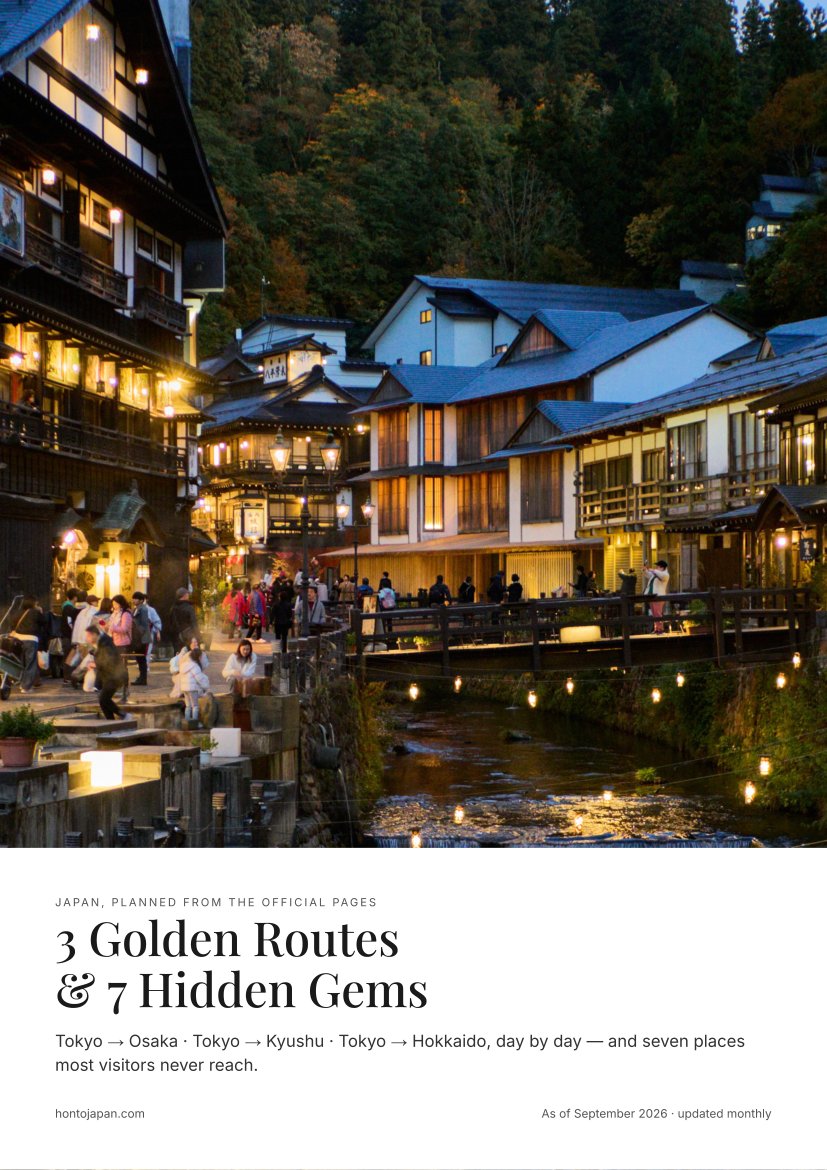
Tokyo to Osaka, Tokyo to Kyushu, Tokyo to Hokkaido — day by day — plus seven places most visitors never reach.
- 12 pages, 80 photographs, every stop linked to its guide
- Every price and opening hour read from the official page
- Re-issued monthly, so it does not go stale in your inbox
Free. One email a month, plus the rare change that matters. Unsubscribe with one click in any email. By subscribing you agree to our privacy policy.