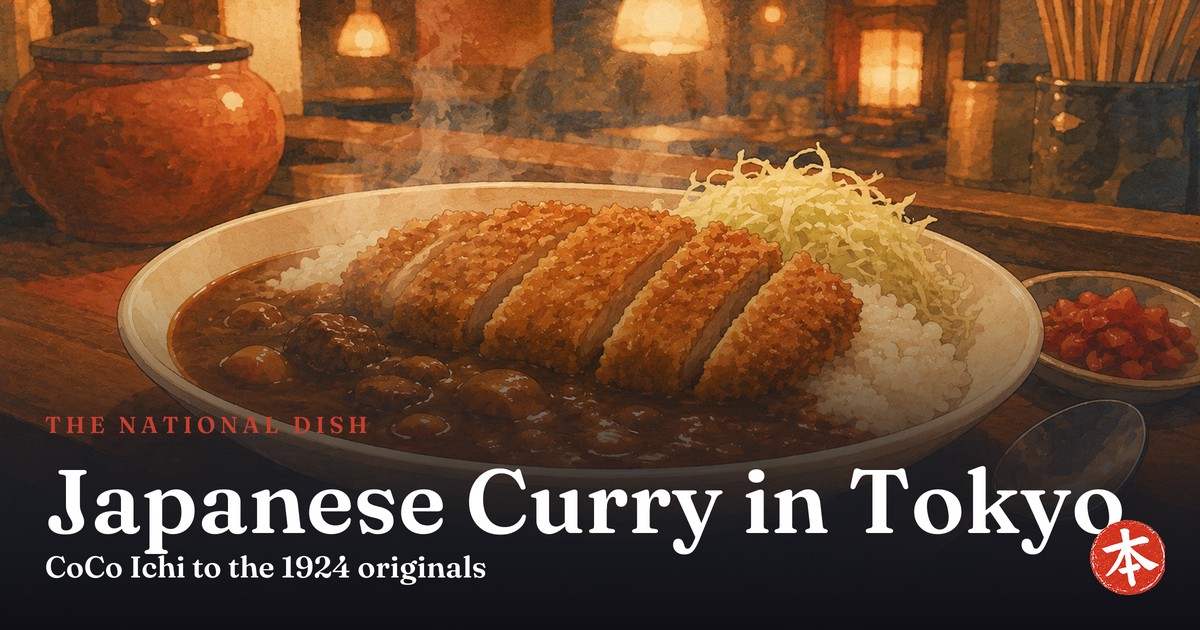
Japanese curry is the country's comfort food — CoCo Ichibanya's own press materials call it the national dish — and Tokyo eats it at every register of the scale, from a ¥570 chain plate you customize by the gram to a 1924 Sumatra-curry house in the used-book district. Yet English-language coverage is thin enough that the ordering system, the price geography and half the origin stories go untold.
This guide fixes that with official sources: how to actually order at CoCo Ichi (and why its price depends on your prefecture), what "Kanazawa-style" officially means, and the Jimbocho old guard — including a curry named "Kashmir" by printing accident.
Tokyo curry at a glance
| The customizer | CoCo Ichibanya — pork base ¥570, rice 150–400g in 50g steps, spice sweet→level 20, 9-language menu · 1,285 stores in Japan (official) |
|---|---|
| The Kanazawa school | Go Go Curry — thick dark roux, cabbage, steel plate, spork, sauce on the cutlet (the official 5 rules) · doors at 10:55 |
| The European benchmark | Bondy (Jimbocho, above a bookshop) — silky, fruity · beef/chicken ¥1,800 |
| The originals | Kyoeido (est. 1924, Sumatra curry, 🚨closed Sun & holidays) · Delhi (est. 1956, Kashmir curry ¥1,350) · Ethiopia (spice-forward, no prices published) |
| Veg / Halal | CoCo Ichi Veg Curry ¥683 (officially no animal ingredients) · certified halal CoCo Ichi in Akihabara |
| Budget | ¥570–900 chains · ¥1,300–1,800 institutions (all official prices, tax included) |
A Japanese-and-English tasting run through Tokyo's curry chains — useful for seeing the styles side by side before you pick a camp:
CoCo Ichibanya: the ordering machine, decoded
The three dials (and the price map)
CoCo Ichi turns curry into a config file, and every dial is official. Base: pork is the ¥570 baseline; beef, seafood and the rest scale up (loin-cutlet curry: ¥907). Rice: 150g to 400g in official 50g steps — above 400g it goes by 100g with a published surcharge (about ¥130 per extra 100g on pork-base). Spice: from sweet-mild to level 20 — the official page notes "normal" equals a typical medium-hot, and older guides still capping the scale at 10 are a decade out of date. Then toppings, the real culture: cutlets, cheese, spinach, eggs, stacked without shame. One map note the official menu prints in small type: outside Tokyo, Kanagawa and Osaka, pork-base plates run ¥21 cheaper — Tokyo is the ceiling price.
The official how-to, from the source
CoCo Ichi's own channel published an English "How to order!" walkthrough — worth ninety seconds before your first visit:
Vegetarian and halal, officially
Two systems most chains don't have. The Veg Curry (¥683) is officially made with no animal-derived ingredients — important, because the standard roux is not vegetarian. And Akihabara hosts a fully certified halal CoCo Ichi (Japan Asia Halal Association, running since 2017, Kanda-Matsunagacho, 11:00–22:30) with its own official menu book — plain curry ¥550, chicken cutlet ¥1,030, and an official quirk: spice runs normal to 10, with no mild option. The multilingual menu book at regular stores covers nine languages, English included.
Go Go Curry: the Kanazawa gospel (and the :55 clock)
Go Go Curry is Tokyo's outpost of Kanazawa-style, and the chain officially defines the style in five rules: a thick, almost gravy-dark roux; shredded cabbage alongside; a stainless-steel plate; a fork or spork; and the katsu on top of the roux with sauce over it. The "55" branding is officially literal — a 55-step roux simmered five hours, rested 55 hours — and it runs the clock too: stores open at 10:55 and close at :55 (the Shinjuku Gyoen flagship runs 10:55–20:55), with the 5th of each month as the official "Go Go Day." Tokyo has 27 stores officially; prices, the official line admits, vary by store — so we won't print one.
Jimbocho: the curry district hiding in the book town
Three institutions, three centuries of style
Tokyo's secondhand-book district is also its densest curry quarter, and the three landmarks each verify. Kyoeido (est. 1924) is officially "Japan's only Sumatra curry" house — a dark, sandy, gently bitter plate unchanged for a century; pork ¥1,300, beef ¥1,700, the famous tongue curry ¥2,200, a baked-apple dessert that officially exists only October to early May — and it's closed Sundays and holidays, the single most itinerary-relevant fact in this article. Bondy (2F of the Kanda Kosho Center — you walk through a bookshop's back stairs) is the European-style benchmark: dairy-rich, fruit-sweetened, officially ¥1,800 for beef or chicken, with longer weekend hours (10:30 open). Ethiopia (est. 1988, technically on neighboring Ogawamachi) is the spice-cabinet outlier — officially named for the coffee the shop once served, not the cuisine; it publishes no prices, so neither do we.
And the printing error that named a genre
Delhi (est. 1956, officially in Yushima near Ueno — every guide says "Ueno," the address says Bunkyo-ku) invented a jet-black, chili-forward, deliberately thin curry and planned to call it Madras curry. A menu-printing mix-up rechristened it Kashmir curry — the official site tells the story itself, noting the name has nothing to do with Kashmir and that in this genre, the thinner and looser the roux, the more "iki" (stylish). ¥1,350, and treat the heat with respect.
How curry fits your Tokyo eating day
Curry is the meal between meals here — the fast, cheap, hot plate when you've queued too long elsewhere. Chains cluster near every station; Jimbocho rewards a bookish lunch detour; and the katsu-curry family tree connects straight to our tonkatsu guide. Curry bread and curry-filled snacks pop up through the street-food scene, morning curry is a real thing at the chains in our breakfast guide — and if you'd rather make the roux than order it, several schools in our cooking-class guide teach it.
(Curry's best crossover is a noodle: curry udon, officially ¥660–680 at the big sanuki chains — the full udon style map is in our Tokyo udon guide.)
(For a hotel within walking distance of Jimbocho: our Hotel Niwa Tokyo guide notes that Exit A5 of Jimbocho Station is about 8 minutes on foot, and that the hotel’s smallest rooms are 18 square meters.)
FAQ
How do I order at CoCo Ichibanya?
Is CoCo Ichibanya the same price everywhere?
What is Kanazawa-style curry?
What’s special about curry in Jimbocho?
What is Kashmir curry — and is it from Kashmir?
Is Japanese curry vegetarian- or halal-friendly?
How much should I budget for curry in Tokyo?
Do I need to queue or book for the famous curry shops?
What actually is Japanese curry?
Bottom line (2026) — CoCo Ichibanya (1,285 stores per its February 2026 profile) orders rice by the gram, spice to level 20, from a ¥570 base, with a ¥21 regional-price note in the official menu. Go Go Curry opens 10:55–20:55 on its five Kanazawa rules and 55-step roux. Jimbocho holds the old guard — a 1924 Sumatra curry house and a “Kashmir” curry house — for a bookish lunch detour.
Sources
CoCo Ichibanya: the official ordering-guide, menu, topping, English, veg-curry and halal pages (prices tax-included as published; the ¥21 regional-difference note quoted from the official menu; 1,285-store count from the official company profile, February 2026). Go Go Curry: the official brand page (the five Kanazawa rules and 55-step roux, quoted verbatim), official store pages (10:55–20:55 hours) and official news (Go Go Day). Bondy, Kyoeido, Ethiopia, Delhi: each shop's own official site (addresses, hours, closures, prices where published, and the Kashmir-curry naming story as Delhi itself tells it). All read August 10, 2026. No official page documents queues or reservations, so we make no claims about either. The embedded videos are by their creators — including CoCo Ichibanya's own official ordering tutorial.
Tokyo to Osaka, Tokyo to Kyushu, Tokyo to Hokkaido — day by day — plus seven places most visitors never reach.
- 12 pages, 80 photographs, every stop linked to its guide
- Every price and opening hour read from the official page
- Re-issued monthly, so it does not go stale in your inbox
Free. One email a month, plus the rare change that matters. Unsubscribe with one click in any email. By subscribing you agree to our privacy policy.