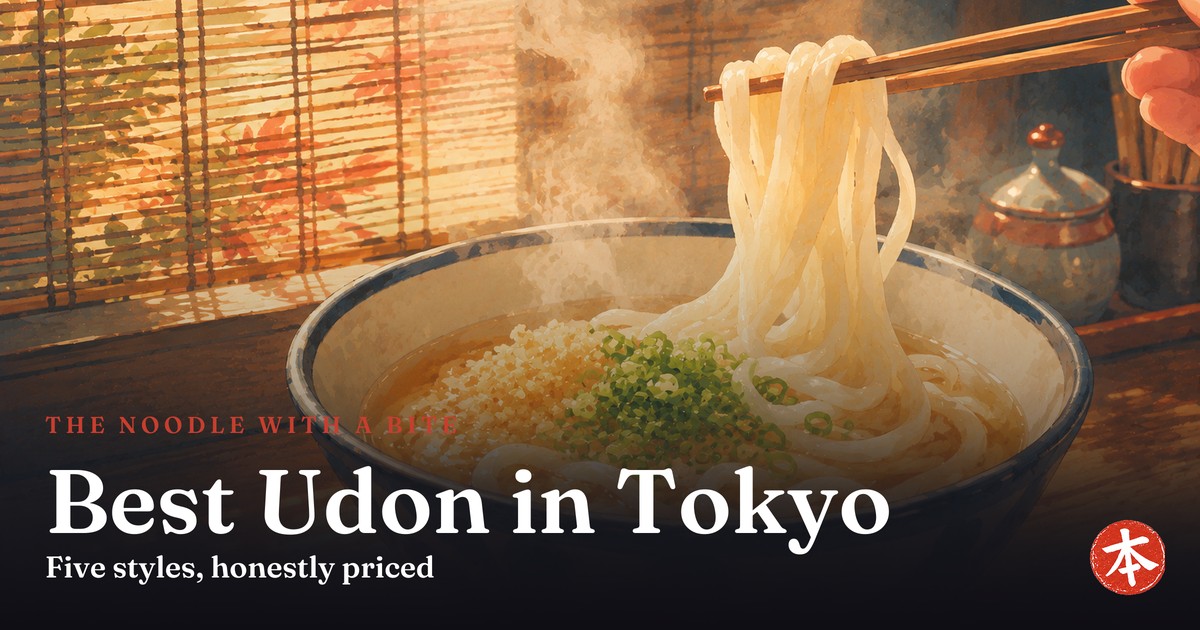
Udon gets filed as ramen's humble cousin, which misses the plot: Tokyo serves at least five distinct udon traditions, from ¥390 self-service sanuki to a ¥3,480 tempura masterpiece at a Yoyogi counter, via Akita's silk-thin inaniwa, Gunma's necktie-wide onihimokawa, and a big-bowl palace that serves until 8 a.m. This guide maps the styles with official prices — and names the two cult shops we excluded because their official pages couldn't be verified.
Tokyo udon at a glance: five styles
| Style | Where | Official prices (Aug 2026) |
|---|---|---|
| Sanuki self-service | Marugame Seimen · Hanamaru (everywhere) | Kamaage ¥390 · kake ¥440 / ¥360 small · curry udon ¥660–680 |
| Artisan counter | Udon Shin (Yoyogi/Shinjuku) | Kake ¥950 · kamatama ¥980 · top ten-zaru ¥3,480 (listed prices) |
| Inaniwa (Akita) | Sato Yosuke (Ginza) | Two-sauce seiro ¥1,400 · lunch walk-in only |
| Onihimokawa (Gunma) | Hanayama Udon (Ginza, behind Kabukiza) | Prices in-store · weekends lunch only · obon (Aug 8–16) lunch only |
| Big-bowl late night | Tsurutontan (Roppongi +) | Roppongi to 8 a.m. · prices not published online |
What a ¥600 bowl of udon looks like when it's taken completely seriously:
The chains: sanuki for pocket change
Marugame or Hanamaru?
Both import Kagawa's sanuki tradition as self-service theater — tray, noodle station, tempura shelf, till — and both publish real prices. Marugame Seimen's official identity is freshness absolutism: noodles cut and boiled in every store, no central kitchen, with the kamaage (pot-fresh, served in its cooking water) as the officially designated signature at ¥390 for the regular size — kake at ¥440, kamatama at ¥550, curry udon at ¥660, per the official menu data as of August 2026. Hanamaru — born in Takamatsu, sanuki's capital — undercuts slightly at ¥360 for small kake (its "from" pricing floats with toppings; the ¥640–840 items advertised this summer are limited-timers, not the base menu). Strategy at both: order the plain style, then build with self-serve tempura — that's where these shops quietly excel.
The artisan tier: Udon Shin
Is a ¥950 bowl of udon worth it?
This is the shop that answers yes. Udon Shin, tucked behind the Shinjuku–Yoyogi border, states its philosophy on its official page: noodle bite (koshi) and suppleness (nobi) contradict each other, and the house pursues the exact midpoint — every portion cut and boiled to order, which the official site warns can mean a 10–15 minute wait per bowl. The listed menu: kake ¥950, kamatama ¥980 (the egg-butter-tempura variants are the cult orders), beef kamatama ¥1,780, and a ¥3,480 top tempura zaru at the summit. Open daily 11:00–22:00 last order, and — the practical miracle — it takes TableCheck reservations online, which converts Tokyo's most famous udon queue into an appointment.
The regional specialists: silk and ribbon
What do Akita and Gunma do that Kagawa doesn't?
Two Ginza addresses import rival prefectural traditions. Sato Yosuke brings Akita's inaniwa udon — thin, glossy, hand-stretched noodles from a family that has, per its official history, passed the method down one-child-at-a-time since the Edo period. The Ginza branch's classic order is the two-sauce seiro at ¥1,400 (soy and sesame-miso); lunch (11:30–15:00) is officially walk-in only, dinner is reserved courses. A few blocks away behind the Kabukiza, Hanayama Udon serves Gunma's onihimokawa — noodles wide as ribbons, draped over the bowl's edge for the country's most photogenic carbohydrate. Its official hours: weekday lunch and dinner (17:30–21:30), weekends lunch only, and — season note — lunch only August 8–16 for obon. Prices are in-store only, so treat it as a mid-range order with a theatrical payoff.
The night shift, and the honest exclusions
Where does udon go after midnight?
Tsurutontan is udon as production number — enormous lacquered bowls, full service, a menu from classic dashi to carbonara-adjacent inventions — and its Roppongi branch officially serves 11:00 to 8:00 a.m. Monday through Saturday, the genre's definitive nightcap (a new flagship, THE SKY TOKYO, opened June 5, 2026). Its restaurant prices aren't published online — the figures on its website belong to mail-order products, a distinction several guides miss. And two famous names are absent by rule, not oversight: Oniyanma (its official site is currently a placeholder) and Yamashita Honki Udon (no verifiable official domain) — both beloved, neither checkable. For the adjacent noodle religions, our Ramen Street guide covers the Tokyo Station corridor, the curry guide includes the curry-udon crossover, and a food tour solves the which-bowl-first problem with a local at the wheel.
(For buckwheat noodles instead: our soba in Tokyo guide covers eight restaurants, where a plain bowl of cold soba costs from 450 yen to 1,320 yen.)
FAQ
What’s the difference between udon and ramen?
What’s the cheapest good udon in Tokyo?
What is kamaage udon?
What’s the artisan tier like?
What is inaniwa udon — and where do I try it?
What is onihimokawa — the super-wide noodle?
Where can I eat udon late at night?
Why aren’t Oniyanma or Yamashita Honki Udon in this guide?
Do these shops have English menus?
Hot or cold — how should I order udon in summer?
Bottom line (2026) — Tokyo udon is five foods wearing one name: Marugame Seimen self-service sanuki from ¥390 (kamaage) up through ¥440/¥550/¥660, Hanamaru at similar entry prices, silky Akita inaniwa in Ginza, Gunma’s ribbon-wide onihimokawa, and Tsurutontan’s big-bowl palace in Roppongi — with the new THE SKY TOKYO branch opening June 5, 2026.
Sources
Marugame Seimen's fresh-boiled-everywhere identity, kamaage signature and menu prices (¥390/¥440/¥550/¥660): its official site and menu data (noting an older ¥370 figure persists in stale page assets — we quote the current structured prices). Hanamaru's origin and from-prices: its official menu pages. Tsurutontan's Roppongi hours, the June 5, 2026 THE SKY TOKYO opening, and the absence of published restaurant prices: its official shop and news pages. Udon Shin's philosophy, listed prices, hours and TableCheck reservations: its official site and menu. Sato Yosuke's history, seiro price and service rules: its official Ginza pages. Hanayama's hours, weekend and obon patterns: its official Ginza pages. All read on August 12, 2026. The embedded video is by its creator.
Tokyo to Osaka, Tokyo to Kyushu, Tokyo to Hokkaido — day by day — plus seven places most visitors never reach.
- 12 pages, 80 photographs, every stop linked to its guide
- Every price and opening hour read from the official page
- Re-issued monthly, so it does not go stale in your inbox
Free. One email a month, plus the rare change that matters. Unsubscribe with one click in any email. By subscribing you agree to our privacy policy.