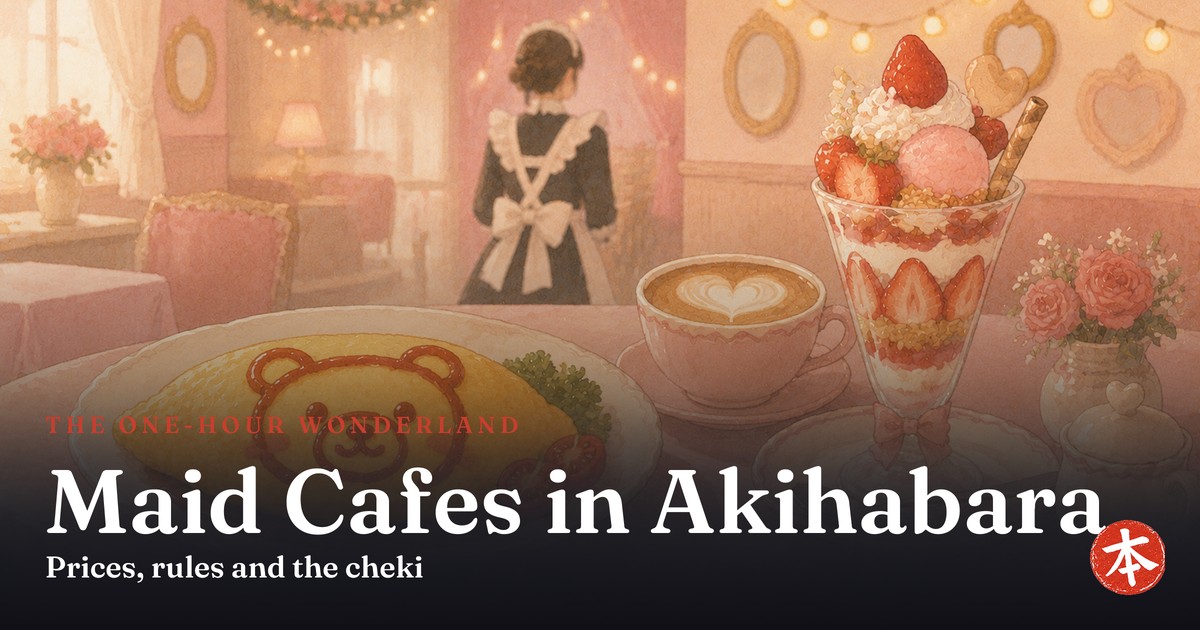
The maid cafe is Akihabara's most misunderstood institution: visitors expect either something seedy or something extortionate, and it's officially neither — entry runs ¥850–¥880 plus one order, kids get in free, and the two big chains publish every rule in advance. What the rules actually govern is theater: the one-hour clock, the no-photographing-the-maids policy (the paid cheki instant photo is the sanctioned exception), and the incantations over your omurice. Here are Akihabara's three flagship experiences, from their own official pages.
Akihabara's three flagship maid cafes at a glance
| @home cafe | Maidreamin | Cure Maid Café | |
|---|---|---|---|
| Style | The canonical show | High-energy, family-friendly | The quiet original |
| Akihabara stores | 3 (Main: Mitsuwa Bldg 3–7F) | 7 | 1 |
| Entry | ¥850/hour + 1 order (kids free) | ¥880/hour + 1 order (under-elem. free) | No entry fee listed — café menu (tea ¥770–880) |
| Hours | 11:00–22:00 (wknd from 10:00) | 10:30–23:00 | 11:00–20:00 |
| Official budget | — | ¥1,500–3,500/person | — |
| Photos | No maids · no video · cheki ¥850–1,050 | Photos & video OK if no staff/customers in frame | Table OK · no video |
What the hour actually looks like, from entry chime to cheki:
How the system works: the hour, the order, the cheki
What am I actually paying for?
Short version: admission rents the seat and the atmosphere, the mandatory order feeds you, and everything memorable is an optional add-on you choose at the table.
Three official layers. Entry: ¥850 at @home cafe (seniors and university students ¥600, middle/high-schoolers ¥400, elementary and under free), ¥880 at Maidreamin (with its own student ladder down to ¥330 and free under-elementary) — both per hour, both requiring at least one drink or set order on top. The stay: @home cafe officially caps it at one hour (extended free if busy service eats your time); Maidreamin just re-bills the entry each hour, with its official all-in guidance of ¥1,500–3,500 per person. The extras: decorated food, drawn-on omurice and the cheki — the instant photo with a maid that is the only sanctioned way a maid appears on your camera roll, officially ¥850 (¥1,050 large) at @home cafe, hand-decorated while you wait. Everything else about photography is prohibition: no shooting maids or other customers at either chain, and no video or audio recording at all at @home cafe. The system sounds fussy; in the room it's frictionless — the maids run the script.
Choosing your cafe: show, energy, or silence
What separates the big two?
Same rulebook, opposite volume knobs — and one of them also happens to run the friendliest English operation in the district.
@home cafe is the genre's Carnegie Hall — the multi-floor main store in the Mitsuwa Building plus outposts in Akiba Cultures Zone and the Don Quijote building, weekday hours 11:00–22:00 (weekends from 10:00), advance tickets sold online (priority entry officially suspended on cosplay-event days), and — the visitor-relevant flex — official English training for maids by native instructors. Maidreamin is the accessible empire: seven Akihabara branches running 10:30–23:00, official reservations at every store, explicit family-friendliness (free ice cream through 6th grade), permissive photo rules (video is fine if no humans of the house are in frame), and that official ¥1,500–3,500 budget line which removes the bill anxiety entirely. Its official FAQ even explains the no-touching rule in-universe: touch a maid and she melts. And Cure Maid Café — the 2001-vintage original — is the palate cleanser: Victorian uniforms, chamber music, real tea at ¥770–880, no shows, walk-ins only (reserved seats are a members' perk). It's where the subculture's founding idea — service as grace, not spectacle — still lives.
Etiquette and the street-tout question
How do I avoid the sketchy versions?
The in-house etiquette is simple because it's printed: don't photograph the humans, don't touch the maids, order your one item, enjoy the ritual. The street outside deserves one piece of general advice (ours, not any cafe's official warning): the costumed flyer-touts along Chuo-dori recruit for a rotating cast of smaller venues with variable pricing — the three names above all publish their prices, which is exactly the point of this guide. Pair the visit with the neighborhood: our Akihabara shopping guide covers the retail floors around the cafes, the Pokémon Center circuit includes the nearby Tokyo DX store, and the Sailor Moon store guide extends the character-pilgrimage day across town to Harajuku. Timing note for the crawl: the cafes peak after dark while the shops peak mid-afternoon, so the natural sequence is retail first, maid cafe as the evening's opening act, arcade as the closer.
Beyond Akihabara: does the format travel?
Yes — Maidreamin alone operates across Tokyo and beyond, and concept cafes of every genus (butlers, ninjas, cats) radiate outward from this district. But Akihabara is where the density, the history and the polish concentrate: if you're doing this once, do it here, at a shop that prints its prices.
FAQ
How much does a maid cafe actually cost?
What is a cheki and why can’t I just photograph the maids?
Is there really a one-hour limit?
Which maid cafe should a first-timer pick?
What is Cure Maid Café?
Can I bring kids to a maid cafe?
Do I need a reservation?
Are the touts on the street the same thing?
What are the actual hours?
Is a maid cafe worth it if I’m not an anime person?
Bottom line (2026) — An Akihabara maid cafe costs ¥850–¥880 entry plus one order, but runs on rules most guides skip: a one-hour clock, a no-photos-of-maids policy, and a paid cheki system. Akihabara concentrates the density and history — if you’re doing this once, do it at a flagship that prints its prices, such as @home cafe or Maidreamin.
Sources
@home cafe's store list and hours, entry prices, one-hour rule, order requirement, cheki prices, photo/video/contact prohibitions, English-training note, advance-ticket terms and child policies: its official English site (locations, menu and tickets pages). Maidreamin's store count and hours, per-hour entry prices, budget guidance, photo rules, family policies and all-store reservations: its official Japanese pricing and FAQ pages and its official global (English) site. Cure Maid Café's hours, photo policy, members-only reservations and menu prices: its official information, reservation and menu pages. All read on August 12, 2026. Prices include tax as listed and can change. The embedded video is by its creator.
Some links on this page may be affiliate links, which means we may earn a commission if you book or buy through them — at no extra cost to you. See our affiliate disclosure.
Tokyo to Osaka, Tokyo to Kyushu, Tokyo to Hokkaido — day by day — plus seven places most visitors never reach.
- 12 pages, 80 photographs, every stop linked to its guide
- Every price and opening hour read from the official page
- Re-issued monthly, so it does not go stale in your inbox
Free. One email a month, plus the rare change that matters. Unsubscribe with one click in any email. By subscribing you agree to our privacy policy.