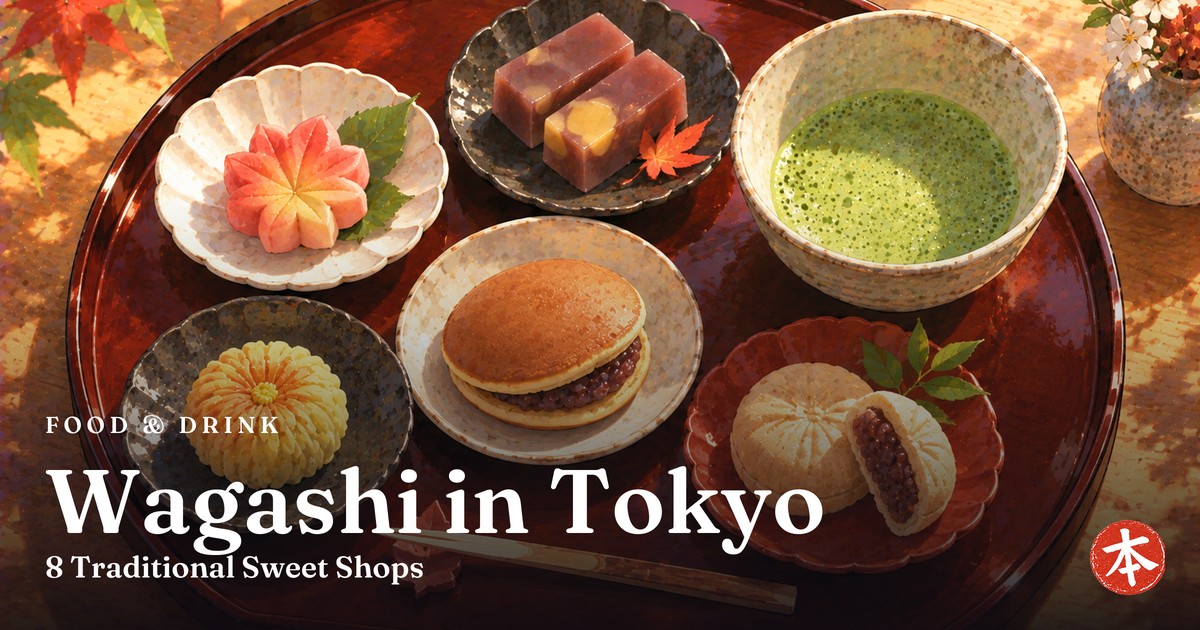
Wagashi, traditional Japanese confections, are sold in Tokyo by shops that have been at it for generations. At the eight shops here, a single sweet costs from 150 yen for a monaka at Usagiya in Ueno to 638 yen for Toraya’s monthly fresh sweet in Akasaka, and a box of yokan to take home from 972 yen.
This page reports only what each shop says on its own website: prices, tax, hours, queues, payment and, shop by shop, how long each sweet keeps, which decides what you can carry home. It is not a ranking. Dango and mochi specialists are covered in our separate mochi in Tokyo guide, so none of those shops appear here.
Wagashi in Tokyo at a glance
| Shop | Area | Known for | From (as published) | Keeps (per the shop) | Closed |
|---|---|---|---|---|---|
| Toraya Akasaka | Akasaka | Yokan | Zangetsu 346 yen; 5 small yokan 1,782 yen, with tax | Small yokan: 1 year from manufacture | 6th of each month (not December) |
| Usagiya | Ueno | Dorayaki | Monaka 150 yen; dorayaki 270 yen, with tax | Dorayaki: 2 days | Wednesdays |
| Funawa | Asakusa | Imo yokan | 5 pieces 972 yen with tax (online) | Online: 4 days incl. arrival, chilled | Open every day (main shop) |
| Shiose Sohonke | Akashicho, near Tsukiji | Manju | Jo-namagashi 648 yen; 9 manju 1,761 yen, with tax | Manju: 14 days | No closing day (main shop) |
| Eitaro | Nihonbashi | Kintsuba | 270 yen on a sale-day online page | Not found | Open all year except New Year |
| Ginza Kikunoya | Ginza | Fukiyose | Age-manju 216 yen with tax (Ginza only) | Fukiyose tin: 31 days or more | Wednesdays (Ginza) |
| Seigetsudo Honten | Ginza | Otoshibumi | 220 yen before tax | Not stated | See official site |
| Mamegen | Azabu-Juban | Bean snacks | Otoboke mame 432 yen with tax | Not stated | Some Tuesdays |
Prices as of September 29, 2026. Sizes and kinds of sweet differ, so the table shows the cheapest item each shop lists, not a like-for-like comparison. Check the official site before you go.
What to know before buying wagashi in Tokyo
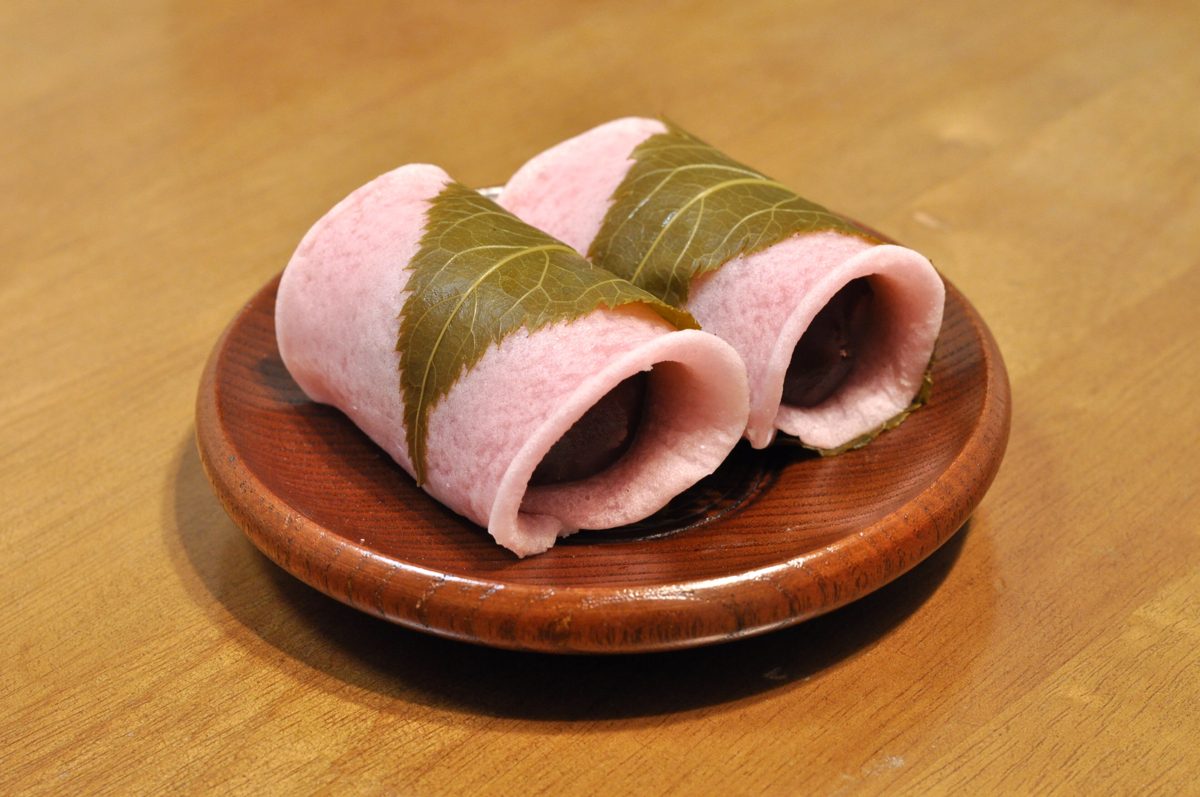
What is wagashi?
Toraya’s English site describes wagashi as traditional Japanese confections, inspired by Japan’s seasons and sensibilities. Its Japanese history page says that around the Genroku era (1688 to 1704), sweets made with costly white sugar and designed and named after the seasons spread from Kyoto; these were called jogashi and are considered the origin of today’s jo-namagashi, the fine fresh sweets. Meanwhile, it says, daifuku and kintsuba were made in Edo, the old name for Tokyo.
Where can I drink tea with wagashi?
Two shops here have their own cafes: Toraya’s cafe in Akasaka and Funawa’s tearooms in Asakusa. Seigetsudo also lists cafes, in Shinjuku, Yokohama and Ueno. For a cup of matcha on its own, see our matcha in Tokyo guide.
Wagashi shops in Akasaka, Ueno and Asakusa
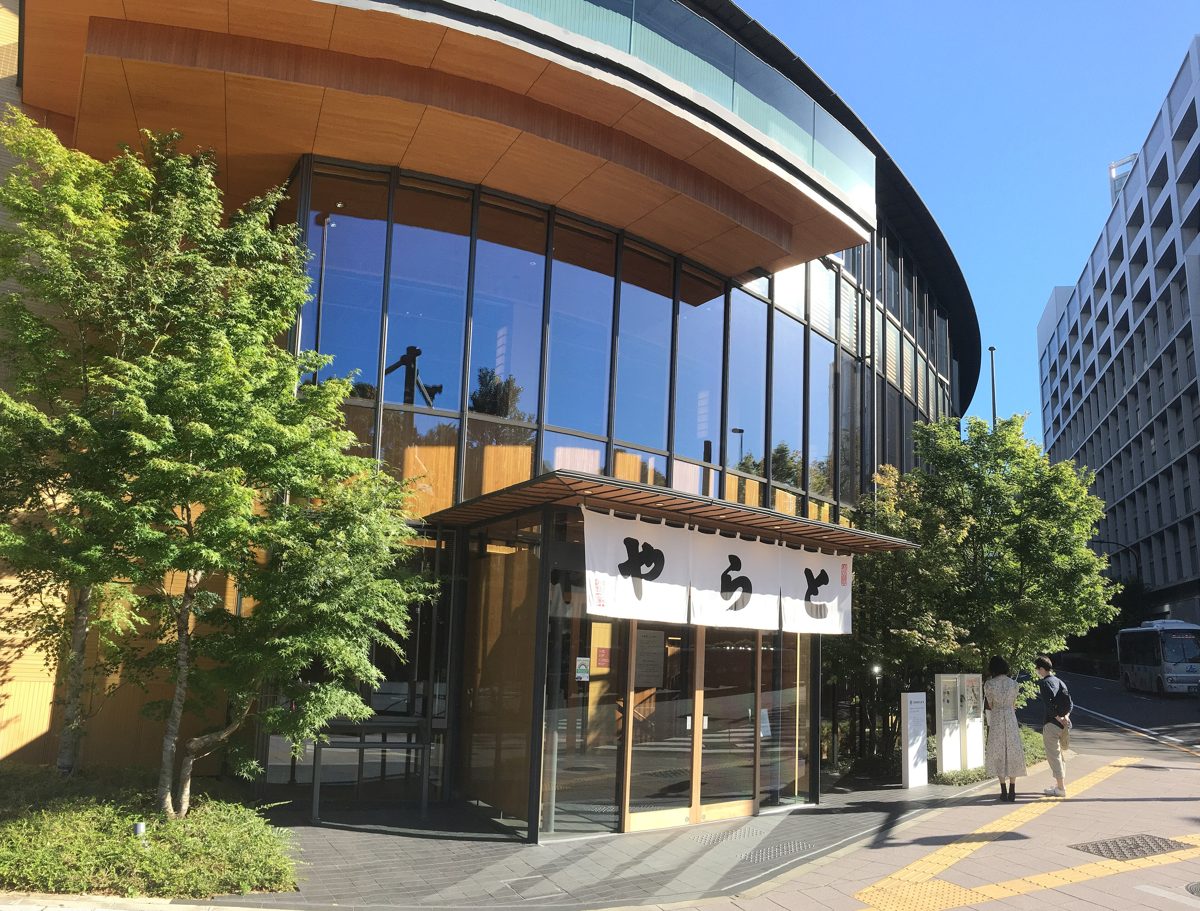
Toraya Akasaka: yokan, a cafe and sweets made that day
Toraya says it opened in Tokyo in 1869, when the capital moved from Kyoto, while keeping its Kyoto shop, and has been in Akasaka since 1879. The Akasaka shop moved to its present site in 1964 and was rebuilt in 2018 as a low building with a shop, a cafe, a gallery and a workshop. It is at Akasaka 4-9-22, Minato-ku, seven minutes from exit A of Akasaka-mitsuke Station on the Marunouchi and Ginza lines. The shop opens 9:00 to 18:00 on weekdays and 9:30 to 18:00 at weekends and on holidays. It closes on the 6th of each month, except in December, and says every floor is barrier-free.
All prices are with tax. Online, five small yokan are 1,782 yen, a medium Yoru no Ume adzuki yokan is 1,512 yen, and a bamboo-wrapped Yoru no Ume is 3,024 yen. Akasaka has its own items: Zangetsu, made in the shop that day and on sale from 13:30, at 346 yen; a Tsuki no Akatsuki yokan sold only here at 4,968 yen; a Senri no Kaze yokan, sold only here and at its Kyoto Ichijo shop, at 2,160 yen; and a box of three small yokan sold only from the vending machine on the first floor, at 1,000 yen. Each month the shop also sells a fresh sweet found only there; for October 2026 it lists Kasen-yaki in the first half and Yamaji no Aki in the second, each 638 yen.
The cafe opens 11:00 to 17:30, last orders 17:00, with lunch from 11:00 to 14:00. Anmitsu with black syrup is 1,760 yen, oshiruko sweet bean soup 1,650 yen, and a seasonal Akasaka udon 1,980 yen. It does not take table bookings. You can join the queue online through AirWait from 11:00 to 16:00, or at the shop from opening time, and your place is canceled if you are not there 15 minutes after being called.
Toraya lists 33 shops in Tokyo, but fresh sweets are sold only at its directly run shops: Akasaka, TORAYA GINZA, TORAYA TOKYO, Tokyo Midtown, the Imperial Hotel and Nihonbashi. Its English site prices are for overseas orders and did not match the Japanese site, so we used the Japanese prices. It does not list payment methods on the pages we read.
Usagiya, Ueno: dorayaki at 270 yen, cash only
Usagiya calls its dorayaki and Kisaku monaka its signature sweets. It raised the dorayaki from 240 yen to 270 yen with tax on April 10, 2026, so older listings elsewhere may still show the old price; it says its other prices did not change. The Kisaku monaka is 150 yen, the kuri manju with chestnut 220 yen, and the usagi manju 240 yen, which needs a reservation.
It says it bakes dorayaki until 16:00. Before then you can buy without a reservation; if you will arrive after 16:00, it asks you to reserve in advance if you can. Customers enter the shop in turn, and if there is a line, it asks you to wait in it. It is cash only, with no cashless payment. It does not ship its fresh sweets, will not sell dorayaki to customers who plan to send them, and ships only its Kisaku yokan.
Usagiya is at Ueno 1-10-10, Taito-ku, four minutes from exit A1 of Ueno-hirokoji Station on the Ginza Line, which has an elevator, or exit A4 of Ueno-okachimachi Station on the Toei Oedo Line, and eight minutes from the south exit of JR Okachimachi Station. It opens 9:00 to 18:00 and closes on Wednesdays; for October 2026 it lists the 7th, 14th, 21st and 28th. Its site does not give a founding year.
Funawa, Asakusa: imo yokan made from sweet potato
Funawa says it has been making sweets since 1902. Its imo yokan is made from sweet potato, sugar and salt, and it says it uses no coloring, preservatives or flavoring. Online, with tax, five pieces are 972 yen, eight 1,555 yen and ten 1,944 yen, and its anko-dama bean paste balls are 874 yen for nine. Its shop list marks shops that sell loose pieces, but the site does not publish a single-piece price.
The Asakusa main shop is at Asakusa 1-22-10, Taito-ku, open 10:00 to 19:00 every day. Its second- and third-floor tearoom, which Funawa calls the birthplace of mitsumame and serves what it calls the original mitsumame, opens 10:30 to 19:00, last order 18:30. The Kaminarimon shop at Asakusa 1-3-5 opens 10:00 to 18:00 on weekdays and to 19:00 at weekends and on holidays, and there are three shops on Nakamise. Beyond Asakusa, Funawa lists shops on the first floor of Daimaru Tokyo, open 10:00 to 20:00, and in the basement of Seibu Ikebukuro. Its Funawa Cafe in Asakusa does not hold or book seats. For other snacks around the temple streets, see our Japanese street food guide.
Old wagashi makers near Tsukiji and in Nihonbashi
Shiose Sohonke, Akashicho: manju since 1349, by its own account
Shiose says its founder, Lin Jingyin, came to Japan from China in 1349 and created what it calls Japan’s first sweet adzuki bean paste and the first manju filled with it. Its English page calls Shiose Japan’s longest-standing confectioner. Both are the shop’s own account. Its manju is a joyo manju, with a skin made from yamato-imo yam, rice flour and sugar.
Prices include tax: nine Shiose manju for 1,761 yen, twelve for 2,322 yen, and the month’s jo-namagashi at 648 yen each, marked as sold in the shop. The main shop is at Akashicho 7-14, Chuo-ku, eight minutes from exit 3 of Tsukiji Station on the Hibiya Line and ten minutes from exit 6 of Shintomicho Station on the Yurakucho Line. It opens 9:00 to 18:30, and 10:00 to 18:00 on Sundays and holidays, with no closing day. Shiose also lists shops in Matsuya Ginza, Daimaru Tokyo and Nihombashi Takashimaya, and at Haneda Airport, where only some items are sold.
Eitaro, Nihonbashi: kintsuba on the same spot since 1857
Eitaro says its Nihonbashi main shop was opened in 1857 and has stood in the same place ever since. Its kintsuba is round, shaped after a sword guard: bean paste wrapped in wheat dough stretched thin as leaf, shaped and baked in sesame oil, a method it says has not changed since the Edo period. It describes its daifuku as made with mochi that bites off cleanly, easy to eat for impatient Edo townspeople.
The only kintsuba price we found is on a sale-day page of its online store: a single kintsuba listed at 270 yen with tax, three for 1,026 yen, and a Nihonbashi dorayaki at 248 yen. The page does not show whether these are the regular prices, and the site does not give shop prices. Three sweets, Amananatto, Tamadare and Ro, are sold only at the main shop and not by mail order; the shop says it can hold them for you if you call the main shop on 03-3271-7785.
The main shop is at Nihonbashi 1-2-8, Chuo-ku, open 10:00 to 18:00 every day, closed only at New Year. Its site does not name the nearest station. Eitaro also lists shops at Nihombashi Takashimaya, Mitsukoshi Main Store, Keio Shinjuku and Haneda Airport Terminals 1 and 2. It does not give the kintsuba’s shelf life or payment methods on the pages we could read.
Wagashi in Ginza
Ginza Kikunoya: Fukiyose, a box of more than 30 dry sweets
Kikunoya’s English page describes Fukiyose, a name it says means gathering fortune, as a jewel box of more than 30 kinds of Japanese-style dry sweets, including cookies made without butter, konpeito hard candy, wasanbon sugar and coated peanuts. A Tokyo Panda tin sold only at Tokyo Station is 1,242 yen with tax, and keeps 31 days or more. Online, a Tsuki Usagi box is 2,376 yen with tax.
Two things are sold only at the Ginza main shop: creative wagashi at 432 yen each, which keep two days, and age-manju, fried manju, at 216 yen, to be eaten the same day, both with tax. The creative wagashi listed on the page still carry summer names, so the current ones may differ, and the shop page carries a note that age-manju sales are paused for the time being; check before going for them. Kikunoya changed its prices for orders from August 15, 2026, raising kuzu-mochi with black syrup from 324 to 378 yen with tax, for example.
The Ginza main shop is at Ginza 5-9-17, on the first floor of the Ginza Azuma Building, on Azuma-dori behind the Ginza Core building; look for the noren curtain with the character for chrysanthemum. It opens 9:30 to 18:00, and 9:30 to 17:30 at weekends and on holidays, and closes on Wednesdays. Kikunoya’s English page describes a different, older location in the basement of the Ginza Core building; we followed the current Japanese shop information. The Tokyo Gift Palette shop at the Yaesu North side of Tokyo Station opens 9:30 to 20:30 on weekdays and 9:00 to 20:30 at weekends and on holidays. The site also lists wagashi classes at the Ginza main shop on September 30, October 14 and October 28; we did not confirm the details or fees.
Seigetsudo Honten, Ginza: otoshibumi, priced before tax
Seigetsudo says it was founded in 1907 in Ginza 7-chome, where its main shop still stands. It describes a family motto, ichidai ikka, literally one generation, one sweet. It revised its prices on September 1, 2026, and publishes them before tax: otoshibumi 220 yen each, up from 200 yen, 960 yen for a box of four, and 270 yen each for its aisatsu monaka and Azuma Ginza. Its site does not give the prices with tax. For the season, a Shine Muscat grape daifuku is 454 yen with tax, sold from September 16 to October 20, 2026 at the Ginza main shop and Matsuya Ginza.
Its Ginza store page gives the address as Ginza 7-16-15, on the first floor of the Seigetsudo Honten Building. That page was posted in 2012, so we are not repeating its opening hours; check the official site before you go. The site does not name the nearest station or list payment methods. Seigetsudo also has a shop in Matsuya Ginza and cafes at Keio Shinjuku, Takashimaya Yokohama and the Panda Sabo at Matsuzakaya Ueno.
A different kind of Tokyo sweet: bean snacks in Azabu-Juban
Mamegen: bean snacks since 1865
Mamegen is not a wagashi maker in the sense of the shops above: it makes mame-gashi, bean snacks. It says it was founded in 1865 and has kept to methods that protect the flavor of the beans. Its most popular, it says, is Otoboke mame at 432 yen with tax; a matcha bean snack is 486 yen, and a mozzarella almond sold only at the main shop and online is 648 yen.
The main shop is at Azabu-Juban 1-8-12, Minato-ku, by exit 7 of Azabu-Juban Station on the Toei Oedo Line and exit 4 on the Namboku Line. It lists hours of 10:00 to 18:30, noting that it is currently on shortened hours, and says it closes on some Tuesdays. At the main shop it makes some things fresh every day, such as just-fried okaki rice crackers and freshly sugar-coated nankinto, and staff will make up a mixed box if you ask. It also lists counters in the basements of Isetan Shinjuku, open 10:00 to 20:00, and Tobu Ikebukuro.
Taking wagashi home from Tokyo: how long does it keep?
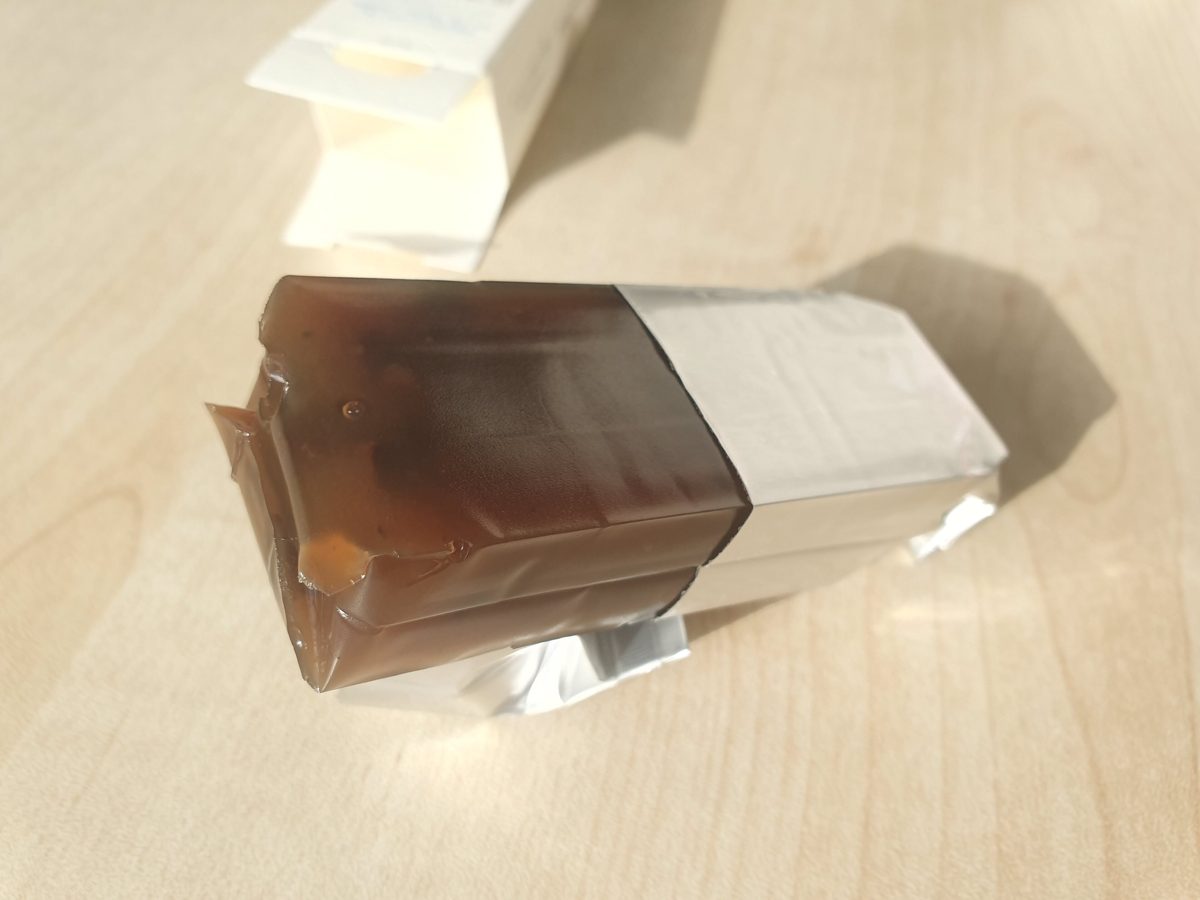
Which wagashi should I eat the same day?
Fresh sweets. Usagiya gives its dorayaki a use-by period of two days, and says it is definitely better on the day it is sold: one, on the spot, is best. Kikunoya gives its Ginza-only age-manju the same day and its creative wagashi two days. Shiose gives its jo-namagashi a use-by date of five days from manufacture. Funawa gives its imo yokan, delivered online, four days including the day it arrives, kept chilled, and says that for pieces bought in the shop the use-by date depends on when they were sold and how they are stored, so ask when you buy.
Which wagashi keeps a week or two?
Shiose’s manju has a best-before period of 14 days, counted from the date it was made. Usagiya’s Kisaku monaka keeps five days from the day of sale.
Which wagashi lasts long enough for a flight home?
Yokan and dry sweets. Toraya gives its small yokan one year from manufacture, around eight months from arrival for online orders. Usagiya’s Kisaku yokan keeps 90 days from the day of sale. Kikunoya gives its Edo no Zei mizu-yokan 50 days and its Tokyo Station Fukiyose tin 31 days or more. Eitaro, Seigetsudo and Mamegen do not give shelf life on the pages we read.
Why does yokan keep so long?
Toraya explains that its yokan contains a lot of sugar, which holds back the growth of microbes, and is made to a standard of thorough heating that makes it hard for them to grow. It adds a warning: once opened, and exposed to the air, yokan can see its sugar recrystallize or mold appear within a week, so seal the opening, keep it at room temperature and eat it soon.
Can I ship wagashi or take it abroad?
Several of these shops sell online, so check each store’s delivery area; note that Usagiya ships only its Kisaku yokan, not its dorayaki. Whether a sweet may be carried into another country depends on that country’s own rules, which this page does not cover; check them before you pack.
What does wagashi cost in Tokyo?
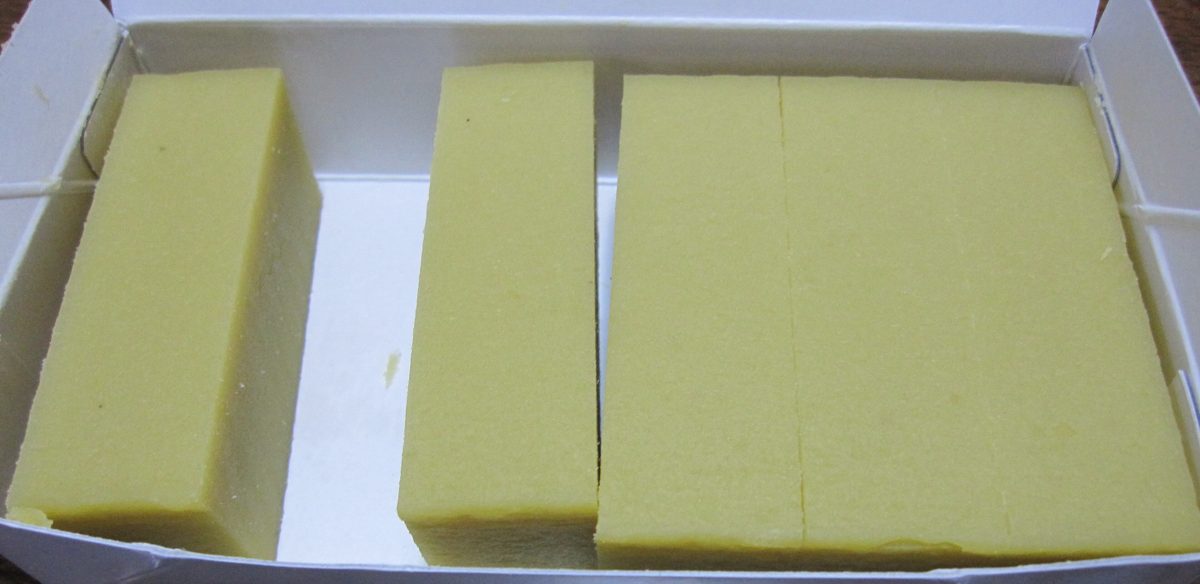
Wagashi prices in Tokyo, as published
| Shop | Single sweet | Box | Tax, per the site |
|---|---|---|---|
| Usagiya | Monaka 150 yen; dorayaki 270 yen | Not covered here | With tax |
| Ginza Kikunoya | Age-manju 216 yen; creative wagashi 432 yen | Fukiyose tin 1,242 yen | With tax |
| Seigetsudo Honten | Otoshibumi 220 yen | 4 otoshibumi 960 yen | Before tax; from September 1, 2026 |
| Eitaro | Kintsuba 270 yen (sale-day page) | 3 kintsuba 1,026 yen | With tax, online |
| Toraya Akasaka | Zangetsu 346 yen; monthly namagashi 638 yen | 5 small yokan 1,782 yen | With tax |
| Shiose Sohonke | Jo-namagashi 648 yen | 9 manju 1,761 yen | With tax |
| Funawa | Not published | 5 imo yokan 972 yen | With tax, online |
| Mamegen | Not applicable | Otoboke mame 432 yen | With tax |
Is tax included in wagashi prices?
Toraya, Usagiya, Funawa, Shiose, Kikunoya and Mamegen mark their prices as including tax, and Eitaro’s online store does too. Seigetsudo is the exception: its September 2026 price notice gives prices before tax and does not publish the with-tax figures.
Which wagashi prices changed recently?
Usagiya’s dorayaki went from 240 to 270 yen on April 10, 2026. Kikunoya changed prices for orders from August 15, 2026. Seigetsudo revised its prices on September 1, 2026. Funawa has a price revision notice on its site, but we could not read its contents, so check its online shop for current prices.
Queues, bookings and paying at Tokyo wagashi shops
Do I need to reserve?
At Usagiya, only if you come after 16:00 for dorayaki, or for the usagi manju at any time. Eitaro will hold its main-shop-only sweets if you call. Toraya’s cafe takes no bookings but runs an online queue, and Funawa Cafe takes no seat bookings. The other shops do not describe reservations on the pages we read, and none of the eight publishes waiting times or the time its sweets sell out.
Can I pay by card at wagashi shops?
Usagiya is cash only. The other seven shops do not list payment methods on the pages we read, so carry some cash in case.
Which wagashi shop in Tokyo suits you?
For yokan, a cafe and a sweet made that day, Toraya in Akasaka. For dorayaki eaten on the spot, with cash, Usagiya in Ueno, before 16:00. For sweet potato yokan near Senso-ji, Funawa. For a manju with a story that goes back to 1349, by the shop’s own account, Shiose Sohonke. For kintsuba baked in sesame oil and sweets sold only at the main shop, Eitaro in Nihonbashi. For a box of dry sweets that keeps a month, Kikunoya in Ginza or at Tokyo Station. For otoshibumi in Ginza 7-chome, Seigetsudo. For bean snacks fried that day, Mamegen in Azabu-Juban. If you go on to Kyoto, our matcha in Kyoto guide covers the tea to drink with them, and our Kappabashi guide covers the kitchen tools street, including a shop for wagashi molds.
Frequently asked questions
How much does wagashi cost in Tokyo?
Which wagashi keeps long enough to take home?
How long does a dorayaki from Usagiya keep?
Is Usagiya cash only?
Can I book a table at Toraya’s cafe in Akasaka?
What is the difference between wagashi and mochi?
Where can I buy wagashi at Tokyo Station?
Is there an English page for these wagashi shops?
Bottom line (2026): Wagashi at Tokyo’s old shops costs from 150 yen for a monaka at Usagiya, where a dorayaki is 270 yen and payment is cash only. For a sweet to fly home with, the shops’ own figures favor yokan: Toraya gives its small yokan one year from manufacture, while Usagiya’s dorayaki keeps two days. Seigetsudo prices are before tax.
Sources
Every price and rule on this page is from the shops’ own websites and official online shops: Toraya, Toraya Akasaka, Toraya shops, Toraya yokan (online shop), Toraya Akasaka October namagashi, Toraya small yokan box, Toraya on best-before dates, Toraya on wagashi, Toraya English site, Usagiya, Usagiya sweets catalog, Usagiya access, Funawa, Funawa history, Funawa shops, Funawa imo yokan, Funawa anko-dama, Funawa imo yokan shelf life, Shiose Sohonke, Shiose shops, Shiose manju, Shiose jo-namagashi, Shiose manju, 9 pieces, Shiose English page, Eitaro, Eitaro shops, Eitaro kintsuba, Eitaro main-shop exclusives, Eitaro namagashi, Eitaro online store sale-day page, Ginza Kikunoya, Kikunoya shops, Kikunoya shop-limited sweets, Kikunoya English page, Kikunoya online shop, Seigetsudo Honten, Seigetsudo Ginza store page (2012), Seigetsudo price revision, Seigetsudo Shine Muscat daifuku, Mamegen, Mamegen shops, Mamegen about, Mamegen bean snacks, all read on September 29, 2026. Prices, hours and seasonal sweets change, so confirm on the official site before you go.
Some links on this page may be affiliate links, which means we may earn a commission if you book or buy through them — at no extra cost to you. See our affiliate disclosure.
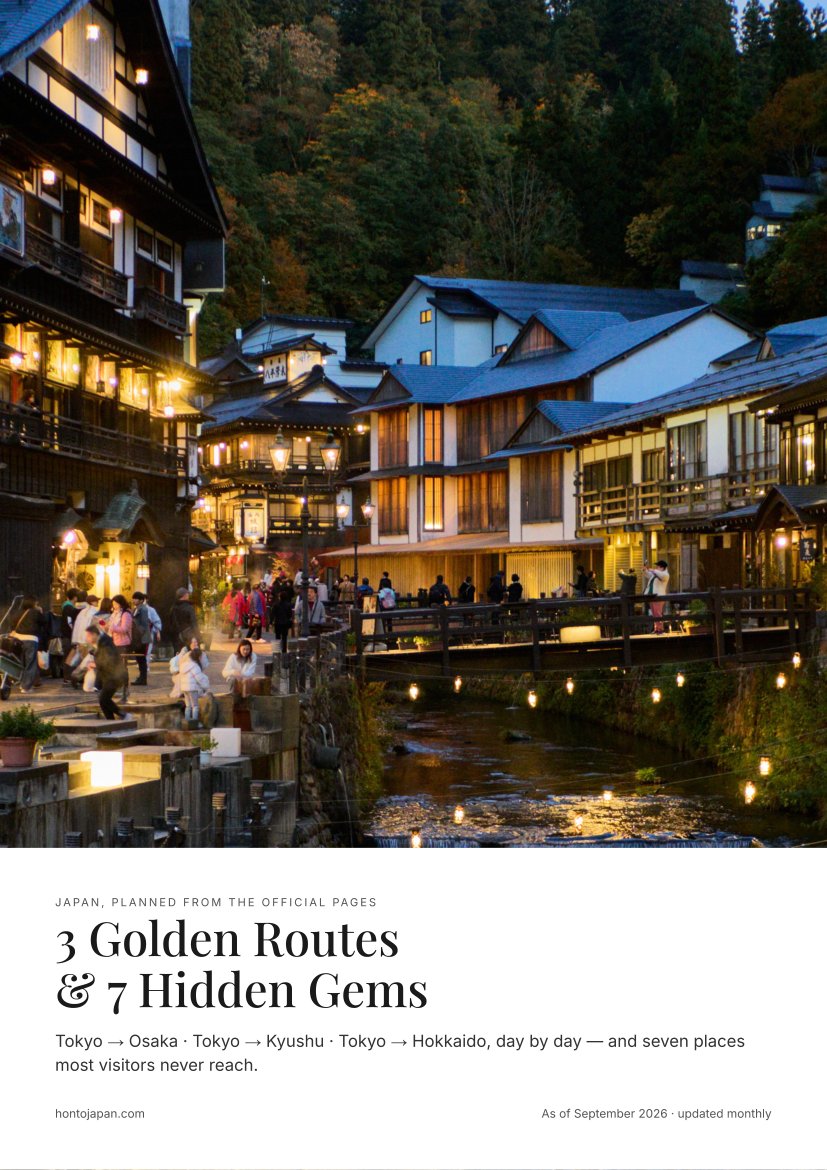
Tokyo to Osaka, Tokyo to Kyushu, Tokyo to Hokkaido — day by day — plus seven places most visitors never reach.
- 12 pages, 80 photographs, every stop linked to its guide
- Every price and opening hour read from the official page
- Re-issued monthly, so it does not go stale in your inbox
Free. One email a month, plus the rare change that matters. Unsubscribe with one click in any email. By subscribing you agree to our privacy policy.