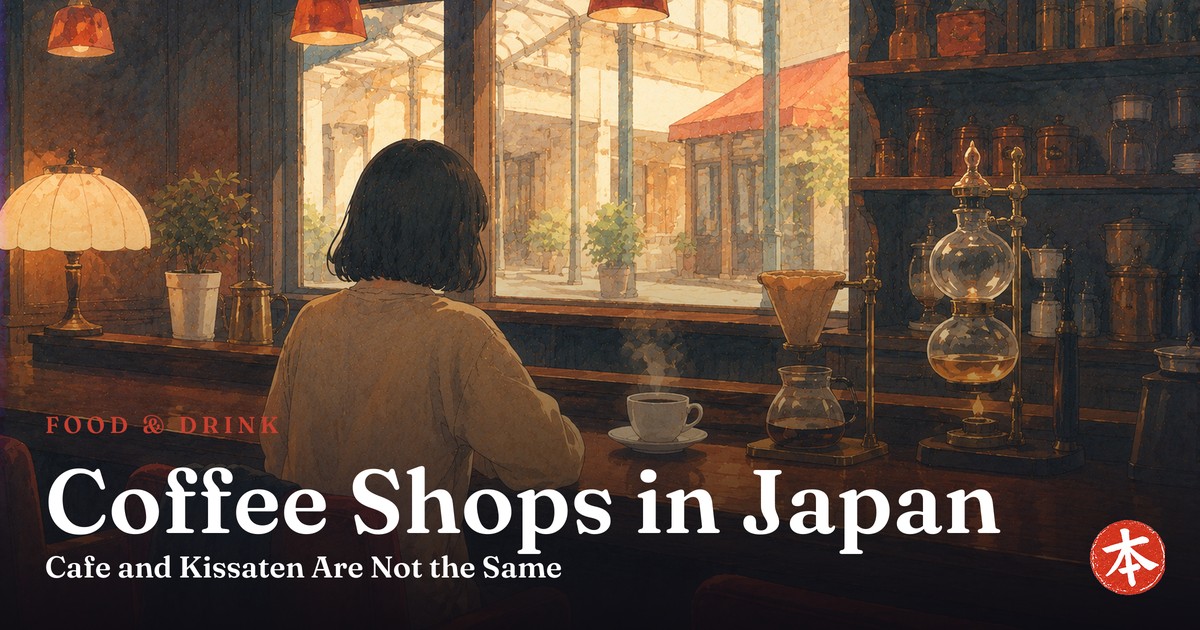
Two coffee shops, a few train stops apart, both serving a cup of black coffee. One charges 300 yen. The other charges 780 yen. Neither is overcharging you, and the reason is not the neighborhood or the quality of the beans. It is that Japanese has two separate words for what English flattens into one: kafe and kissaten. They are different businesses with different economics, and once you can tell them apart at the door, the price stops being a surprise.
This guide covers what each chain actually charges, the two incompatible systems both called "morning service," and the smoking rules — which reversed in 2020 and which most English coverage still gets backwards.
The short version. A chain coffee runs about 300 to 510 yen; an old kissaten runs 780 yen and up, and the extra is the seat, not the bean. Komeda has no national price at all — its blend is published as a 460 to 700 yen range. Starbucks Japan charges by location tier. Morning service before 11 a.m. at Komeda is free food with a drink; at Doutor it is 50 yen off a set until 10:30. And you almost certainly cannot smoke, whatever you read in an older guide.
Kafe and kissaten are two different words, and two different prices
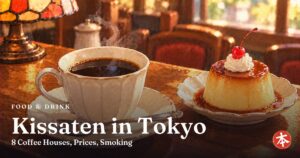
Start here, because it explains most of what looks like random pricing. A kafe in current Japanese usage means the counter-service model: you order, you pay, you carry your cup to a table, you leave when you are done. That is Doutor, Tully's, Saint Marc, Starbucks and the specialty roasters. A kissaten is the older form — a sit-down coffee house, usually independent, often decades old, where someone takes your order at the table and nobody expects you to hurry.
The price difference is not subtle. Doutor's blend is 300 yen for a small after its July 2026 revision. Inoda Coffee's Arabia no Shinju in Kyoto is 780 yen — the same category of drink, 2.6 times the price. You are buying the room and the service as much as the coffee.
| Shop | Drink | Price (tax incl.) | Type |
|---|---|---|---|
| Doutor Coffee Shop | Blend Coffee | S 300 / M 350 / L 400 yen | Chain kafe |
| Saint Marc Cafe | Saint Marc Blend | S 350 / M 410 yen | Chain kafe |
| Tully's Coffee | Coffee of the Day | Short 390 / Tall 450 / Grande 510 yen | Chain kafe |
| Komeda's Coffee | Komeda Blend | 460–700 yen (a range) | Chain, kissaten style |
| Inoda Coffee (Kyoto) | Arabia no Shinju | 780 yen | Kissaten, since 1940 |
| Starbucks Japan | Drip Coffee | Not published on the official site | Chain, tiered pricing |
| Hoshino Coffee | Blend | Not published on the official site | Chain, kissaten style |
Why two chains will not tell you their prices
This is worth knowing before you assume a guide is being lazy. Hoshino Coffee's official menu pages contain no prices at all — every item is a photograph with a name, and the yen symbol does not appear anywhere on them. Its morning service times are not published either. Starbucks Japan does not put drink prices in its public pages in a form that can be read without the store selector. Any English article quoting an exact figure for those two is quoting something other than the company — which is why the cells above are empty. Not stated officially is a real answer.
One more thing about the English pages
If you plan to read a chain's English site before you go, note what Doutor puts directly under its language switcher: "This site uses a machine automatic translation service." The company is telling you the English is unreviewed — fine for finding a store, less fine for the small print on what a set includes.
Komeda has no national price, and says so itself
Most chains add a line about some stores differing. Komeda goes further: the price it publishes is a range. Its official menu system returns Komeda Blend as 460 to 700 yen, not as a number with an asterisk. The top of its menu page states plainly that menus and prices differ by store, and its product notices repeat that selling prices vary by location.
That is a spread of about 52 percent on one cup. It runs through the whole drinks list, from Cafe au Lait at 500 to 740 yen upward. Dine-in and takeaway are the same price.
Which chains keep dine-in and takeaway the same?
Most of them, deliberately. Doutor, Tully's and Komeda all state that dine-in and takeaway are the same price, which means they are absorbing the difference between the two consumption tax rates rather than passing it to you. Doutor used to do it the other way: before December 2022 its small blend was 224 yen to sit and 220 to take away. It scrapped the four-yen gap and went to a single 250 yen, then 280, then 300 yen from July 23, 2026. That revision covered around 1,200 stores across Doutor and Excelsior, and the company attributed it to raw material, logistics and labor costs.
Starbucks Japan charges by where the store is
This one surprises people who assume Japanese chains are uniform. Since February 2025, Starbucks Japan has run location-based pricing on its core drinks, in three tiers rather than one national price.
| Tier | Where | Share of stores | Difference |
|---|---|---|---|
| Location price A | Service areas, airports | 4% | +13 to 32 yen (pre-tax) |
| Location price B | Tokyo 23 wards, central Osaka | 27% | +4 to 28 yen (pre-tax) |
| Standard | Everywhere else | about 69% | — |
Then on February 18, 2026 the company widened tier A: on top of service areas and airports, parts of Tokyo's 23 wards moved into the highest band. In the same change, stores outside tiers A and B — about 70 percent of the network — saw some core drinks go up by 5 to 30 yen, while A and B stores held their prices. One More Coffee, the discounted second brewed cup, moved by 20 yen.
For scale: Starbucks Japan had 2,116 stores as of March 31, 2026, against 1,079 Komeda's Coffee outlets at the end of February 2026 and 1,075 Doutor Coffee Shops at the end of July 2026. Tully's says approximately 850 and does not publish an exact count anywhere.
Morning service is two systems that work nothing alike
Four classic Nagoya morning services in one video, which is the system most English guides describe as if it were national. Japanese, but the plates say it: coffee ordered, food arriving free alongside it. Hold this against the Kochi version and you can see immediately why one word is covering two different customs.
Both get translated as "morning service" and they are not the same offer. One gives you food for free; the other gives you a discount on food you buy. Walking into the wrong one hungry is a wasted morning.
| Type | Chain | What happens | Until |
|---|---|---|---|
| A. Free with a drink | Komeda's Coffee | Order any drink and bread plus a topping comes with it at no extra charge | 11:00 a.m. |
| B. Set discount | Doutor | Buy a morning set; 50 yen off the total, any drink qualifies | 10:30 a.m. |
| B. Set discount | Saint Marc Cafe | Croissant and coffee set from 390 yen | 10:00 a.m. |
| B. Set discount | Tully's | Egg sandwich set with a drink from 700 yen | Not stated officially |
| C. Paid breakfast | Inoda Coffee | A standalone breakfast at full price (1,890 yen) | 11:00 a.m. |
The Saint Marc number is the one to remember if you are counting yen: 390 yen buys a croissant and a coffee before 10 a.m., which is 90 yen more than a Doutor blend on its own. For a fuller sit-down version of the same meal, our guide to Japanese breakfast in Tokyo covers what the hotels and specialists serve.
What Komeda actually gives you
Order a drink before 11 a.m. and you choose one of six combinations: thick-cut toast or a roll, paired with a boiled egg, house-made egg paste, or Komeda's sweet red bean paste. Then you pick a spread — butter or margarine, strawberry jam, or warm soy milk. None of it costs extra. The red bean option is worth understanding: toast with sweet red bean paste is a Nagoya specialty, and it sits in the free morning selection as standard, which is not something most visitors expect to find by accident.
Two things to note. The morning-only sides — coleslaw at 200 to 260 yen, Hokkaido yogurt at 170 to 230 — cannot be ordered on their own, only alongside the set. And Komeda states that availability differs by store, with one named regional exception: stores in Okinawa serve a different yogurt.
Is morning service really a Nagoya thing?
The association is real, but be careful with what gets claimed. In household spending data for 2025, Nagoya households spent 20,276 yen a year on coffee-shop visits against a national average of 11,823 — about 1.7 times, and the highest of any prefectural capital. Gifu is often named as the champion; in the 2025 single-year figures it is third, at 15,355 yen, behind Nagoya and Tokyo. Where Gifu genuinely leads is density: it has one coffee shop per 834 residents, second only to Kochi's 831, against a national average of 2,146.
What you should not believe is that morning service runs longer or comes with more in Nagoya. Komeda's published time is 11 a.m. nationwide, and the only regional difference the company names anywhere is the Okinawa yogurt. Nor does Komeda claim to have invented the custom — the origin story you have read is not stated officially by the chain or by the industry body.
Smoking: the rules reversed in 2020, and English guides missed it
If you have read that Japanese coffee shops are smoky, that guide is describing a country that stopped existing in April 2020. Under the revised Health Promotion Act, restaurants and cafes are non-smoking indoors as a rule. The Ministry of Health puts it plainly: from full enforcement in April 2020, violating this can carry a fine.
The three conditions a shop must meet to allow smoking
The exemption is narrow and all three conditions must be satisfied together:
| Condition | Requirement |
|---|---|
| 1. Existing business | The shop was already trading on April 1, 2020 |
| 2. Capital | 50 million yen or less, and not majority-owned by a large company |
| 3. Floor area | Customer seating area of 100 square meters or less |
Tokyo adds a fourth condition
The Tokyo Metropolitan Government passed its own ordinance that is stricter than the national law. In Tokyo, an exempt shop must also have no employees — the ordinance excludes any establishment with workers as defined by the Labor Standards Act, counting family members working in a family business separately. In practice: a shop run entirely by its owner and family can have smoking seats; one with a single part-timer cannot.
When the ordinance was announced in 2018, the metropolitan government estimated that about 84 percent of Tokyo restaurants would fall under the regulation, on the basis that 83.7 percent had employees. Nationally, the health ministry estimated up to about 55 percent of restaurants might qualify. Both are pre-enforcement estimates from 2018, not measurements of what followed.
Read the sign at the door before you sit down
Japan requires a sign at the main entrance stating the shop's smoking status; failing to post one, or posting a false one, carries a penalty of up to 500,000 yen. The health ministry publishes sixteen standard signs, so the information is there before you sit down — except that there is no official English version of the signs. Chinese and Korean translations exist; English does not. Tokyo's own English page tells visitors simply to check the sign at the entrance.
In some smoking rooms you cannot take your coffee
There are four room types and they differ on exactly the point that matters in a cafe:
| Room type | What you may smoke | Food and drink |
|---|---|---|
| Smoking room (standard) | All tobacco | Not allowed |
| Heated tobacco only room | Heated products only | Allowed |
| Smoking-permitted room | All tobacco | Allowed (exempt shops only) |
| Smoking-purpose room | All tobacco | Allowed, excluding staple foods |
So in a cafe with an ordinary smoking room, you leave your coffee at the table and come back. Only the heated-tobacco room and the exempt shops' smoking-permitted room let you take a drink in. The "staple food" exclusion in the last row has an official definition too — rice, bread excluding sweet buns, and noodles.
Under-20s cannot enter a smoking area at all
The line is 20, not 18, and it is absolute. The ministry states that people under 20 may not enter a smoking area even if they are not smoking, and specifically that they cannot be sent in as staff either. It applies to all four room types. If you are traveling as a family and a shop is entirely a smoking-permitted room, that shop is closed to your group.
One practical point: the law covers indoors only, with street smoking governed separately by each municipality. Inoda's Kyoto main store is the clean example — the building is non-smoking with a booth, and the garden seats allow smoking.
Kissaten are disappearing, which is exactly why to visit one
The decline is steep. Government establishment surveys compiled by the All Japan Coffee Association put the peak at 154,630 coffee shops in 1981. The 2024 count is 54,302 — about 35 percent of the peak, roughly one in three still standing.
| Year | Coffee shops |
|---|---|
| 1966 | 27,026 |
| 1975 | 92,137 |
| 1981 (peak) | 154,630 |
| 2001 | 88,933 |
| 2021 | 58,664 |
| 2024 | 54,302 |
A caution on that table, because it matters: the 2024 figure comes from a reference table in the government's survey, which changed its coverage that year, and the bureau says other 2024 tabulations are not comparable with earlier ones. The direction is not in doubt; treat each number as belonging to its own series.
Where the coffee habit actually lives
Here is the statistic that reframes the whole subject. In a 2024 industry survey of 4,000 people, the average person drank about 10.05 cups of coffee a week. Of those, 7.28 were at home and 0.22 — roughly 2 percent — were at a coffee shop. Japan is a coffee-drinking country whose coffee drinking happens in kitchens.
That reverses the usual framing. The kissaten is not where Japan drinks coffee; it is a place that survives on people choosing to go. Which is the argument for spending 780 yen at an old counter instead of 300 at a chain: you are not buying a better coffee, you are visiting something that is running out.
Households spend about 9,635 yen a year on coffee beans and instant against 3,153 yen on green tea leaves — three times as much; the tea half of the story is in our guide to matcha in Kyoto. Per person, Japan is a moderate drinker: 3.2 kg a year against Finland's 9.6.
Where to go: the old and the new share the same streets
English coverage likes an old-versus-new framing. The shops do not. Glitch Coffee opened in Jimbocho in 2015 and describes the neighborhood in its own words as a district where Japan's kissaten culture is alive — a light-roast specialist that set up inside the old coffee quarter rather than away from it. The two forms share the same blocks.
| Shop | City | What it is |
|---|---|---|
| Glitch Coffee & Roasters | Tokyo (Jimbocho) | Light-roast single origin, opened 2015 |
| Onibus Coffee | Tokyo | Roaster since 2012; 7 stores in Japan, 3 overseas |
| Koffee Mameya | Tokyo | Bean-focused specialty counter |
| Fuglen Tokyo | Tokyo | Nordic roasting style |
| Inoda Coffee | Kyoto | Kissaten, founded 1940; 211 seats, 7:00–18:00 daily |
| Rokuyosha | Kyoto | Long-standing kissaten |
| Kurasu Kyoto | Kyoto | Modern specialty |
Kyoto puts 1940 and the 2010s within a walk
Kyoto is the easiest city to see both in one morning. Inoda opens at 7 a.m., every day of the year, which makes it a genuine first stop before temples rather than a detour — its Kyoto breakfast set runs to 1,890 yen, or you can simply have the 780 yen coffee. Modern specialty roasters work the same central districts. If you would rather have the food side explained in person, a guided food tour covers ground a cafe list cannot.
And if what you actually want is a themed room rather than a serious cup, that is a different category with different rules — see our guides to themed cafes in Tokyo and to manga cafes, where the word kissa survives in manga kissa even though almost nobody goes for the coffee.
Outside the big cities the kissaten culture is often stronger, not weaker, because the chains never took the ground. Kochi is a good example of that — a small city where the independent cafes are the default rather than the alternative.
Planning your coffee stops
Before 11 a.m., go to Komeda if you want to eat without paying for food, and before 10:30 to Doutor or 10 to Saint Marc for the cheapest combination. Budget 700 yen for the higher end of Komeda rather than 460, because you cannot know in advance. Expect chain prices in the 23 wards and at airports to be higher, which is now company policy rather than an impression. And check the entrance sign if smoking matters to you in either direction.
Coffee in Japan FAQ
How much does coffee cost in Japan?
What is the difference between a cafe and a kissaten?
Does Komeda charge the same price everywhere?
Are Starbucks prices the same across Japan?
What is morning service in Japan?
Can you smoke in coffee shops in Japan?
Can I drink my coffee inside a smoking room?
Are kissaten disappearing in Japan?
Bottom line (2026) — Japanese has two words where English has one, and the gap is real money: a chain kafe blend is 300 yen at Doutor, while a kissaten cup is 780 yen at Inoda. Komeda has no national price — it publishes 460 to 700 yen for one drink — and Starbucks Japan charges by location tier. Morning service is two systems: free bread with any drink until 11 a.m. at Komeda, versus 50 yen off a set until 10:30 at Doutor. And smoking indoors has been the exception, not the rule, since April 2020 — check the sign at the entrance, because there is no English version of it.
(For pancakes at a coffee chain: our souffle pancakes in Tokyo guide notes that Musashi no Mori Coffee in Ginza sells its fuwa-toro pancake for 900 yen with tax, and adds a 10 percent late-night charge to orders from 22:00.)
Sources
Chain prices, morning service contents and times, and the dine-in versus takeaway policy: each company's own Japanese menu pages and official menu system, read individually. Price revision dates and amounts: the companies' own press releases — Doutor for July 23, 2026 and Starbucks Japan for February 2025 and February 18, 2026. Store counts: each company's corporate profile or investor relations page. The indoor smoking rule, the three exemption conditions, the four room types and the under-20 restriction: the Health Promotion Act and the Ministry of Health, Labour and Welfare. The fourth Tokyo condition and the 84 percent estimate: the Tokyo Metropolitan Government ordinance and its 2018 announcement. Coffee shop counts, weekly cups by location and household spending: government establishment and household surveys, with the historical series compiled by the All Japan Coffee Association. All read on August 31, 2026 — chains revise prices without much notice, so confirm before you travel.
Some links on this page may be affiliate links, which means we may earn a commission if you book or buy through them — at no extra cost to you. See our affiliate disclosure.
Tokyo to Osaka, Tokyo to Kyushu, Tokyo to Hokkaido — day by day — plus seven places most visitors never reach.
- 12 pages, 80 photographs, every stop linked to its guide
- Every price and opening hour read from the official page
- Re-issued monthly, so it does not go stale in your inbox
Free. One email a month, plus the rare change that matters. Unsubscribe with one click in any email. By subscribing you agree to our privacy policy.