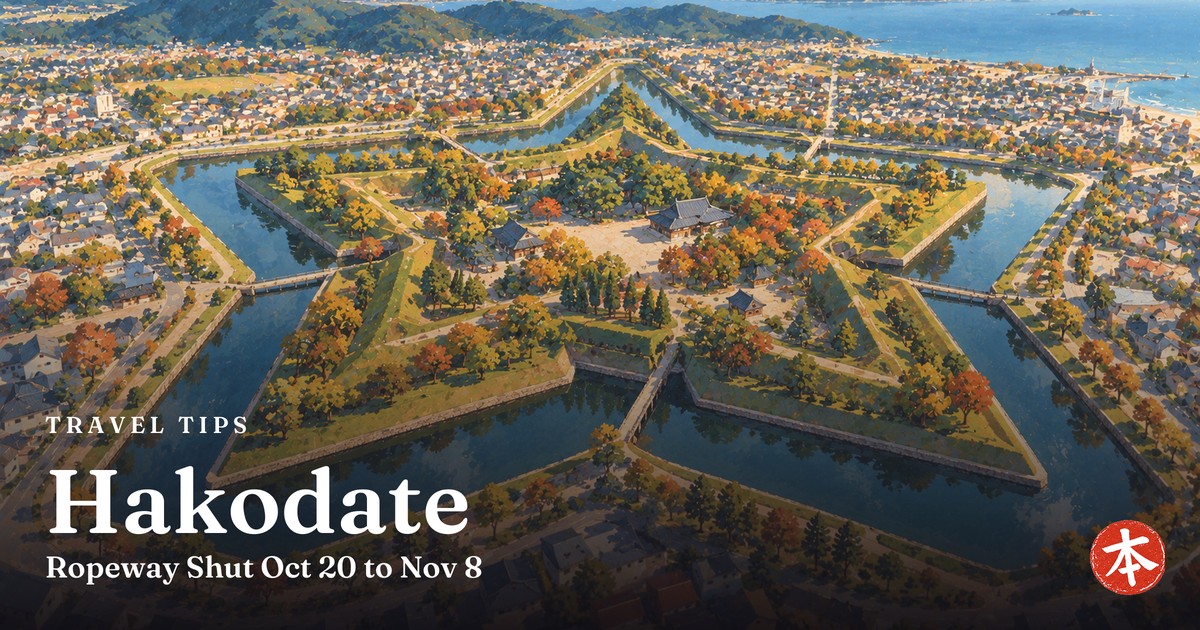
If you are going to Hakodate in late autumn 2026, one date matters more than anything else in this guide: the Mount Hakodate ropeway is suspended from Tuesday October 20 to Sunday November 8 for statutory maintenance inspection.
Three weeks, covering the end of the autumn colors. The night view from that summit is the single reason most people come to this city, and there is no equivalent to switch to. Nobody writing in English has this yet, because it sits in a notice on the operator’s Japanese front page.
The other thing worth knowing before you go is that the city’s two towers behave in opposite ways this year. The ropeway closes for maintenance. Goryokaku Tower is repainting its entire shaft and repairing the section beneath the deck — and stays open throughout. Here is what each one actually charges, when they run, and the rules that catch visitors.
The Hakodate ropeway closure, and how to time the summit
A 2026 guide built entirely around mistakes the maker actually made in Hakodate, including how to approach Mount Hakodate and when not to. Japanese, but the segment on the summit shows the crowd at the hour everyone arrives — which is the thing the operator warns about and the thing photographs never convey.
What are the normal hours?
From April 20 to September 30, the last car up is 21:30 and the last car down is 22:00. Cars leave every 15 minutes and the ride takes about three minutes. Note the half-hour gap between the two last cars — that is your maximum time at the top if you take the final ascent, and it is not long.
When exactly is it busy?
The operator is unusually precise about this. It states that the summit observation deck is expected to be very crowded for one to two hours from sunset and from the time the night view begins — and it publishes both of those times, live, on its front page. On the day we checked, sunset was 18:00 and the night view began at 18:28. Those are 28 minutes apart, which is the actual definition of blue hour here rather than a guess.
What do I do if I am there during the closure?
Reset the trip around the other tower and the ground-level city, and accept that the mountain view is not part of this visit. Goryokaku Tower is open every day of that period and gives you a different thing entirely — a fort seen from directly above rather than a harbor seen from a mountain. The one thing not to do is build a late-October itinerary around a sunset ascent and find out at the base station. The notice is published; it just is not published in English.
Can I see the queue before I go?
Yes, and you should. The site publishes live waiting times at both the base and summit stations, the current departure interval, live cameras, and a crowding status for the two viewing spaces — the rooftop deck and Isaribi Park. It also states that once the wait passes 20 minutes, you are queuing outdoors. In Hakodate, in October, that is a materially different experience from queuing inside, and it is the number to watch.
Getting up Mount Hakodate by car, and the pet rule
Where do I park?
At the base station car parks, charged at 300 yen for the first hour and 150 yen for each further 30 minutes. The capacity is small: the Mount Hakodate base tourist car park has 47 municipal spaces (one accessible) and 39 private (one accessible), and the Motomachi tourist car park adds 41 surface and 52 multi-story. That is under 180 spaces for the city’s main attraction.
Is there anything for busy days?
There is a scheme most visitors never notice. During Golden Week, weekends, public holidays and peak periods, an attendant is on the car park from midday until 22:00 (21:00 in winter) handing out parking tickets. You show that ticket to a member of staff when you use the ropeway and they stamp it. It is a validation system, and it only exists on the days it is worth having.
Can I bring a pet?
Guide, service and hearing dogs travel with you, under the assistance dogs law. Everything else needs a carrier that completely encloses the animal. The operator spells out the failure case rather than leaving it vague: a sling or a rucksack, or any arrangement where the head or part of the body is outside, or close to it, will be refused entirely. Cage or cart with the animal fully inside, or you do not board.
Goryokaku Tower prices, and the card that gets you in free
| Ticket | Standard | Group (30+) | Disability certificate |
|---|---|---|---|
| Adult | 1,200 yen | 1,080 yen | 600 yen |
| Junior and senior high | 900 yen | 810 yen | 450 yen |
| Elementary | 600 yen | 540 yen | 300 yen |
| Under school age | Free | ||
The disability rate covers one accompanying person as well as the certificate holder, which is not always the case elsewhere. Hours are 9:00 to 18:00, open every day, with observation ticket sales ending at 17:50.
What is the free-entry card?
What is actually up there?
Two levels. The second observation floor, 90 meters up, gives the view of the star fort below and, on a clear day, across the Tsugaru Strait to the Shimokita and Tsugaru peninsulas in Aomori; it also holds an exhibition space on the fort’s history. The first observation floor has a see-through floor at 86 meters — reinforced glass with nothing but air under it. At ground level there is a glass-roofed atrium with planting, free to sit in.
Is there anything to do at the bottom?
The atrium on the ground floor is an all-weather glass-roofed space with planting in it, and the tower explicitly offers it as somewhere to rest for free after walking the fort — no ticket required. There is also a gallery inside the tower showing the work of Ueki Sotsu, a Hakodate-born painter known for pictures built around the kappa water spirit; the autumn 2026 showing runs August 22 to November 13. Neither is a reason to come, but both are reasons not to leave the moment you come down.
Anything unusual happening this year?
Two things. The tower is repainting the entire shaft and repairing the neck section directly beneath the deck, from May 19 to November 15, 2026, and states it stays open as normal throughout. And it has moved its Respect for the Aged Day free admission for local over-65s from the holiday itself to September 23, 2026, because the holiday falls inside Silver Week this year and heavy crowds are expected — an operator deliberately moving a giveaway off its own busiest day.
Practical rules at the Hakodate towers
Where do I leave a bag?
At Goryokaku Tower, immediately left of the main entrance. There are 36 small lockers at 300 yen (40 by 44 by 57 cm) and 30 large at 500 yen (83 by 44 by 57 cm), and every one has a service door — a small hatch that lets you take things in and out repeatedly without paying again, which is a genuinely good design. Payment takes cash in 100-yen coins only, or cards, e-money, transport IC and QR.
Buy ahead if you can. The tower sells advance tickets at convenience stores, and the stated benefit is not a discount but a queue: with one in hand you go straight to the lift rather than through the ticket line. On a day when the tower is also publishing a live wait time on its front page — as it does — skipping that line has real value.
Smoking and pets at the tower?
The whole building is non-smoking. Pets are not admitted at all — guide, service and hearing dogs excepted. That is a stricter line than the ropeway, which accepts fully enclosed carriers, so a pet that can ride up the mountain still cannot go up the tower.
What else is in Hakodate worth knowing about?
One thing the tower flags that visitors rarely connect to Hakodate: the Jomon Prehistoric Sites in Northern Japan were inscribed as a World Heritage site on July 27, 2021, and two of them are in Hakodate — the Ofune and Kakinoshima sites. The hollow clay figure known as Kakku, excavated in the city’s Minamikayabe district, is a designated National Treasure. That is a very different Hokkaido from the one in the brochures.
Why are there two towers in the first place?
Because they answer different questions. The mountain gives you the shape of the city — a narrow neck of land with water on both sides, which is the whole reason the night view works. Goryokaku Tower exists for the opposite reason: the star fort below it is a shape you cannot read from the ground at all, and the tower was put there so that you could. One is a viewpoint that happens to overlook a city; the other is a viewing device built for one specific object. Doing both in a day is not repetition, and if you only have time for one, that is the distinction to choose on.
How does Hakodate fit with the rest of Hokkaido?
It is the southern gateway, and it pairs naturally with Sapporo rather than competing with it — see our Sapporo guide for the city and Sapporo ramen for the thing everyone eats there. In winter the calculation changes: the snow festival pins early February, skiing shapes the rest of the season, and our December weather guide shows what a Hokkaido winter actually looks like against the rest of the country.
Hakodate FAQ
Is the Mount Hakodate ropeway closed in 2026?
What time does the ropeway run?
When is the summit busiest?
Can I take my dog up Mount Hakodate?
What does Goryokaku Tower cost?
Is there a way in for free?
Can I park at Goryokaku Tower?
Is anything under construction?
Bottom line (as of September 8, 2026) — The Mount Hakodate ropeway is suspended October 20 to November 8, 2026 for statutory inspection. Outside that, from April 20 to September 30 the last car up is 21:30 and down 22:00, every 15 minutes, and the summit is very crowded for one to two hours from sunset. Goryokaku Tower is 1,200 yen, open 9:00–18:00 daily with sales ending 17:50, has no private car park, and admits museum association cardholders plus one companion free.
Sources & what we deliberately did not state
The closure dates, hours, intervals, crowding guidance, pet policy and parking rates come from the official Mount Hakodate Ropeway website. The fees, hours, works schedule, locker details, parking position and museum-card concession come from the official Goryokaku Tower website. Both were read on September 8, 2026. Maintenance and works dates are marked as scheduled and can move; check both operators before you travel.
Deliberately not stated: the ropeway fare, because we did not open its fare page; the ropeway’s winter timetable, because only the April 20 to September 30 hours were published on the pages we read and we will not extrapolate; the morning market, bay area and Motomachi businesses, because none of that was verified against an official source; any ranking of the night view, because neither operator claims one; and the admission and hours for Goryokaku park itself, which the tower does not publish.
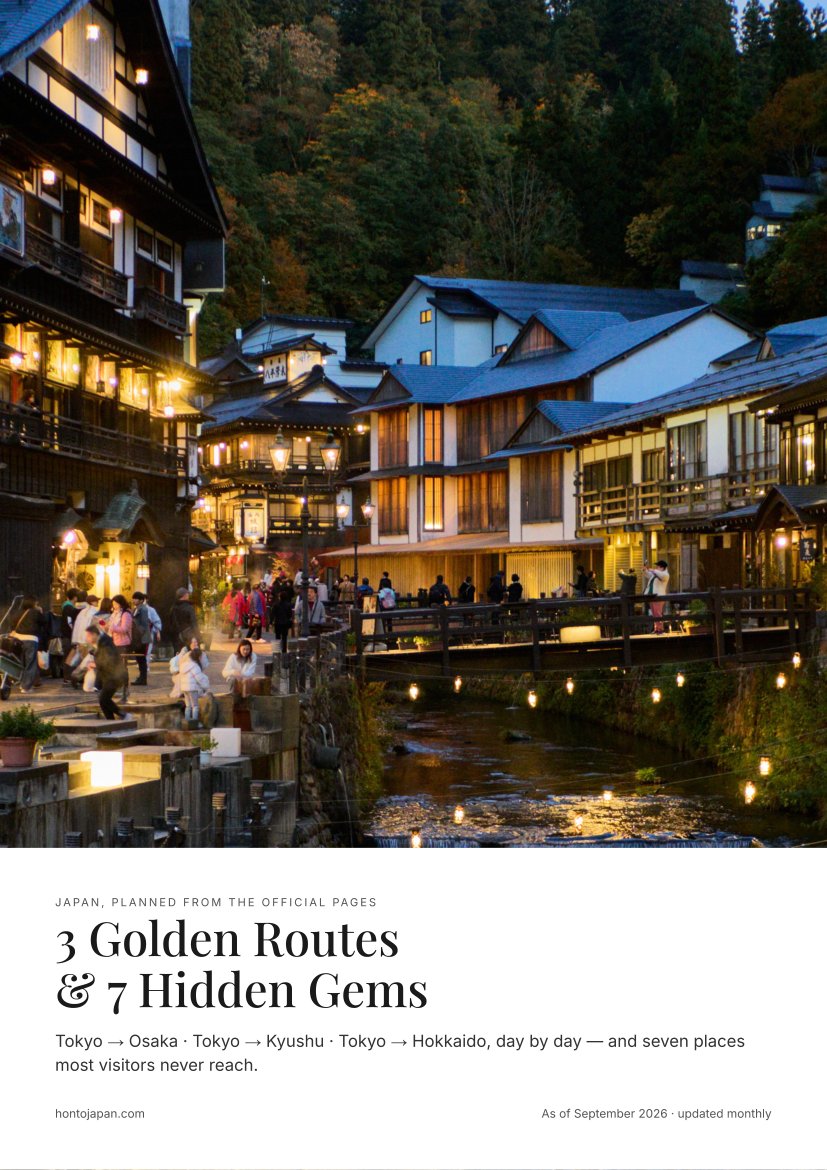
Tokyo to Osaka, Tokyo to Kyushu, Tokyo to Hokkaido — day by day — plus seven places most visitors never reach.
- 12 pages, 80 photographs, every stop linked to its guide
- Every price and opening hour read from the official page
- Re-issued monthly, so it does not go stale in your inbox
Free. One email a month, plus the rare change that matters. Unsubscribe with one click in any email. By subscribing you agree to our privacy policy.