Japan has a mandatory allergen labeling system and wheat is on it. That sounds like good news, and for one half of your day it is. The other half is the problem: the Consumer Affairs Agency states that food from restaurant operators is not subject to the labeling requirement. Menus are outside the law.
So the situation inverts the advice you would give in most countries. In Japan, the packaged sandwich in a convenience store is the readable option, and the bowl handed to you across a counter is the unknown one. The agency does encourage restaurants to provide allergen information voluntarily — but voluntary is the word it uses.
And then there is the bottle on the table. Kikkoman states that its regular soy sauces are made from wheat, soybeans, salt and water. Soy sauce is in almost everything here, which is why “no bread” is nowhere near enough.
What the law actually covers
| Situation | Allergen labeling required? |
|---|---|
| Packaged processed food (supermarket, convenience store) | Yes — mandatory |
| Restaurants | No. Voluntary information is described as desirable |
| Food sold unpackaged where it was made or processed | No — explicitly outside the requirement |
| Sold by weight over a counter | No |
The agency’s own framing is that the obligation attaches to food in containers and packaging. Everything about eating in Japan with celiac disease follows from that one boundary.
Why restaurants are the hard part
So is asking pointless?
No — but calibrate what an answer is worth. Staff can tell you what goes into a dish, and many will. What they are not doing is issuing a regulated declaration, and they are usually not trained on cross-contact. Treat the answer as information from a person, not as certification from a system.
Does this apply to chains as well as small shops?
The exemption is about the category, not the size. The agency’s wording explicitly contemplates that the appropriate level of voluntary information varies with the scale and type of business — which is a polite way of saying a large chain may publish an allergen chart and a six-seat counter will not.
What about food sold at a counter or by weight?
Also outside the requirement. The agency states that when food is sold directly to consumers at the place it was made or processed, without being put into packaging, labeling is not required. That covers a lot of what looks like retail: bakery counters, deli cases, market stalls.
Soy sauce: the ingredient that is in everything
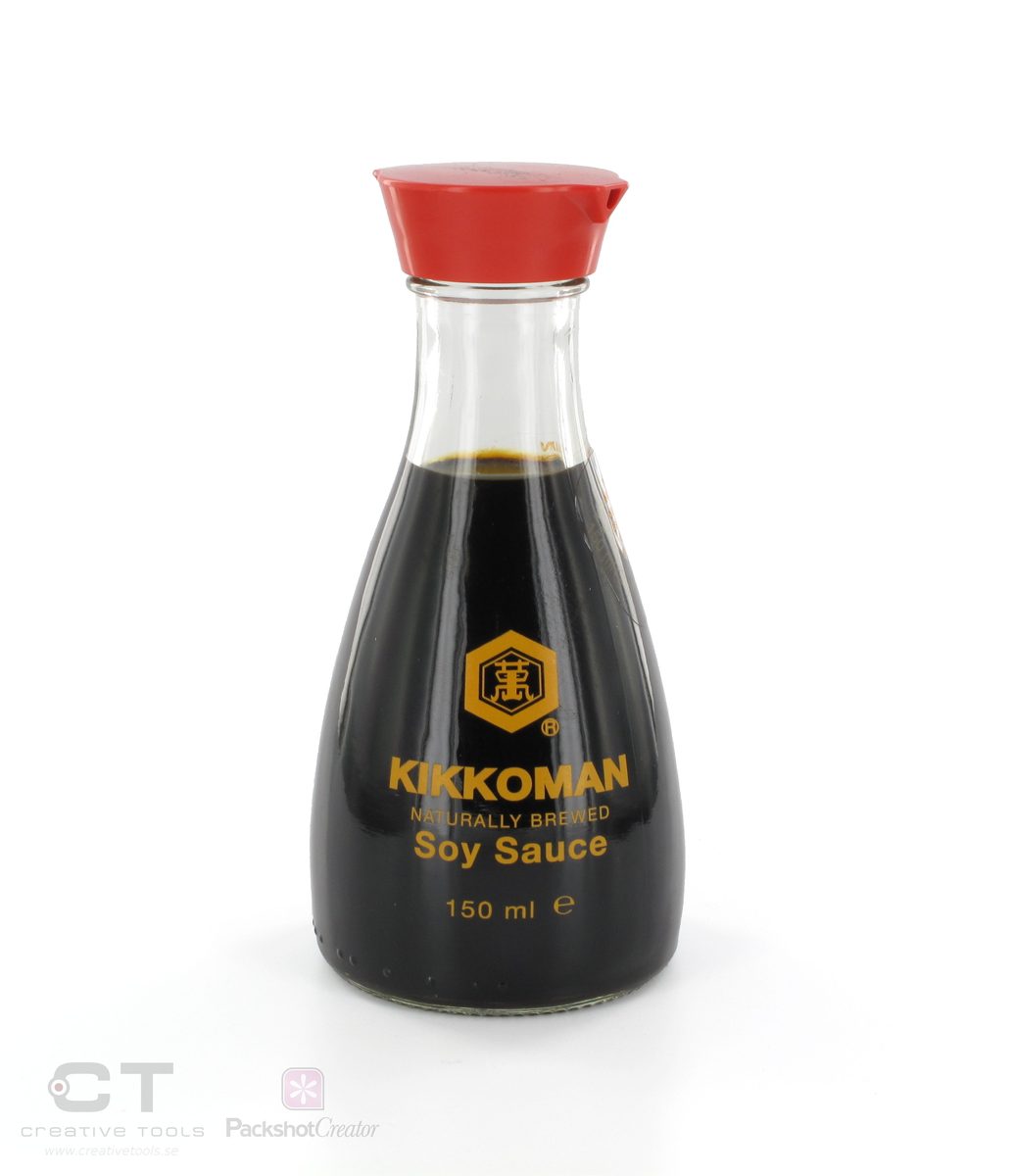
Kikkoman states that its regular soy sauces are made from wheat, soybeans, salt and water. Not a trace, not a processing aid — wheat is one of the four things soy sauce is brewed from. And soy sauce is the base of teriyaki, of most dipping sauces, of a great deal of braised and simmered cooking, and it sits on tables by default.
Is there a gluten-free soy sauce?
Yes, as a product. Kikkoman’s gluten-free soy sauce is brewed with water, soybeans, rice and salt — rice in place of wheat — and is certified gluten free by the Gluten Intolerance Group of North America. There is also a gluten-free tamari made from water, soybeans, salt and a touch of sugar. Both are certified at under 10 parts per million.
Will I find those bottles in Japan?
Do not count on it. The pages we read are Kikkoman’s US product pages, and the certification is a North American one. The existence of a gluten-free soy sauce somewhere in the company’s range tells you nothing about what is in the dispenser at a conveyor belt sushi restaurant in Osaka. Several travelers solve this by carrying their own.
Is tamari a safe default?
No. The gluten-free tamari is gluten free because it is brewed without wheat and certified as such, not because it is tamari. Treating the word as a category guarantee is exactly the kind of shortcut that goes wrong here.
Allergen labeling is not the same as gluten free
Japan’s system exists to protect people from allergic reactions, and it treats wheat as an allergen. Celiac disease is an autoimmune condition with a different threshold, and the two do not map onto each other cleanly. We looked for a Japanese legal definition of “gluten free” with a numeric limit and did not find one, so we are not going to describe one.
What does that mean in practice?
That a product with no wheat in its ingredient list is a good sign and not a guarantee at celiac thresholds. The declaration answers “is wheat an ingredient”. It does not answer “was this made on shared equipment”, which is the question that matters to you.
Is rice flour automatically safe?
Not automatically. The Consumer Affairs Agency publishes a consumer leaflet titled, in effect, be careful of wheat allergy from rice flour products — which exists precisely because rice flour products are not always pure rice flour. If the agency thought this was obvious, it would not have printed the leaflet.
How common is wheat allergy in Japan?
Common enough to sit near the top of the official causes. In the agency’s own breakdown of immediate-type reactions, wheat accounts for 8.1 per cent, behind hen’s egg at 26.7, walnut at 15.2 and cow’s milk at 13.4. That is why wheat is on the mandatory list at all — and it is also why staff will usually recognize the word for it.
The list changed recently. Older guides are wrong
| Date | Change |
|---|---|
| April 1, 2026 | Cashew nut added to the mandatory list |
| March 28, 2024 | Macadamia nut added to the recommended list; matsutake removed from it |
| March 9, 2023 | Walnut added to the mandatory list |
| September 19, 2019 | Almond added to the recommended list |
None of these are wheat, so none of them change your gluten answer directly. They matter for a different reason: they tell you how old the guide you are reading is. Any English page that lists the mandatory allergens without cashew nut was written before April 2026, and you should treat the rest of its claims with the same suspicion.
How many items are on the mandatory list now?
We are not going to give you a number. The agency publishes the current set as a diagram dated April 2026 and a handbook of the same vintage, both as PDFs we could not read as text. We can tell you what changed and when, because those are written out as dated announcements. Counting from them would be inference, and inference is how wrong numbers get into English guides and stay there for years.
A practical way to eat
Where should I buy most of my food?
Supermarkets and convenience stores, if reading labels is your main tool — because that is the exact space where the law requires the declaration. This is the inversion worth internalising: in Japan the packaged food is the transparent option.
What should I carry?
Your own soy sauce if you use it, and a written explanation in Japanese of what you cannot eat and why. The second one matters more than a phrasebook line, because it survives being handed to a kitchen. This is the same approach that works for other dietary constraints here — see the vegetarian guide and the halal guide, both of which run into the same gap between what a menu says and what a stock contains.
Is a food tour a good idea or a bad one?
It depends entirely on whether the operator handles dietary requirements in advance and in writing. A food tour booked with your requirement stated at booking is one of the few situations where somebody has thought about your meal before you arrive. A tour booked without saying anything is a long afternoon of declining things.
What else governs what restaurants have to do?
Hygiene and safety sit under a separate framework from labeling — our food safety law guide covers what is actually regulated in a Japanese kitchen. Allergen disclosure in restaurants is not part of it.
(Managing a religious diet alongside a medical one? Our kosher in Japan guide has the rabbis’ own notes on supermarket bread, farmed versus wild fish, and which three chains stock imported kosher goods.)
Gluten free in Japan FAQ
Does Japan require restaurants to label allergens?
Where does the labeling requirement actually apply?
Is wheat one of the mandatory allergens?
Does soy sauce contain wheat?
Is tamari always gluten free?
Is allergen labeling the same thing as gluten free?
Has the mandatory list changed recently?
Are supermarkets safer than restaurants?
Bottom line. Japan puts wheat on its mandatory allergen list and then applies that duty only to packaged food. Restaurants are explicitly outside it, and the soy sauce they cook with is made from wheat. Read packages, carry a written explanation, treat friendly answers as information rather than certification, and do not read a wheat-free label as a celiac guarantee — the system was not built to answer that question.
Sources
The scope of the labeling obligation, the restaurant exemption, the unpackaged-sales exemption, the dated additions of walnut and cashew nut, the macadamia and matsutake changes, the rice flour leaflet and the 8.1 per cent figure for wheat were read in Japanese off the Consumer Affairs Agency website on September 9, 2026. The soy sauce ingredients, the gluten-free soy sauce and tamari formulations, the Gluten Intolerance Group certification and the 10 parts per million figure come from Kikkoman’s own product pages, checked the same day. Rules change; confirm anything medical with your own clinician.
Some links on this page may be affiliate links, which means we may earn a commission if you book or buy through them — at no extra cost to you. See our affiliate disclosure.
Tokyo to Osaka, Tokyo to Kyushu, Tokyo to Hokkaido — day by day — plus seven places most visitors never reach.
- 12 pages, 80 photographs, every stop linked to its guide
- Every price and opening hour read from the official page
- Re-issued monthly, so it does not go stale in your inbox
Free. One email a month, plus the rare change that matters. Unsubscribe with one click in any email. By subscribing you agree to our privacy policy.