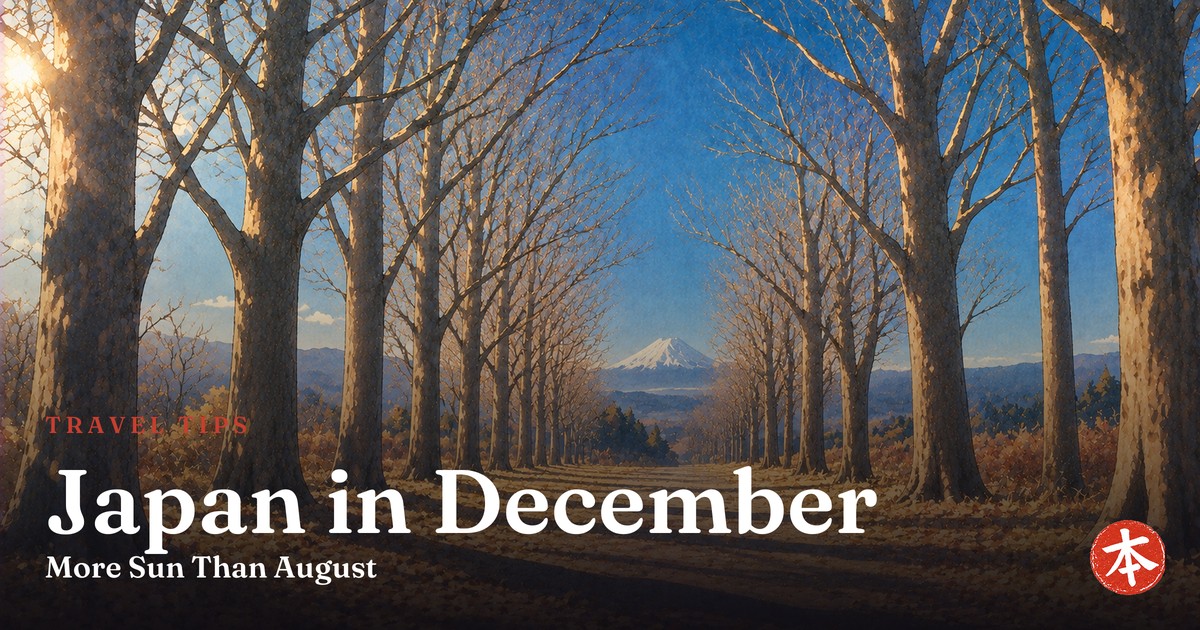
Here is the number that should reframe a December trip: Tokyo gets 174.4 hours of sunshine in December and 174.2 in August. Those are the Japan Meteorological Agency’s 30-year normals, and they say December is fractionally the brighter month. Rainfall runs 57.9 mm against August’s 154.7 — only January is drier in the whole year.
December in Japan is cold and clear, not cold and gray. What it is not is uniform: on the same day the normals put Naha at 19.0°C and Sapporo at −0.9°C under 113 cm of cumulative snowfall. Below are the official figures for five cities, what they mean for what you carry, and where the snow actually is. If you are still choosing a month, our guide to the best time to visit Tokyo puts December against the rest of the year.
December weather in Japan at a glance
| City | Average | Daily high | Daily low | Rainfall | Sunshine | Snowfall |
|---|---|---|---|---|---|---|
| Tokyo | 7.7°C | 12.0°C | 3.8°C | 57.9 mm | 174.4 h | 0 cm |
| Kyoto | 7.2°C | 11.6°C | 3.5°C | 57.3 mm | 134.4 h | 2 cm |
| Osaka | 8.7°C | 12.3°C | 5.3°C | 55.5 mm | 152.1 h | 0 cm |
| Sapporo | −0.9°C | 2.0°C | −4.0°C | 114.5 mm | 82.7 h | 113 cm |
| Naha | 19.0°C | 21.5°C | 16.8°C | 110.0 mm | 107.4 h | — |
Japan Meteorological Agency climate normals, 1991–2020.
What is the single most useful number here?
The 11.3-degree spread between Naha and Tokyo, on the same date. Japan in December is not one climate you pack for — it is at least three. A trip that takes in Sapporo and Okinawa in the same fortnight is a trip that needs two sets of clothes, and no amount of layering bridges 20 degrees.
Why December is one of Japan’s sunniest, driest months
Does December really get as much sun as August?
In Tokyo, yes — marginally more. The normals give December 174.4 hours and August 174.2. The winter half of the year is the bright half on the Pacific side of Japan, and the peak is January at 192.6 hours, the sunniest month Tokyo has. The mental image of a dim, drizzly Japanese winter belongs to the other coast.
And how dry is it?
57.9 mm in Tokyo, against 154.7 mm in August and 224.9 mm in September, which is the wettest month. Only January, at 59.7 mm, comes close to December — and December is actually the fractionally drier of the two. If rain is the thing that would ruin your trip, this is close to the safest month you can pick. For the other end of that scale, see our typhoon season guide.
Which city is actually the driest?
Osaka, narrowly. The December rainfall normals run Osaka 55.5 mm, Kyoto 57.3, Tokyo 57.9 — close enough that the ranking is trivia rather than a reason to choose. The real split is with the two ends of the country: Naha 110.0 mm and Sapporo 114.5 mm, roughly double the Kansai and Kanto figures for completely different reasons, rain in one case and snow in the other.
Why is Kyoto darker than Tokyo, and does it get worse?
It does get worse, and the gap is bigger than most people expect. In December, Kyoto records 134.4 hours of sunshine against Tokyo’s 174.4 — a 40-hour deficit. Carry that into January and it widens to 123.5 against 192.6, nearly 70 hours. The temperatures are within half a degree of each other; the light is not. If photographs are the point of your trip, that difference is worth more than the thermometer.
So why does December feel harsher than the numbers suggest?
Because of the daily swing and the wind, neither of which shows up in a monthly average. Tokyo’s December normals run from a 3.8°C low to a 12.0°C high — more than eight degrees inside a single day. You dress for the morning and carry the afternoon, or the other way round. Sunshine at seven in the morning in December is not warmth.
Snow in December: where you will actually find it
Will I see snow in Tokyo?
How much snow does Sapporo get?
113 cm of cumulative snowfall in December alone, with a normal maximum depth of 28 cm and an average temperature of −0.9°C. Sunshine drops to 82.7 hours, less than half of Tokyo’s. This is the mirror image of the Pacific-side winter: where Tokyo is bright and dry, Hokkaido is dim and buried. Our skiing guide covers the resorts that sit under it.
What about Kyoto and Osaka?
Kyoto records a normal of 2 cm of December snowfall and a maximum depth of 2 cm — enough to dust a temple roof for a morning in a good year, not enough to plan around. Osaka records none. Both cities are firmly in the cold-and-mostly-dry camp rather than the snow camp.
Is there a middle option between Tokyo and Hokkaido?
The Japan Alps and the Nagano side, which is why the snow monkey park works as a December day trip from Tokyo when Tokyo itself has no snow at all. We are not going to give you a snowfall normal for the park itself — we have not pulled that station — but the pattern is the one the Sapporo and Tokyo figures describe: elevation and the Sea of Japan side get the snow, the Pacific plain does not.
What to pack for December weather in Japan
How cold does it actually feel?
Tokyo in December sits around 7.7°C on the average day. That is a jacket, not an expedition parka. The problems come from the two ends: the 3.8°C morning low, and the fact that everything indoors is heated hard.
What do people in Japan actually wear?
Layers they can shed, because the indoor-outdoor swing is bigger than the outdoor one. Trains, department stores and restaurants run warm, and a single heavy coat with nothing underneath you can adjust becomes a burden by lunchtime. A mid-layer plus a wind-resistant shell beats one thick coat for the same reason it does in any city with good heating.
What changes if I am going north?
Everything. Sapporo’s normal daily low in December is −4.0°C and its high is 2.0°C — the whole day sits below Tokyo’s coldest hour. Gloves, something over your ears and boots with grip stop being optional. The 113 cm snowfall normal means the ground underfoot is a factor, not just the air.
And if I am going to Okinawa?
A light jacket. Naha’s December low normal is 16.8°C, warmer than Tokyo’s daily high. The catch is rain: 110.0 mm against Tokyo’s 57.9, nearly double. Okinawa in December is mild and damp where the mainland is cold and dry, which is the reverse of what most people pack for.
December or January? What the normals say about the neighboring month
The two months look similar from outside Japan and are not. Since January is the month most people weigh December against, here is the comparison on the agency’s own numbers.
Which is warmer, December or January?
December, by a clear margin in the cities most visitors see. Tokyo’s December average is 7.7°C against January’s 5.4°C, and the daily low falls from 3.8°C to 1.2°C. Kyoto follows the same shape, 7.2 down to 4.8°C. If your tolerance for cold is the deciding factor, December is the softer month by roughly two degrees everywhere on the main island.
But January is sunnier — does that matter?
It is, and it might. Tokyo’s January sunshine normal is 192.6 hours against December’s 174.4 — eighteen hours more over a slightly longer month, and the brightest figure in Tokyo’s year. Rainfall is a wash: 59.7 mm in January against 57.9 in December. So the trade is real but small: January buys you light and costs you warmth.
Does the north get worse in January?
Substantially. Sapporo goes from 113 cm of December snowfall to 137 cm in January, and from −0.9°C to −3.2°C average, with the daily low dropping to −6.4°C. Naha barely moves by comparison — 19.0°C in December to 17.3°C in January. The further from the Pacific plain you go, the more the month you choose actually decides.
December travel: what the weather does not tell you
Are temples open at the end of December?
It depends entirely on the temple, and the blanket assumption that Japan shuts is wrong. Todaiji in Nara states that it is open all year barring special events or emergencies. Koyasan does the opposite and publishes a separate hall-by-hall timetable for the new year period, because its hours genuinely change — its Torodo hall of lamps, closed at 17:00 the rest of the year, reopens from around midnight to 2:00 on January 1.
So what is the rule?
There is not one, and that is the point worth carrying. Check each place you plan to visit, in the week before you go, on that place’s own site. Anything that gives you a single confident sentence about “Japan over new year” is generalizing from one example.
Where does December fit in a longer trip?
It suits the classic route better than the summer does, because the walking is comfortable and the light is good for photographs. Our ten-day itinerary works in any season, but the December version of it involves less sweating and more layers. One practical consequence of the short days: the sun sets early enough that an itinerary built around outdoor sights needs its walking done by mid-afternoon, and its indoor stops saved for after dark.
(Two months earlier, the picture is different: our Japan in October guide covers the month when Tokyo records its heaviest rain and maple color has reached only Hokkaido.)
(The month before this one is when the rain stops: our Japan in November guide shows Tokyo dropping from 235 mm to 96, and puts the JMA’s maple line through Kanto on November 30 and Kyoto in December.)
Japan December weather FAQ
Is December a good month to visit Japan?
How cold does Tokyo get in December?
Does it snow in Tokyo in December?
Where in Japan can I actually see snow in December?
How warm is Okinawa in December?
What should I pack for Japan in December?
Is Kyoto colder than Tokyo in December?
Are temples and attractions open over the new year?
Bottom line (2026) — Tokyo in December is 7.7°C on average with 174.4 hours of sunshine, fractionally more than August, and 57.9 mm of rain, the second-driest month of the year. Snowfall in Tokyo is 0 cm; Sapporo gets 113 cm at −0.9°C, and Naha sits at 19.0°C. All figures are Japan Meteorological Agency normals for 1991–2020.
Sources & what we deliberately did not state
Every temperature, rainfall, sunshine and snowfall figure above is a Japan Meteorological Agency climate normal for the 1991–2020 statistical period, read from the agency’s station pages for Tokyo, Kyoto, Osaka, Sapporo and Naha on September 7, 2026. The temple opening statements come from the official Todaiji and Kongobuji websites, read the same day.
Deliberately not stated: the number of rainy days in December, because we did not pull that series and will not estimate it from the rainfall total; autumn leaf peaks and illumination dates, because they shift year to year and we have no official source for the coming season; and December flight and accommodation prices, which are dynamic and have no published fare behind them. A normal is a thirty-year average, not a forecast — treat any single December as capable of sitting outside it.
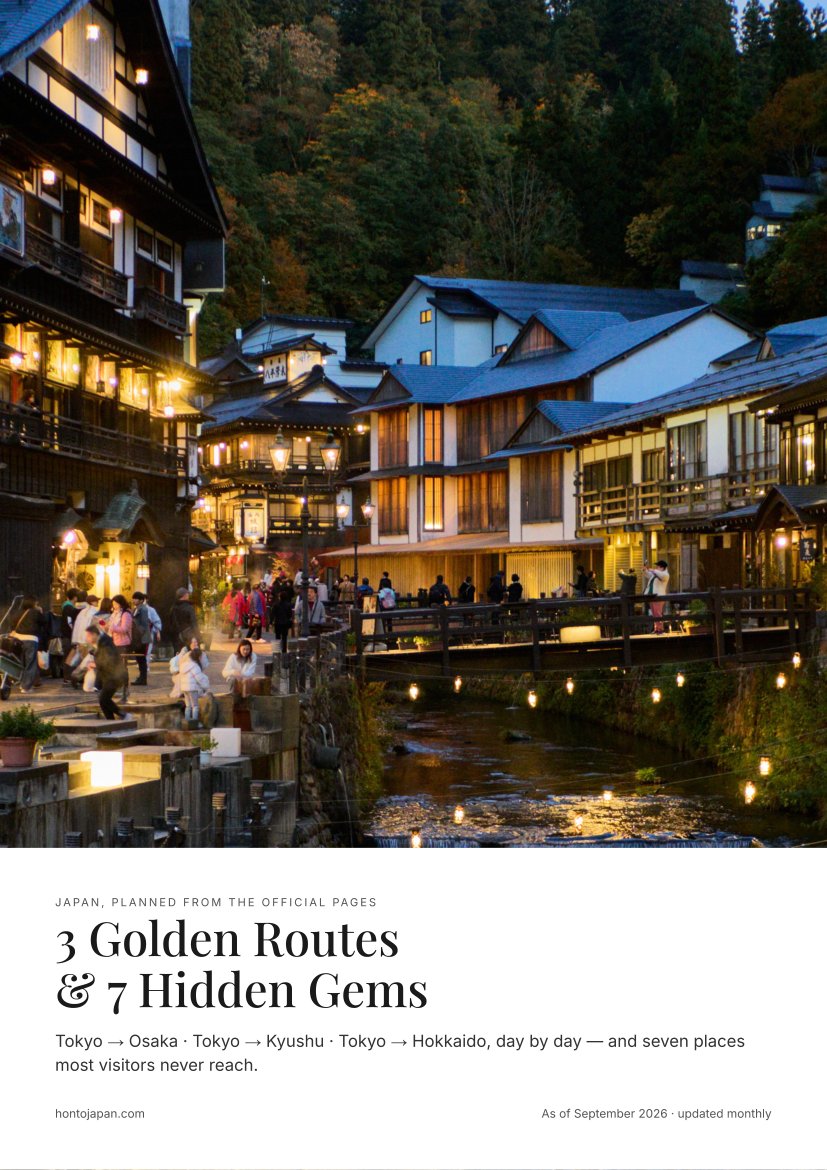
Tokyo to Osaka, Tokyo to Kyushu, Tokyo to Hokkaido — day by day — plus seven places most visitors never reach.
- 12 pages, 80 photographs, every stop linked to its guide
- Every price and opening hour read from the official page
- Re-issued monthly, so it does not go stale in your inbox
Free. One email a month, plus the rare change that matters. Unsubscribe with one click in any email. By subscribing you agree to our privacy policy.