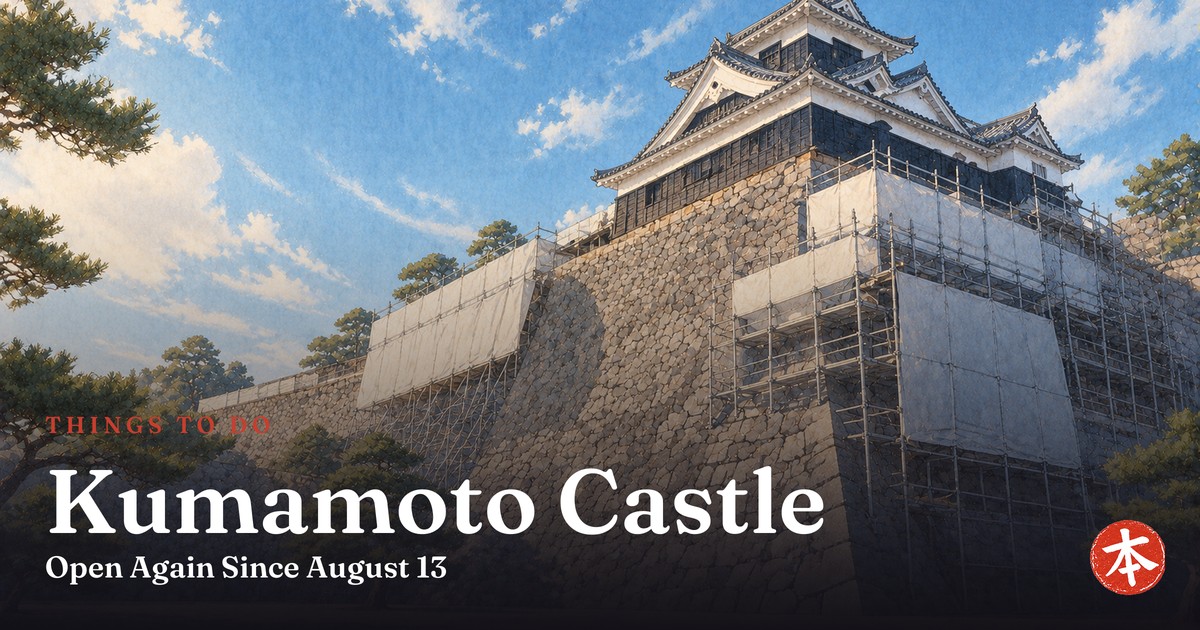
Kumamoto Castle reopened on August 13, 2026, after a temporary closure following the 2026 Kumamoto earthquake. The castle itself is now listed by its own operators as operating normally.
What most coverage will not tell you is the second half: the castle publishes a running list of what around it is still shut, and as of its August 18 update that list includes a museum, a car park, a facility inside the tourist information center, and the sword performances by the castle’s own warrior troupe. Traffic restrictions are still in place around the site.
This guide is that list, plus everything else the castle sets out in Japanese and rarely in English — the weekday gate rule that means one entrance, the ticket office that stops selling at four whatever time the castle closes, the ban on eating in the paid area, and the photography policy for the keep.
What is open and closed at Kumamoto Castle right now
| Facility | Status (castle update, August 18, 2026) |
|---|---|
| Kumamoto Castle | Operating normally |
| Wakuwakuza museum | Closed indefinitely |
| Sakura-no-Koji shops and restaurants | Normal |
| Tourist information center | Normal |
| Multipurpose facility, 2nd floor of that center | Unavailable |
| Volunteer guides | Resumed |
| Castle warrior troupe | Talks and photos only, no performances — 11:00–12:00 and 14:30–15:30 |
| Kumamoto City Museum / Prefectural Museum of Art | Normal |
| Sannomaru No.2 car park | Closed |
| Josaien tourism facility car park | Partially closed |
| Roads around the site | Traffic restrictions in place |
How reliable is that list?
It is the castle’s own, and it carries its own last-updated stamp — August 18, 2026 — along with a warning that opening information may change at any time depending on aftershocks and safety inspections. That is a more honest framing than most operators manage, and it is the reason to check the castle’s news page yourself on the morning you go rather than trusting any article, this one included.
Does the closure affect tickets?
Yes, in one specific way. Because the Wakuwakuza museum is shut, group bookings are being taken for the castle-only ticket for the time being rather than the combined ones. Separately, from September 1, 2026 group applications moved off fax and email entirely and onto a web registration form. If you are organizing a school trip or a coach party, both of those changed this year.
Has anything been restored since the reopening?
The free shuttle bus came back on August 4, 2026, ahead of the castle itself. It runs between Josaien, the South Gate and the Ninomaru car park, 9:00 to 17:00 with the last departure from Ninomaru, at 10 to 15 minute intervals. The volunteer guides have also restarted. Events canceled because of the earthquake have not all returned.
Kumamoto Castle tickets, hours and the 16:00 cut-off
| Ticket | Individual | Group (30+) |
|---|---|---|
| High school age and above | 800 yen | 640 yen |
| Elementary and junior high | 300 yen | 240 yen |
| Pre-school | Free | — |
| Annual pass (high school age and above) | 1,600 yen | — |
The annual pass is sold only at the Ninomaru ticket office, 8:45 to 16:00, is valid for a year from issue, is not sold to anyone below high school age, and requires a photograph to be taken for the card. You must show the original on entry.
What are the hours exactly?
September through to the following June: 9:00–17:00, last admission 16:00, last climb into the keep 16:30. July and August: 9:00–19:00, last admission 18:00, last climb 18:30. The castle closes on exactly one day a year: December 29.
Who gets in free?
Elementary and junior high students attending school in Kumamoto City, holders of a physical disability certificate and similar documents, residents of Kumamoto City aged 65 and over, and holders of a Joshu-tegata castle-lord certificate. You have to show identification, and — this is the part people miss — you still have to collect a zero-yen ticket at a ticket office before last admission. Free entry is not walk-through entry.
Which gate, and can I buy online?
Weekdays: South Gate only, for both entry and exit. Weekends and public holidays: North or South. Groups always South. The North Gate office opens only at weekends and on holidays, and construction can close the North Gate entirely. Online tickets are sold as QR codes by email — but note that once bought there is no cancellation, no date change and no refund.
What payment methods work?
Almost everything. Credit cards include VISA, Mastercard, JCB, UnionPay, Diners, Amex and Discover — though UnionPay and Discover do not work in the automated ticket machines, only at staffed windows. Transport IC cards including PiTaPa, plus Edy, WAON, nanaco, iD and QUICPay. QR payments include WeChat Pay, Alipay, PayPay, au PAY, d Barai, MerPay, Rakuten Pay, BankPay, J-Coin Pay and Yucho Pay. The castle also asks that tickets are not resold.
The rules inside Kumamoto Castle
Can I photograph the keep?
Yes, for yourself. Inside the keep, photography and video are for personal record only; the castle asks that images are not posted or streamed on social media, and that exhibits are not reused commercially or redistributed. Tripods and selfie sticks are banned inside the keep, and some exhibits carry a no-photography mark. In the wider paid area, tripods and selfie sticks are asked against when it is busy, and streaming is asked against generally. Any shooting that is not personal requires an application.
Food, drink and smoking?
No eating in the paid area. Drinks are allowed but only in lidded containers — a specific and sensible rule around exposed stonework and exhibits. The whole park is fire-free, and there is no smoking area inside the paid zone at all; smokers use the one beside the Fukko Joshu reception at Ninomaru, or the one at Josaien.
What cannot I bring in?
And if I need help getting around?
Power-assisted wheelchairs are lent free of charge, with three conditions: a companion is required, they cannot be used in the rain, and they cannot be reserved. Inside the keep there are three priority lifts, for wheelchair and stroller users with their companions and for anyone who finds stairs difficult — speak to staff at the keep entrance. Four first-aid rooms are marked across the site, each doubling as a nursing room except the one in the rest house by the keep. One more thing worth knowing if you are with a tour: guides and tour leaders are not permitted to address groups inside the keep.
Driving and parking at Kumamoto Castle
| Car park | Spaces | Rate |
|---|---|---|
| Ninomaru — 8:00–18:30 Sep–Jun, 8:00–20:30 Jul–Aug | 210 cars, ~10 bikes | 400 yen up to 2 hrs, then 200 yen/hr |
| Sannomaru No.1 | 101 cars, 10 coaches | Coach 1,200 yen up to 3 hrs, then 400 yen/hr |
| Sannomaru No.2 | 231 cars | Currently closed |
| Kunai | 41 cars | — |
| Josaien tourism facility — 8:00–22:30 | 58 cars, 54 bikes | Bikes 100 yen up to 2 hrs, then 50 yen/hr |
| Josaien coach park — 24 hrs, in/out 6:00–23:30 only | 37 coaches | 1,200 yen up to 3 hrs, then 400 yen/hr |
Is there a size limit?
Yes, and it is the sort of thing you find out at the barrier. Vehicles over five meters long, and semi-medium vehicles, cannot use the Ninomaru car park. They are directed to the coach bays at Sannomaru No.1 instead — charged at the ordinary car rate, which is at least a fair outcome. If you have a large rental van, that is your answer before you drive up the hill.
Can coaches book ahead?
No longer. The reservation system for the Josaien coach park was discontinued on April 1, 2026. Ordinary tourist coaches now operate on a first-come basis with no reservation. The only reservable category is welfare buses, through a dedicated booking site. For a coach party this is a real planning change from previous years.
Should I drive at all?
The castle itself asks visitors to allow plenty of time and to come by public transport — and with a car park closed and traffic restrictions still in place after the earthquake, that request has more force than usual. The Shiromegurin loop bus runs from Kumamoto Station around the castle and the sites near it, and its day pass carries discounts for those facilities. For placing the castle in a wider Kyushu route, see our Fukuoka guide and, for the onsen town two hours east, Yufuin.
Why Kumamoto Castle looks like a building site, and why that is the point
Kumamoto City films its own restoration work. This episode, shot in September 2019, follows the keep repairs while they were under way — scaffolding, hard hats, stone by stone. The keep itself is finished now; the stonework around it is not, which is why the footage still describes what you will be walking through.
What am I actually visiting?
Something the castle calls the Kumamoto Castle Special Opening. The 2016 Kumamoto earthquake brought down stone walls and collapsed structures, and the restoration has been running ever since. Rather than close for the duration, the castle opened a route in 2019 that lets you see the damage and the repair work in progress. The pitch is explicit and unusually confident: this is a version of the castle you can only see during the works.
How old is the castle?
Kato Kiyomasa completed it in 1607 on the plateau then called Chausuyama, using what the castle describes as the most advanced engineering of its day. Hosokawa Tadatoshi took over as lord of the Kumamoto domain in 1632. Miyamoto Musashi is among the figures tied to it.
So the keep is not original?
No, and the castle says so plainly. In 1877 the site became a battlefield in the Satsuma Rebellion, and a fire immediately before the fighting began destroyed the keep and the Honmaru Palace area. The keeps you see today, large and small, were rebuilt in 1960 in steel-reinforced concrete as an external reconstruction. Knowing that changes what you look for: the stonework is the old part, and it is the stonework the earthquakes damaged. If original timber keeps are what you are after, Himeji and Matsumoto are the ones to see, and Nagoya is the other great reconstruction.
(Continuing south on the Kyushu Shinkansen: our Kagoshima map guide has the 250 yen, 15-minute ferry to the volcano and the CUTE day pass that covers it.)
Kumamoto Castle FAQ
Is Kumamoto Castle open right now?
What does it cost to enter?
What are the opening hours?
Which gate do I use?
Can I eat inside the castle grounds?
Can I post photos from inside the keep?
Where do I leave my luggage?
Is there a wheelchair or lift?
Bottom line (as of September 8, 2026) — Kumamoto Castle reopened August 13, 2026 and its own status page, updated August 18, lists the castle as normal but the Wakuwakuza museum and the Sannomaru No.2 car park closed, with traffic restrictions still in place. Entry is 800 yen, hours are 9:00–17:00 (9:00–19:00 in July and August), and the Ninomaru office stops selling at 16:00 all year. Weekdays are South Gate only. No eating in the paid area, lidded drinks only, no lockers inside, and photography in the keep is for personal record rather than posting.
Sources & what we deliberately did not state
Fees, hours, gates, payment methods, the photography and food rules, accessibility provision, parking rates and capacities, the shuttle bus and the history all come from the official Kumamoto Castle website — its viewing guide, access page, history page and news notices — read on September 8, 2026. The closure list is the castle’s own, last updated August 18, 2026, and the castle warns that aftershocks and safety inspections can change it at any time. Check its news page on the day.
Deliberately not stated: the date, magnitude or damage of the 2026 earthquake, because the castle publishes operational status only and that is all we verified; when the museum will reopen, because the castle says only that it is closed indefinitely; the completion date of the restoration; the specific streets under traffic restriction, because the castle shows them on a map image rather than in text; and any estimate of how long you will queue, because the castle publishes a live wait time and we will not guess ahead of it.
Tokyo to Osaka, Tokyo to Kyushu, Tokyo to Hokkaido — day by day — plus seven places most visitors never reach.
- 12 pages, 80 photographs, every stop linked to its guide
- Every price and opening hour read from the official page
- Re-issued monthly, so it does not go stale in your inbox
Free. One email a month, plus the rare change that matters. Unsubscribe with one click in any email. By subscribing you agree to our privacy policy.