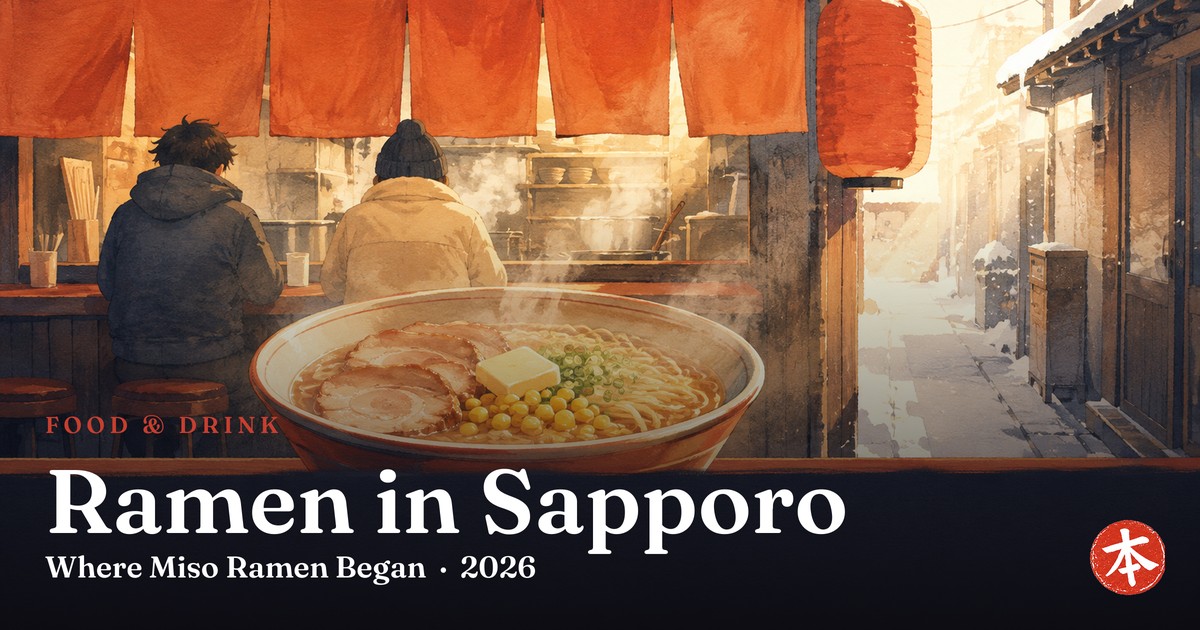
There is a story every English guide tells about Sapporo miso ramen: a customer asked for noodles to be dropped into tonjiru, pork soup, and a genre was born. The shop credited with inventing it calls that a complete urban legend — on its own website, in the second-generation owner's own words. That is the level of information available here in English, and it is why this guide is built entirely from shop and operator sources: because the practical stuff is wrong too. Six of the seventeen shops in Ramen Yokocho take no card at all. Sapporo Ramen Republic closed years ago. And the famous shop's own English page has the wrong opening hours.
Sapporo ramen at a glance
| Item | Official answer (Aug 2026) |
|---|---|
| The style | Pork-and-vegetable broth, yellow medium-thick curly noodles — the association's own definition |
| Where it started | Street stalls around Nijo Market and Tanukikoji, 1946–47 |
| 🚨 The tonjiru story | Called "a complete urban legend" by the inventor's son, on the shop's own site |
| Shops in the city | The association says about 800–1,000 ramen specialists |
| Ramen Yokocho | 17 shops · Minami 5 Nishi 3, Susukino · no facility-wide hours |
| 🚨 Payment there | 6 of 17 take no card, no e-money, no QR — bring cash |
| Airport | Hokkaido Ramen Dojo, domestic terminal 3F, before security, 9 shops, mostly 9:00–21:00 |
| 🚨 Sapporo Ramen Republic | Closed — the facility's domain no longer exists and the operator has removed it |
| Late night | Real: Baisensha to 3am, Shimijimi to 5am on weekends. Not at the airport |
A Sapporo resident's own miso ramen shortlist, in Japanese:
The origin story, from the shop that owns it
What does Aji no Sanpei actually claim?
That the dish came from miso soup, not pork soup, and from a conviction rather than a request. The second-generation owner writes that his father, Morito Ohmiya, held that miso is good for you, took his cue from miso soup, and worked it into something he called "miso-flavored men" — a name that drifted into "miso ramen" over time. Then he addresses the story you have read everywhere and calls it a complete urban legend, adding that his father used to shake his head and ask why it kept going around. The same pages claim two other firsts for the shop: the curly noodle, developed with Nishiyama Seimen when straight noodles were the norm, and garlic in the broth, an idea the father brought back from wartime years in Manchuria. Treat all of it as the shop's account — but note that no other party has a stronger claim to be the source.
So when was it invented?
We are not going to give you a year, and here is why. The Sapporo Tourist Association's English page says 1958. Its Japanese page gives no year at all. The shop gives no year. And the same organization's Japanese and English pages name two different men with the same surname as the noodle innovator. When the only dated claim sits in a single translation of a single page, it is a figure to attribute, not to assert. What the association does describe consistently is the 1946–47 street-stall period around Nijo Market and the Tanukikoji arcade, and the technical evolution: straight noodles thickened and crimped so they would not slip off chopsticks and would carry more soup, and egg added to turn the bran-brown dough yellow. One nice detail: a Sapporo portion then was 140–150g of fresh noodles against about 110g in Tokyo or Kyushu.
Ramen Yokocho: seventeen shops, and a cash problem
Which shop, and why the operator wants you to spread out
The alley has published something unusual: a request that visitors stop queueing for the same two or three shops. Its words — the alley is narrow, a line for one shop blocks the entrance of its neighbors, and every shop there is one the operator stands behind with confidence. Read that as both a courtesy and a tip: the shops named in guidebooks have the queue, and four doors down has seats. There is also no facility-wide opening time — the operator states outright that hours and closing days vary shop by shop, so check the individual page rather than assuming the alley "is open."
What the alley is, historically
It dates itself to 1951, when eight shops opened beside the Toho Koraku theater in Minami 5 Nishi 3 and became known as the Koraku Ramen Restaurant Street; the operator marked its 75th anniversary in 2026 and describes itself as the birthplace of miso ramen. Two housekeeping notes. Smoking: the alley announced that its passageway and shops are non-smoking until 22:00 — note the time limit, which guides that say "entirely non-smoking" overstate. And there is a nearby facility called Shin Ramen Yokocho that the operator has formally disowned, stating it is entirely unaffiliated and that there is only one Ganso Sapporo Ramen Yokocho in the city.
Late-night, in detail
This is where Sapporo genuinely beats other ramen cities, and it is all published. Baisensha runs 8:00 to 3:00am — effectively a nineteen-hour shop, and the only breakfast option in the alley. Shimijimi goes to 5am on Fridays and Saturdays (last order 4:00). Ikkaku runs to 2:30am, Teshikaga to 2am on weekends, Tenho to 2am Monday through Saturday, Gantetsu to 2am, and Shirakaba Sanso's alley branch to 3am, or 4am on Fridays and Saturdays. If your evening is Susukino, ramen at the end of it is a solved problem.
The airport, the closed facility, and the shops with famous names
New Chitose: before or after security?
Before — which is both the convenience and the catch. The Hokkaido Ramen Dojo is on the 3rd floor of the domestic terminal, landside, so anyone can eat there without a boarding pass, but you have to clear screening afterward. Nine shops carry the dojo label: Shirakaba Sanso, Ebisoba Ichigen, Teshikaga, Hakodate Ajisai, Yuki Akari, Asahikawa Baikohken, Keyaki, Sapporo Hien and Sora, most running 9:00 to 21:00 with last orders around 20:30. That line-up quietly teaches you Hokkaido's three ramen cities in one corridor — Sapporo miso, Asahikawa's soy-based double soup, and Hakodate's shio, which Ajisai describes as a kombu-based broth combined with pork and chicken and startlingly clear. If you are already through security on the domestic side, the option is Tomikawa Seimenjo on the 2nd floor, which also opens earliest in the building at 8:00. Two warnings: the airport changed domains, so English guides' links now fail; and the dojo is not a late-night backstop when your flight is delayed.
Sapporo Ramen Republic: gone, and still being resurrected
It was inside Esta, beside Sapporo Station, and it closed with the building. Three official signals line up: the facility's own domain no longer resolves at all; an archived capture of the operator's site from 2023 still lists it alongside farewell notices for Esta; and the operator's current corporate site lists its facilities without either Esta or the Ramen Republic. No official source anywhere states a relocation or a reopening. There is one trap worth naming, because it explains why the listing keeps reappearing: Shirakaba Sanso's official store page still contains the full Ramen Republic entry, wrapped in an HTML comment so it never displays. Anything that reads page source instead of the page — a scraper, or an AI writing a guide — will happily republish a shop that shut years ago.
Sumire, Junren, Ichigen: the shops whose own sites withhold things
Sumire and Junren share a root. Junren's history page is the clean explanation: Akiko Muranaka founded the shop in Nakanoshima in 1964, writing the name 純連 but reading it "Sumire"; in 1983 the reading was changed to "Junren" so more people would find it approachable. Today Sumire's flagship is in Nakanoshima, open from 10:00 — earlier than most guides say — and closing at 18:00 in winter, shut Wednesdays; the Susukino branch runs 11:00 to midnight. Junren is in Hirakiwa, near Sumikawa Station, 11:00 to 21:00, so describing Junren as the Nakanoshima shop is backwards. Then the gaps: Sumire publishes no prices and no address on its top page; Shirakaba Sanso publishes no prices at all; Ebisoba Ichigen publishes neither prices nor opening hours for any branch — and its Sapporo flagship was temporarily closed and only reopened at 6pm on April 7, 2026, which invalidates a swathe of recent write-ups. Ramen Shingen, which appears on every list, has no official site at all, and the aggregators disagree about its hours by up to two hours — so we are not printing any. For how Sapporo's style sits against the rest of the country, see our guides to Tokyo Station's ramen street, ramen in Shibuya and tsukemen.
FAQ
Did miso ramen really start with a customer asking for noodles in pork soup?
What time does Aji no Sanpei open?
What does it cost?
Is Sapporo Ramen Republic still open?
Where should I eat if I only have a couple of hours?
Can I pay by card in Ramen Yokocho?
Is there late-night ramen?
What is at New Chitose Airport, and is it before or after security?
What is the difference between Sumire and Junren?
Are there vegetarian, vegan or halal options, or English menus?
Bottom line (2026) — The shop that invented miso ramen calls the popular “customer asked for noodles in pork soup” origin story a complete urban legend on its own website. Six of the seventeen shops in Ganso Sapporo Ramen Yokocho take no card at all, and Sapporo Ramen Republic has closures to check. Carry cash for the alley and read the shop-by-shop hours before you queue.
Sources
The miso-ramen account, current hours, closing days and prices: Aji no Sanpei's official site, including its owner's notes and its notices page dated August 3, 2026. Shop count, individual shop hours and payment methods, the queueing request, the smoking notice, the alley's history and its disclaimer about Shin Ramen Yokocho: Ganso Sapporo Ramen Yokocho. Airport shop list, floors, hours and payment options: Hokkaido Airports' official New Chitose pages and its own shop data. Origin period, noodle evolution, portion weights, shop numbers and the three-city framing: the Sapporo Tourist Association, supervised by the Hokkaido Noodle Manufacturers' Cooperative. Branch details and the 1964/1983 naming history: Sumire, Junren, Shirakaba Sanso and Ebisoba Ichigen's own sites. The Ramen Republic closure: the facility's dead domain, an archived 2023 capture of the operator's site, and the operator's current facility list. All read on August 21, 2026. The embedded video is by its creator.
Some links on this page may be affiliate links, which means we may earn a commission if you book or buy through them — at no extra cost to you. See our affiliate disclosure.
Tokyo to Osaka, Tokyo to Kyushu, Tokyo to Hokkaido — day by day — plus seven places most visitors never reach.
- 12 pages, 80 photographs, every stop linked to its guide
- Every price and opening hour read from the official page
- Re-issued monthly, so it does not go stale in your inbox
Free. One email a month, plus the rare change that matters. Unsubscribe with one click in any email. By subscribing you agree to our privacy policy.