The official website of Umi Jigoku — the largest and best known of the Beppu hells — publishes its adult admission twice, and the two figures do not match. The dedicated fee page says 500 yen. The facility overview page on the same site says 450 yen. Both were live on September 8, 2026.
It is a small discrepancy and probably an unupdated page. But it is exactly the kind of thing that gets copied into English guides as fact, from whichever page the writer happened to land on, and then repeated for years. We are telling you both and telling you which to budget for.
The rest of this guide is the material that does not appear in English at all: what the combined ticket actually covers, why the water is that specific blue, and the reason the Japanese coach tour — guide included — was invented in this town in 1928.
Beppu hells prices: the two figures, and the combined ticket
| Ticket | Adult (high school+) | Elementary / junior high |
|---|---|---|
| Umi Jigoku, individual (fee page) | 500 yen | 250 yen |
| Umi Jigoku, group of 20+ | 400 yen | 200 yen |
| Umi Jigoku, certificate holder | 300 yen | 150 yen |
| Combined ticket, 7 hells | 2,400 yen | 1,200 yen |
| Combined, group of 20+ | 2,000 yen | 1,000 yen |
| Combined, certificate holder | 1,200 yen | 600 yen |
| Combined, certificate holder in a group of 20+ | 1,000 yen | 500 yen |
Is the combined ticket worth it?
That depends on a number the site does not give you. What it does say is that individual admission is settled separately at each site — there is no partial bundle, you either hold the combined ticket or you pay at every gate. Umi Jigoku alone is 500 yen. If the other six are priced the same, the 2,400 yen combined ticket pays for itself at the fifth hell and loses money at four. We verified only Umi Jigoku’s own price, so that is a rule of thumb rather than a calculation — but it is a far more useful starting point than “buy the pass.”
What about school groups?
There is a separate, cheaper scale, by reservation: 1,200 yen for high school students, 800 for junior high, 700 for elementary, on the combined ticket. Kindergartens and nurseries use the infant group rate, also by reservation. Note the shape of that — a high school student on a school trip pays 1,200 where an individual adult pays 2,400, which is a genuine half-price rather than a token reduction.
When is it open?
8:00 to 17:00, every day of the year, with free parking. The eight o’clock opening is the most useful line on the whole site: paid attractions in Japan overwhelmingly open at nine or ten, and an hour of head start matters when you are trying to see several sites in one day.
Why the Beppu sea hell is blue
What causes the color?
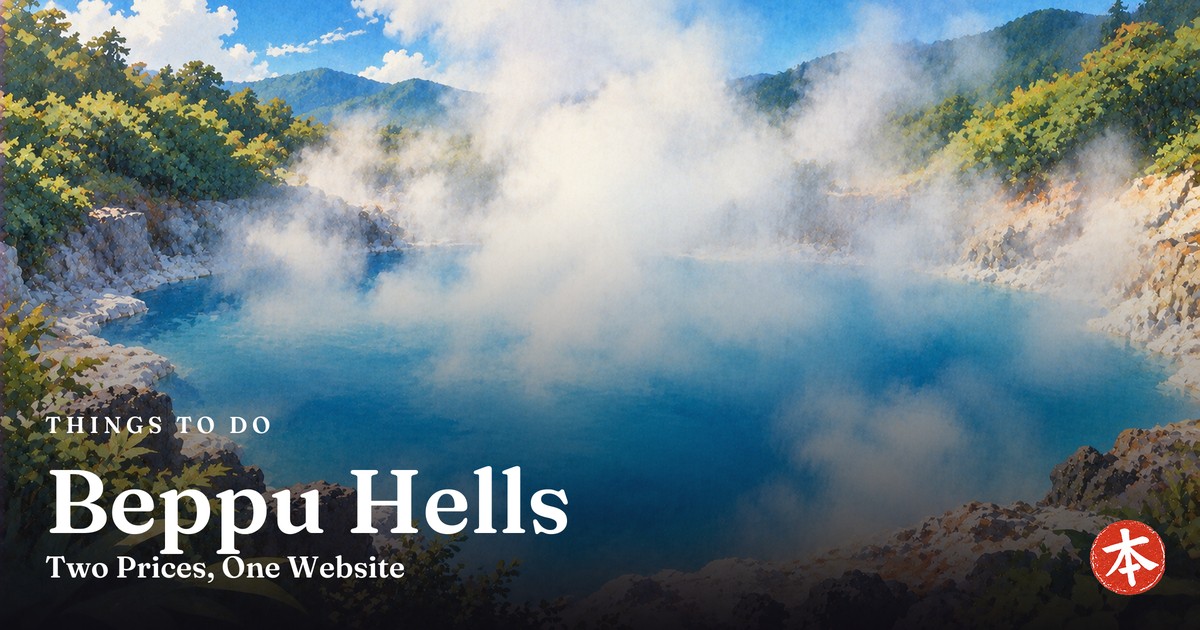
Dissolved iron sulfate. The site attributes the cobalt blue directly to a high concentration of iron sulfate in the spring water, and the resemblance to seawater is where the name comes from — umi jigoku, sea hell. It is not a reflection of the sky, and it is not algae; it is dissolved mineral content, which is why it holds the same color on an overcast day.
How hot and how deep?
The water sits at around 98 degrees Celsius — two degrees off boiling — and the site says the vein feeding it is held to run more than 200 meters deep. The spring is acidic. Those three facts together explain the fencing: this is not a pool that is merely too hot to enter, it is a chemically aggressive one at very nearly boiling point.
How old is it?
Roughly 1,200 years. Umi Jigoku is described as one of the hot springs that formed alongside the eruption of Mount Tsurumi in the ninth year of the Jogan era. That puts the pond itself into the Heian period, which is a long time for something to have been sitting at 98 degrees.
Is it protected?
Four of the hells are. Umi Jigoku, Chinoike Jigoku, Tatsumaki Jigoku and Shiraike Jigoku were designated together as the Hells of Beppu, gazetted on July 23, 2009. The designation names their value as springs that emerge in distinctive and varied colors and forms, worth seeing and academically significant. Within Oita Prefecture it was only the second such designation ever, and the first in 86 years — the previous one was Yabakei, in 1923.
How Beppu invented the Japanese coach tour
When did people start paying to look at these?
1910. Utsunomiya Noritsuna — a prefectural assembly member and later a member of the national Diet — leased Umi Jigoku from its owner, built visitor facilities, and charged two sen admission. The site treats that as the start of hell viewing as an organized business rather than a curiosity. At first almost nobody came: there was no road linking the sites, and visitors arrived in numbers you could count on your fingers.
What changed?
The army. A large-scale military exercise was scheduled for 1923, and a group of Beppu city assembly members led by Yamada Kohei lobbied the national government hard to build the road the troops would march along. After the exercise was over, that road became the hell circuit road — and the sites suddenly had a route connecting them. An infrastructure project justified by an army maneuver is the reason this attraction exists in the form it does.
Why did a politician bother?
Because in 1910 nobody had yet worked out that a boiling pond was a product. The land was owned by a family, and the site records that Utsunomiya leased it from the first-generation owner rather than buying it — a small detail that says a lot about how speculative this was. Two sen was a real price for a thing that had, until then, been free to look at from the edge of a field. What he added was not the pond but the frame around it: paths, viewing facilities, a gate and a ticket. Every hell on the circuit today runs on that template.
Who else came?
The site displays photographs of Helen Keller alongside its own history, and records that the poet Yosano Akiko visited the prefecture in 1931 and wrote about the sea hell. There is a haiku monument in the grounds, composed by Takano Sujiu in 1940 and erected in 1969. For a site whose selling point is boiling water, it has accumulated an unusual amount of literary attention.
What is actually inside the Beppu sea hell grounds
A Japanese travel program doing the full circuit, including the sea hell, the blood pond, dango-jiru and the food steamed on geothermal heat. Twenty-four minutes, in Japanese — but it answers the question a price table cannot, which is whether standing next to a 98-degree pond for an afternoon is something you would enjoy.
What do I walk through?
You enter under a thatched nagayamon gate — the site’s signature building, fully refurbished in 2000 — and come out into a garden. There is a pond with giant water lilies and water lilies, and a greenhouse off to the right before the shop where the giant lilies are raised, heated by the hell water itself. A red-torii shrine, Hakuryu Inari Daijin, sits on the slope looking down over the blue pond.
Can I get in any of the water?
One piece of it. There is a foot bath fed with 100 per cent of the hell’s own source water, free-flowing — which is the only way you will feel this spring rather than look at it. Whether anything else on site is bathable we did not verify, and this is a viewing attraction rather than a bathhouse. For actually getting into water in this part of Kyushu, Yufuin is the obvious pairing.
Is there anything to eat?
Two things worth knowing. The cafeteria does kamaage udon, dango-jiru and champon, and the site singles out its geothermally steamed baked pudding at 300 yen. At the exit there are gokuraku manju — paradise buns, steamed in a geothermal steamer, made by hand one at a time, bite-sized. Cooking with the ground heat rather than a stove is the local idiom, and both are inside the same admission.
Is anything else on at the moment?
The site runs a night event, Yoru no Umi Jigoku, from September 18 to 27, 2026. There is also a separate hot spring museum that opened in December 2022. And the grounds are currently undergoing refurbishment work: temporary walkways are in place, the souvenir shop is trading from a temporary unit, and the site states it is otherwise operating normally.
Planning a Beppu day
Where does this fit in Kyushu?
Beppu and Yufuin sit close together on the eastern side of Oita and are usually done as a pair, from a base in either. Fukuoka is the usual gateway to the island, and Yufuin is the softer, more resort-shaped counterpart to Beppu’s industrial-scale steam.
What should I know about onsen etiquette before I go?
More than most guides tell you, and the rules are legal as much as social — our guide to what Japanese law actually says about onsen covers the part everyone gets wrong. If you have tattoos, read our tattoo and onsen guide before booking anything, because the policy varies by property and not by region. And for a completely different style of hot spring town, Kusatsu is the one to compare against.
Who do I contact about the hells?
The Jigoku Association handles inquiries about the hell circuit as a whole, on 0977-66-1577. Umi Jigoku itself is on 0977-66-0121, at 559-1 Kannawa, Beppu, Oita. Kannawa is the district name you want on a map — the hells are clustered around it rather than around Beppu Station.
Beppu hells FAQ
How much does Umi Jigoku cost?
What does the combined ticket cover?
Should I buy the combined ticket?
Why is the water blue?
How old is it?
What are the opening hours?
Is it a National Scenic Beauty site?
What else is on the site?
Bottom line (as of September 8, 2026) — Umi Jigoku’s fee page says 500 yen for adults and its facility page says 450; budget for 500. The combined ticket is 2,400 yen for seven hells, and individual admission is settled at each gate. Open 8:00–17:00 all year with free parking. The water is blue from dissolved iron sulfate, sits at about 98°C, and formed roughly 1,200 years ago. Four hells were designated National Places of Scenic Beauty in 2009, and Japan’s first sightseeing bus and female bus guide were created here in 1928.
Sources & what we deliberately did not state
Prices, group and school rates, hours, parking, the geology, the color explanation, the history and the on-site facilities all come from the official Umi Jigoku website — its fee page, facility page and origins page — read on September 8, 2026. The two conflicting admission prices are both quoted here exactly as the site gives them; we have not asked the operator which is current.
Deliberately not stated: the names and individual prices of the other six hells, because Umi Jigoku publishes only its own and we will not fill that in from memory; a recommended order for the circuit, because no official route exists; any ranking claim about Beppu’s spring water volume, because this operator makes none; the opening hours of the other hells, because we did not read their sites; and whether anything beyond the foot bath can be bathed in, because we did not verify it.
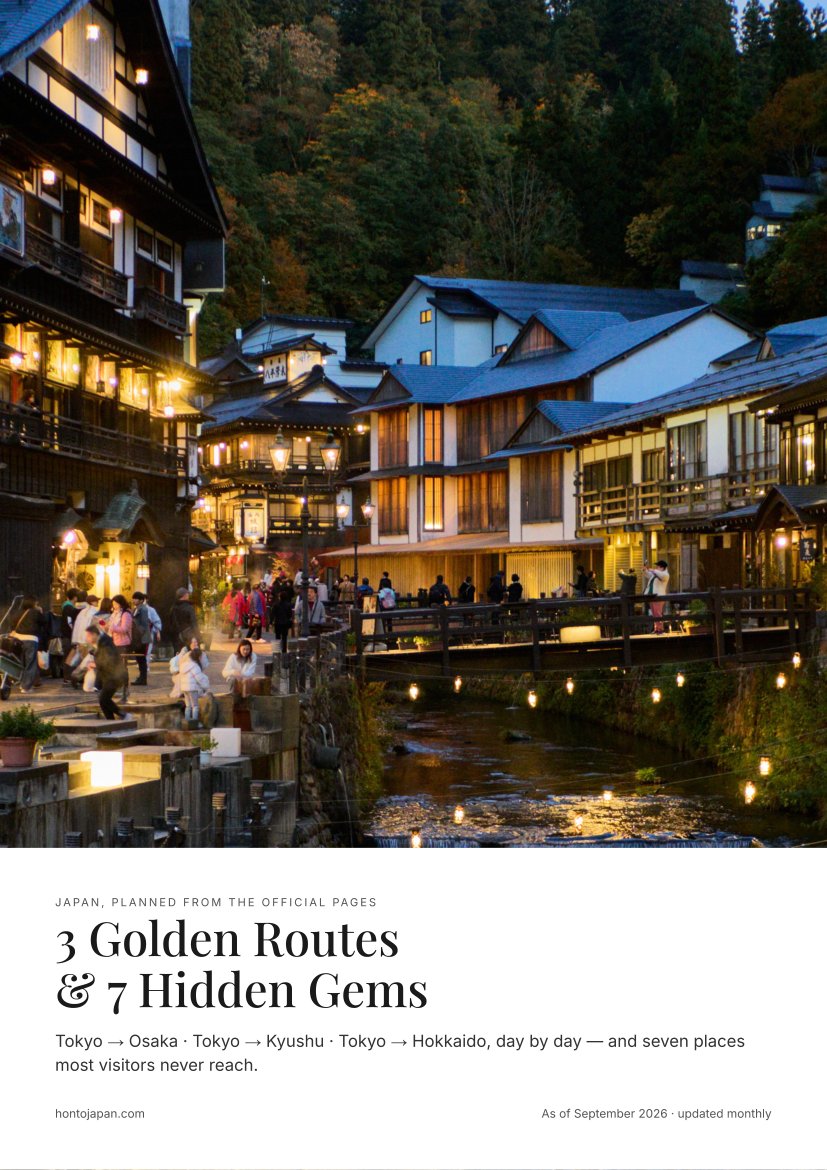
Tokyo to Osaka, Tokyo to Kyushu, Tokyo to Hokkaido — day by day — plus seven places most visitors never reach.
- 12 pages, 80 photographs, every stop linked to its guide
- Every price and opening hour read from the official page
- Re-issued monthly, so it does not go stale in your inbox
Free. One email a month, plus the rare change that matters. Unsubscribe with one click in any email. By subscribing you agree to our privacy policy.