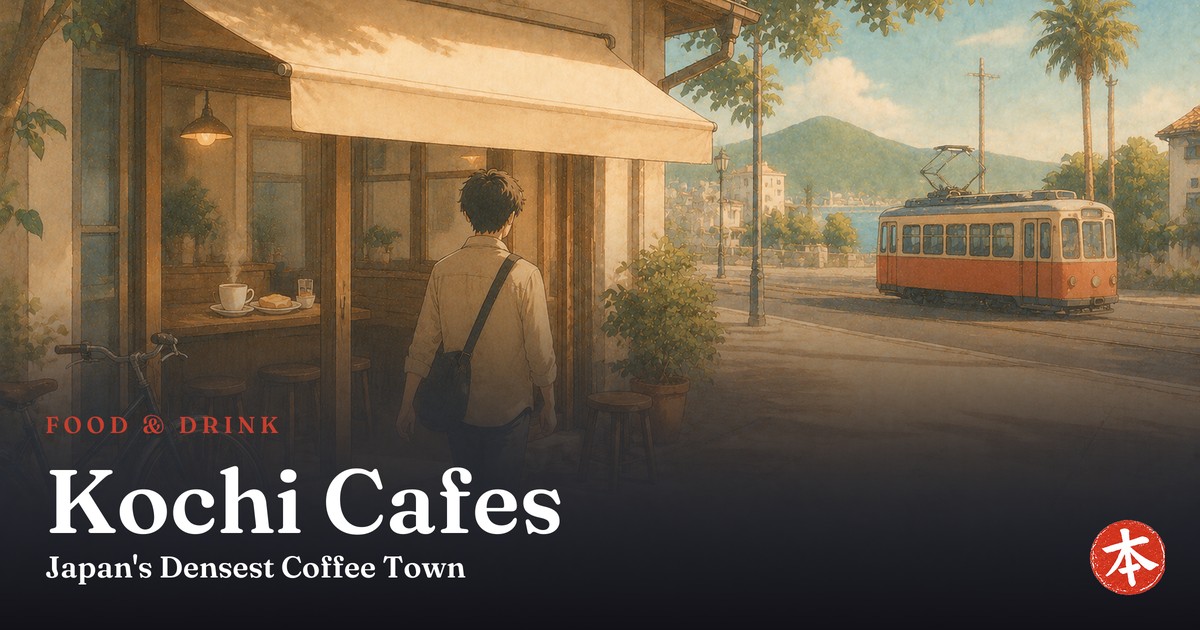
Kochi is not on most itineraries. It is on the Pacific side of Shikoku, it takes effort to reach, and the English-language material about it is thin. It also has, by the government's own count, more coffee shops per person than any other prefecture in Japan — and 91.9 percent of them are individually owned.
That combination is unusual enough to build a trip around. This guide covers what the statistics actually say, what the local version of morning service involves — it is not the Nagoya version — and which shops are open when. It also flags the places where two official sources contradict each other, which happened three times in researching this.
Kochi has the most coffee shops per person in Japan
The Statistics Bureau published this directly in its analysis of the national establishment census: Kochi at 1.56 coffee shops per 1,000 residents, the highest of any prefecture, against a national average of 0.55. That is roughly 2.8 times the average. Gifu was second at 1.43, with Aichi and Wakayama tied at 1.13, and the analysis noted the concentration in western Japan.
| Prefecture | Coffee shops per 1,000 people |
|---|---|
| Kochi | 1.56 |
| Gifu | 1.43 |
| Aichi / Wakayama | 1.13 |
| National average | 0.55 |
What the ranking does not measure
Density says nothing about size, and here that matters. Kochi ranks sixth by coffee shop employees per head, well below its first place for shop count. A prefecture with the most shops and only the sixth-most staff is a prefecture of very small shops — counters with a handful of seats, not cafes with a floor of tables. Which is the texture of the place, and it is also why several of them close in the early afternoon.
And almost none of them are chains
This is the part that makes the density worth traveling for. The same analysis found 91.9 percent of Kochi's coffee shops were individually owned, second only to Wakayama, and 86.4 percent within Kochi City — 401 of 464 establishments. Meanwhile the prefecture ranks only sixth by employee numbers per head.
Read those together and the picture is precise: a lot of shops, nearly all independent, and each one small. Not a city with a big chain presence. A city where the coffee shop is a neighborhood institution run by one family.
Why, according to the prefecture
Kochi's own tourism site offers three explanations rather than one. It says the density is attributed to the local tradition of women working, which built up an eating-out sector around them; to coffee shops functioning as the community meeting place; and — the most Kochi-specific of the three — to it being a fishing region, where crews come in for morning service after finishing a shift. The prefecture presents these as theories, and so do we.
Morning service here is not the Nagoya version
A morning-service tour of Kochi, filmed after national television covered the local habit. In Japanese, but the plates are the argument: what arrives alongside the coffee here is a meal rather than a slice of toast, and comparing these images with the Nagoya version below is the fastest way to see the difference.
Japan's famous morning service is usually explained as toast and an egg with your coffee. Kochi's is a mixed Japanese and Western plate, and the Japanese half is not a garnish.
What it costs, where the shops publish it
Two published examples. One long-running bakery cafe charges 450 yen on top of your bread for a drink, soup, salad and egg. A shop in the arcade near the castle adds its set for 100 yen on top of a drink — buttered toast, salad and a boiled egg. At that price the calculation is not really about value. For the hotel-buffet version, three central hotels open their breakfast to non-guests at 1,800 to 2,000 yen, which is a different proposition entirely — see our guide to Japanese breakfast for what that format involves.
The shops, and when they actually open
Opening times matter more here than usual, because several of the best-regarded places close in the early afternoon and two of them close at weekends rather than on a weekday. This table is from the prefecture's own feature on the city's coffee shops.
| Shop | Hours | Closed | Known for |
|---|---|---|---|
| Depot Kyomachi | 8:00–21:00 | Never | A morning set with rice ball and miso soup; 1 min from Harimayabashi |
| Nagano Kyokudo Lin Belle | 7:00–17:30 | Sun, holidays | Bakery cafe; set is +450 yen; local "hat bread" |
| Spoon | 7:00–18:00 | Irregular | Set for +100 yen; by the castle and Hirome |
| Pasta Cafe Hachinomori | 8:00–21:00 | Not stated | 15 different morning sets |
| Coffee Shop Zum Zum | 9:00–14:00 | Weekends | The double morning — rice ball and toast |
| Kissa Noah | 7:30–15:00 | Weekends | Four generations; house-made red bean toast |
| Cafe Pulcino | 7:30–14:30 | Mon | Blueberry and cheese toast, its best seller for 20 years |
| Cafe Shoku-Do Bubuya | 7:30–12:00 | Sun, 3rd Mon | Toast cut over 10 cm thick |
| Grayge Coffee Roaster | 9:00–17:00 | Irregular | Own roasting; latte 600 yen; Wi-Fi and power |
Two things to check before you set out
First, Zum Zum and Noah close on weekends and public holidays, which is the reverse of what a visitor expects, and Bubuya stops serving at noon or when it sells out. Second, several of the newer roasters list their closing day as irregular and point to social media. We have not verified those accounts, so we are not repeating their contents — treat "irregular" as a genuine risk rather than a formality, and have a second shop in mind.
Three of the best-known cafes share one operator
This is the fact that changed how we saw the city, and we have not seen it in any English article. Three well-regarded Kochi cafes — a tea house in the central arcade, a patisserie cafe, and a Japanese sweets cafe — are all run by the same non-profit, which operates them as employment support workplaces for people with disabilities.
The organization was founded in 2004 and states its philosophy as "Not Charity But The Chance!" — which is the point. These are not sheltered workshops with a shop attached; they are competitive cafes in prime locations that happen to be run this way, and nothing on the shopfronts announces it.
| Cafe | Where | Hours | Closed |
|---|---|---|---|
| Hidamari-Komichi Tosacha Cafe | Obiyamachi arcade, 2 min from Ohashi-dori tram stop | 11:00–17:00 (last order 16:30) | Wed |
| Strawberry Fields | Kanda, Kochi City | 9:00–16:30 (dine-in last order 13:30) | Thu |
| Kanmi-Saryo Sakurasaku | Ohara-cho | Morning 8:30–10:30, lunch 11:00–15:00 | Tue |
The tea house is the one to prioritize: it serves Tosa tea by growing area, plus cold-brewed tea, tea soft-serve and a sweet potato tempura ice cream, two minutes from a tram stop in the main shopping arcade. If tea rather than coffee is what you are after in Japan, this and matcha in Kyoto are two different answers to the same question.
The sweets cafe serves morning from 8:30
The third of the three is worth a separate mention because of its timing. It runs morning service from 8:30 to 10:30 and then lunch until 15:00, which fills the gap left by the tea cafe not opening until 11:00. It is known for hand-made warabimochi and other Japanese sweets, with a daily lunch at 880 yen. Closed Tuesdays.
A cafe in the castle museum, with no ticket needed
Kochi Castle is the main sight in the city, and the history museum beside it has a cafe on its second floor with a view of the keep. The useful part: the museum states that entry to the second floor does not require an admission ticket and invites people to use the cafe freely.
| Cafe Histoire, Kochi Castle Museum of History | |
|---|---|
| Hours | 9:00–18:00, and from 8:00 on Sundays |
| Closed | Mondays (Tuesday if Monday is a holiday) |
| Ticket needed | No — the second floor is open to all |
| Published prices | Ryoma Vienna coffee 700 yen; blue cream soda 700; toast set 850; cake 750 |
Two more within reach of the station
If you are near JR Kochi Station rather than the castle, two places publish their own hours. A self-roasting coffee shop that started as a crowdfunded project opens 10:00 to 17:00, closed Tuesdays plus irregular days, and ships nationally. A patisserie with a cafe space a short walk from the station opens 10:00 to 19:00 with last orders at 18:30, closed Tuesdays and Wednesdays, and publishes a monthly calendar — its most recent one at the time of writing covered August and September 2026, which is a good sign that the page is being maintained.
The 8:00 Sunday opening is deliberate, because Sunday is market day on the street outside. Note that the prefectural tourism page lists this cafe as closing at 17:00 with irregular days off; the museum's own page says 18:00 and Mondays, and the sightseeing bus leaflet agrees with the museum. We use the museum's.
Aisukurin is not ice cream, legally
You will see aisukurin everywhere in Kochi, and it is genuinely a different product rather than a regional name for ice cream. One long-running maker publishes its composition as 0.9 percent milk fat and 7.6 percent non-fat milk solids; the prefecture describes the category as a frozen confection with 3 percent milk fat or less. In Japan that puts it below the legal threshold for ice cream, which is why the texture is closer to sorbet.
The central shop near Harimayabashi opens 9:00 to 18:00, closed Wednesdays except in June, July and August, and sells seven flavors — plain, strawberry, soda, matcha, chocolate, melon and yuzu. There is also a stand at Katsurahama beach, and a shop near the station that opens at 8:00 and never closes.
What we cannot tell you
The price. Aisukurin is traditionally sold by the number of scoops, and every English page quotes a figure for it — but the maker's official site publishes prices only for its mail-order tubs, not for the counter. So the per-scoop price is not stated officially, and we are not going to repeat a number we cannot source. Bring change and ask.
Getting around, and two numbers that changed
Central Kochi is compact and the tram does most of the work. Two figures in circulation are out of date, and both are the kind that cause a problem at the moment you need them.
| Current | What older pages say | |
|---|---|---|
| Tram, flat central fare (adult) | 230 yen | 200 yen |
| Sightseeing bus day pass (adult / child) | 1,500 / 1,000 yen | 1,000 / 600 yen |
The tram fare rose on November 1, 2024. The bus pass figures are from the current fiscal year's official leaflet. If a guide quotes the tram at 200 yen, it has not been revised in two years, which tells you something about the rest of it. Getting to Kochi at all is the bigger cost — if it is part of a longer trip, our guides to the Japan Rail Pass and regional passes cover which one fits.
The Sunday market hours are genuinely disputed
The street market on Otesuji, right by the castle, has run for centuries and is the reason to be in Kochi on a Sunday. But two departments of the city government publish different hours for it — one says roughly 5:00 to 17:00 in summer, the other roughly 6:00 to 14:00 — and they disagree on the size too, at over 350 stalls versus about 300. We are giving you both, because picking one would be inventing certainty. Aim for mid-morning and you are safe under either version.
Hirome Market is not a cafe
It gets recommended as one, and it is not. Hirome is a covered hall of food stalls around shared tables — a place to eat and drink with strangers rather than to sit with a coffee. The official tenant list contains tea houses and sweet shops but no dedicated coffee specialist. It opens 10:00 to 23:00 on weekdays and from 9:00 on Sundays, with each stall keeping its own hours. Worth going. Not for coffee.
Fitting it into a trip
The realistic shape is two mornings. Kochi's coffee culture happens before noon — several of the best shops are shut by 14:00 or 15:00 — so an itinerary that has you looking for a cafe at 16:00 will find the modern roasters open and the old ones closed.
Day one: a 7:00 or 7:30 opener for a proper morning set, then the castle and the museum cafe, which needs no ticket and stays open until 18:00. Day two, ideally a Sunday: the street market from mid-morning, the tea cafe in the arcade for Tosa tea, and Hirome for an early dinner. Aisukurin fits anywhere; the central shop is open until 18:00.
If you only have one morning, make it Sunday. The market, the arcade cafes, the museum cafe opening an hour early and Hirome opening an hour early are all on the same few blocks.
Kochi cafes FAQ
Does Kochi really have the most coffee shops in Japan?
Are Kochi’s cafes chains?
What is morning service like in Kochi?
Which Kochi cafes open earliest?
How much is the tram in Kochi?
Is there a cafe at Kochi Castle?
What is aisukurin?
Is Hirome Market a cafe?
Bottom line (2026) — Kochi has more coffee shops per person than any prefecture in Japan — 1.56 per thousand against a national 0.55 in the government's 2014 analysis, and still the lowest population-per-shop figure in 2021 data. 91.9 percent are individually owned, so this is a city of one-off shops rather than chains. Morning service here comes with rice balls and miso soup, several shops open at 7:00, and a few close at weekends rather than midweek. Three of the best-known cafes are run by one non-profit as employment-support workplaces. The tram is now 230 yen, not 200.
Sources
Coffee shops per head, the share of individually owned businesses and the employee ranking: the Statistics Bureau's published analysis of the national establishment census, with the later population-per-shop figures from an industry association compilation of 2021 census data. Shop opening hours, closing days, morning-set contents and prices: the prefecture's own feature on the city's coffee shops and, where a shop or its operator publishes its own page, that page in preference — the two disagree in three places and we have said which we used each time. The non-profit's founding year, philosophy and the status of each of its cafes: the organization's own site. Museum cafe hours, prices and the ticket-free second floor: the museum's own page. Milk fat content and flavors: the maker's site and the prefecture. Tram fare, bus pass prices, market hours and Hirome's hours: the transport operator, the current official leaflet, the city government and the market operator. All read on August 31, 2026 — small independent shops change hours without notice, so treat the table as a starting point.
Some links on this page may be affiliate links, which means we may earn a commission if you book or buy through them — at no extra cost to you. See our affiliate disclosure.
Tokyo to Osaka, Tokyo to Kyushu, Tokyo to Hokkaido — day by day — plus seven places most visitors never reach.
- 12 pages, 80 photographs, every stop linked to its guide
- Every price and opening hour read from the official page
- Re-issued monthly, so it does not go stale in your inbox
Free. One email a month, plus the rare change that matters. Unsubscribe with one click in any email. By subscribing you agree to our privacy policy.