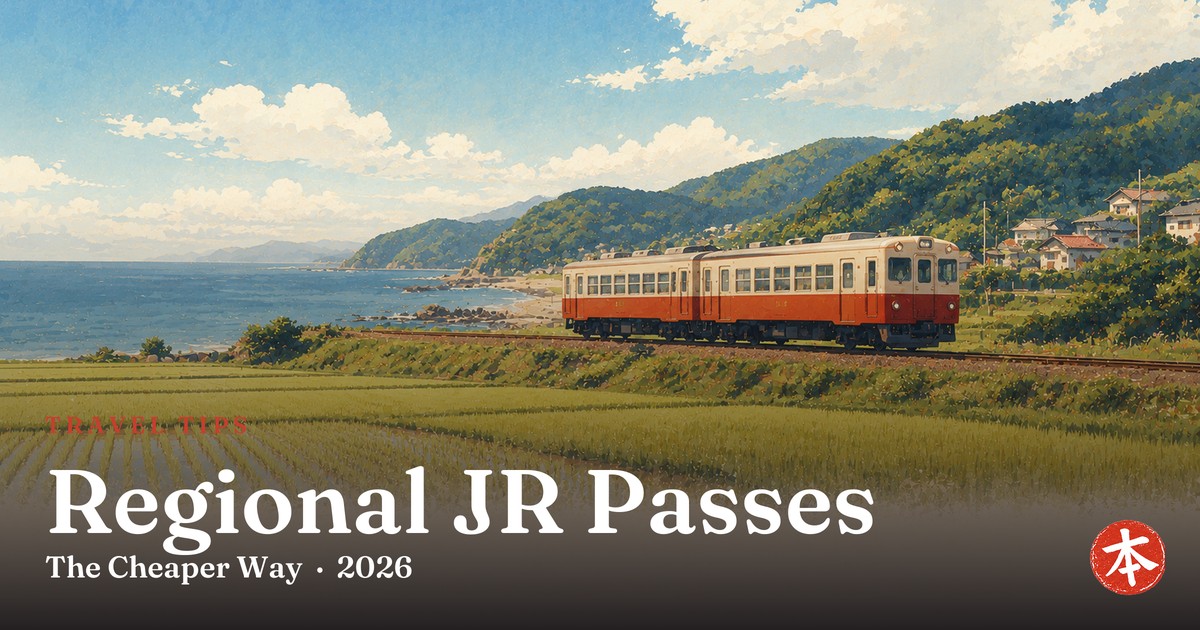
Quick answer: if your trip stays inside one region of Japan, a regional JR pass will almost always beat the ¥50,000 nationwide JR Pass — often by a huge margin. A 3-day JR TOKYO Wide Pass is ¥16,000; a 3-day Kansai Area Pass is ¥5,800. You only need the nationwide pass if you're genuinely crossing the country end to end.
The catch is that Japan's railways are split among six JR companies, and each regional pass only works on its own company's turf. Get the geography right and you save a small fortune; get it wrong and you end up buying single tickets anyway. This guide lays out the main passes side by side, the bullet-train coverage that trips people up, and which pass wins for common routes — updated for the October 2026 price change.
Regional JR passes at a glance
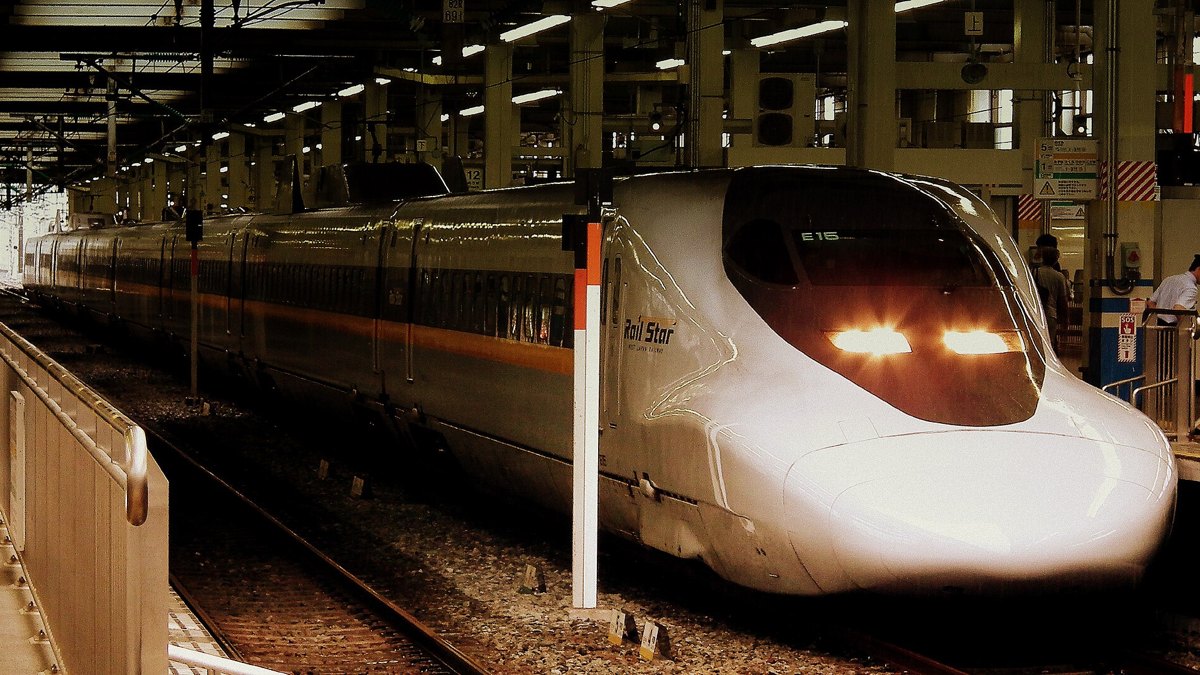
Adult prices, as of July 2026. "Shinkansen" shows which bullet-train sections the pass covers — the single biggest thing to check, because no regional pass covers the Tokaido Shinkansen (the Tokyo–Nagoya–Osaka line).
| Pass | Operator | Adult price | Days | Shinkansen coverage |
|---|---|---|---|---|
| JR TOKYO Wide Pass | JR East | ¥16,000 (child ¥8,000) | 3 | JR East lines incl. GALA Yuzawa; not Tokaido |
| JR EAST PASS (5-day) | JR East | ¥35,000 | 5 | All JR East Shinkansen; not Tokaido |
| JR EAST PASS (10-day) | JR East | ¥50,000 | 10 | Same as above |
| Kansai Area Pass | JR West | ¥2,800 / ¥4,800 / ¥5,800 / ¥7,000 | 1 / 2 / 3 / 4 | None (HARUKA reserved seat twice) |
| Kansai WIDE Area Pass | JR West | ¥12,000 | 5 | Sanyo: Shin-Osaka ⇄ Okayama |
| Okayama-Hiroshima-Yamaguchi | JR West | ¥17,000 | 5 | Sanyo: Okayama ⇄ Hakata; Miyajima ferry included |
| All Kyushu Area Pass | JR Kyushu | ¥22,000 / ¥24,000 / ¥26,000 | 3 / 5 / 7 | Kyushu + West Kyushu Shinkansen; not Hakata–Kokura |
| Northern Kyushu Pass | JR Kyushu | ¥15,000 / ¥17,000 | 3 / 5 | Hakata–Kumamoto only; 6 reserved seats |
| Southern Kyushu Pass | JR Kyushu | ¥12,000 | 3 | Kumamoto–Kagoshima-Chuo only; 6 reserved seats |
| Hokkaido Rail Pass | JR Hokkaido | ¥22,000 / ¥28,000 / ¥37,000 (+¥1,000 if bought at a station) | 5 / 7 / 10 | Limited expresses; not the Hokkaido Shinkansen |
| Mt. Fuji–Shizuoka Mini Pass | JR Central | ¥6,500 | 3 | None (local limited-express non-reserved + bus + ferry) |
| Reference: Nationwide JR Pass | JR Group | ¥50,000 / ¥80,000 / ¥100,000 | 7 / 14 / 21 | Nationwide (NOZOMI/MIZUHO need a supplement) |
The October 2026 change pushes you toward regional passes
From October 1, 2026, the JR Group's price notice raises the nationwide pass's overseas-agency (Exchange Order) prices by about 5–6%, while freezing the official-online price for a limited time. That mainly affects the ¥50,000 nationwide pass — but it widens an already large gap. When the whole-country pass gets pricier and a single-region trip never needed it in the first place, the regional passes look better than ever. If you're still weighing the nationwide option, run your route through the break-even math in our full JR Pass guide and the before/after numbers in the price breakdown first.
JR East just reshuffled its passes — ignore older guides
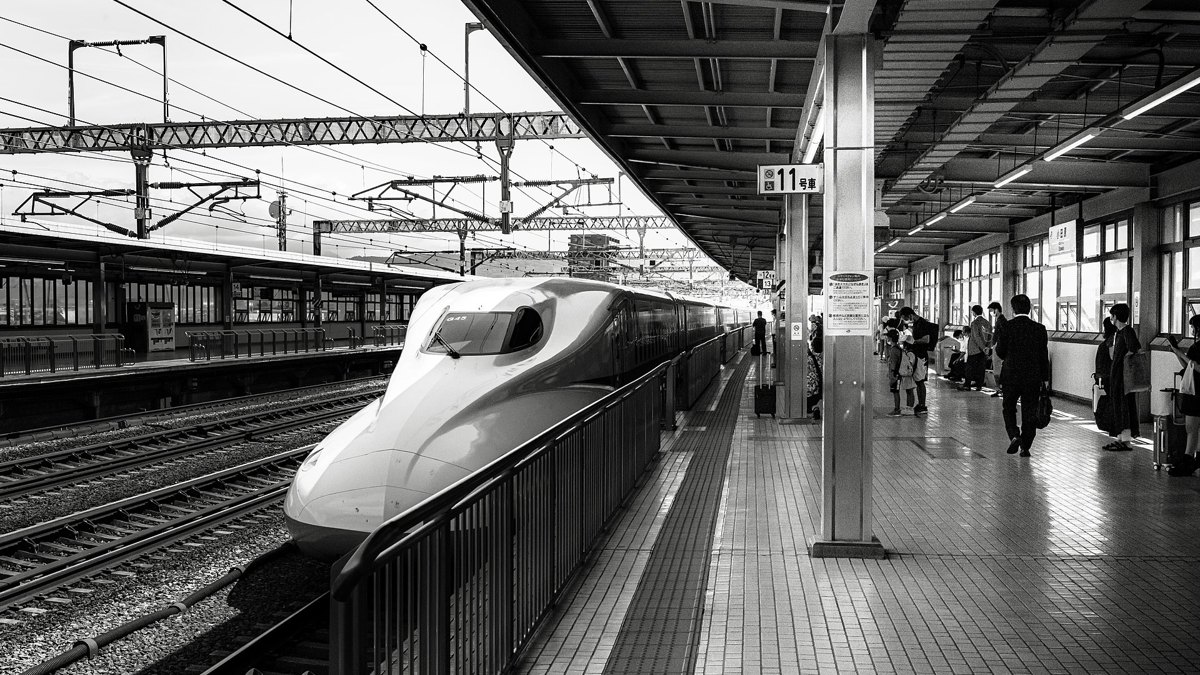
JR East retired its separate Tohoku and Nagano/Niigata area passes and replaced them with a single JR EAST PASS, sold as 5-day (¥35,000) and 10-day (¥50,000) versions covering the entire JR East area. The 3-day JR TOKYO Wide Pass (¥16,000) stays as the short-trip option for Tokyo and nearby. A lot of travel articles still list the old passes by name, so this is one to verify on the official site rather than trust to a two-year-old blog. JR East even publishes its own worked example: the Tokyo Wide Pass pays off against roughly ¥21,500 of normal fares, and the JR EAST PASS beats about ¥52,000 on a Tokyo–Sendai–Shin-Aomori loop.
Which regional pass wins for your route
The passes only make sense mapped to an actual itinerary. A few common ones, using official prices:
- Tokyo + Nikko / GALA Yuzawa day trips: the JR TOKYO Wide Pass (¥16,000) — roughly a third of the nationwide pass, and enough for the day trips most first-timers actually take.
- Kansai only (Kyoto–Osaka–Nara): a 3-day Kansai Area Pass is just ¥5,800 — about one-ninth of the nationwide pass. For airport runs it even throws in two HARUKA reserved seats.
- Osaka → Hiroshima → Fukuoka: pair the Kansai WIDE (¥12,000) with the Okayama-Hiroshima-Yamaguchi pass (¥17,000) — about ¥29,000 total, versus buying the nationwide pass just to ride one corridor.
- Touring Kyushu: the 7-day All Kyushu Area Pass is ¥26,000 — around half of what those same trains cost individually.
- Hokkaido: the 5-day Hokkaido Rail Pass (¥22,000) narrowly beats about ¥23,140 of normal fares — a thin margin, so it only pays off if you're moving between cities most days.
The Shinkansen catch, spelled out
Region-by-region details worth knowing
Kansai (JR West)
The Kansai family scales cleanly by day — ¥2,800 / ¥4,800 / ¥5,800 / ¥7,000 for 1 to 4 days — and the standard Kansai Area Pass includes two reserved seats on the HARUKA airport express, which is the exact train most visitors take from Kansai Airport. It doesn't cover any Shinkansen; step up to the Kansai WIDE (¥12,000, 5 days) if you want the Shin-Osaka–Okayama bullet-train leg.
Kyushu (JR Kyushu)
Three tiers: All Kyushu (¥22,000/¥24,000/¥26,000 for 3/5/7 days), Northern Kyushu (Hakata–Kumamoto, ¥15,000/¥17,000) and Southern Kyushu (Kumamoto–Kagoshima-Chuo, ¥12,000). The regional versions cap you at six reserved seats, and remember the Hakata–Kokura Shinkansen gap noted above.
Hokkaido (JR Hokkaido)
Two quirks catch people out. First, the pass costs ¥1,000 more if you buy it at a station rather than reserving ahead. Second, JR Hokkaido's limited expresses are entirely reserved-seat with no non-reserved cars, so seat reservations aren't optional. The pass does not cover the Hokkaido Shinkansen.
Mt. Fuji area (JR Central)
JR Central runs a set of tourist passes — the Mt. Fuji–Shizuoka Mini Pass is ¥6,500 for 3 days, covering local limited-express non-reserved seats plus buses and a ferry, but no Shinkansen. One oddity: reservations for JR Central's tourist passes are handled through the JR-WEST online reservation site, which surprises people expecting a JR Central page.
Buying, picking up and refunds
Eligibility mirrors the nationwide pass: you buy as a foreign visitor and pick up with a passport carrying the "Temporary Visitor" stamp. Most regional passes can be bought after you arrive — at station ticket offices or machines — and several are a little cheaper bought online in advance. On refunds, JR West charges a 10% fee (minimum ¥220) before use, and no refund is possible once a pass is activated; other JR companies are broadly similar but set their own terms. If you decide the nationwide pass fits after all, our official-website guide covers buying it the cheapest way.
(For Nikko the useful pass is not a JR one at all. We break down which of the two area passes is worth it, and the traps in both.)
(Which pass reaches which line is laid out in our shinkansen map guide, including the Hokkaido pass that cannot be used on the Hokkaido Shinkansen.)
(For the Kanto-east area specifically, our Tokyo Wide Pass guide covers the three-day window, the routes it does and does not include, and how to pick it up on arrival.)
(Planning the Hokuriku end of a trip? Our Kanazawa map guide covers the buses, the airport link and which rail connections actually still run.)
FAQ
Are regional JR passes cheaper than the nationwide JR Pass?
Can I use a regional JR pass on the Shinkansen?
Which regional pass is best for a first trip?
Did JR East change its passes?
Do I have to buy regional passes before arriving in Japan?
Can I get a refund on a regional JR pass?
Timing a trip around the blossoms? A regional pass is the cheapest way to chase the bloom front north — see our guide to sakura full bloom timing.
Bottom line (2026) — The ¥50,000 nationwide JR Pass rarely pays off for a single-region trip. Regional passes – Tokyo Wide, Kansai, all-Kyushu, Hokkaido and others – are cheaper, and the deciding factor is which shinkansen sections each one covers. Eligibility mirrors the nationwide pass: buy as a foreign visitor and pick up with your passport.
Sources
Official JR company pass pages and the JR Group price-change notice (PDF, April 2026), all checked July 27, 2026: JR East (TOKYO Wide Pass, JR EAST PASS), JR West (Kansai Area / Kansai WIDE / Okayama-Hiroshima-Yamaguchi), JR Kyushu (All / Northern / Southern), JR Hokkaido (Hokkaido Rail Pass) and JR Central tourist passes. Prices and covered sections change — the official page for each pass is the live source, so confirm there before buying.
Both the JR EAST PASS and the TOKYO Wide Pass cover the Narita Express into Tokyo.
Planning around the blossoms? See the best cherry blossom spots in Japan.
Some links on this page may be affiliate links, which means we may earn a commission if you book or buy through them — at no extra cost to you. See our affiliate disclosure.
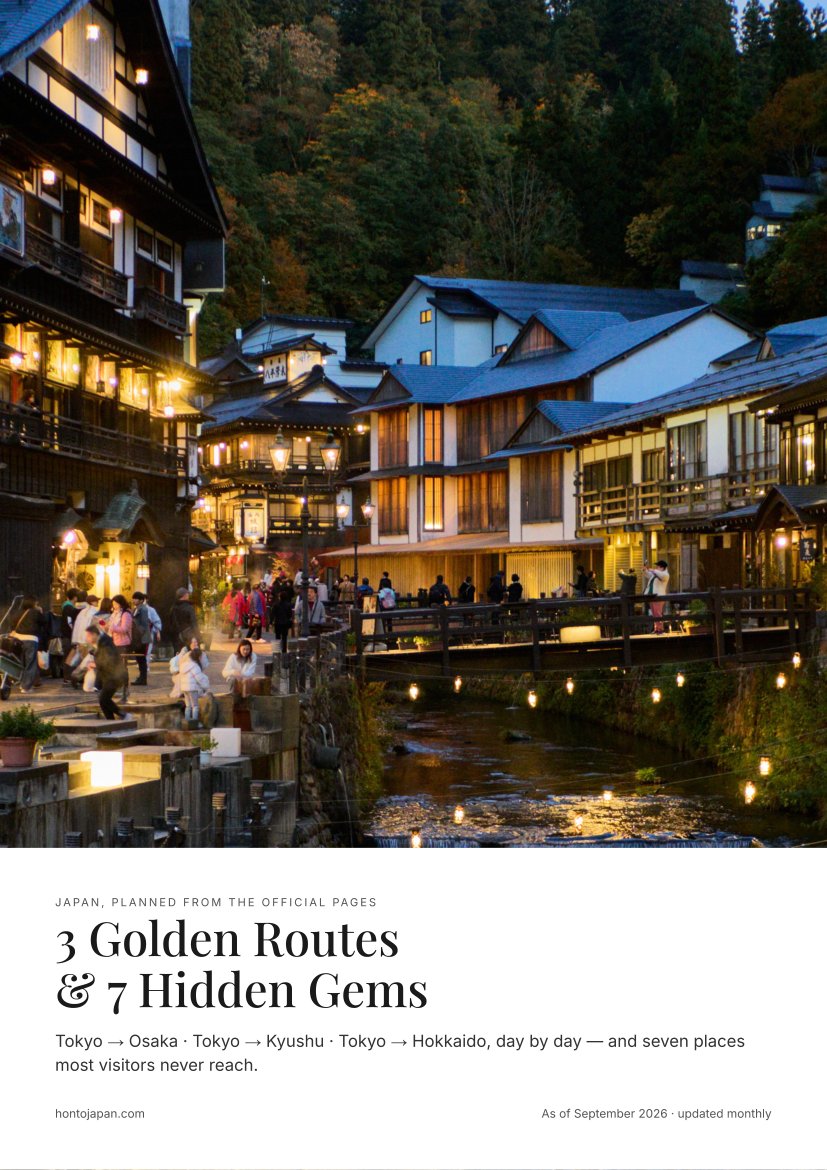
Tokyo to Osaka, Tokyo to Kyushu, Tokyo to Hokkaido — day by day — plus seven places most visitors never reach.
- 12 pages, 80 photographs, every stop linked to its guide
- Every price and opening hour read from the official page
- Re-issued monthly, so it does not go stale in your inbox
Free. One email a month, plus the rare change that matters. Unsubscribe with one click in any email. By subscribing you agree to our privacy policy.