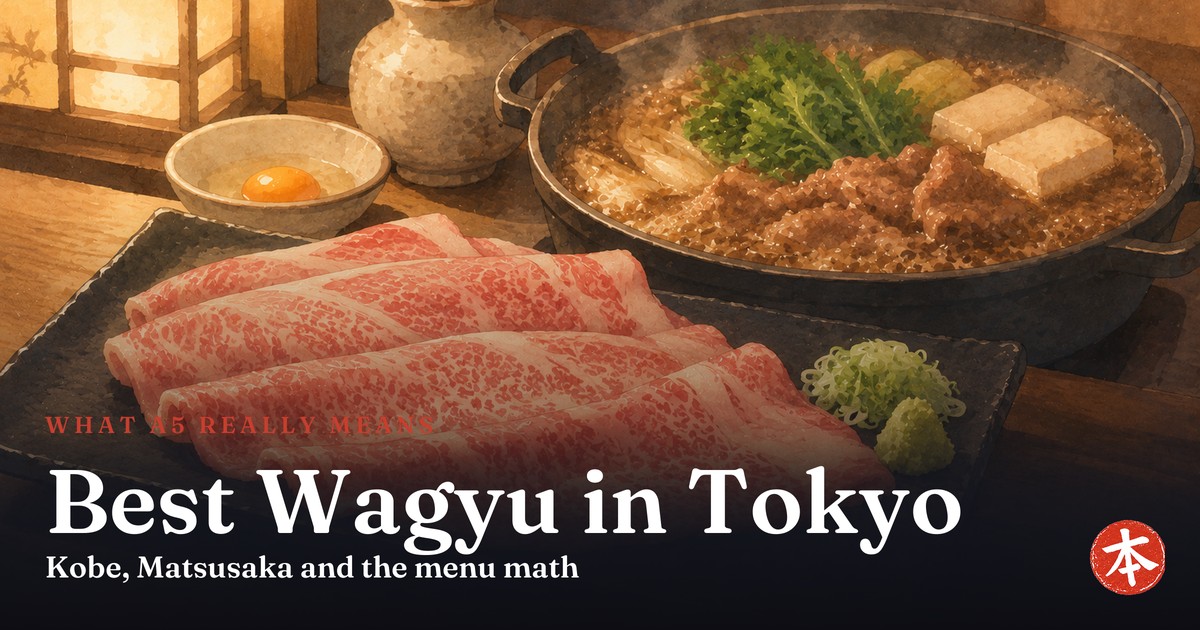
Wagyu is the most mythologized food in Japan, and the myths cost travelers real money. So before the restaurants, three official corrections: A5 is a yield-and-marbling grade, not a flavor guarantee; Kobe is one strictly certified brand (about 7,000 head a year), not a synonym for wagyu; and Matsusaka beef has no grade requirement at all — its rules are about breed and birthplace. With the definitions straight, Tokyo's wagyu ladder is gloriously walkable: a ¥5,390 sukiyaki lunch at a house from 1895, up to a ¥55,000 certified-Kobe teppanyaki course in Ginza.
Wagyu in Tokyo at a glance
| Style | Where (official prices, Aug 2026) |
|---|---|
| Sukiyaki lunch (entry) | Asakusa Imahan — lunch zen ¥5,390 · est. 1895 · female-only Japanese Black |
| Sukiyaki dinner | Asakusa Imahan gozen ¥9,680 / top kaiseki ¥18,700 (+10% service over ¥5,500) |
| Contrarian sukiyaki | Chinya (Asakusa) — "appropriately marbled" 30-month female wagyu · prices not published |
| Hotel teppanyaki | Imperial Hotel "Kamon" — lunch from ¥9,900, dinner from ¥31,000 |
| Ginza teppanyaki | Ginza Ukai-tei — lunch ¥13,200 · courses ¥27,500–38,500 · Kobe-beef special ¥55,000 (+13% service) |
| Grill-your-own | Yakiniku — its own ladder from ¥690 solo grills up; see our yakiniku guide |
Kobe, Matsusaka and kuroge wagyu side by side — what the differences look like on the plate:
Decoding the labels: A5, wagyu, and the words that lie
What does A5 really measure?
Per the official grading standard, the letter grades yield — A, B or C, meaning how much sellable meat the carcass produces, which affects your dinner not at all — and the number grades quality on a 1–5 scale, judged on marbling, meat color, firmness and texture, and fat quality. So "A5" compresses to: maximum marbling, top visual quality. It says nothing about breed, brand, feeding or flavor balance. The breed question is separate and officially crisp: wagyu means four Japanese breeds — Japanese Black, Brown, Shorthorn and Polled — while kokusan-gyu ("domestic beef") only means raised in Japan, any breed at all. Menus that flash "A5" and "wagyu" are telling you two true, narrow things; the interesting information — brand, cut, feeding — is in the fine print.
Kobe vs Matsusaka: what the certificates actually say
Why is real Kobe beef so rare?
Because the official bar is brutal: Tajima-strain cattle from Hyogo's closed bloodline, virgin or steer, graded A or B at level 4+, marbling score BMS 6 or higher, carcass weight capped at 499.9kg — and only about 7,000 head a year clear it. Everything sold abroad as "Kobe-style" skips all of this. Matsusaka plays a different game: its official definition demands virgin female Japanese Black cattle, individual registration, and a career spent longest-and-last in the designated Matsusaka area — but no grade minimum whatsoever. The famous "Special Matsusaka" (Hyogo calves fattened 900+ days) is around 4% of output. One more official myth-check: the beer-and-massage stories are waved off by the Kobe council itself — the magic is breeding and time, not spa treatment.
The formats: sukiyaki, teppanyaki, and where yakiniku fits
Heavily marbled beef is rich by design, so the serving format is a decision about dosage. Sukiyaki — thin slices in sweet soy warishita, dipped in raw egg — is the classic frame for maximum marbling in small, devastating quantities. Shabu-shabu swishes the same slices through kombu broth for a lighter read. Teppanyaki is the chef's medium: thick cuts, precise sear, served in course form. Yakiniku hands you the tongs and rewards ordering breadth over one hero cut — it has its own price ladder, mapped in our Tokyo yakiniku guide. If your trip has room for one high-marbling meal, spend it on sukiyaki or teppanyaki; the fat does more per gram there.
The restaurants: officially priced, English-ready
Where should the sukiyaki pilgrimage go?
Asakusa Imahan (Kokusai-dori honten) is the working answer: founded 1895, officially committed to female-only Japanese Black beef, open every day 11:30–21:30, with an official English page and printed prices — lunch zen at ¥5,390, the marbled dinner gozen at ¥9,680, the top kaiseki at ¥18,700, plus 10% service on bills over ¥5,500 (reserve by phone). A few blocks east, Chinya by Komagata is the connoisseur's counterpoint: its official philosophy is teki-sashi — "appropriate" marbling rather than maximum — from 30-month female wagyu, bookable in English via TableCheck (course prices live in its reservation PDFs, not on the site, so we don't quote them). Note for name-collectors: Ningyocho Imahan is a separate company from Asakusa Imahan — famous in its own right, 12% service charge, currently revising its menu prices for September, which is why we cite its structure and not its numbers.
And the teppanyaki splurge?
Two officially priced routes. The Imperial Hotel's Kamon (main building, 17th floor) runs teppanyaki lunch from ¥9,900 and dinner from ¥31,000 — hotel polish, hotel English. Ginza Ukai-tei, in a jewel-box room on Ginza 5-chome, publishes its whole ladder: lunch course ¥13,200, signature courses at ¥27,500 and ¥38,500, and the seasonal special at ¥55,000 built around certified Kobe beef (two people minimum, three days' notice, 13% service) — its English site states plainly that top-grade Japanese Black beef anchors every course. For the meat meal at the opposite end of the formality scale, our tonkatsu guide covers Tokyo's breaded-pork masters, and the food tour guide is the pick if you'd rather have a local sequence the whole evening.
(The other great splurge protein: Tokyo's historic unagi houses — real menus, service charges, and the day the most famous one closes.)
(For wagyu cooked at the table in a sweet soy broth: our sukiyaki in Tokyo guide compares eight restaurants, from a 2,750 yen weekday lunch to a 26,000 yen Matsusaka beef course.)
FAQ
What does wagyu actually mean?
Is A5 wagyu the best?
What makes real Kobe beef different?
Is Matsusaka beef all A5?
How much does a wagyu dinner cost in Tokyo?
What’s the cheapest way to try great wagyu?
Sukiyaki, shabu-shabu, teppanyaki or yakiniku — which is best for wagyu?
Do these restaurants speak English? Do I need to book?
Are the ‘beer-fed, massaged cows’ stories true?
Which one restaurant would you pick for a first wagyu splurge?
Bottom line (2026) — A5 is a yield-and-quality grade, not a flavor guarantee; Kobe beef is a certified subset (Tajima strain, A/B grade 4+, BMS 6+, about 7,000 head annually); and Matsusaka has no grade requirement at all. Format is a dosage decision — sukiyaki, teppanyaki, or yakiniku — with restaurants in Tokyo starting from ¥5,390.
Sources
Grading definitions (A/B/C yield grades, 1–5 quality grades and their four judging criteria): the Japan Meat Grading Association's official carcass grading standard. The four-breed wagyu definition, the domestic-beef distinction, the Kobe beef certification rules (Tajima strain, A/B grade 4+, BMS 6+, carcass limits), the ~7,000-head annual figure and the official response to feeding myths: the Kobe Beef Marketing & Distribution Promotion Association's official definition and FAQ pages. Matsusaka rules and the Special Matsusaka figures: the Matsusaka beef council pages on the Matsusaka city official site. Restaurant facts — Asakusa Imahan's prices, hours, founding and service charge; Chinya's teki-sashi philosophy; Imperial Hotel Kamon's course floors; Ginza Ukai-tei's course prices, Kobe-beef special and 13% service —: each restaurant's official pages, all read on August 12, 2026. Prices are tax-included as listed and change; service charges are additional where noted. The embedded video is by its creator.
Tokyo to Osaka, Tokyo to Kyushu, Tokyo to Hokkaido — day by day — plus seven places most visitors never reach.
- 12 pages, 80 photographs, every stop linked to its guide
- Every price and opening hour read from the official page
- Re-issued monthly, so it does not go stale in your inbox
Free. One email a month, plus the rare change that matters. Unsubscribe with one click in any email. By subscribing you agree to our privacy policy.