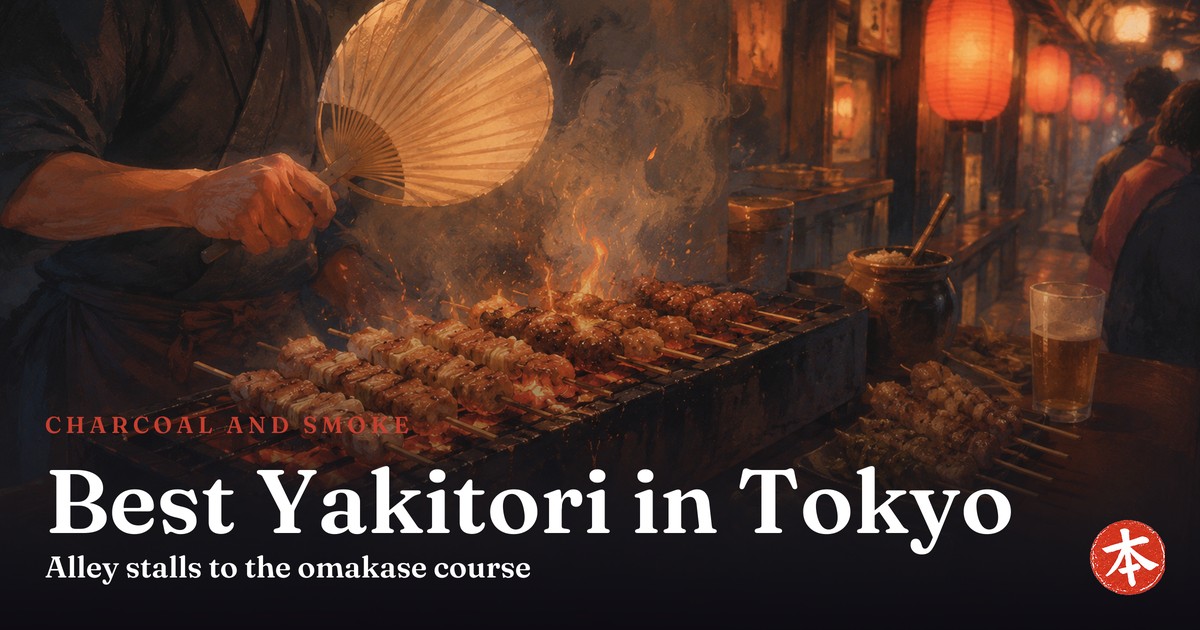
Yakitori is Tokyo's most democratic luxury: the same charcoal-grilled chicken skewer exists as a few-hundred-yen chain item, a smoky alley-stall supper, and a ¥10,450 omakase course — officially priced — in Gaienmae. It's also the genre where guides recycle the stalest "facts": the famous one-price chain no longer publishes its price (and is quietly testing non-uniform pricing), and Omoide Yokocho holds about 60 eateries, not the "300 bars" of legend. Here's the ladder as the official pages actually describe it.
Tokyo yakitori at a glance: the ladder
| Tier | Name | Official facts (Aug 2026) |
|---|---|---|
| Atmosphere | Omoide Yokocho (Shinjuku) | ~60 eateries / ~80 businesses (association figure) · hours vary by stall · official English site |
| Budget chain | Torikizoku | Uniform-price branding · no table/seat/late-night charges · 🚨 price not published (July 2026 release cites ¥390 items) · Shizuoka non-uniform test since Apr 2026 |
| Regional chains | Akiyoshi · Daikichi | Akiyoshi: 11 Tokyo shops (Fukui original) · Daikichi: 48-year franchise · prices per branch |
| Old-school specialist | Isehiro (Kyobashi) | Founded 1921 · lunch 11:30–14:00, dinner 17:00–21:00 · closed Sun & holidays |
| Course omakase | Yakitori Imai (Gaienmae) | Courses ¥8,800 / ¥10,450 · weekday dinner only · English booking via TableCheck |
What a serious charcoal counter looks like in motion:
The alley tier: Omoide Yokocho, corrected
How big is it really?
Smaller and better than the legend. The merchants' association — which runs an official English site — counts about 60 eateries, mostly yakitori and motsuyaki grills, among roughly 80 businesses on a plot of about 630 tsubo (a couple of thousand square meters) hard against Shinjuku Station's west exit. The "300 bars" number that stalks the internet describes nothing that exists. Practicalities the association leaves to each stall: hours, seating and payment all vary, so treat it as a crawl — one round of skewers and a drink per stop — rather than a dinner reservation. It's the smoke-and-lantern version of the experience; for the sit-down drinking-food canon around it, our izakaya guide is the companion read.
The budget tier: Torikizoku and the one-price asterisk
Is the famous uniform price still true?
The branding is intact: Torikizoku officially calls itself "the all-uniform-price yakitori restaurant" and pledges no otoshi (table snack) charge, no seat charge, no late-night surcharge — three fees that quietly pad most izakaya bills. The number itself has gone shy: the brand site no longer prints the price anywhere (we checked the raw pages), and the only current official figure is ¥390 including tax on a July 2026 limited-menu release. More telling for the future: since April 2026 the company has been running a non-uniform pricing test at five Shizuoka stores. Tokyo branches remain one-price as of our check — just read the menu for today's number, and note that stores in opening-sale periods don't take reservations. Between the alley and the chain sit two regional names worth knowing: Akiyoshi, the Fukui institution with 11 Tokyo shops from Ueno to Ginza, and Daikichi, the 48-year-old franchise whose neighborhood grills dot the suburbs — neither publishes prices, both run cheap and local.
The specialist tier: a century of chicken
Where do you taste the old school?
Isehiro in Kyobashi has grilled chicken as a specialist since 1921 — Taisho-era credentials, a business-district address, and a rhythm to match: lunch 11:30–14:00, dinner 17:00–21:00 (Saturdays to 20:30), closed Sundays and holidays. No English page, no published prices, phone reservations — the friction is the authenticity. Lunch is the visitor's move: the century-old craft at its most accessible hour. One honest omission from this tier: Torishiki, the Meguro icon, is absent because we couldn't verify a working official site to check a single fact against — and this guide doesn't print hearsay.
The course tier: Yakitori Imai
At the top, yakitori becomes a tasting menu. Yakitori Imai in Gaienmae prints its prices officially — the Imai course at ¥8,800, the omakase at ¥10,450 — and runs weekday dinners only (17:30–22:30, closed Saturday and Sunday). The visitor-friendly part is structural: the official site routes overseas guests to an English TableCheck reservation page, which makes one of Tokyo's serious chicken counters also one of its easiest high-end bookings. Order nothing; that's the format — the chef sequences the bird from delicate to rich. If your trip already includes a wagyu night from our yakiniku guide, Imai is the poultry rebuttal: same charcoal, opposite philosophy.
Playbook: ordering, timing, and the crawl strategy
Order in waves — two or three skewers per person per round; the grill rewards patience. Calibrate with momo (thigh) in both tare and shio, then branch to tsukune, kawa and one organ cut. Time it Japanese-style: chains and alleys peak 19:00–21:00; going at 17:30 buys you the counter seats. Cash still matters at alley stalls, whatever the chains take. And if you'd rather have the whole evening sequenced by someone who knows the stalls, a guided food tour — several run through the yokocho districts — solves the first-night problem in one booking.
(At the other end of the scale, our Torikizoku guide covers the chain where every skewer and every drink costs the same 390 yen.)
(For chicken in a pot instead: our chanko nabe in Tokyo guide notes that Chanko Edosawa simmers its soppu-daki broth from the bones of old hens, with chicken chanko at 2,508 yen with tax per portion.)
FAQ
What exactly is yakitori?
Where should a first-timer go for the atmosphere?
Is Torikizoku really all one price?
How much does high-end yakitori cost?
What about the famous old-school shops?
Is Toriki… I mean, what happened to Torishiki?
Are chicken wings at Yamachan the same thing?
Do yakitori restaurants take reservations?
What should I actually order first?
Is yakitori expensive in general?
Bottom line (2026) — Tokyo yakitori runs from Omoide Yokocho’s roughly 60 eateries (not 300) to a ¥10,450 omakase course at Yakitori Imai in Gaienmae. Torikizoku‘s uniform-price branding no longer publishes the figure; a ¥390 limited-menu figure and a Shizuoka non-uniform pricing test (April 2026, five stores) come from its official releases.
Sources
Torikizoku's uniform-price branding and no-charge policy: its official brand site; the ¥390 limited-menu figure and the Shizuoka non-uniform pricing test (April 2026, five named stores): its holding company's official July 2026 and March 2026 press releases; the reservation exception for sale-period stores: the official FAQ. Yakitori Imai's course prices, hours and English booking route: its official site and menu. Isehiro's founding year, hours and closures: its official site. Omoide Yokocho's shop counts and area: the Shinjuku West Exit merchants' association official site (Japanese and English). Akiyoshi's Tokyo store count and Daikichi's franchise facts: their official sites. All read on August 12, 2026; prices are tax-included as listed and can change. The embedded video is by its creator.
Tokyo to Osaka, Tokyo to Kyushu, Tokyo to Hokkaido — day by day — plus seven places most visitors never reach.
- 12 pages, 80 photographs, every stop linked to its guide
- Every price and opening hour read from the official page
- Re-issued monthly, so it does not go stale in your inbox
Free. One email a month, plus the rare change that matters. Unsubscribe with one click in any email. By subscribing you agree to our privacy policy.