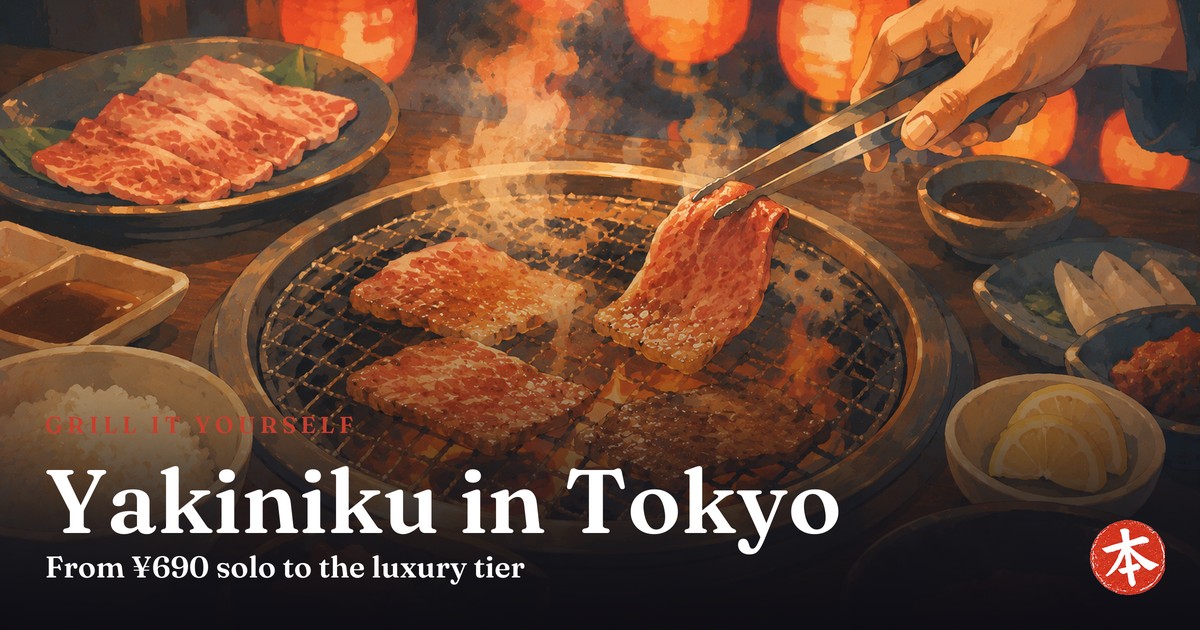
Yakiniku — Japan's grill-it-yourself barbecue — is the meal visitors most often get wrong on price, in both directions. Some skip it thinking it's a splurge; others walk into a luxury house expecting chain prices. The official 2026 numbers span ¥690 to ¥24,800, and this guide sorts the ladder rung by rung: the solo fast-food grill, the real all-you-can-eat tiers, the famous-name lunch trick, and the brand-new service-charge change at Jojoen that most guides haven't caught yet.
Tokyo yakiniku at a glance: the ladder
| Tier | Name | Official numbers (Aug 2026) |
|---|---|---|
| Solo fast food | Yakiniku Like | Sets from ¥690 · one smokeless roaster per seat · Shinjuku Kabukicho branch 24h |
| All-you-can-eat | Gyukaku | ¥3,058 / ¥3,718 / ¥4,158 courses, wagyu course ¥6,578 · 90 min |
| Famous-name luxury | Jojoen | Shibuya lunch from ¥3,200 · dinner courses ~¥15,000–27,000 · 🚨 service charge now 5% (Aug 7, 2026) |
| Visitor-friendly premium | Rokkasen (Shinjuku) | Courses ¥9,800–¥24,800 (top = Kobe beef) · English site & booking |
| Modern premium | Ushigoro | 6 Tokyo locations (Ginza, Omotesando…) · prices not published officially |
| Old-school wagyu | Heijoen (Asakusa) | Whole-wagyu buyer · by Kaminarimon Gate · 11:00–23:00, no closing days |
What the solo-roaster experience actually looks like, on camera:
How yakiniku works (and how it differs from Korean BBQ)
What am I actually ordering?
Plates of raw, specific cuts — beef tongue as the traditional opener, then short rib (karubi), loin (rosu), and offal for the adventurous — which you grill yourself over a tabletop roaster and dip in tare sauce. The format descends from Korean grilling but evolved its own Japanese identity: à la carte pacing, wagyu at the top end, rice and soup as sides rather than a spread of banchan. Two useful mental models: it's the most controllable meal in Japan (you decide every portion and price increment), and it's the most social — which is why the solo-format chain below was genuinely news when it appeared.
¥690: the solo grill — Yakiniku Like
Is solo yakiniku actually normal here?
Normal enough to have its own chain. Yakiniku Like calls itself, in its own words, a "yakiniku fast-food restaurant" — one smokeless roaster per person, order by touch panel, sets starting at ¥690 including tax (a price floor the chain explicitly kept through its April 2026 menu renewal, while increasing meat volume). The Shinjuku Kabukicho branch runs 24 hours, year-round by policy with an official occasional-closure caveat — making it Tokyo's definitive 3 a.m. post-izakaya meal. One honesty note our checking turned up: the chain has no English site, whatever blogs claim about English menus — expect picture menus and a touch panel instead.
The all-you-can-eat tier: Gyukaku's real prices
What does 90 minutes of unlimited yakiniku cost?
Gyukaku publishes its course ladder officially, which almost no guide quotes correctly: ¥3,058 for the 50-item course, ¥3,718 for 70 items, ¥4,158 for the flagship Gyukaku course, and ¥6,578 for the kuroge wagyu course — tax included, 90 minutes with last order at 70. The official small print worth respecting: contents vary by branch and season, so book the specific store (reservations run through the chain's official store-search system) and confirm its menu rather than assuming the web prices are universal. As a value benchmark: the gap between the 50-item course and a la carte at a premium house is roughly 5x — this tier is where groups and big appetites should land.
The famous name: Jojoen — and its brand-new 5% rule
Is Jojoen affordable at all?
At dinner, no — its official English pages put kaiseki-style courses in the ¥15,000–¥27,000 band, and that's the occasion tier. At weekday lunch, surprisingly yes: the Shibuya branch officially lists yakiniku lunch at ¥3,200, mixed lunch at ¥4,200 and a premium set at ¥6,700 — the classic local trick for tasting a luxury brand at a third of the evening price (note the branch closes 16:00–17:00 on weekdays between services). The 2026 news: by official announcement, from August 7, 2026 the service charge is a flat 5% at every branch, replacing the old mixed 10%/5% system — so third-party pages still warning about "10% service" are out of date. Payment is traveler-friendly: cards plus Alipay+ and WeChat Pay, per the official English site.
The visitor-friendly premium: Rokkasen and the wagyu heavyweights
Where can I book high-end yakiniku entirely in English?
Rokkasen, on the 10th floor above Shinjuku's west exit, is the smoothest premium entry for visitors: the official site runs in four languages, booking works through TableCheck in English, and the official course prices are printed plainly — HOTARU at ¥9,800, HATSUNE at ¥13,800 (with Matsusaka sirloin), and the Kobe-beef TAMAKAZURA at ¥24,800. Open daily 11:00–23:00. Beyond it sit two houses that publish no prices online, deliberately: Ushigoro, the modern premium brand with six Tokyo locations from Ginza to Omotesando (Ginza: weekdays from 17:00, weekends from 11:30, no closing days), and Heijoen, the old-school operator that buys wagyu by the whole animal, whose Asakusa flagship sits steps from Kaminarimon Gate and serves 11:00–23:00 without a closing day — the natural lunch upgrade on an Asakusa sightseeing day. For both, trust their tier, not the prices on review sites.
Practical playbook: reserving, paying, grilling
Reservations scale with the tier: walk into Yakiniku Like, book Gyukaku through the official system for weekend evenings, and reserve the premium houses days ahead — Rokkasen in English via TableCheck, Jojoen via phone or its site. Charges: premium houses add service (now 5% at Jojoen officially; expect similar at peers), chains generally don't. Grilling: few pieces at a time, tongs for raw meat, and at the top tier let staff handle the expensive cuts. Pair this guide with our tonkatsu guide for the other great Japanese meat meal, the izakaya guide for the drinking-first version of a meaty evening, or a guided food tour if you want a local to order the first round of cuts for you.
FAQ
What exactly is yakiniku?
Can I eat yakiniku alone in Tokyo?
How much does all-you-can-eat yakiniku cost?
What is the most famous high-end yakiniku in Tokyo?
Which yakiniku restaurants in Tokyo have English menus?
How much should I budget for good wagyu yakiniku?
Do I need a reservation?
Is yakiniku the same as Korean BBQ?
What’s the etiquette — do I grill it myself?
Bottom line (2026) — Tokyo yakiniku runs from Yakiniku Like‘s ¥690 solo grill (kept through the April 2026 menu renewal; the Kabukicho branch is 24-hour) to Kobe-beef courses at ¥24,800. Gyukaku‘s official 90-minute all-you-can-eat tiers are ¥3,058/¥3,718/¥4,158/¥6,578, and Jojoen just added a 5% service charge.
Sources
Yakiniku Like's fast-food self-description, ¥690 entry price (kept through the April 2026 menu renewal) and the Shinjuku Kabukicho branch's 24-hour operation: the chain's official site and store page. Gyukaku's course prices (¥3,058/¥3,718/¥4,158/¥6,578, 90 minutes) and the branch-variation caveat: the official course-menu pages. Jojoen's Shibuya lunch prices, hours, dinner-course band, payment methods and the August 7, 2026 unification of service charges at 5%: Jojoen's official Japanese and English pages and its official August 2026 announcement. Rokkasen's course prices, languages and hours: its official English site. Ushigoro's locations and Ginza hours, and Heijoen's Asakusa flagship details: their official store pages. All read on August 12, 2026; prices include tax as officially listed and can change. The embedded video is by its creator.
Tokyo to Osaka, Tokyo to Kyushu, Tokyo to Hokkaido — day by day — plus seven places most visitors never reach.
- 12 pages, 80 photographs, every stop linked to its guide
- Every price and opening hour read from the official page
- Re-issued monthly, so it does not go stale in your inbox
Free. One email a month, plus the rare change that matters. Unsubscribe with one click in any email. By subscribing you agree to our privacy policy.