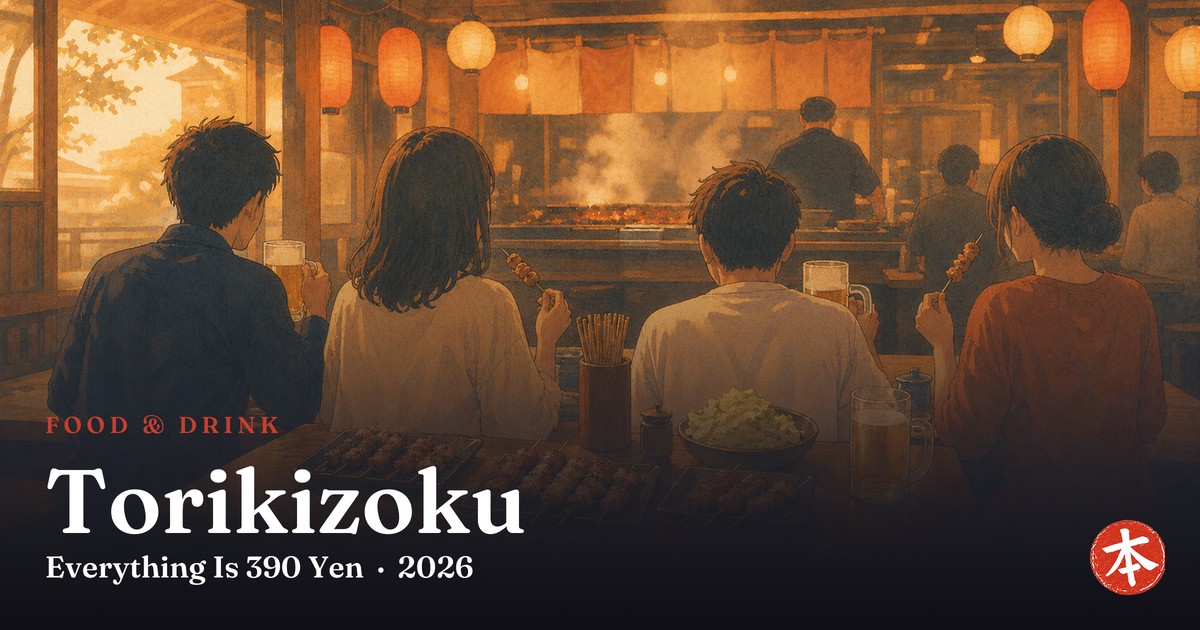
The izakaya is the hardest room in Japan for a visitor to walk into: no English, an unexplained charge on the bill, and no idea what anything costs until it arrives. Torikizoku removes all three problems at once. Every single item — food and drink alike — is 390 yen including tax. The tablet on your table switches to English, Korean or Traditional Chinese. And the chain states outright that it charges nothing for the compulsory appetizer, the seat, or late-night service — three fees that quietly inflate izakaya bills everywhere else. One warning before you go: Torikizoku's own English page still shows last year's prices in places.
Torikizoku at a glance
| Item | Official answer (Aug 2026) |
|---|---|
| Price | 390 yen incl. tax — every food item, every drink · since May 1, 2025 |
| 🚨 One exception | The recreated first branch in Higashi-Osaka is 350 yen flat |
| Yakitori portion | 2 skewers per order |
| 🚨 Otoshi / cover | None. No seating charge, no late-night charge either |
| Founded | 1985, Higashi-Osaka · parent company listed on the TSE Prime Market |
| Branches | 701 per the official store finder · English page says "over 600" |
| Hours | Typically 16:00/17:00 to midnight or 1am · many city branches to 4–5am |
| Ordering | Table tablet in English / Korean / Traditional Chinese |
| Age rule | Under-20s cannot enter alone (alcohol is served) |
| All-you-can-eat | 3,900 yen · 2 hours · 4+ adults, phone booking by the previous day |
Japanese television went inside the chain to ask how the flat price works (note: filmed when the price was 370 yen):
The price, and the three stale numbers on their own website
The one branch where it isn't 390
In 2025 the company rebuilt its first-ever branch — Shuntoku, in Higashi-Osaka, where it started in 1985 — and reopened it as a recreation, with a small free museum upstairs. That branch runs at 350 yen flat, and the company spells out that the 350-yen and 250-yen prices apply only there. (250 was the founding price, brought back for six days in May 2026.) So "everything is 390 yen" is true everywhere except the one place the chain began.
What 390 yen buys
For skewers, two of them — the company states that one portion equals two sticks, which is the number that makes the flat price legible. The chicken is domestic and skewered in the shop rather than bought in, and the tare sauce is unchanged since the founding. The thing to order first is Kizoku-yaki, the house skewer, in thigh or breast, with tare, salt or spice. Beyond that: chicken-skin, gizzard, heart, bonjiri, tsukune with cheese, and non-skewer plates like the karaage and the fluffy yam teppanyaki. Drinks run to about fifty, including mega jockeys, highballs, sours, wine and alcohol-free options — all at the same 390.
🚨 No otoshi: why this is the headline for a visitor
What you are being spared
At a standard Japanese izakaya you will be brought a small dish you did not order, called otoshi, and charged a few hundred yen per person for it. It functions as a cover charge, it is rarely explained in English, and it is the single most common source of "why is my bill higher than I calculated". Torikizoku's position is a flat sentence on its philosophy page: it does not charge for otoshi, for seating, or for late-night service. That third one matters more than it looks, because many Japanese bars add a late-night surcharge after 10pm or midnight — and Torikizoku is open well past both. If you want to understand the convention this chain is opting out of, our izakaya guide explains otoshi and how it normally works.
So what does an evening actually cost?
Arithmetic, for once, rather than estimation. Four skewer orders (eight sticks), two side plates and two drinks is eight items = 3,120 yen. Add a third drink and you are at 3,510. There is no service charge, no cover, and no seat fee to layer on top — the number you count is the number you pay, plus nothing. Compare that to the specialist yakitori restaurants where a set course starts several times higher, and the trade becomes clear: Torikizoku is not the best yakitori in Japan, it is the most predictable.
The practical mechanics
Ordering, and the four instructions everyone misses
Every table has a touchscreen with a language switch — English, Korean, Traditional Chinese, Japanese — and paper menus exist in the same languages with photographs. You never have to speak to a server to order. Four things the chain tells English readers that are easy to skip: cabbage refills are free; used skewers go in the skewer holder, not on the plate; empty plates can be stacked; and the clay-pot rice takes about 30 minutes, so order it at the start rather than the end. When you finish you pay at the counter, and you must carry your binder there — the bill does not come to the table.
Booking, seating, and going alone
You can reserve by phone, through the official site or via the app; the system is ebica, and Torikizoku's English site links a version you can complete in English. Two things follow from booking: you are on a two-hour limit from your reserved time, and branches running an opening promotion do not take reservations at all. On going solo: the chain has no private rooms — tables are divided by partitions only — and we can tell you that counter seating exists at every one of the sixty branches we sampled, typically eight seats. What we will not tell you is that solo diners are welcome or that walk-ins are guaranteed, because Torikizoku has never said either.
Hours, age and smoking
We pulled opening hours for all 701 branches from the official store finder. The pattern: open 16:00 or 17:00, close at midnight or 1am, with a meaningful cluster of city-center branches running to 4am or 5am. Daytime opening exists but is uncommon enough that the store finder has a filter for it, and closing days vary branch by branch. On age, the rule is firm and stated: people under 20 cannot come in unaccompanied, because alcohol is served; with an adult over 20 they are admitted on condition that no alcohol is served to them, and staff may ask for ID. On smoking, we have to be honest that no official policy statement exists. What does exist is a store-finder filter for branches with an indoor smoking booth — present at 18 of the 60 we sampled — so check your branch rather than assuming the room is smoke-free.
The all-you-can-eat deal, and who it excludes
Toriki Bansankai in full
3,900 yen a head, two hours, food and drink included. The conditions are where people come unstuck. You need four or more adults, counted from junior high school age — so three adults and a child does not qualify. It must be booked by phone, by the previous day; the online system does not take it. Last orders are 20 minutes before time, or 60 minutes for the clay-pot rice. The kitchen chooses your opening dishes, then you order freely. Leftovers from your extra orders are charged for, outside food and drink are not allowed, and nothing may be taken home. Arrive 15 minutes late and it counts as a cancellation; cancel on the day and you pay half per head. Elementary school children are half the adult rate and preschoolers are free.
Allergies, and the two things the company refuses to promise
The documentation is genuinely good: a bilingual allergen and nutrition PDF covering all 28 designated allergens item by item, updated August 2026, a searchable allergen filter on the site, and published country-of-origin information following the agriculture ministry's guidelines. The caveats are equally plain: everything is cooked in one kitchen so allergens may transfer, and utensils, tableware and the frying oil are not separated. And then the gap — there is no official statement about halal, vegetarian, vegan or gluten-free at all. Vegetable dishes exist (the free-refill cabbage, edamame, salted cucumber), but with a shared fryer we would not describe anything here as vegetarian-safe. One more current detail: six drinks have been suspended chain-wide since April 28, 2026 with no stated end date, so a menu photo from an older article may show things you cannot order. If you want the wider context of Tokyo's drinking streets, our Golden Gai guide covers the opposite end of the spectrum — tiny bars where a seat charge is the norm.
FAQ
How much is everything, exactly?
Wait, Torikizoku’s own English page says a different price?
Is there really no table charge?
What does 390 yen actually get you?
Can I go alone?
Do I need to book?
What is Toriki Bansankai?
Is it good for kids?
Can I eat here with allergies, or as a vegetarian?
How do I order without Japanese?
How late is it open?
Can I pay by card?
Bottom line (2026) — Torikizoku charges 390 yen (tax included) for every dish and drink, a flat price in effect since May 1, 2025. The chain states outright that it does not charge for the compulsory appetizer (otoshi), the seat, or late-night service – three fees that routinely catch visitors at ordinary izakaya. Note the chain’s other policies before assuming it works like any other izakaya.
Sources
The flat price and its full revision history: Torikizoku's dated price-revision PDFs on its official site, most recently the March 2025 notice effective May 1, 2025. The no-otoshi statement, portion size, private-room policy, reservation terms, age rule and all-you-can-eat conditions: the official Japanese site, its FAQ, and the English site. Allergen and nutrition data and the shared-kitchen caveats: the official allergen PDF, updated August 2026, and the allergen search page. Store count, opening hours, seating types and payment methods: the official store-finder's own data, covering all 701 branches for hours and a random sample of 60 for the rest. Corporate structure and listing: the company profile page and the parent group's corporate site. All read on August 24, 2026. The embedded video is by its creator.
Some links on this page may be affiliate links, which means we may earn a commission if you book or buy through them — at no extra cost to you. See our affiliate disclosure.
Tokyo to Osaka, Tokyo to Kyushu, Tokyo to Hokkaido — day by day — plus seven places most visitors never reach.
- 12 pages, 80 photographs, every stop linked to its guide
- Every price and opening hour read from the official page
- Re-issued monthly, so it does not go stale in your inbox
Free. One email a month, plus the rare change that matters. Unsubscribe with one click in any email. By subscribing you agree to our privacy policy.