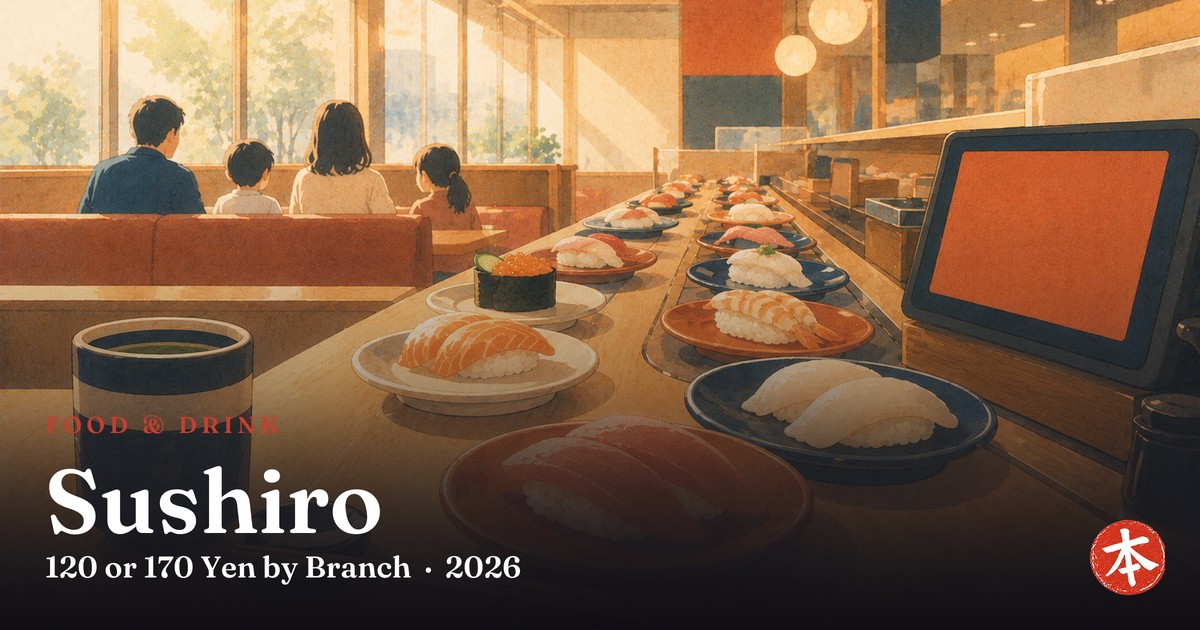
Every English guide gives Sushiro a single price. Sushiro does not have a single price. It has four, assigned by branch type — and the company is completely open about it, to the point of writing the price into the branch name in its own store finder. Suburban branches are 120 yen a plate. City-center branches are 150. Dotonbori and Kyoto Gion are 170. Which means the branches a visitor is most likely to walk into are almost all in the upper bands, and the number in your guidebook describes somewhere you would need a car to reach. Prices also rose on July 22, 2026, and the loyalty scheme every article describes ended in May.
Sushiro at a glance
| Item | Official answer (Aug 2026) |
|---|---|
| 🚨 Plate price | Four bands by branch: 120 / 130 / 150 / 170 yen, tax included |
| 🚨 Priciest branches | Dotonbori and Kyoto Gion — 170 yen |
| Last price change | July 22, 2026 — lean tuna 120 → 150 and up |
| Branches | 659 in Japan (as of Sept 30, 2025) |
| Founded | 1984, Toyonaka, Osaka · flat 100-yen format began 1996 |
| Tablet languages | English, Chinese (simplified), Korean + Japanese |
| 🚨 Reservations | Smartphone app only. Phone bookings are not accepted; PC not supported |
| 🚨 IC cards | Not accepted. "We do not accept electronic money" — official English site |
| Cards | Visa · Mastercard · JCB · Amex · Diners · Discover — all branches |
| Smoking | All branches, all seats non-smoking — heated tobacco included |
What ordering from the tablet actually looks like, filmed in-store:
🚨 Four prices, and how to know which one you are about to pay
The same fish, three prices
| Item (tax incl.) | Suburban (120 band) | City center (150 band) | Dotonbori (170 band) |
|---|---|---|---|
| Shrimp / squid / egg | ¥120 | ¥150 | ¥170 |
| Simmered conger eel | ¥140 | ¥170 | ¥190 |
| Selected lean tuna | ¥150 | ¥180 | ¥200 |
| Fresh salmon / albacore | ¥180 | ¥210 | ¥230 |
Roughly 40% between the cheapest and dearest bands on identical items. Ten plates that come to about 1,400 yen in a suburban branch land nearer 2,000 at Dotonbori. That is still inexpensive — but if you have budgeted from an article quoting 120 yen and you are eating in Osaka's most famous street, the gap is real. For the wider category and how the chains differ, see our conveyor-belt sushi guide, and if you want to compare directly, Kura Sushi and Hama Sushi price their menus on different logic again.
July 2026: the tuna went up
On July 15, 2026 the company announced a revision effective July 22. Selected lean tuna moved from 120 yen and up to 150 and up, with some other sushi and sides also revised, while salmon, squid and shrimp were explicitly held at 120 and up. The stated causes were logistics costs, labor costs and catch volatility, and the notice adds that the rice remains 100% domestic. The announcement closes with the sentence that governs this entire article: prices differ by branch, and you should check your branch's menu page.
Ordering, reserving, paying
The belt may be a screen — but read this carefully
Sushiro has a format called Digiro in which the conveyor experience is reproduced on a large touch display — sushi images scroll past and you tap what you want — with food arriving by a dedicated per-table lane called Auto Waiter, and a smaller version at counter seats. The company says rollout is "expanding" and publishes no number. Here is where we part company with most English coverage: there is no official announcement that physical belts have been removed. We read every company news item from 2015 to 2026. Sushiro's own commercial-property page still discusses belt length and layout. Digiro branches exist and are increasing — that is the honest ceiling of what anyone outside the company can say.
Reservations are app-only, and the 30-minute rule
The FAQ is unambiguous: phone reservations are not accepted, booking runs through the smartphone app, and PCs are not supported. Two branches are excluded. There are two modes — "going now" takes a queue number remotely, "going later" books a slot up to a month ahead — and both require account registration and login. The rule that bites: if you do not check in within 30 minutes, your booking cancels itself. The system is also offline daily from roughly 2am to 6am. Private hire and large group events are not accepted at all.
Your IC card will not work
This is the single most practical thing in this article. Sushiro's English site states: electronic money is not accepted. No Suica, no PASMO, no ICOCA, no iD or QUICPay — at a chain where everything else about the experience is frictionless. What does work: credit cards at every branch (Visa, Mastercard, JCB, American Express, Diners Club and, unusually for Japan, Discover), and thirteen QR services including Alipay and WeChat Pay — though the FAQ warns QR acceptance varies by branch, and named branches such as Universal CityWalk take only a subset. If you are relying on IC cards elsewhere in your trip, our Suica guide covers where they do and don't reach.
Allergies, diet, and what the chain will not promise
Well documented, clearly disclaimed
Sushiro publishes allergen PDFs in Japanese and English, both updated August 17, 2026, covering 28 items — the 8 legally required plus 20 recommended — and marking each dish twice over: ingredients actually used, and ingredients that merely share a production line. Dotonbori gets its own separate file because its menu differs. Calories are shown for every item. But the limits are stated as plainly as the data: allergens not originally in a dish may unintentionally transfer during factory production or in-store preparation, and the company asks you to consult a medical professional and decide for yourself. On nutrition beyond calories, the FAQ is blunt — salt and other nutritional content are not published.
The blank spaces
We searched the official site for vegetarian, vegan, halal, and for any offer to prepare dishes with allergens removed. Zero results, in Japanese and English alike. Sushiro makes no claim in any of these areas, and with cross-contact acknowledged in both the factory and the store, we are not going to build a recommendation the company declines to make. The same applies to wasabi-free ordering: widely asserted in English writing, entirely absent from the official site. Ask when you arrive. Two other things worth knowing: every branch is fully non-smoking, heated tobacco included, and menus vary regionally — tempura shrimp nigiri, for instance, is not sold in Aichi, Gifu, Mie or at Dotonbori. When you are in Osaka and weighing where to eat, our Dotonbori guide has the surrounding context — including why that particular branch charges what it does.
FAQ
How much is a plate at Sushiro?
How do I check my branch’s price before I go?
What does the price difference actually look like?
Did prices go up recently?
Is Sushiro still conveyor-belt sushi?
Can I reserve a table?
Can I pay with my Suica or IC card?
Is there an English menu?
Can I ask for sushi without wasabi?
What about allergies?
Is there vegetarian or halal food?
Do points still work the way guides describe?
Bottom line (2026) — Sushiro does not have one plate price; it has four bands set by branch type, from 120 yen in the suburbs to 170 yen in Dotonbori and Gion, and the branches visitors actually reach are almost all in the upper bands. Prices rose again on July 22, 2026, and the old Maido Point scheme has changed. Check the store-specific menu page before you go.
Sources
Branch price bands, per-item prices and the store-name price labels: Sushiro's official branch-specific menu pages and store-finder data, sampled across 110 branches. The July 2026 price revision: the company's official news release dated July 15, 2026. Reservation rules, payment methods, the points changeover, nutrition disclosure, smoking policy and private-hire policy: the official FAQ and the Sushiro app pages. Tablet languages and the electronic-money statement: the official English site. Allergen data and disclaimers: the official allergen PDFs in Japanese and English, updated August 17, 2026. Company history, branch count and listing status: the official corporate profile and history pages. All read on August 24, 2026. The embedded video is by its creator.
Some links on this page may be affiliate links, which means we may earn a commission if you book or buy through them — at no extra cost to you. See our affiliate disclosure.
Tokyo to Osaka, Tokyo to Kyushu, Tokyo to Hokkaido — day by day — plus seven places most visitors never reach.
- 12 pages, 80 photographs, every stop linked to its guide
- Every price and opening hour read from the official page
- Re-issued monthly, so it does not go stale in your inbox
Free. One email a month, plus the rare change that matters. Unsubscribe with one click in any email. By subscribing you agree to our privacy policy.