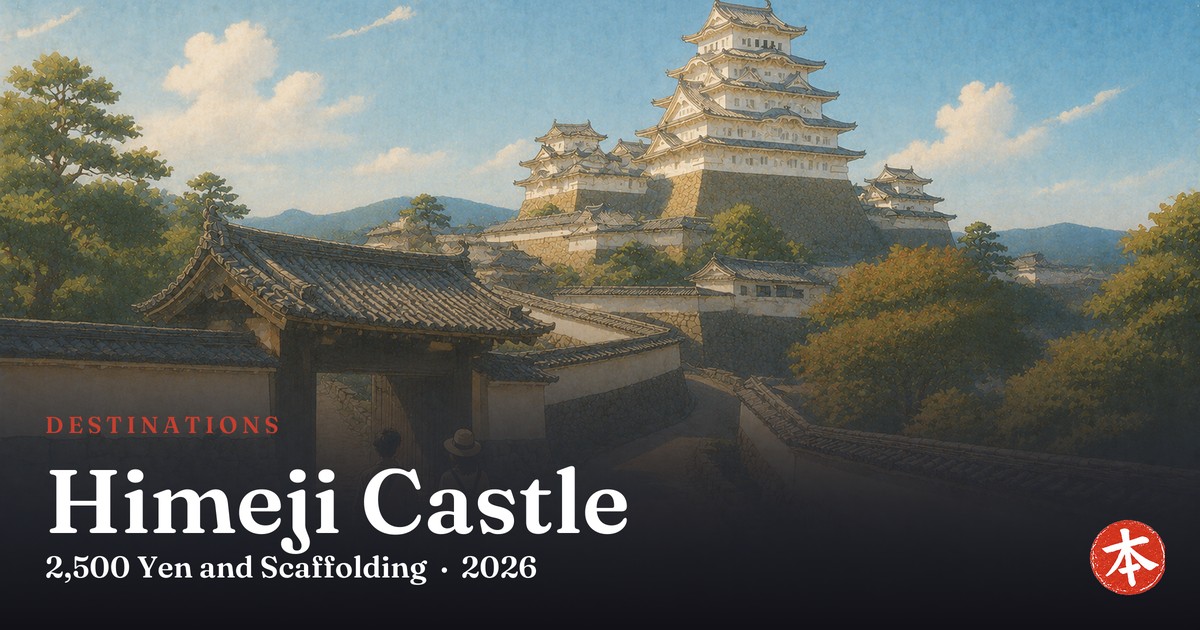
Two things changed at Himeji Castle in 2026, and between them they invalidate most of what is written about it in English. Admission went from 1,000 yen to 2,500 on March 1 — the combination ticket with Koko-en garden went from 1,050 to 2,600 — while under-18s became free. And since early July 2026 there has been scaffolding around the main keep, which the city says will stay until around late July 2027, affecting the view, the night illumination, and part of the courtyard where everyone takes the classic photograph. Neither fact appears in the guides currently ranking for this castle.
Himeji Castle at a glance
| Item | Official answer (Aug 2026) |
|---|---|
| 🚨 Admission (18+) | ¥2,500 — was ¥1,000 until Feb 28, 2026 |
| Under 18 | Free (was ¥300) · proof of age required |
| 🚨 With Koko-en | ¥2,600 — was ¥1,050 |
| Himeji residents 18–64 | ¥1,000 · 65+ free — by residence, not nationality |
| Hours | 9:00–17:00 · gate closes 16:00 · buildings close 16:30 |
| 🚨 Real deadline | Reach the keep entrance by 16:10 — 15 min walk from the gate |
| Closed | December 29–30 only · free entry on December 11 |
| 🚨 Scaffolding | July 2026 – around July 2027, around the main keep |
| 🚨 Reservations | None. Digital tickets do not skip the queue |
| Crowd cap | 1,000 people per hour into the main keep |
| Time needed | 90–120 minutes for everything · ~1 hour for the keep |
What the interior is actually like, including the steep stairs:
🚨 The price change, and the two-tier rate
Who pays 1,000 yen, and why it is not what it looks like
The reduced rate is for residents of Himeji City aged 18 to 64, with residents 65 and over admitted free on a city-issued card. This is worth stating precisely because it is easy to describe wrongly: it is a residence-based rate, not a nationality-based one. A foreign resident of Himeji pays 1,000 yen. A Japanese visitor from Tokyo pays 2,500, the same as a visitor from abroad. Proof of address is required at the window. Other reductions: disability certificate holders enter free with one carer — three carers if using a wheelchair — though the physical certificate is required and photos or copies are not accepted. A Loop Bus day pass gets you 10% off standard admission, though not the combination ticket. And on December 11, the anniversary of the UNESCO listing, entry is free — digital tickets are not sold for that date.
🚨 The scaffolding: what it affects and what it doesn't
Conservation work under the city's medium-term plan began in early July 2026 and is scheduled to run until around late July 2027. The structures involved — the Ni-no-yagura turret, the Mizu-no-ichi and Mizu-no-ni gates and adjoining walls — sit directly on the main route from the ticket gate to the keep. The city's own wording is unusually direct: the work affects the viewing environment, the appearance of the main keep, and the night-time illumination. It also notes that parts of the visitor route have been narrowed, and that work vehicles may be moving through.
The photograph you may not get
The detail worth knowing before you commit: part of Bizen-maru has been reserved as a storage area for construction materials. Bizen-maru is the courtyard at the foot of the keep — the spot the classic looking-up photograph is taken from. The keep itself is open and its interior is unaffected, so the visit still works; what is compromised is some of the exterior photography and the evening lighting. If the postcard shot is your whole reason for the trip, that argues for going after summer 2027. If you want to see the building, go now — with the caveat above about narrowed paths.
Timing, tickets and the queue nobody can skip
There is no reservation system
The official FAQ says it plainly: Himeji Castle has no reservation system, and when the keep is busy you queue and enter in turn. What exists instead is the Shirasagi digital ticket, sold for a chosen date and 30-minute slot up to 90 days ahead, at 500 per slot between 9:00 and 15:30. Read what the castle says about it though: it exists to smooth entry and does not guarantee priority viewing when the castle is crowded. It saves you the ticket window, not the wait. Practical notes: no paper ticket is issued, you cannot change the date or party size (cancel and rebuy), groups of 30+ cannot use it at all, and payment is credit card only with 3-D Secure — even though the on-site windows take IC cards, QR payments and UnionPay.
The 16:10 rule
The castle closes at 17:00, but that is not your deadline. Ticket sales and the gate close at 16:00; the buildings close at 16:30; and the official guidance states that anyone wanting to go inside the keep must reach the keep entrance by 16:10 — which is a 15-minute walk from the ticket gate. A late-afternoon arrival can therefore buy a full-price ticket and still not get into the building. Note too that re-entry is not permitted and tickets are valid for the day only.
The summer hours that no longer exist
If you have read that the castle stays open until 18:00 from June to August, that used to be true. We checked the page source on the official site: the sentence is still there, but commented out, so it never displays. The published hours are 9:00–17:00 all year, with the site noting only that hours may vary by season. We found no announcement of an extension for 2026, so we are not going to tell you there is one.
Inside: what to expect physically
It is harder than most castle visits
The castle's own description is that reaching the keep is comparable to a light mountain climb. The keep is five roofs outside, six floors plus a basement inside, standing 92 meters above sea level once you count the hill and the stone base. Stairs are steep and narrow, there are no elevators or escalators, and — because it is a wooden national treasure — no air conditioning anywhere inside. In August that is a serious consideration. There are three toilets in the paid area, a vending machine only before the Hishi Gate, and water fountains at the Hishi Gate and Bizen-maru. Allow 90 minutes to two hours for the full site, about an hour for the keep alone.
Accessibility, stated honestly
Wheelchair users cannot enter the main keep, the Nishi-no-maru or the Hyakken-roka corridor. A wheelchair route reaches Bizen-maru at the keep's foot, but the official guidance says it requires two to three experienced assistants and warns that attempting it with one is very dangerous. The castle does not lend wheelchairs (it does lend walking sticks), and there is no accessible toilet in the paid area — the nearest is in the free Sannomaru plaza. Guide dogs are admitted, with a specific official caution that dogs have previously been unable to descend the keep's stairs. Koko-en garden next door does lend wheelchairs free, and says it is navigable with an assistant.
Four rules that catch people out
Shoes come off inside the buildings, and the official advice is to bring socks or slippers because splinters occasionally happen. Since March 2026 the plastic bags once handed out at the keep entrance are gone — you now receive a shoulder-strap bag once, at the paid-area entrance, and keep it. The castle's English page still describes the old system, so this is easy to get wrong. Second: monopods, tripods and selfie sticks are banned inside buildings, and drones carry a fine of up to 100,000 yen. Third: pets have been banned from the paid area since March 1, 2026, with no facility to leave them — guide and hearing dogs excepted. Fourth: wheeled suitcases must go in a locker, lockers are limited, and strollers generally cannot be taken inside.
Getting there, guides and Koko-en
From the station, and the bus fare everyone has wrong
It is a 20-minute walk from JR Himeji Station, straight up the avenue with the castle ahead of you the entire way — genuinely one of the better approaches to any Japanese castle. By bus it is five minutes on foot from the Otemon-mae stop. On the Loop Bus, the fare is 210 yen a ride, 110 for children, or a 600-yen day pass — and here is the trap: the city's own tourism page and Koko-en's English page both still show 100 yen, a figure that changed in December 2023. We are going with the bus operator. Also note the Loop Bus does not run on weekdays from December through February. Getting to Himeji itself: about 30 minutes by Shinkansen from Shin-Osaka — though some Nozomi services pass through without stopping — and roughly 3 hours 10 minutes from Tokyo. If you are combining it with Kyoto, our Tokyo–Kyoto guide covers the same corridor, and the Japan Rail Pass may or may not pay for itself depending on how much of it you do.
Two different English guides, and only one is free
These get conflated constantly. The volunteer foreign-language guides are free — look for the "Free Guide" sign just inside the ticket gate, no booking. Separately there is a paid English guided tour at 1,500 yen for adults 19 and over, 1,000 for ages 13–18, free for under-13s, on top of admission — running 10:00–11:45 and 13:00–14:45 daily, same-day sign-up only, first ten people. There is also a premium audio guide at 1,000 yen — the third edition has an English version — available until an hour before the gate closes, and, less well known, a free smartphone audio guide you run on your own device with earphones.
Koko-en next door
The garden west of the main gate is 400 yen, free for under-18s, or included in the 2,600-yen combination ticket — which is only valid on your castle date. It runs 9:00 to 17:00 with last entry at 16:30, closed December 29–30, and holds nine linked gardens across roughly 33,000 square meters with a tea house and a restaurant. It is also the accessible option of the two: wheelchairs are lent free and the garden says it is navigable with an assistant despite some steps. One nearby closure to note — the Himeji City Museum of Art is shut from April 2026 until December 2027. For another castle to compare it against, Osaka Castle is a very different proposition: a reconstruction with an elevator, rather than an original wooden keep with none.
(For other price and rule changes this year: our list of Japan travel changes in 2026 notes that Himeji Castle admission went from ¥1,000 to ¥2,500 on March 1, 2026, one of 15 dated changes, 7 of them accommodation taxes.)
FAQ
How much does it cost now?
Why do some people pay 1,000 yen?
Is there scaffolding on the castle right now?
Will it still be worth visiting?
Do I need to book in advance?
So how does the crowding actually work?
What time do I actually have to arrive?
Is it open later in summer?
How long does it take, and how hard is it?
Can I visit in a wheelchair?
What are the rules I might not expect?
How do I get there from the station?
Bottom line (2026) — Himeji Castle admission rose from ¥1,000 to ¥2,500 on March 1, 2026, and the Koko-en combination ticket went from ¥1,050 to ¥2,600; under-18s are now free. Scaffolding stands around the main keep until July 2027, with part of Bizen-maru used for storing materials. The keep itself is still open – just budget for the higher price and expect the exterior view to be obstructed.
Sources
Admission prices, the March 2026 revision and its full before-and-after table, opening hours, closing days, the hourly admission cap, the conservation-work notice and its dates and scope, accessibility limits, the shoe-bag change, the pet ban and photography rules: Himeji City's official castle pages and the Himeji Castle management office's own site, including its FAQ and official leaflet. Digital ticket terms: the official Shirasagi ticket site and the city's explanatory page. Koko-en prices, hours and wheelchair provision: the garden operator's official pages. Loop Bus fares, routes and seasonal suspension: Shinki Bus, the operating company. All read on August 24, 2026. Prices and works schedules change; check the official site before traveling. The embedded video is by its creator.
Some links on this page may be affiliate links, which means we may earn a commission if you book or buy through them — at no extra cost to you. See our affiliate disclosure.
Tokyo to Osaka, Tokyo to Kyushu, Tokyo to Hokkaido — day by day — plus seven places most visitors never reach.
- 12 pages, 80 photographs, every stop linked to its guide
- Every price and opening hour read from the official page
- Re-issued monthly, so it does not go stale in your inbox
Free. One email a month, plus the rare change that matters. Unsubscribe with one click in any email. By subscribing you agree to our privacy policy.