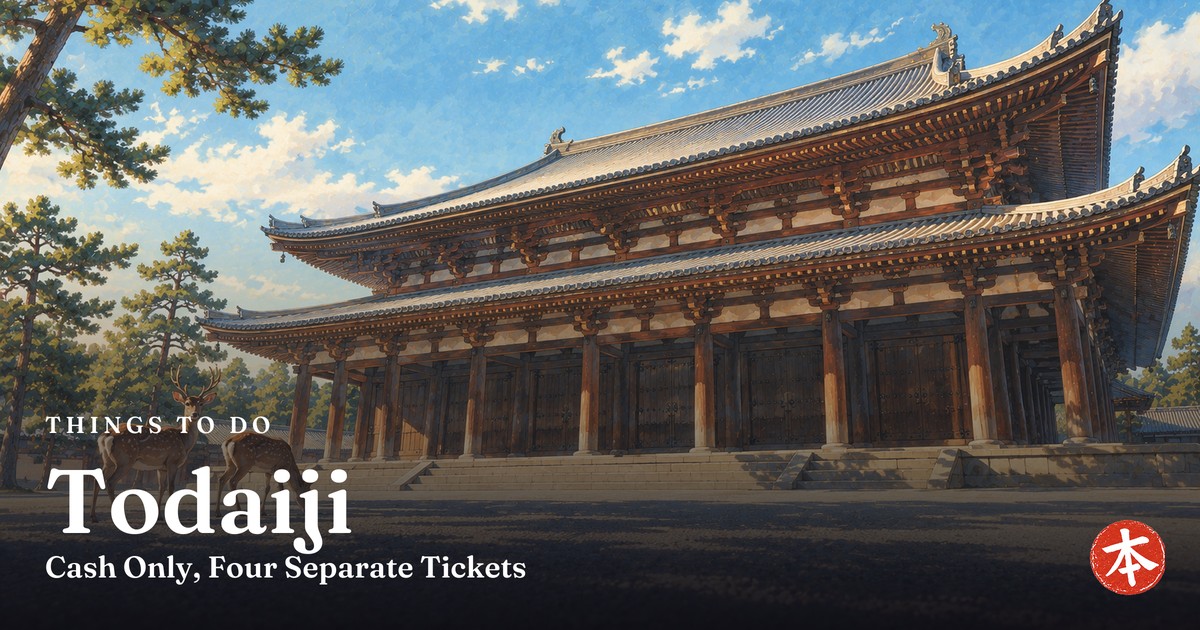
Todaiji does not sell one ticket. The Great Buddha Hall, Hokke-do, the Kaidan-in ordination hall and the temple museum each take their own admission — ¥800 for an adult, every time — and the temple’s own admission page says the quiet part out loud: payment is cash only. No cards, no IC tap, no QR. That single sentence is the difference between a smooth morning and standing at a ticket window counting coins.
The other thing worth knowing before you go is that the halls keep different hours. The Great Buddha Hall opens at 7:30 from April through October, earlier than almost anything else in Nara. Hokke-do and Kaidan-in do not open until 8:30 and shut at 16:00. Plan around the short-hours halls, not the famous one. If you are still working out how Nara fits into a wider trip, our Tokyo to Nara route guide covers getting there.
Todaiji at a glance
| What | Official figure (as of September 7, 2026) |
|---|---|
| Adult admission, per hall | ¥800 (university students and above) |
| High school / junior high / elementary | ¥500 / ¥400 / ¥200 |
| Payment | Cash only — stated on the official admission page |
| Great Buddha Hall hours | Apr–Oct 7:30–17:30 / Nov–Mar 8:00–17:00 |
| Hokke-do & Kaidan-in hours | 8:30–16:00 all year |
| Museum hours | 9:30–17:30 (last entry 17:00) / Nov–Mar 9:30–17:00 (16:30) |
| Combination ticket | Great Buddha Hall + museum ¥1,200 (junior high and above), ¥600 elementary |
| Closed | Open all year barring special events or emergencies |
| Parking | None for private cars or tour buses |
| Audio guide | 9 languages, 30 minutes, from 15 m past the ticket gate |
Which hall should I pay for if I only pick one?
The Great Buddha Hall, without much argument. It is the building everyone comes for, it holds the longest hours of anything at Todaiji, and at 7:30 in the warmer half of the year it opens before the coach parties arrive. Hokke-do and Kaidan-in reward a second visit rather than a first one, and their 16:00 closing makes them easy to miss entirely.
What Todaiji admission actually costs: four separate tickets
This is the part English guides flatten into one number. Todaiji charges at four gates, and the official wording is explicit that admission is collected at each of the Great Buddha Hall, Hokke-do, the Kaidan-in ordination hall and the Todaiji Museum.
How much is admission to the Great Buddha Hall?
¥800 for adults, and the temple defines an adult as a university student or above. High school students pay ¥500, junior high ¥400, elementary ¥200. Groups of 30 or more pay ¥700 per adult. These are the same figures at every hall, so the arithmetic scales in a straight line.
Do I really pay again at each hall?
Yes. Two halls plus the museum is ¥2,400 for one adult. There is no all-in precinct pass. It is worth knowing this before you are standing at the Kaidan-in gate wondering why the ticket in your hand does not work, because the walk between halls is not short and doubling back costs you more than the money.
Is the museum combination ticket worth it?
It saves ¥400. The Great Buddha Hall and the Todaiji Museum together are ¥1,200 for junior high students and above, against ¥1,600 bought separately, and ¥600 for elementary students. You can buy it at either the Great Buddha Hall or the museum. One catch: the temple restricts it to individual visitors — groups are not eligible.
Can I pay by card, IC card or QR?
Are there other discounts?
Holders of a disability certificate, and residents using Nara City’s Roshun handbook or Nana-maru card, are admitted free on presentation at the window. Special group rates for disability facilities and special-needs schools run ¥350 / ¥250 / ¥100 and require a reduction application form carrying the facility’s official seal.
Todaiji opening hours, hall by hall
Todaiji is open all year — the temple’s wording is that it does not close barring special events or emergencies. What changes is the hour, and it changes differently for each hall.
What time does the Great Buddha Hall open and close?
7:30 to 17:30 from April through October, and 8:00 to 17:00 from November through March. The 7:30 opening is the useful fact here. Very little else in Nara is open that early, so a 7:30 start buys you the hall in something close to quiet.
Why do Hokke-do and Kaidan-in close so early?
Both run 8:30 to 16:00, all year, with no seasonal extension. That is a two-hour shorter afternoon than the Great Buddha Hall in summer. If your plan is Nara in an afternoon, these two are what you will lose, so decide in the morning whether you want them.
When is the museum open, and when is it shut?
9:30 to 17:30 with last entry at 17:00 from April through October, and 9:30 to 17:00 with last entry at 16:30 from November through March. It is open all year but takes occasional closures — the temple has published August 24 and October 6 to 9, 2026 as closed days. Check before you build the combination ticket into your plan.
Getting to Todaiji, and where you cannot park
Nara is close to both Kyoto and Osaka, which is why it so often becomes a day trip rather than a stay. Our Kyoto duration guide and the ten-day Golden Route itinerary both treat it that way.
Where do I park a car or a tour bus?
What if I arrive by bicycle or motorbike?
The temple asks that all light vehicles, bicycles and motorbikes included, are left at the bicycle parking area southwest of the Nandaimon gate, and that you walk in from there. Riding through the precinct is not an option.
Is a rail pass worth it for the Nara leg?
It depends entirely on what else you are doing that week, and Nara alone will not justify one. Our Japan Rail Pass guide works through the break-even honestly rather than assuming the answer is yes.
What you are actually looking at inside Todaiji
The Great Buddha Hall is a National Treasure and an Edo-period rebuild — and the story of why it is the size it is turns out to be a story about money.
How big is the Great Buddha Hall?
57.012 m east to west, 50.480 m north to south, 48.742 m tall. The temple calls it one of the largest wooden buildings in the world, and those are its own published figures rather than a rounded number from a guidebook.
Why is the current hall smaller than the original?
Because the rebuild ran out of money. The hall burned twice, in the Jisho and Eiroku conflicts, and the present building was raised in the Edo period by the monk Kokei. The Nara- and Kamakura-period halls were eleven bays wide, about 88 m; financial difficulty cut the rebuild to seven bays. The height and the depth, though, are as they were at the founding.
What is the audio guide, and which languages does it run in?
Nine: Japanese (adult and child versions), English, Chinese, Korean, French, German, Spanish, Italian and Vietnamese. The recording runs 30 minutes and covers the temple’s history, the buildings and the statues. You collect it 15 meters past the Great Buddha Hall ticket gate, before the Chumon, between 10:00 and 17:00 from April through October and 10:00 to 16:30 in the winter half. Individuals need no reservation; groups of ten or more do.
What are the rules inside the halls?
Ordinary photography along the visitor route is fine. The temple asks you not to use a tripod and not to take posed group photographs, and separately asks that you do not sketch or use a flashlight inside. Across the whole precinct, smoking and drone filming are banned.
Groups, school trips and who gets into Todaiji free
Do groups need to reserve?
No, and Todaiji is refreshingly blunt about it: advance booking and prior application are not accepted, and fax and telephone are unnecessary. You turn up and give the group name at the window. For a temple that receives school parties at this volume, that is an unusual policy and worth trusting rather than second-guessing.
Who is admitted without paying?
For school and other groups: the escorting teachers, doctors, nurses, tour conductors, drivers, photographers and licensed interpreter-guides. The temple is precise about the last two — a tour conductor means someone holding the qualification who is actually escorting, and an interpreter-guide means a national license holder or someone carrying an original paper ID card with a company seal and photograph. App-based ID is not accepted, with a single exception for Chinese licensed guides whose official app certificate is recognized.
Are local Nara schools treated differently?
Yes. Elementary and junior high schools within Nara City are admitted free when a teacher escorts the group and the visit forms part of a class. It is a small clause, but it tells you something about how the temple sees itself — the children who live around it are not tourists. Note also that the audio guide desk takes questions by email only; the temple asks that you do not telephone about it.
Is a teacher’s advance site visit free?
No. A preparatory visit — including a teacher scouting a school trip — is charged at the ordinary ¥800. The temple also asks that tickets are not bought on your behalf by hotels, rest houses, souvenir shops or car parks.
Todaiji FAQ
How much does it cost to see the Great Buddha at Todaiji?
Can I pay for Todaiji admission by credit card?
What time does Todaiji open?
Is the combination ticket for Todaiji worth buying?
Is there parking at Todaiji?
Do I need to book Todaiji in advance, even as a group?
Is there an English audio guide at Todaiji?
Can I take photos inside the Great Buddha Hall?
Bottom line (2026) — Todaiji charges ¥800 per adult at each of the Great Buddha Hall, Hokke-do, Kaidan-in and the museum, and payment is cash only. The Great Buddha Hall runs 7:30–17:30 from April through October; Hokke-do and Kaidan-in close at 16:00 year-round. The Great Buddha Hall plus museum combination ticket is ¥1,200 and is for individuals only. There is no parking for cars or tour buses.
Sources & what we deliberately did not state
Every figure above comes from the official Todaiji website, read on September 7, 2026: the opening hours and admission page, the Great Buddha Hall page, the museum page, and the visitor notice on the front page. Prices, hours and closure dates change — check the temple’s own pages before you travel.
Deliberately not stated: the audio guide rental fee, because the official page carries the heading but no figure; how long each hall takes to walk, because the temple publishes no such guidance and we have not timed it ourselves; and the height of the Great Buddha statue, because the official page gives the dimensions of the building and we are not filling that gap from memory. Where a competitor states these confidently, ask where the number came from.
Tokyo to Osaka, Tokyo to Kyushu, Tokyo to Hokkaido — day by day — plus seven places most visitors never reach.
- 12 pages, 80 photographs, every stop linked to its guide
- Every price and opening hour read from the official page
- Re-issued monthly, so it does not go stale in your inbox
Free. One email a month, plus the rare change that matters. Unsubscribe with one click in any email. By subscribing you agree to our privacy policy.