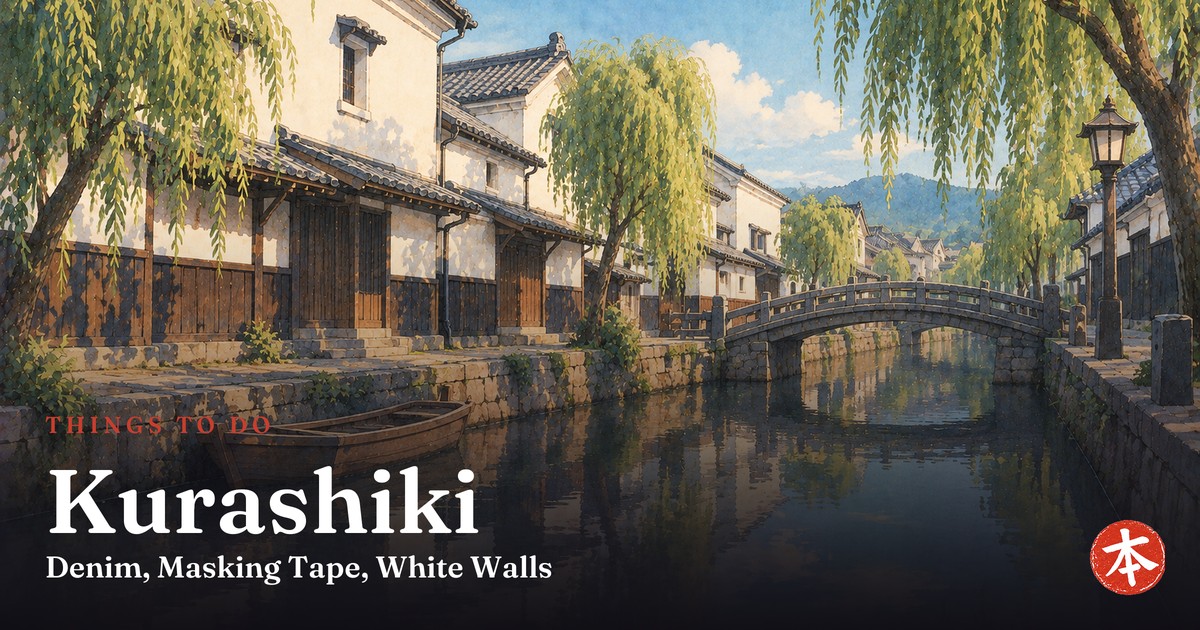
The photograph that brings people to Kurashiki is the same one every time: white-walled storehouses, a willow-lined canal, a punt going past. It is genuinely lovely and it is a half day.
The city’s own list of ten essential things starts there and then goes somewhere unexpected. Kurashiki is the birthplace of Japanese-made denim. It is the birthplace of masking tape. It holds three Japan Heritage stories — more than any other municipality in the country. And it publishes live congestion data for seven car parks, which is the single most practical thing on any Japanese city tourism site we have read this year.
| What you came for | The Bikan historical quarter — white walls, canal, Western-style buildings |
|---|---|
| What is also here | Kojima, birthplace of Japanese denim · masking tape · Washuzan, Inland Sea viewpoint |
| The museum | Ohara Museum of Art — Japan’s first private museum of Western art |
| Heritage | Three Japan Heritage stories, the most of any municipality |
| Night views | Three sites designated as Japan Night View Heritage |
| Before you arrive | The city publishes live congestion for seven car parks |
| Realistic plan | Bikan is half a day. The rest of the city is a separate decision |
Check Kurashiki’s car parks before you go, even without a car
What the city actually publishes
On its official tourism site, Kurashiki runs a page showing real-time congestion for seven car parks: Achi-terrace Kurashiki, the station front lot, the station east lot, the municipal central lot, the Bikan district south lot, the Bikan district east lot, and the Achi 3-chome lot. The data is supplied by a company called VACAN.
Why this is useful even if you arrive by train
Car park occupancy is a proxy for how many people are inside the quarter. Seven lots showing full on a Sunday at eleven is not a parking problem, it is a crowd forecast. Nothing else on the Japanese tourism web gives you that signal in advance for a specific town, and it costs nothing to look.
And if you do drive
The lots split into two groups that matter: the ones by the station, and the ones by the Bikan quarter itself. Those are different walks. Checking which group has space before you commit to an exit is the whole point of the page.
What we are not telling you
Prices and capacities. The congestion page is a live status board, not a rate card, and we did not open each operator. If cost matters more than availability, that is a separate check.
The Bikan quarter is half a day, and that is fine
Half a day sounds short until you see how compact the quarter is. This walk-through by a couple who live in Okayama covers ten spots and, more usefully, the order to do them in — the canal, the willows, the museum and the side lanes. It is in Japanese, but you are watching it for the distances between things.
What it is
The city describes it as a beautiful townscape where white-walled buildings and Western-style architecture are in harmony, and that mixture is the point. This is not a preserved Edo village. It is a merchant district that kept its warehouses and then had European buildings dropped into it, which is why it looks unlike other historic quarters in Japan.
The Ohara Museum of Art, and its actual claim
It sits inside the quarter, and the city’s description of it is specific: the first private museum of Western art in Japan. That is a founding claim rather than a size claim, and it explains why a regional city has a collection that people travel for. We have not read the museum’s own pages, so no hours or prices here.
Why half a day is the honest estimate
The quarter is compact and walkable, the canal is short, and the buildings are the attraction rather than a sequence of ticketed sites. Add the museum and lunch and you have filled a morning comfortably. The mistake is not that people only spend half a day — it is that they then leave the city.
Where it sits on a Japan route
Kurashiki is on the corridor between Osaka and Hiroshima, reached via Okayama, which is why it usually appears as a stop rather than a destination. Our guide to Osaka to Hiroshima covers that run, and the Shinkansen price guide covers how breaking a journey affects what you pay.
Kojima: where Japanese denim comes from
The claim, in the city’s words
Kojima is a district of Kurashiki, and the official list calls it the birthplace of domestically produced jeans and a holy site of Japanese denim that fascinates visitors from around the world. That is unusually strong language for a municipal tourism page, and it is the kind of claim a city only makes when the industry is still there.
Why this matters more than it sounds
Japanese selvedge denim has a global following that has nothing to do with Japanese tourism, and people who care about it know Kojima by name without knowing it is in Kurashiki. If that is your thing, you have been planning to come here without realizing it.
It is a different trip from the canal
Kojima is a separate district, not a corner of the Bikan quarter. That is the single most useful thing to know before you plan: the denim and the white walls are not the same afternoon. Treat them as two half-days, or pick one.
And the other thing invented here
Masking tape. The city states plainly that Kurashiki is where it comes from. Decorative washi tape is a category Japan exports to the world and buys enormously at home, and the origin is a manufacturing city on the Inland Sea rather than a Tokyo design studio. Of all ten items on the official list, this is the one most likely to make a visitor reconsider what kind of place they are in.
The rest of Kurashiki’s official ten
Washuzan, for the view
Described by the city as a representative scenic spot of the Setonaikai National Park and one of the great views of Okayama Prefecture. It looks out over the Inland Sea and its islands. This is the part of the city that has nothing to do with either the canal or the denim.
Tamashima, for the 1950s
A port town with a Showa-retro shopping street still intact. Not restored for tourists — kept. That distinction is what makes these streets interesting and also what makes them quiet, which is either the appeal or the problem depending on what you want from an afternoon.
Mabi, for a fictional detective
The city lists Mabi as the birthplace of Kosuke Kindaichi, the detective created by the novelist Seishi Yokomizo. It is on the official list of ten, which tells you something about how seriously Japan takes literary geography. For a visitor who has not read the novels it will mean little; for one who has, it is a pilgrimage.
Two designations worth knowing
Three Japan Heritage stories — the most held by any municipality in the country, per the city. And three sites designated as Japan Night View Heritage. We have not read either list, so we are not naming the stories or the viewpoints. What the numbers tell you is that this is a city with more layers than the canal photograph suggests.
Getting to Kurashiki and moving around it
The five ways in
The official access page divides it exactly this way: JR, covering both Shinkansen and conventional lines; car, ordinary roads and expressways; highway bus; air, through Okayama Airport; and movement between districts once you are in the city. That last category existing as its own section is the tell.
Why the fifth category is the important one
A city tourism site does not create a separate heading for internal travel unless internal travel is a problem. Kurashiki’s attractions are spread across districts — Bikan, Kojima, Tamashima, Mabi — and the official page treats getting between them as a distinct question from getting to the city. Plan accordingly.
The Shinkansen question
The route runs via Okayama, and the connection there is the part to check rather than the Shinkansen leg itself. Our Shinkansen price guide covers how fares are built, which matters when the last leg is a conventional line rather than a bullet train.
Where it fits with the neighbours
This stretch of the Inland Sea coast is a chain rather than a set of separate trips: Kobe to the east, Hiroshima to the west, and Kurashiki roughly between them. If you are already crossing this ground, adding a night here costs you the night rather than the travel.
Timing a visit
Use the congestion board, not a rule of thumb
We could tell you to avoid weekends, and it would be true and useless. The city gives you the actual answer for the actual day, for free, in advance. That is a better input than any general advice about seasons, including ours.
The one thing worth planning around
Domestic holiday weeks, when this whole corridor fills up regardless of what any live board says that morning. Our guide to Japan’s public holidays covers which weeks those are and what closes during them.
Fruit, if the timing lands
The official ten includes Kurashiki afternoon tea, built around seasonal fruit. Okayama is a serious fruit-growing prefecture, and the afternoon tea format is how the city has chosen to package that for visitors. What is in season decides what it is, which is the whole idea and also why we are not describing it further.
Kurashiki FAQ
What is Kurashiki known for?
Is Kurashiki a day trip or an overnight?
Can I check how busy Kurashiki is before I go?
What is the Ohara Museum of Art?
Why is Kurashiki associated with denim?
Masking tape really comes from here?
How many Japan Heritage stories does Kurashiki have?
How do I get to Kurashiki?
Bottom line. The Bikan quarter is half a day and it is worth it, but it is the smallest part of what this city is. Kurashiki is also the birthplace of Japanese denim (in Kojima, a separate district), the birthplace of masking tape, home to Japan’s first private museum of Western art, and holder of three Japan Heritage stories — more than any other municipality. Before you go, open the city’s live congestion board for seven car parks: it is the only advance crowd signal we have found for a Japanese town, and it works whether or not you are driving.
Sources & what we deliberately did not state
Checked on September 3, 2026. Researched in Japanese from Kurashiki Tourism WEB, the city’s official tourism site: the congestion information page, the ten essentials page and the access page. From those pages: real-time congestion published for seven car parks — Achi-terrace Kurashiki, the station front lot, the station east lot, the municipal central lot, the Bikan district south lot, the Bikan district east lot and the Achi 3-chome lot — with data supplied by VACAN; the official list of ten comprising the Bikan historical quarter described as a townscape where white walls and Western architecture are in harmony, the Ohara Museum of Art described as the first private museum of Western art in Japan and located within the quarter, Washuzan as a representative scenic spot of the Setonaikai National Park, Kojima as the birthplace of domestically produced jeans and a holy site of Japanese denim attracting visitors from around the world, the Showa-retro shopping street of Tamashima, Mabi as the birthplace of the detective Kosuke Kindaichi created by Seishi Yokomizo, Kurashiki afternoon tea built on seasonal fruit, Kurashiki as the birthplace of masking tape, the city holding three Japan Heritage stories which it states is the most in the country, and three sites designated as Japan Night View Heritage; and the access page organized into JR by Shinkansen and conventional lines, car by ordinary and expressway roads, highway bus, air via Okayama Airport, and travel between districts within the city. More on how we work: how we research.
Deliberately not stated. Admission prices and opening hours for the Ohara Museum of Art or anything else, because we read the city-level pages rather than each venue. Journey times to Kurashiki, because the official access page is a set of links by transport mode rather than a table of figures and we did not open each one. The content of the three Japan Heritage stories and the names of the three night-view sites, because we have not read those lists. Car park prices and capacities, because the congestion page is a live status board rather than a rate card. And any booking link for activities here, because we did not check what is available and we would rather carry no link than a wrong one. This reflects what those sources said on September 3, 2026; the official site carries the current position.
in English
Every week we read the Japanese sources English-language media never touches — new openings, price changes, limited releases, rule changes, the seasonal things that come and go in three weeks — and send you a three-minute read of what actually matters. Hit reply with a question about your trip and a human answers.
Free. Unsubscribe anytime. We never share your address.