The single most valuable thing about a Tokyo–Osaka Shinkansen ticket is something almost no English guide explains. A paper ticket is issued to the entire Tokyo ward zone and the entire Osaka city zone — so your local JR ride to the station, and the hop from Shin-Osaka onward to Osaka Station, are already paid for. Smart EX explicitly does not include this, which can erase its 200-yen saving with a single local train. Below: what the journey actually costs across four seasonal price tiers, why the non-reserved cars are 1 and 2 rather than 1 to 3, and why there is no trolley service in ordinary cars.
Tokyo to Osaka at a glance
| Item | Official answer (Aug 2026) |
|---|---|
| Distance | 552.6 km (JR's fare-calculation distance) |
| Nozomi | 2h30 · fastest services 2h27 · from Shinagawa 2h23 |
| Hikari / Kodama | 2h54 / 3h54 |
| Reserved (regular season) | ¥14,720 = ¥8,910 fare + ¥5,810 express |
| Seasonal range | ¥14,520 → ¥15,120 across four tiers |
| Non-reserved | ¥13,870 — flat all year |
| 🚨 Best advance fare | EX Hayatoku 21 · ¥12,980 — but zero changes allowed |
| 🚨 Paper vs Smart EX | Paper includes the local ride at both ends · Smart EX does not |
| 🚨 Free seating | Cars 1 and 2 — not cars 1–3 |
| 🚨 Onboard sales | Green Cars only. No trolley in ordinary cars at all |
The Tokyo to Shin-Osaka run, filmed in the direction you will be traveling:
Is a pass worth it for your route? Our JR Pass calculator compares single tickets for the trains you add, day by day, with the 7, 14 and 21-day Japan Rail Pass, and finds the start day that saves the most.
🚨 The city-zone rule, and why it beats the online discount
Smart EX throws this away. Its terms state that the city-zone system does not apply to Smart EX products, and that local-line fares to and from the Shinkansen station are charged separately. So the ¥200 discount is undone by one local ride — and reversed by two.
When Smart EX is still the right choice
For the boarding experience, not the price. There is no annual fee, you can book from a year ahead until four minutes before departure, and changes are free and unlimited before you pass the gate. If your plans are soft, that flexibility is worth more than a few hundred yen. Just don't choose it believing it is cheaper — on the non-reserved fare it offers no discount whatsoever, at ¥13,870 either way.
The one discount that is genuinely large
EX Hayatoku 21: ¥12,980, the same price every day of the year — around 1,700 yen below the regular walk-up reserved fare, and it does not spike in peak season. Book at least 21 days ahead, by 23:30. The condition is absolute and worth reading twice: after booking you cannot make any changes at all, including changing the train. Also note that EX Hayatoku 7 and 1 do not cover this route — 7 begins at Tokyo–Okayama, 1 stops at Tokyo–Maibara — despite appearing in comparison articles that suggest otherwise.
What the seat costs, by season
| Seat | Off-peak | Regular | Busy | Peak |
|---|---|---|---|---|
| Nozomi reserved | ¥14,520 | ¥14,720 | ¥14,920 | ¥15,120 |
| Hikari / Kodama reserved | ¥14,200 | ¥14,400 | — | — |
| Non-reserved | ¥13,870 — identical on every date | |||
| Green Car | ¥19,390 | ¥19,590 | — | ¥19,990 |
The basic fare is ¥8,910 in every single case; only the express charge moves. Broadly, much of September and early October 2026, and weekdays from mid-January 2027, fall in the cheap band, while most Friday-to-Sunday travel in October and November sits in the expensive one. If you are continuing to Kyoto or arriving from there, the Tokyo–Kyoto route and Osaka–Kyoto follow the same fare logic.
Seats, luggage and the missing trolley
Cars 1 and 2 — and eight periods with none at all
JR Central and JR West stated it jointly in May 2026: Nozomi trains normally have non-reserved seating in cars 1 and 2. The widely repeated "cars 1 to 3" is simply wrong. On eight blocks of dates in the 2026 fiscal year — Golden Week (April 24–May 6), Obon (August 7–16), and six long weekends including December 25–January 5 — every Nozomi between Tokyo and Hakata is fully reserved. Holding a non-reserved ticket during those periods lets you stand in the deck of an ordinary car only, and never in the Green Cars, which are cars 8 to 10. Hikari and Kodama keep their free seating year-round.
Big suitcases need a reservation, not a fee
Bags totaling 161–250cm across three dimensions require a seat with oversized baggage space, reserved when you buy — it costs no more than a normal reserved seat. Arrive without one and there is a 1,000 yen charge. Anything over 250cm cannot be brought aboard. Sports equipment, musical instruments, wheelchairs and strollers are exempt regardless of size.
Eat before you board
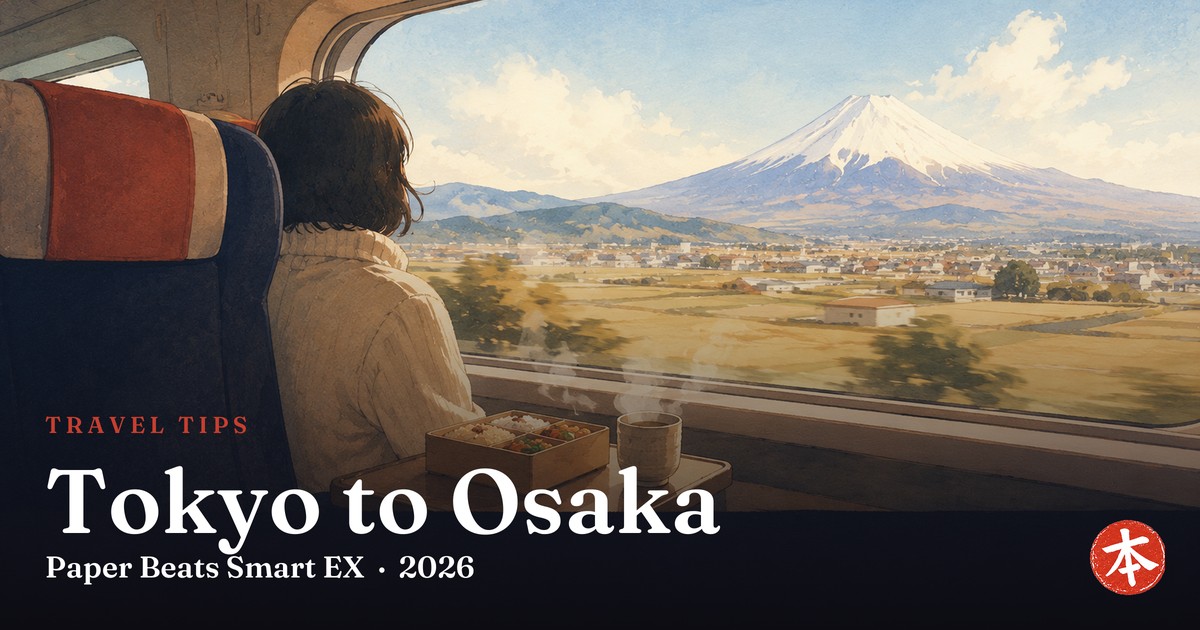
This is the practical warning of the article. There is no trolley service in ordinary cars. JR Central states that onboard sales are not conducted in the ordinary cars of Nozomi or Hikari, nor on any Kodama — between Tokyo and Shin-Osaka the service exists only in the Green Cars of Nozomi and Hikari. On a two-and-a-half-hour ride that matters. Buy an ekiben at the station. What you do get in every car: free Wi-Fi, and on the N700S a power socket at every seat. And be clear on smoking — the trains are entirely non-smoking with no smoking rooms; the booths that older guides describe are gone.
Mount Fuji, arrival, and the alternatives
Seat E, both directions
JR Central does publish guidance on this, on its travel-promotion site: the main viewing stretches are Shin-Yokohama to Odawara and Mishima to Shin-Fuji, and taking row E gives you the mountain from the window in either direction. It adds that A-side passengers may see a "left-side Fuji" between Shizuoka and Kakegawa, where the track runs north–south. Two caveats we owe you: this appears only in Japanese, on the promotional site rather than the railway pages — and the official text names seat E only. The "Green Car seat D" tip you may have seen is not something JR has said.
Shin-Osaka is not central Osaka
Plan one more leg. Osaka Station, for the Umeda district, is four minutes away on the JR line and normally ¥180 — free with a paper Shinkansen ticket, as covered above. On the subway, Umeda falls in a ¥240 fare band from Shin-Osaka and Namba ¥290, as of April 2026. We could not retrieve an official journey time for the subway legs, so we are not going to give you one. Heading for the neon and the food, our Dotonbori guide covers what is where.
Plane, bus, or train
JAL puts Haneda to Itami at about 65 minutes — but that is airport to airport, and once you add the trip out to Haneda, security, and the ride in from Itami, the door-to-door figure typically lands close to the Shinkansen's, which starts and ends in the middle of each city. The night bus is the genuine budget option: JR Bus Kanto's service leaves Tokyo Station at 23:00 and arrives Osaka Station at 07:31 — 8 hours 31 minutes — from a 9,000 yen base fare plus a seat-class supplement. Its real economics are the hotel night you skip. And if you are covering several cities, what the JR Pass does and doesn't cover is the first thing to settle; our route map shows how the lines connect.
FAQ
How long does it take, and how much?
Why do fares change by date?
Is Smart EX actually cheaper?
So a paper ticket covers my subway ride?
Is there a real advance discount?
Can I use a Japan Rail Pass?
Should I leave from Tokyo Station or Shinagawa?
Where is the non-reserved seating?
Is there food on board?
Which side for Mount Fuji?
How do I get from Shin-Osaka to central Osaka?
Is flying or the night bus better?
Bottom line (2026) — A paper Shinkansen ticket is issued to the whole Tokyo ward zone and the whole Osaka city zone, so local trains at either end cost nothing extra. Smart EX drops that benefit entirely, which can wipe out its 200-yen saving. Four seasonal fare tiers apply, so which ticket is cheaper depends on your date and your onward stations – not on the headline fare alone.
Sources
All fares, journey times and the city-zone verification were priced through JR Central's official fare-and-timetable search across fifteen travel dates, and cross-checked against an independent Smart EX fare table on a control route. Ticket rules, seasonal surcharge bands, oversized baggage terms, onboard service, Wi-Fi, power and smoking policy: JR Central's official rule and equipment pages. Non-reserved car composition and the fully-reserved periods: the JR Central and JR West joint press release of May 2026 and JR Central's English Nozomi page. Smart EX and EX Hayatoku terms and prices: the official Smart EX site. Pass terms, the Nozomi supplement and pass prices: japanrailpass.net. Osaka Metro fare bands: Osaka Metro's published zone table, April 2026. Flight time: JAL's official route page. Night bus timetable: JR Bus Kanto. Mount Fuji viewing guidance: JR Central's travel site. Read August 24, 2026. The embedded video is by its creator.
Some links on this page may be affiliate links, which means we may earn a commission if you book or buy through them — at no extra cost to you. See our affiliate disclosure.
Tokyo to Osaka, Tokyo to Kyushu, Tokyo to Hokkaido — day by day — plus seven places most visitors never reach.
- 12 pages, 80 photographs, every stop linked to its guide
- Every price and opening hour read from the official page
- Re-issued monthly, so it does not go stale in your inbox
Free. One email a month, plus the rare change that matters. Unsubscribe with one click in any email. By subscribing you agree to our privacy policy.