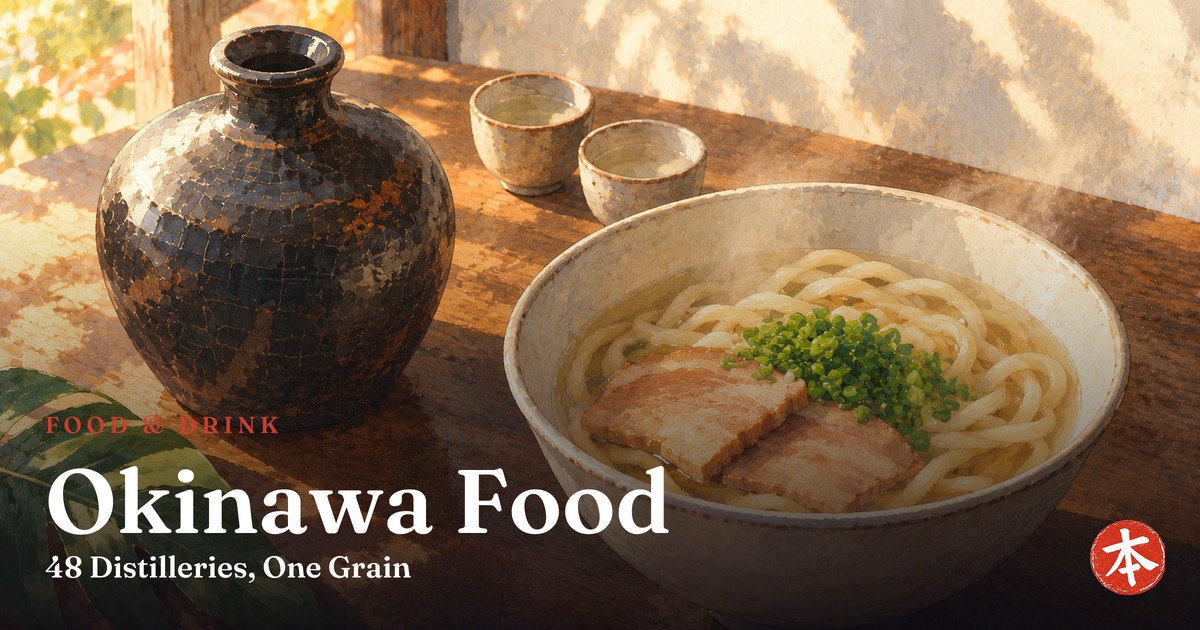
Two numbers from Okinawa’s own tourism board tell you what kind of food culture this is. There are more than 300 specialist Okinawa soba shops in a prefecture of about 1.4 million people, and 48 awamori distilleries making the island’s spirit. Neither of those is a figure you get from a place that eats like the rest of Japan.
And awamori is older than you would guess. The prefecture dates something recognizable as its ancestor to around 1470 and calls it the oldest distilled spirit in Japan — a root of shochu rather than a branch of it. It is made from Thai long-grain rice, not Japanese rice, fermented with black koji. Below is what to eat, what to drink, and the two dates the island writes into its calendar for the drinking part. For where these islands actually are, see our Okinawa map guide.
Okinawa food, by the categories the prefecture itself uses
| Category | What the tourism board says it is |
|---|---|
| Okinawa soba | The staple. 300+ specialist shops; flavor varies by area, topping and broth. Popular toppings: soki spare ribs, san-mai-niku pork belly |
| Court cuisine | Served on vermilion lacquerware: rafute, kombu rolls, tempura, tofuyo, kamaboko |
| Home cooking / shokudo | Island vegetables. Goya champuru, jushi seasoned rice, hirayachi — which the board compares to Korean jeon |
| Okinawan fast food | Grew its own way under outside influences. Flagship is taco rice; also burgers and pizza |
| Cafes and sweets | Zenzai — shaved ice over sweet red beans — described as the local, not the tourist, version |
| Folk-song bars | Live music with local dishes and awamori |
| Izakaya and bars | Awamori, house selections by the glass, alongside Okinawan food |
What should I eat first?
Okinawa soba, and not because it is famous. It is the one dish with 300 shops of variation behind it, which means the version you eat is a specific choice rather than a generic one — the broth and the topping change from town to town. Order it with soki at least once. After that the rest of the list opens up: court cuisine and home cooking are two different answers to the same question about what these islands eat, and the fast food category is a third answer that arrived from outside and stayed.
Okinawa soba: the dish with 300 shops behind it
Is it soba at all?
Not in the sense the word carries elsewhere in Japan. It shares the name and very little else — this is not a buckwheat noodle in a cold dipping sauce. The tourism board treats it as its own category entirely, separate from every mainland noodle. Expect a hot bowl, a clear pork-based broth and a thick wheat noodle.
What is the difference between soki and san-mai-niku?
Both are pork, cut differently and cooked differently. Soki is spare rib, which the board describes as tender; san-mai-niku is three-layer belly, simmered. Ordering one or the other changes the bowl more than the broth does. If a shop offers both, they are not garnishes — they are the decision. Soki is the one most first-time visitors are photographed with, because a rib sitting on top of the noodles is the image of this dish, but san-mai-niku is the older, plainer choice and the one you will see locals order.
Does the bowl change as I move around the islands?
The prefecture says so directly: the flavor differs by area, by ingredient and by broth. That is an unusual thing for a tourism board to advertise, because it undercuts the idea of a single definitive version. It also means that eating soba in three towns is a legitimate itinerary rather than repetition. Practically, that also means you should not judge Okinawa soba on one bowl. If the first one does not land, the next town’s version may be a different broth entirely.
Awamori: Japan’s oldest spirit, made from Thai rice
How old is it, really?
The prefecture dates something recognizable as awamori’s ancestor to around 1470 and calls it the oldest distilled spirit in Japan, describing it as a root of shochu. That places its origins before the Japanese distilling tradition most visitors have heard of, on an island that was then its own kingdom trading across Asia.
Why Thai rice?
What is kusu?
Awamori aged three years or more — that is the prefecture’s own threshold, not a marketing term. What makes the aging worth doing is that awamori keeps changing in the bottle: the components mature and both flavor and aroma deepen. A distillery’s kusu is a different drink from its new spirit, not simply a smoother one.
Which bottle is the hard one to find?
Awanami, made on Hateruma. Production is small enough that the tourism board calls it a rare bottle that awamori enthusiasts covet. It is the kind of thing worth knowing about before you are in a bar rather than after — if you see it, that is the moment. The same logic applies more broadly across the other distilleries: production runs here are small by the standards of national spirits brands, so a bottle on a shelf in Naha is not necessarily a bottle you can find again once you leave the prefecture. Buy it where you meet it.
The two dates Okinawa puts in the calendar
What are Awamori Day and Kusu Day?
November 1 is Awamori Day. September 4 is Kusu Day, for the aged spirit. Both are formally designated, and the prefecture says events run in various places around them to pass on and promote awamori culture. A drink with two official days in the calendar is a drink the place takes seriously.
Should I plan a trip around them?
Not the whole trip — but if your dates are near either, check what is on. These are the occasions when distilleries and bars do something they do not do the rest of the year. The same logic applies to sake elsewhere in Japan; our Tokyo sake tasting guide covers how that world works on the mainland.
How do people actually drink it?
More freely than you might expect from a spirit this old. The prefecture lists the usual on the rocks and cut with water, and then keeps going: cocktail-style preparations, and awamori cut with coffee. Its own framing is that the variety of ways to drink it exists because the spirit is loved rather than despite it — there is no correct method being guarded here.
Where do I drink it with music?
At a min-yo bar. The tourism board files folk-song bars and live houses as their own dining category: live performance while you eat local dishes and drink awamori, with prefectural musicians playing night after night. It is the one category on the board’s list where the music is the reason and the food comes with it, rather than the other way round.
Can I visit a distillery?
The tourism board promotes it as an activity, with reports from working distilleries and a list of places to visit among the 48. Its framing is that the ingredients are essentially the same everywhere — Thai rice and black koji — and the differences come from the making. That is a reasonable argument for visiting more than one.
Beyond soba: what else Okinawan food actually is
What is taco rice?
Taco filling over rice, and it is not a novelty item — the prefecture files it as the flagship of a whole category it calls Okinawan fast food, describing that category as having grown in its own direction under the influence of other countries’ food cultures. American-style burgers and pizza sit in the same group. The history of the islands is legible on the plate.
What is tofuyo, and should I be careful with it?
Fermented tofu, served in very small pieces as part of court cuisine, and yes — small is the operative word. It appears on the lacquer tray alongside rafute, kombu rolls, tempura and kamaboko. It is the item on that tray most likely to surprise a first-time visitor, and it is not meant to be eaten in a mouthful.
What is the local dessert?
Zenzai, and the Okinawan version is not the mainland one. Here it is shaved ice piled over sweet kintoki beans, which the tourism board describes as the taste locals grew up with — a cold dish in a hot place rather than the warm red bean soup the same word means elsewhere in Japan.
Is there beef, or is it all pork?
There is beef, and it is prefectural. The tourism board runs steak, yakiniku and barbecue as a category of its own and specifies Okinawa-raised wagyu. That matters because the rest of the food here is so pork-led — the belly, the ribs, the champuru — that visitors assume beef is imported or absent. Steak in particular has a longer history on these islands than on the mainland, for the same reasons taco rice does.
Where does this fit in a trip?
Okinawa is far enough from the main islands that its food is a reason to go rather than a bonus — see our guide to getting there for what the journey involves. If your frame of reference is what Japan tastes like on the mainland, our Japanese breakfast guide and wagyu guide make the contrast obvious.
Okinawa food FAQ
What is Okinawa soba, and how is it different from mainland soba?
What is awamori?
What does kusu mean on an awamori bottle?
How many awamori distilleries are there?
Are there special dates for awamori?
What is taco rice, and is it really Okinawan?
What should I eat if I want the home cooking rather than the restaurant version?
What is Okinawan court cuisine?
Bottom line (2026) — Okinawa has more than 300 specialist soba shops and 48 awamori distilleries. Awamori dates to around 1470, is the oldest distilled spirit in Japan, and is made from Thai rice with black koji — not Japanese rice. Kusu means aged three years or more. November 1 is Awamori Day and September 4 is Kusu Day.
Sources & what we deliberately did not state
Every category description, count and date above comes from the Okinawa Convention & Visitors Bureau’s official tourism site — the gourmet category pages and the awamori feature — read on September 7, 2026. The board notes that its published content reflects the date of posting, so confirm anything time-sensitive with the venue.
Deliberately not stated: individual restaurant names, addresses and prices, because those live in a search tool rather than in a list we could verify as a whole; the technical definition of an Okinawa soba noodle, which the gourmet pages do not give; awamori strengths and bottle prices, which the feature does not publish; and anything connecting Okinawan food to health or longevity, which is a claim a tourism page cannot support and we will not repeat.
Tokyo to Osaka, Tokyo to Kyushu, Tokyo to Hokkaido — day by day — plus seven places most visitors never reach.
- 12 pages, 80 photographs, every stop linked to its guide
- Every price and opening hour read from the official page
- Re-issued monthly, so it does not go stale in your inbox
Free. One email a month, plus the rare change that matters. Unsubscribe with one click in any email. By subscribing you agree to our privacy policy.