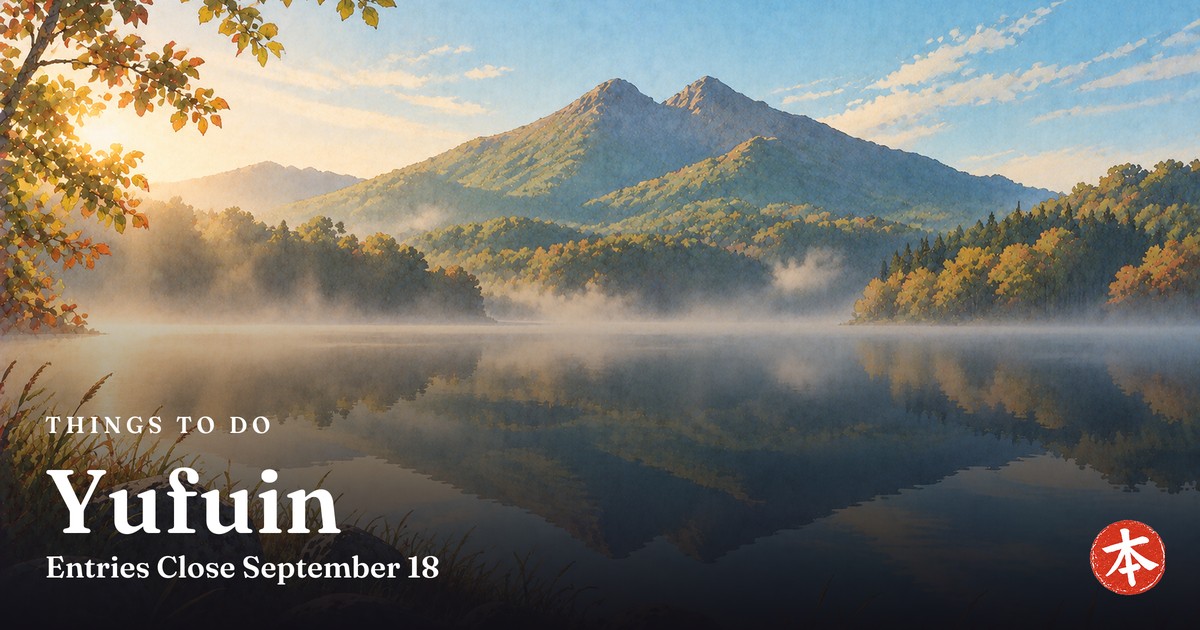
Once a year, 400 people gather on a cattle pasture outside Yufuin, eat beef, and then take turns screaming about their lives into the open air. There is a prize draw afterwards and an awards ceremony for the best shouting. This is not a novelty someone invented for tourists — the 52nd edition takes place on October 12, 2026.
Yufuin is usually sold to visitors as a genteel hot spring town with a shopping street, and it is that. It is also a city of five districts, only one of which most people ever see, containing a strongly acidic spring the city calls one of Japan’s three great medicinal waters and an old cure town paved in stone. Below is what the city itself publishes, including the deadline you will miss if you read this too late.
The Yufuin beef-eating screaming contest, in full
| Detail | Official |
|---|---|
| Edition | 52nd |
| Date | October 12, 2026 (public holiday Monday) |
| Venue | Namiyanagi Farm, Kawakami, Yufuin |
| Capacity | 400, first come first served |
| Entry | ¥5,000 junior high and above / ¥2,000 below |
| Applications | Opened Aug 10, close Sept 18 at 17:00 or when full |
| Payment | Bank transfer, due Sept 25 |
| How to apply | Email or fax — not an online booking platform |
| Schedule | 9:30 reception / 10:30 entry / 11:30 screaming sign-up / 12:00 contest / 13:00 draw / 14:00 awards |
Is it really 52 years old?
That is the number the city publishes. Half a century of an event whose format is “eat beef, then shout” tells you something about how seriously this place takes not taking itself seriously. It is held on a working farm rather than in the town, which is part of the point. Fifty-two years also means the event predates most of what visitors now come to Yufuin for — the boutiques and the cafes on the main street are a much more recent layer over a town that was already doing this every October.
What is the catch for a visitor?
Yufuin is five districts, not one town
What are they?
The tourism bureau organizes the whole city into Tsukahara, Yufuin, Yunohira, Shonai and Hasama. Central Yufuin — the one with the shopping street and the lake — is a single district. Almost every English guide treats it as the entirety of the place.
What is in Tsukahara?
Height and acid. It sits at 600 meters on the north side of Mount Yufu, and the city describes Tsukahara Onsen as one of Japan’s three great medicinal springs, strongly acidic. Around it are art galleries, restaurants and inns spread across highland rather than clustered in a street. It is the answer if central Yufuin feels like a queue. The distinction matters more than it sounds: a hot spring district that is a landscape rather than a street changes what the day looks like, because there is no strip to walk and nothing to queue for. You go there to be somewhere, not to see something.
And Yunohira?
The old cure town. The city’s own word is toji — a place people went to take the waters over days rather than overnight — and it describes a stone-paved town where deep greenery and the sound of the river run together. If your idea of a hot spring town was formed by photographs of Ginzan or Kinosaki, this is the same century.
Do I need a car for the other districts?
We are not going to pretend to know. The city publishes area guides but no transport times between districts that we read, and inventing a bus frequency would be worse than saying nothing. Ask at the tourist information office in central Yufuin, which is listed on the official site as the combined office of the tourism association and the ryokan union. That office is worth finding for a second reason: it is run jointly by the tourism association and the inns themselves, which means the people behind the counter are the ones with a direct line to the accommodation you are asking about, rather than a municipal desk reading from the same website you already have open.
What to do in Yufuin between baths
What is the horse carriage?
A tsuji-basha — a horse-drawn carriage that tours the town, which the city features as one of its signature experiences. It runs from the area by the station. We have deliberately not given you a fare or a departure time, because the city’s own feature on it publishes neither, and this is the sort of detail other guides state confidently and get wrong a season later.
Can I bathe without staying the night?
Yes, and the city runs a feature specifically on day-use bathing in Yufuin, which tells you it is a normal thing to do here rather than a favor. That matters for anyone passing through on the train with a few hours rather than a night. For what a full ryokan stay involves, our ryokan guide covers the format.
What is on in the evenings?
Kagura — ritual dance with music. The city posts a Yufuin Onsen Kagura performance roughly once a month on a Sunday, and a separate regular Shonai Kagura in the Shonai district. These are listed on the official news page with dates, and they are the kind of thing that never appears in an English itinerary. Neither performance is staged for tourists in the sense of being scheduled around them — they run on their own calendar, and you either happen to be there or you plan around it.
Is there anything else on this autumn?
A Molkky tournament on the Tsukahara highland on October 4, 2026, 10:00 to 16:00, at ¥3,500 for adults and ¥3,000 for elementary students including lunch, in teams of two to four, capped at 60 teams. Molkky is a Finnish throwing game. That a Japanese highland resort runs a Finnish lawn game tournament is the sort of detail that tells you more about a place than its brochure does.
What the official notices say, and what we will not guess at
There is a monkey advisory?
There is. In August 2026 the tourism bureau published a notice to visitors headed as a warning about wild monkeys. We can tell you it exists because we saw it listed. We cannot tell you what it says, because we did not retrieve the text, and a safety notice is the last thing to paraphrase from a headline. Read it on the official news page before you go.
And the notice about traveling to Oita?
Same position. The bureau posted something in August 2026 addressed to people planning trips to Oita Prefecture. We have not read it, so we are not going to characterize it. What we will say is that a tourism body posting a notice of that shape is worth two minutes of your time before you book, in either direction.
Why mention notices you have not read?
Because knowing they exist is itself useful, and because the alternative — silently omitting them — would leave you with a cleaner article and less information. The bureau also posted that the Yufugawa Gorge is operating normally, which is the reassuring end of the same habit: this is a city that publishes operational status, and it is worth checking.
Practical notes for a Yufuin trip
Where does Yufuin sit relative to everything else?
In Oita, in the northeast of Kyushu, inland from the coast and surrounded by mountains — the city describes central Yufuin as sitting in a basin ringed by peaks including Mount Yufu. For getting around the island, our Fukuoka guide covers the usual entry point to Kyushu.
When is the best time to come?
The city’s own event calendar answers this indirectly. Its named events cluster in autumn — the Molkky tournament on October 4, the screaming contest on October 12 — and the summer entries are festivals and neighborhood markets rather than things a visitor plans around. Kagura runs monthly year-round. If you want the town at its most active rather than at its prettiest, October is when the city itself is busiest with its own people.
What kind of accommodation is there?
Inns, mostly, and the city’s own description of the appeal is eating and bathing at a ryokan surrounded by mountains rather than sightseeing between them. Several operators run properties in the area — our Hoshino Resorts guide covers one group’s brands and how they differ, which is useful context for reading any Japanese hot spring town’s accommodation list. The pattern to look for is whether a property is an inn first and a hotel second, because that decides whether dinner is part of the stay or a separate decision you make each evening.
What should I know before getting into the water?
Two things that apply everywhere in Japan and catch visitors out here as much as anywhere. What legally counts as an onsen is narrower than the word suggests — see our onsen law guide — and the rules about tattoos vary by facility rather than by law, which our tattoos and onsen guide works through. Neither is a Yufuin-specific problem, but both decide where you can bathe.
Yufuin FAQ
What is the Yufuin beef-eating screaming contest?
How do I enter, and when does it close?
What actually happens on the day?
Yufuin or Yufuin – what is the town actually called?
What is Tsukahara Onsen?
What is Yunohira?
Can I ride the horse carriage?
Is there anything I should be careful about?
Bottom line (2026) — The 52nd Yufuin beef-eating screaming contest is on October 12, 2026 at Namiyanagi Farm: 400 places, ¥5,000 for junior high age and above, applications closing September 18 at 17:00 with payment due September 25. Yufu City is five districts, not one town — Tsukahara at 600 m has a strongly acidic spring the city calls one of Japan’s three great medicinal waters, and Yunohira is the old stone-paved cure town. Check the official news page: there is an August 2026 wild monkey advisory.
Sources & what we deliberately did not state
Every date, price, capacity and district description above comes from the Yufu City Tourism Bureau’s official site — the area guides, the news listing and the event page for the 52nd contest — read on September 7, 2026. Event details change and places sell out; confirm on the official page before transferring money.
Deliberately not stated: accommodation rates, because the city links to booking rather than publishing prices; the horse carriage fare and timetable, which its feature omits; any water chemistry beyond the city’s own phrase “strongly acidic”; transport times between the five districts, which we did not find published; and the contents of the August 2026 notices about wild monkeys and about travel to Oita — we confirmed the headlines but not the text, and paraphrasing a safety notice you have not read is how misinformation starts.
Tokyo to Osaka, Tokyo to Kyushu, Tokyo to Hokkaido — day by day — plus seven places most visitors never reach.
- 12 pages, 80 photographs, every stop linked to its guide
- Every price and opening hour read from the official page
- Re-issued monthly, so it does not go stale in your inbox
Free. One email a month, plus the rare change that matters. Unsubscribe with one click in any email. By subscribing you agree to our privacy policy.