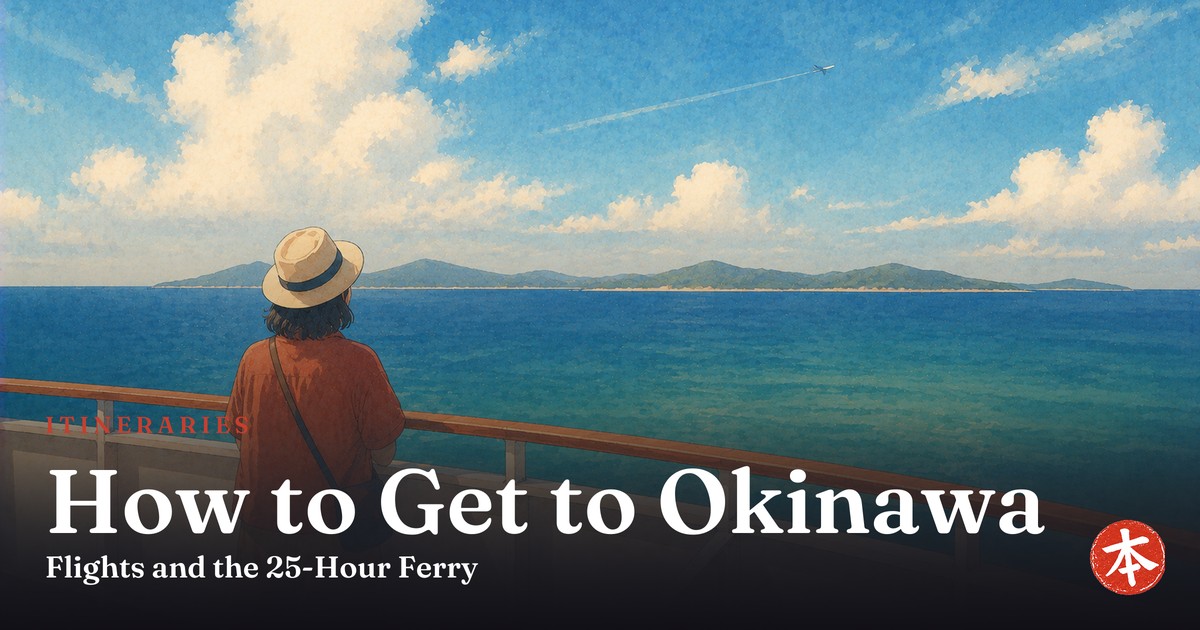
There are two ways to get to Okinawa, and English guides only tell you about one. You can fly — about 2h40m from Haneda to Naha, from 29 domestic cities — or take a daily passenger ferry from Kagoshima that takes exactly 25 hours, calls at six islands, and sells second class for ¥14,880 before the fuel surcharge. The ferry is not a curiosity: it has a filed fare table and online booking.
This guide covers getting to Okinawa from outside Okinawa — flights, the ferry, Naha Airport to the city, and the hop on to Ishigaki and Miyako. For how the main island is laid out once you arrive, read our Okinawa map guide. Along the way we fix what other guides get wrong: Naha has had no LCC terminal since 2019, the monorail pass is a 24-hour pass at ¥1,000, and August beats September for typhoons.
Okinawa at a glance: the two ways in
Okinawa sits about 1,000 miles southwest of Tokyo and no railway reaches it — nothing you do with a Japan Rail Pass gets you there. The choice is binary.
| Fly | Ferry | |
|---|---|---|
| From | 29 domestic cities, 32 routes | Kagoshima Shinko only |
| Time | Haneda–Naha 2h40m block time | Exactly 25 hours; 25h30m northbound |
| Frequency | Dozens of flights a day | One sailing a day each way |
| Lowest published | Skymark advance band from ¥7,200 | ¥14,880 second class, pre-surcharge |
| Real all-in | Dynamic — varies by date | ¥17,610 as sold in August 2026 |
| Stops | None | Amami, Tokunoshima, Okinoerabu, Yoron, Motobu |
| Arrives | Naha Airport, 13 min from downtown | Naha Port, 10 min walk from Asahibashi |
Which cities have nonstop flights to Naha?
Naha Airport publishes its own count, bigger than the English internet thinks: 45 cities on 48 routes — 16 overseas cities on 16 routes, 29 domestic cities on 32 routes.
Which Japanese cities can I fly to Okinawa from?
The official list runs Sapporo and Sendai; Tokyo (Haneda and Narita), Ibaraki, Niigata, Komatsu, Shizuoka, Nagoya, Osaka (Kansai and Itami) and Kobe; and Iwakuni, Hiroshima, Okayama, Matsuyama, Takamatsu, Fukuoka, Nagasaki, Kumamoto, Miyazaki, Kagoshima, Amami, Okinoerabu and Yoron. The useful surprises are Iwakuni, Komatsu, Shizuoka, Takamatsu and Matsuyama, whose nonstops nobody writes about. Check your nearest airport before assuming you must connect via Tokyo.
Which airlines fly the main trunk routes?
The answers are not the ones you would guess. Haneda–Naha: ANA, JAL with JTA, Skymark and Solaseed Air, which alone runs three round trips a day. Narita–Naha and Kansai–Naha: Peach and Jetstar Japan. Fukuoka–Naha: Peach, Skymark and Solaseed — and there the operator is JTA, not JAL mainline. Kobe and Ibaraki are Skymark.
Can I fly to Okinawa nonstop from another country?
From Asia, yes, and from further afield than most expect. Naha's official list gives 16 overseas cities: Seoul and Busan; seven mainland Chinese cities; Taipei, Taichung and Kaohsiung; Hong Kong; and Singapore, Kuala Lumpur and Bangkok. But there is no nonstop from North America, Europe or Australia — those markets connect via Tokyo, Osaka, Taipei, Seoul, Hong Kong or Singapore, and an Asian connection is often cheaper than doubling back through Japan.
🚨 The Osaka answer changed on October 25, 2026
If you have read that the way to fly Osaka to Okinawa is out of Kansai, that advice predates Japan Transocean Air's winter schedule, covering October 25, 2026 to March 27, 2027.
Since Itami is far closer to central Osaka than Kansai, this is a real gain for anyone based in the city — but booking Kansai out of habit now means fewer daily options all winter.
What does a flight to Okinawa actually cost?
Honestly, for most carriers nobody can tell you: Japanese domestic fares are overwhelmingly dynamic. What we can do is show the one airline that files a public table.
Which airline publishes a real fare table?
Skymark. It files a full table each schedule period with two columns, regular and peak, and prints the dates for each. These are from the 2026 summer table, covering travel March 29 to October 24, 2026. One way, tax included:
| Route | Adult standard (regular) | Adult standard (peak) | Advance band |
|---|---|---|---|
| Haneda – Naha | ¥47,000 | ¥51,300 | ¥7,200 – ¥41,200 |
| Nagoya (Chubu) – Naha | ¥42,600 | ¥45,600 | ¥6,100 – ¥36,300 |
| Kobe – Naha | ¥39,000 | ¥42,600 | ¥5,500 – ¥35,400 |
| Fukuoka – Naha | ¥30,800 | ¥33,400 | ¥5,600 – ¥24,600 |
| Haneda – Miyako (Shimojishima) | ¥58,900 | ¥65,300 | ¥8,900 – ¥48,600 |
| Naha – Miyako (Shimojishima) | ¥18,900 | ¥19,800 | ¥5,000 – ¥17,500 |
The ¥4,300 gap between ¥47,000 and ¥51,300 on Haneda–Naha tells you what a peak date costs, and the same windows lift every other carrier and most hotels. The advance-purchase buckets move inside a published band, so treat them as a range.
Why will you not give me a typical ANA or JAL price?
Because neither publishes one. ANA's domestic fare page lists fare types — Flex, Standard, Simple, Sale, card and shareholder discounts, island-resident, youth and senior — with no route-by-route yen amounts. One narrow exception: ANA did publish a Haneda–Naha table for travel between March 29 and May 18, 2026, topping out at ¥68,640. That figure only means anything with those dates attached, because ANA stopped publishing fare tables from May 19, 2026.
For JAL we say less, not more. JAL's fare pages return HTTP 403 to every automated request, so we have no sourced view of its fare structure and leave it out entirely rather than repeat what other sites assume. Either way, fares rise as seats sell — book early.
When are the expensive dates?
Skymark's filed table gives the cleanest published peak calendar for 2026 summer: March 29–April 5, May 1–7, July 17–August 23, September 18–24 and October 9–13. For winter, JTA upgauges its Haneda island routes on exactly two windows — December 25–January 3 and March 19–27 — which is as good as a peak declaration. Obon is officially August 7 to 16. Our guide to timing a Japan trip covers the same calendar from the mainland side.
The ferry: 25 hours from Kagoshima to Naha
This is the section nobody else writes. The Kagoshima–Okinawa ferry is a scheduled passenger route with four cabin classes, a filed fare table, a published timetable and online booking — and between two operators it sails every day in each direction.
The complete 25-hour crossing from Kagoshima Shinko to Naha Port aboard Ferry Naminoue, filmed end to end by the Japanese railway channel 813鉄道ch. Even without Japanese you can see the whole thing: boarding, what a second-class room and a berth actually look like, the island port calls, the arrival at Naha. Most people do not believe the ferry is real until they watch someone take it.
Who runs it, and does it really go every day?
Two companies alternate on the same route. A-Line runs Ferry Akebono and Ferry Naminoue; Marix Line runs Queen Coral Plus and Queen Coral Cross. Marix says so on its own booking page and tells you to check which company is sailing on your date. The effect is a daily departure with a different ship and phone number depending on the day. Booking opens one month before sailing, from 08:30.
What is the port-by-port timetable?
Both operators publish identical times. Southbound is exactly 25 hours across seven ports.
| Port | Arrive | Depart |
|---|---|---|
| Kagoshima Shinko | — | Day 1, 18:00 |
| Naze, Amami Oshima | Day 2, 05:00 | 05:50 |
| Kametoku, Tokunoshima | 09:10 | 09:40 |
| Wadomari, Okinoerabu | 11:30 | 12:00 |
| Yoron | 13:40 | 14:10 |
| Motobu, Okinawa main island | 16:40 | 17:10 |
| Naha Port | Day 2, 19:00 | — |
Northbound runs half an hour longer at 25h30m, leaving Naha 07:00 and reaching Kagoshima Shinko at 08:30 the next morning. Both operators warn that even on a normal sailing, weather and sea conditions can change the schedule and the ports called at.
How much does it cost, and what is the fuel surcharge?
One way, adult, tax included, before the surcharge, Kagoshima Shinko to Naha:
| Class | Base fare | As sold, August 2026 (surcharge included) |
|---|---|---|
| Special class (suite) | ¥37,200 | ¥39,930 |
| First class cabin | ¥29,760 | ¥32,490 |
| Second class berth | ¥14,880 + berth supplement | ¥23,890 |
| Second class (open tatami / carpet room) | ¥14,880 | ¥17,610 |
| Second class, student | ¥11,910 | — |
The right-hand column is not our arithmetic — those are the prices Marix's own booking calculator quoted for a late-August 2026 sailing. The gap between the columns is the fuel surcharge, the number every English guide omits: ¥2,730 per adult through August 2026, dropping to ¥2,520 from September 1, which brings second class to about ¥17,400. A-Line resets it roughly every three months with the price of fuel oil, so expect your quote to exceed any table online.
Should I get off at Motobu instead of Naha?
Possibly, and no English guide mentions it. The southbound ship calls at Motobu at 16:40 — the port for the Motobu peninsula, the northern end of the main island where the Churaumi Aquarium is. Heading north first, you can step off two hours twenty minutes before the ship reaches Naha. Second class to Motobu is ¥13,930, and Yoron to Naha is only ¥1,990, which makes an island stopover almost free.
How do I reach the two ferry terminals?
Kagoshima Shinko is about 20 minutes by local bus or 15 by taxi from Kagoshima-Chuo Station. Naha Port is about 15 minutes from Naha Airport by car, or Yui Rail to Asahibashi, about 10 minutes, then a 10-minute walk. One honest gap: neither operator names the wharf used at Naha, so ask when you book.
Is the ferry actually a good idea?
If you are counting days, fly. Twenty-five hours each way is two days of your itinerary, and you have to reach Kyushu first. But if the journey is the point — a night at sea, six island ports, the Nansei chain scrolling past from a deck chair — nothing else in Japan is like it. It is also the only way to bring a vehicle, and far more weather-sensitive than flying.
Landing at Naha: terminals, the monorail and the LCC myth
Naha Airport is compact and easy once you know one thing: the LCC terminal you may have read about no longer exists.
Where does Peach check in now the LCC terminal is gone?
Check in on the third floor, then down to the second for departures. Arriving, note that if you land on an international flight, the monorail, buses and rental car counters are all on the domestic side — the airport sends you over there on foot.
How much is the monorail into the city?
Yui Rail runs from a station attached to the domestic terminal through downtown Naha out to Urasoe — 19 stations since the 2019 extension. Adult fares from the airport:
| To | Fare | Time from airport |
|---|---|---|
| Akamine / Oroku | ¥250 | 4–5 min |
| Asahibashi (bus terminal, ferry port) | ¥290 | 11 min |
| Kenchomae (south end of Kokusai-dori) | ¥290 | 13 min |
| Makishi (north end of Kokusai-dori) | ¥320 | 16 min |
| Omoromachi (museums, shopping) | ¥320 | 19 min |
| Shuri (Shuri Castle) | ¥360 | 27 min |
| Tedako-Uranishi (terminus) | ¥390 | 37 min |
Is the 24-hour pass worth it, and why is it not a day pass?
Yui Rail sells a 24-hour pass at ¥1,000 (children ¥500) and a 48-hour pass at ¥1,800 (¥900). It is valid 24 hours from purchase — a rolling pass, not one that dies at midnight, so buy at 3 p.m. on arrival and it covers you until 3 p.m. tomorrow. At ¥290 for the airport ride, it pays for itself around the fourth trip, and it carries discounts at Shuri Castle, Fukushuen and Tamaudun.
Does my Suica work in Okinawa?
On the monorail, yes — since March 10, 2020. Yui Rail lists PASMO, ICOCA, SUGOCA, nimoca and the rest alongside Suica, and you can top up at windows and machines on the island. Limits: no auto-charge, no commuter passes, no points, and the ¥200 adjacent-station discount is OKICA only. All 19 stations also take credit-card tap-to-ride, which Yui Rail warns is not the 24-hour pass. New to Japanese IC cards? See our Suica and IC card guide.
What about buses from the airport?
The airport groups its stands by destination: limousine coaches north to the Churaumi Aquarium, Junglia Okinawa and the west-coast resorts; express routes 111 and 117 toward Motobu; and city routes 26, 99, 132 and TK01/TK02 for Kokusai-dori. We stop there, because the airport's own page publishes no fares and no journey times. Check with the operator on the day — easier with data, which our Japan eSIM guide covers.
Connecting on to Ishigaki, Miyako and the Yaeyama islands
Okinawa is not one island, and reaching the good ones is a separate problem. The prefecture counts 13 island air routes as of April 2026, flown by JTA, RAC, ANA, Solaseed, Skymark and First Flying.
Can I skip Naha entirely?
Often, yes, and it saves half a day. Peach's published 2026 summer timetable shows nonstops to Ishigaki from Kansai (2h35m), Narita (3h20m) and Fukuoka (2h15m). Strikingly, there is no Peach Naha–Ishigaki route in that schedule at all, so routing an LCC trip through Naha does not even work. Skymark flies Haneda nonstop to Shimojishima in three hours, and Haneda–Ishigaki and Haneda–Miyako run nonstop as a joint undertaking by JAL and JTA.
Wait — Miyako has two airports?
Skymark again gives the only hard numbers: Naha to Shimojishima is ¥18,900 regular and ¥19,800 at peak. For JTA and ANA on Naha–Ishigaki and Naha–Miyako it is dynamic pricing with no official fixed fare, so we will not print one.
What do the Yaeyama island ferries cost?
From Ishigaki the small islands are reached by fast boat from the Euglena Ishigaki Port Ritō Terminal. Two operators run near-identical networks at identical prices, fuel surcharge included:
| Route from Ishigaki | Adult one way | Adult round trip |
|---|---|---|
| Taketomi | ¥970 | ¥1,880 |
| Kohama | ¥1,720 | ¥3,340 |
| Kuroshima | ¥1,850 | ¥3,590 |
| Iriomote – Ohara (south) | ¥2,520 | ¥4,880 |
| Iriomote – Uehara (north) | ¥3,290 | ¥6,370 |
| Hateruma (Anei Kanko only) | ¥4,990 | ¥9,670 |
Which Iriomote port do I want?
Iriomote has two ports at opposite ends of the island, ¥770 apart, and they are not interchangeable. Ohara is southern; Uehara is northern and serves different lodgings and trailheads. Worse, the Uehara crossing is exposed and is first to be suspended in rough seas — so routinely that the operator publishes a standing procedure for reaching Uehara when it is out, plus a substitution bus from Ohara.
When to go, and what a typhoon really does
Is September really typhoon season?
It is imprecise, and the imprecision matters. The Japan Meteorological Agency's 1991–2020 normals — an approach means the center came within 300 km — give Okinawa July 1.5, August 2.2, September 1.9, October 1.1, annual 7.7. So August is the peak month, not September, and at 5.8 for the entire mainland, Okinawa gets about a third more than all of it. January and February are blank: not one approach in 30 years. Our typhoon season guide goes deeper nationally.
This is not theoretical. JAL and JTA's report on Obon 2026, which they define as August 7 to 16, records 86.4 percent load factor on mainland–Okinawa routes against 92.7 the year before, and explains the drop in one sentence: cancellations caused by Typhoon No. 13. An airline reporting that a typhoon disrupted Japan's busiest travel week — in August.
What actually happens to my flight or my ferry?
They fail differently, and knowing which you are exposed to changes how you plan. Aircraft are canceled outright, hours ahead. Ferries run conditionally. On our research day, with a typhoon nearby, Yaeyama Kanko Ferry said all routes were scheduled but conditions might force "conditional operation, with the possibility of turning back" — the boat may sail, get partway and return with you aboard. So never schedule a same-day island hop before an international departure in typhoon season.
(If you are starting from Kagoshima, our Kagoshima map guide covers the city itself, including the Sakurajima ferry that stopped running 24 hours in October 2025.)
Frequently asked questions
How long does it take to get to Okinawa from Tokyo?
Is there really a ferry to Okinawa, and is it worth taking?
How much does the ferry from Kagoshima to Naha actually cost?
Does Naha Airport still have an LCC terminal?
How do I get from Naha Airport into the city?
Is the Yui Rail day pass worth buying, and is it really a day pass?
Can I fly straight to Ishigaki or Miyako without going through Naha?
Is September really typhoon season in Okinawa?
Bottom line (2026) — Two ways in: fly, or ride the 25-hour Kagoshima–Naha ferry, which Marix Line and A-Line alternate to run daily — ¥14,880 in second class, ¥17,610 as actually sold in August 2026 with the fuel surcharge. Flying, Skymark is the one carrier with a published fare table (¥47,000 / ¥51,300 Haneda–Naha); everyone else is dynamic pricing with no official fixed fare. At Naha, take Yui Rail: ¥290 to Kenchomae, or the ¥1,000 24-hour pass. Note August outranks September for typhoons.
Sources
Route counts, airline lists and terminal procedures: Naha Airport Terminal Building. Ferry timetables, fares, surcharges and port access: Marix Line and A-Line, with the all-in prices read live off Marix's own booking calculator. Monorail fares, passes and IC rules: Yui Rail, with the February 1, 2025 revision confirmed in Japanese press reporting. Published fares, peak windows and block times: Skymark and Peach 2026 summer PDFs. The winter schedule, Itami launch, Kansai reduction and Obon load factors: Japan Transocean Air releases 26028 and 26029. Island air routes: Okinawa Prefectural Government. Yaeyama fares: Yaeyama Kanko Ferry and Anei Kanko. Typhoon normals: Japan Meteorological Agency. Fare types and the fare-table publishing change: ANA. Read August 27, 2026. Fares change — confirm officially before you travel. The embedded video is by its creator, 813鉄道ch.
Some links on this page may be affiliate links, which means we may earn a commission if you book or buy through them — at no extra cost to you. See our affiliate disclosure.
Tokyo to Osaka, Tokyo to Kyushu, Tokyo to Hokkaido — day by day — plus seven places most visitors never reach.
- 12 pages, 80 photographs, every stop linked to its guide
- Every price and opening hour read from the official page
- Re-issued monthly, so it does not go stale in your inbox
Free. One email a month, plus the rare change that matters. Unsubscribe with one click in any email. By subscribing you agree to our privacy policy.