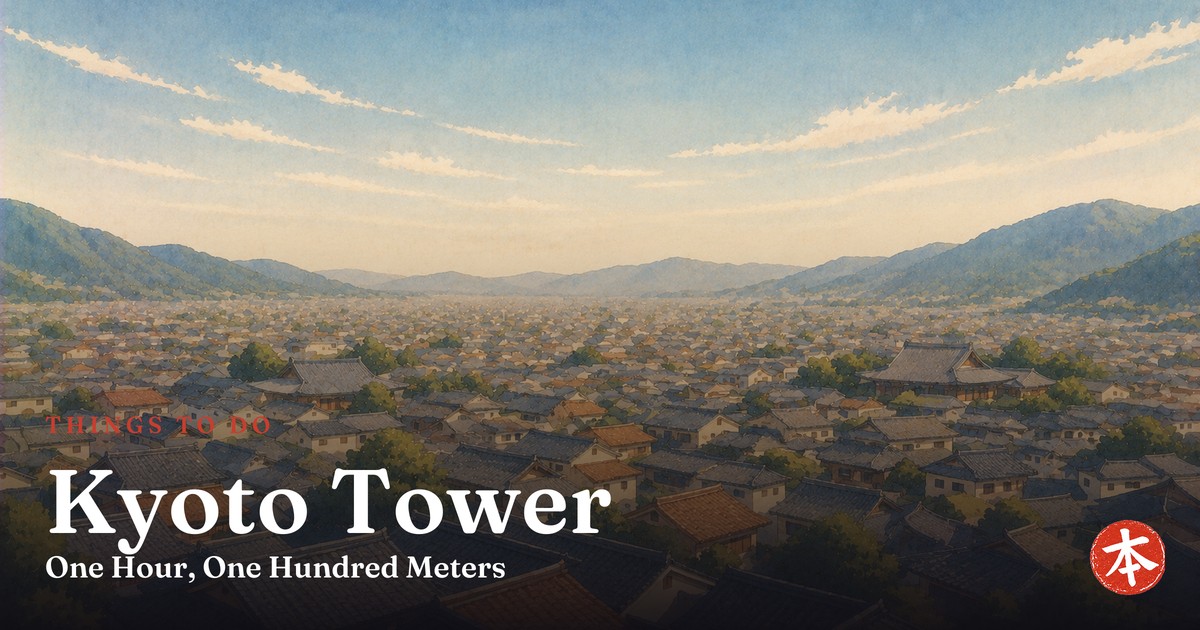
Kyoto Tower is 131 meters tall, which would be unremarkable anywhere else in Japan. In a city that does not build high, it is the tallest structure there is — and that is the entire reason the view works.
| What you book | Admission to the Nidec Kyoto Tower observation deck |
|---|---|
| Name change | Renamed from Kyoto Tower on April 1, 2024. Same building |
| Deck height | 100 meters, in a 131-meter structure |
| How long | 1 hour — the listing’s own suggestion |
| Book ahead? | The listing says yes — to avoid the ticket booth line in peak season |
| Where | Directly opposite Kyoto Station, reachable by underground passage |
| Price | Listed at US$5.65 when we read it |
| Hours | Not shown on the listing. We are not guessing |
The listing itself tells you to book ahead
This is worth flagging because it is rare. Most attraction pages leave the question open. This one answers it in its own words.
Why a station tower gets a booth queue
Position explains it. The tower is the first thing you see when you walk out of Kyoto Station, which means a large share of its visitors are people who decided to go up about ninety seconds earlier. That demand lands entirely at the ticket booth. A deck can be quiet while its counter is busy, and that is the specific situation here.
Peak season in Kyoto is not a vague phrase
Cherry blossom in spring and the color season in autumn turn this city into one of the most concentrated tourist destinations in the world, and Kyoto Station is where all of that arrives. If you are visiting in either window, treat the queue warning as literal rather than as boilerplate.
One hour is the other half of the argument
The listing suggests one hour for this attraction, the shortest suggestion of any observation deck we have covered. An hour is a slot you can fit between a train and a hotel check-in. Spending twenty minutes of it in a line is a much bigger proportional loss than it would be at an attraction you had set aside a half day for.
Check Kyoto Tower tickets → Affiliate link — affiliate disclosure.
It is Nidec Kyoto Tower now
Three minutes from the observation deck, and useful for one specific reason: the new name is on the building in the footage. If you are searching for tickets and finding two different names, this is what the renamed tower looks like now — and what the view from a hundred meters over a low city actually gives you.
The listing carries a notice at the top: Kyoto Tower was renamed Nidec Kyoto Tower starting from April 1, 2024.
What the rename is and is not
It is a naming rights arrangement. The building has not moved, changed hands in any way you would notice as a visitor, or altered what it sells. If you booked something called Kyoto Tower and arrived at something called Nidec Kyoto Tower, you are in the right place.
Why the old name will outlive the new one for a while
Renamed landmarks take years to settle in guidebooks, station signage, map apps and conversation, and this one is only recently changed. Expect to see both names in the same trip. Searching for either will find the same tower.
What it does not change
Height, deck, position, and everything else in this guide. We mention it only because a mismatch between the name on your booking and the name on the building is a genuine moment of doubt when you are standing outside a station in a foreign city, and it takes one sentence to remove.
One hundred meters is low, and that is why it works
The observation deck sits at 100 meters inside a 131-meter structure. Both numbers look small written next to the towers in Tokyo and Osaka. Neither number is the point.
Kyoto does not build high
The city’s skyline is deliberately low, which means there is nothing between this deck and the horizon in any direction. At a hundred meters you are already above everything. In a city of tall buildings, a hundred meters would put you looking at other buildings; here it puts you looking at the whole basin and the mountains around it.
What you can actually pick out
The listing names Kiyomizu-dera, Toji and Chion-in, and says the view reaches as far as Osaka. It adds Fushimi Inari and Mount Hiei elsewhere. East, south and north are all represented in that list, which is the practical way of confirming that the deck really is a full circle rather than a window with a good side.
Telescopes, panels, and the reason to go before you sightsee
There are free telescopes and binoculars, and interactive touch panels explaining what you are looking at. That combination makes this useful as an opening move rather than a closing one. Standing above Kyoto and finding the temples on your list, in relation to each other, does more for your planning than an hour with a map.
See dates and options → Affiliate link — affiliate disclosure.
The building underneath is a second attraction
The deck is one floor. The tower building is several, and the listing describes a range of things in it that have nothing to do with the view.
Sky lounge, shops and restaurants
There is a Sky Lounge Bar where you can sit with the view and a drink, souvenir shops on the lower floors carrying tower-exclusive items and local crafts, and restaurants serving both traditional and contemporary Kyoto food. None of that is admission. All of it is the reason the one-hour estimate turns into two.
The cultural activities are the surprise
The listing names three: making fake food replicas, making fresh sushi, and a kimono rental shop. Food-sample making is a genuinely Japanese craft experience that is hard to find slots for elsewhere, and having it in the building opposite the station is unusually convenient. We did not verify pricing or booking for any of them, so treat them as things to look into rather than things you can walk into.
There is a public bath house in the tower
The listing lists a public bath house among the building’s amenities. That is an unusual thing to find under an observation deck and a genuinely good one at the end of a day spent walking Kyoto’s hills. Whether it costs extra is not stated, and we would assume it does.
Being opposite the station changes how you use it
Most observation decks are destinations. This one is a stop, and planning it as a stop is what makes it worth the money.
The underground passage is the detail to remember
The listing gives two routes from the station: out through the Karasuma Central Gate, or through an underground passage directly into the tower. The second one matters in August heat and in rain, and it is not obvious from outside that it exists.
It also works as the last hour of a trip
If you have a late train and luggage, an hour here beats an hour on a station bench, and you are already where you need to be. Our guide to Osaka to Kyoto covers that leg if you are moving on rather than home.
What to do with the rest of the day
Nishiki Market is the obvious food follow-on and it is central. Gion is the evening one. Both are things you will have just looked down at, which is a better introduction than a photo.
Check availability → Affiliate link — affiliate disclosure.
Deliberately not stated here
| What we are not saying | Why |
|---|---|
| Opening and closing hours | The field was blank on the listing. Towers vary and last entry is always earlier than closing |
| The last-entry time | Not stated, and it is the number that binds |
| The yen gate price | Not verified from the operator. US$5.65 is the reseller listing’s price, labeled as such |
| Whether the bath house is included | Not stated. It is listed as a building amenity, which is not the same as an inclusion |
| Prices or booking for the cultural activities | Not stated. Food-sample and sushi workshops normally require their own reservation |
| Whether the sky lounge needs a deck ticket | Not stated either way |
Kyoto Tower tickets FAQ
Should I book Kyoto Tower tickets in advance?
Why is it called Nidec Kyoto Tower?
How tall is Kyoto Tower and how high is the deck?
What can you see from the deck?
How long should I allow?
Is the public bath house part of the ticket?
Is it worth going up if I have limited time in Kyoto?
How do I get there from Kyoto Station?
Check Kyoto Tower tickets → Affiliate link — affiliate disclosure.
Bottom line (2026) — the tower opposite Kyoto Station was renamed Nidec Kyoto Tower on April 1, 2024 and is the same building. The deck sits at 100 meters in a 131-meter structure, and being low is why it works: Kyoto builds nothing tall, so the view is a clean circle taking in Kiyomizu-dera, Toji, Chion-in, Fushimi Inari, Mount Hiei and, on a clear day, as far as Osaka. The listing suggests one hour and explicitly advises booking ahead to avoid the ticket booth line in peak season. It showed US$5.65 and no opening hours at all, so confirm the times for your date. Reach it from the station through the underground passage rather than the street.
Sources
Written on September 2, 2026 from the Klook listing for the Nidec Kyoto Tower ticket: the notice that Kyoto Tower was renamed Nidec Kyoto Tower starting from April 1, 2024; the structure standing at 131 meters as the tallest in Kyoto with an observation deck at 100 meters; the 360-degree view naming Kiyomizu-dera, Toji and Chion-in temples, Fushimi Inari Shrine, Mount Hiei and a sightline as far as Osaka; the free telescopes and binoculars, interactive touch panels and photo spots; the Sky Lounge Bar, souvenir shops, restaurants and public bath house; the cultural activities including fake food replica making, sushi making and a kimono rental shop; the suggested duration of one hour; the location just north of Kyoto Station with access through the Karasuma Central Gate or the underground passage; the listing’s own advice to book ahead to ensure entry and avoid long lines at the ticket booth in peak season; and the listed price of US$5.65 with a 4.6/5 rating across 2,400 reviews and 70,000+ bookings. The opening hours field was empty, which is why no hours appear here. More on how we work: how we research.
Naming rights, prices and building tenants change, and a tower attached to a station complex changes with the complex. This reflects what that source said on September 2, 2026, and the operator publishes its own current times that are worth a glance the week you go.
Tokyo to Osaka, Tokyo to Kyushu, Tokyo to Hokkaido — day by day — plus seven places most visitors never reach.
- 12 pages, 80 photographs, every stop linked to its guide
- Every price and opening hour read from the official page
- Re-issued monthly, so it does not go stale in your inbox
Free. One email a month, plus the rare change that matters. Unsubscribe with one click in any email. By subscribing you agree to our privacy policy.