Most guides to Nagoya Castle describe the keep, its golden fish and its record-breaking floorspace, and never mention the thing you need to know before you buy a ticket: you cannot go inside it. The castle’s own website says so on its front page.
| The keep | Cannot be entered — stated on the official site the day we checked |
|---|---|
| What you enter | The reconstructed Hommaru Palace, plus the grounds |
| Queue | The official site publishes a live waiting time for the palace |
| Completed | 1615, by Tokugawa Ieyasu |
| Claim to fame | Japan’s first castle designated a National Treasure; the keep had the largest floorspace of any |
| On the roof | The golden shachihoko — visible from the grounds |
| Price | Listed at US$3.15 when we read it |
| Hours | Not shown on the reseller listing. Check the official site |
The keep cannot be entered, and the castle says so daily
This is the fact that reorders everything else, so we are putting it first rather than in a footnote.
Why this matters more than a normal closure
At most castles the keep is the visit. It is the silhouette on the poster, the thing you climb, and the view at the end. Arriving to find it closed is not like finding one wing of a museum shut; it is closer to buying a ticket for a tower and being given the garden. Nothing about that is a problem if you knew beforehand. Everything about it is a problem if you did not.
The reseller page does not tell you
We read the Klook listing first, and it describes the keep entirely in the past tense — a large keep that boasted the largest total floor area, a castle that was designated a National Treasure. All accurate. None of it says you cannot go in. That gap between an accurate description and a useful one is exactly why we opened the operator’s site.
How to check for your own day
The line we quoted is a live status display, which means it is written for today and not for September. Open the castle’s own English front page for the date you are going and read the operating information block. It takes ten seconds and it is the only version of this information that is guaranteed to be current.
Check Nagoya Castle tickets → Affiliate link — affiliate disclosure.
The Hommaru Palace is what you actually walk into
Nagoya Castle runs its own channel, and this episode is entirely about the Hommaru Palace — the building you can actually enter. Twenty-five minutes in Japanese, but the reconstructed rooms, the gold-leaf screens and the cypress ceilings do not need translating. Watch a few minutes and the reason the palace matters more than the keep here stops being an abstract claim.
With the keep closed, the palace is the indoor attraction, and it is a substantial one rather than a stand-in.
What it is
The residence inside the castle’s main enclosure. The Klook listing calls it lavish; the official site presents it alongside the keep and the golden roof fish as one of the things that made this castle significant in the first place. It was lost with everything else in the war and has been reconstructed, which the official site describes as part of restoration work returning the castle to its original condition.
The official site publishes its waiting time
This is the detail that tells you the most. The front page carries a live Hommaru Palace admission waiting time with a timestamp — it read zero minutes at 11:00 on the Wednesday we checked. Operators do not build live queue displays for attractions that never have queues. Read that as: quiet on a weekday morning, plan differently for a spring weekend.
A reconstruction is not a lesser thing here
Japan has very few original castle interiors, and most of what visitors walk through anywhere in the country is rebuilt. The honest framing is not original against fake but what the reconstruction is for: in this case, showing the interior of a shogunal residence that no longer exists anywhere else. Going in expecting that is a good afternoon. Going in expecting four-hundred-year-old timber is not.
What you can see without going inside anything
A lot, which is the reason this still works as a visit.
The golden shachihoko
The official site calls them votive tiger-fish roof devices; the Klook listing calls them golden shachi, mythical fish-like statues. They sit at both ends of the ridge of the keep and they are the emblem of the entire city. Crucially, they are on the outside. The keep being shut does not take them away from you.
The scale claim, and what it means from ground level
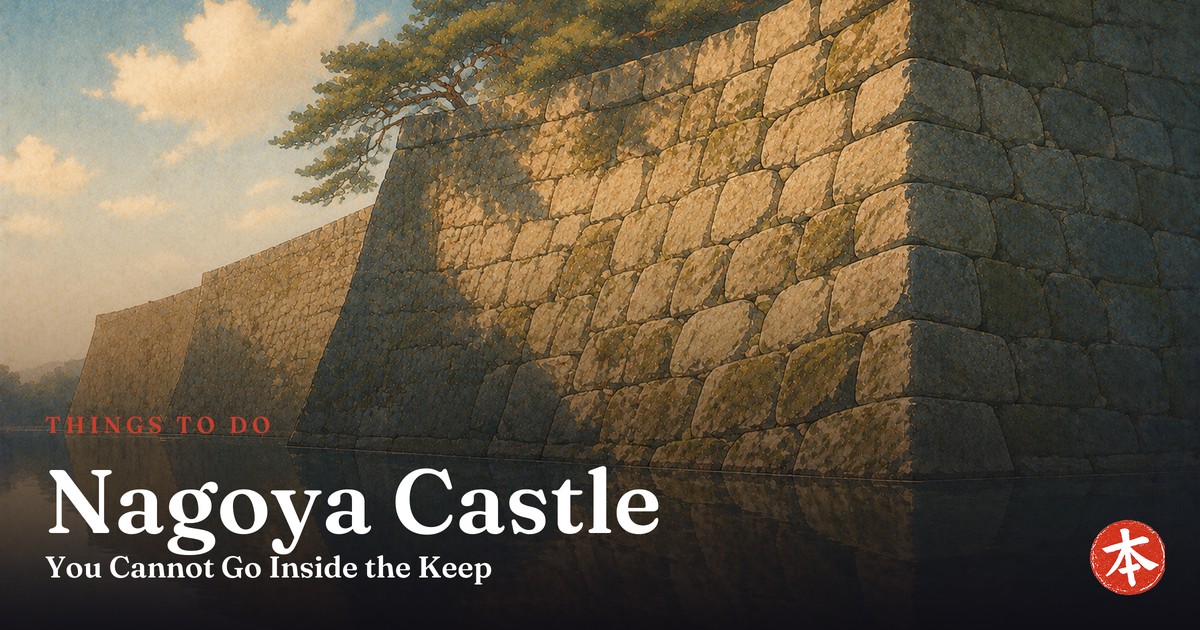
Both sources make the same point: this keep had the largest floorspace of any castle keep in Japan. Standing underneath a building described that way is a different experience from reading the sentence, and it is available to anyone in the grounds. The footprint is the claim, and the footprint is visible.
The grounds, the walls and the moats
The castle occupies a large site in central Nagoya, and the stone walls and moats are the parts that reach furthest back. As at other Japanese castles, these are the elements least changed by fire and reconstruction. If you have an hour and the interiors are closed, this is where the hour goes.
See ticket options → Affiliate link — affiliate disclosure.
1615, a National Treasure, and an air raid
The history here is short to tell and it explains the current state of the site better than any description of the buildings does.
| What the sources state | Detail |
|---|---|
| Completed | 1615 by Tokugawa Ieyasu. The Klook listing gives the era name as Keicho 20 |
| Status | Japan’s first castle designated a National Treasure |
| The keep | Boasted the largest floorspace of any tower keep |
| Destroyed | In wartime air raids |
| Since | Designated a historic site; restoration work is ongoing |
Why the past tense is everywhere
Read either source closely and almost every superlative is historical. The castle was the first National Treasure. The keep boasted the largest floorspace. That grammar is not evasive — it is accurate, and it is describing a building that burned. Once you notice it, the closure of the keep stops being surprising.
There is a reconstruction project
The official site carries a section for a Nagoya Castle Keep Reconstruction Project, and describes restoration work as returning the castle to its original condition. We are not going to tell you when that finishes or what the keep will be when it does, because those are decisions and timelines we did not verify. What it does tell you is that the current state is a stage in something, not a permanent condition.
One note on how the two sources word it
The reseller listing describes the site as a National Special Historic Site; the official English page says National Historic Site. We have used the operator’s own wording. It is a small difference and we mention it only because it is the kind of thing that gets copied between guides until nobody knows which is right.
Check availability → Affiliate link — affiliate disclosure.
Fitting it into a trip that is mostly somewhere else
Almost nobody flies to Japan to see Nagoya. Almost everybody passes through it, which makes this a stopover attraction, and stopover attractions live or die on how well they fit a gap.
If you want a castle you can climb
That is a different trip. Himeji is the preserved one, with original timber and an interior you go up, and it is the answer for anyone whose priority is the building itself. Osaka Castle is a reconstruction with a museum inside and an observation deck on top. Nagoya is the site, the grounds and the palace.
Nagoya as a gateway rather than a stop
The city is also the way into the mountains — our Takayama guide covers where that line goes. If you are heading that way, an afternoon at the castle before the train is a natural shape for the day rather than a detour.
When to skip it
If your only interest is climbing a keep for the view, and your date falls while the keep is closed, skip it without guilt and put the time somewhere else. That is a real answer and we would rather give it than talk you into a ticket you will regret. For everyone else — anyone interested in the palace, the grounds or the history — the closure changes the visit without ruining it.
Deliberately not stated here
| What we are not saying | Why |
|---|---|
| Opening and closing hours | The reseller listing’s hours field was blank. The official site publishes today’s status, which is where to look |
| The yen gate price | Not verified. US$3.15 is the reseller listing’s price, labeled as such |
| When the keep will reopen | The official site has a reconstruction project section; we did not verify any date and will not guess at one |
| Which other structures are closed | The notice says the keep and some other structures without listing them |
| Whether the palace is inside standard admission | Not stated on the reseller listing. The official site shows it with its own admission waiting time |
| The height or dimensions of the keep | Not verified. We repeat only the floorspace claim both sources make |
(For how the castle connects to the rest of the city, our Nagoya map guide covers the 500-yen Me~guru loop bus, its direct 8:30 and 9:00 castle departures, and the Monday it does not run.)
Nagoya Castle FAQ
Can you go inside Nagoya Castle’s keep?
So what does the ticket actually get you?
What is the Hommaru Palace?
Is there a queue for the palace?
When was Nagoya Castle built and by whom?
What are the golden fish on the roof?
How much is admission?
Is it still worth visiting with the keep closed?
Check Nagoya Castle tickets → Affiliate link — affiliate disclosure.
Bottom line (2026) — on the day we checked, Nagoya Castle’s own website said the castle was open and that the tower keep and some other structures cannot be entered. What you walk into is the reconstructed Hommaru Palace, for which the official site publishes a live admission waiting time. The castle was completed in 1615 by Tokugawa Ieyasu, was Japan’s first castle designated a National Treasure, had the largest floorspace of any keep, and was destroyed in wartime air raids; restoration work continues. The golden shachihoko are on the roof and visible from the grounds. The reseller showed US$3.15 and no opening hours — so read the official status page for your own date before you go.
(For eel near the castle: our hitsumabushi guide includes Bincho’s Kinshachi Yokocho branch, one of four Bincho restaurants in Nagoya that list hitsumabushi at 3,980 yen.)
(If you take that line to Takayama: our Hidatei Hanaougi guide notes that the ryokan’s free shuttle leaves Takayama Station’s West exit every 30 minutes from 14:30 to 17:30, by reservation only, and that the ryokan takes bookings with dinner and breakfast only.)
Sources
Written on September 2, 2026 from two sources. From Nagoya Castle’s official English website: the operating information stating that the castle was open that day and that the tower keep and some other structures cannot be entered; the live Hommaru Palace admission waiting time, shown as zero minutes as of 11:00 am on September 2; that the castle was completed in 1615 by the Shogun Tokugawa Ieyasu; the golden shachihoko described as votive tiger-fish roof devices; the keep boasting the largest floorspace of any tower keep; that it was Japan’s first castle to be designated a National Treasure; that it was destroyed in wartime air raids and subsequently designated a historic site; that restoration work is returning it to original condition; and the presence of a Nagoya Castle Keep Reconstruction Project section. From the Klook listing for the Nagoya Castle ticket: the era name Keicho 20 for 1615, the description of the Hommaru Palace as lavish and of the castle as a fortress with ironclad defenses, the address at 1-1 Honmaru in Naka Ward, and the listed price of US$3.15 with a 4.6/5 rating across 304 reviews and 10,000+ bookings. More on how we work: how we research.
The closure notice we quote is a live status line written for one day, and restoration work changes what is open. This reflects what those sources said on September 2, 2026, and the castle’s own front page carries the current position for the day you are going.
Tokyo to Osaka, Tokyo to Kyushu, Tokyo to Hokkaido — day by day — plus seven places most visitors never reach.
- 12 pages, 80 photographs, every stop linked to its guide
- Every price and opening hour read from the official page
- Re-issued monthly, so it does not go stale in your inbox
Free. One email a month, plus the rare change that matters. Unsubscribe with one click in any email. By subscribing you agree to our privacy policy.