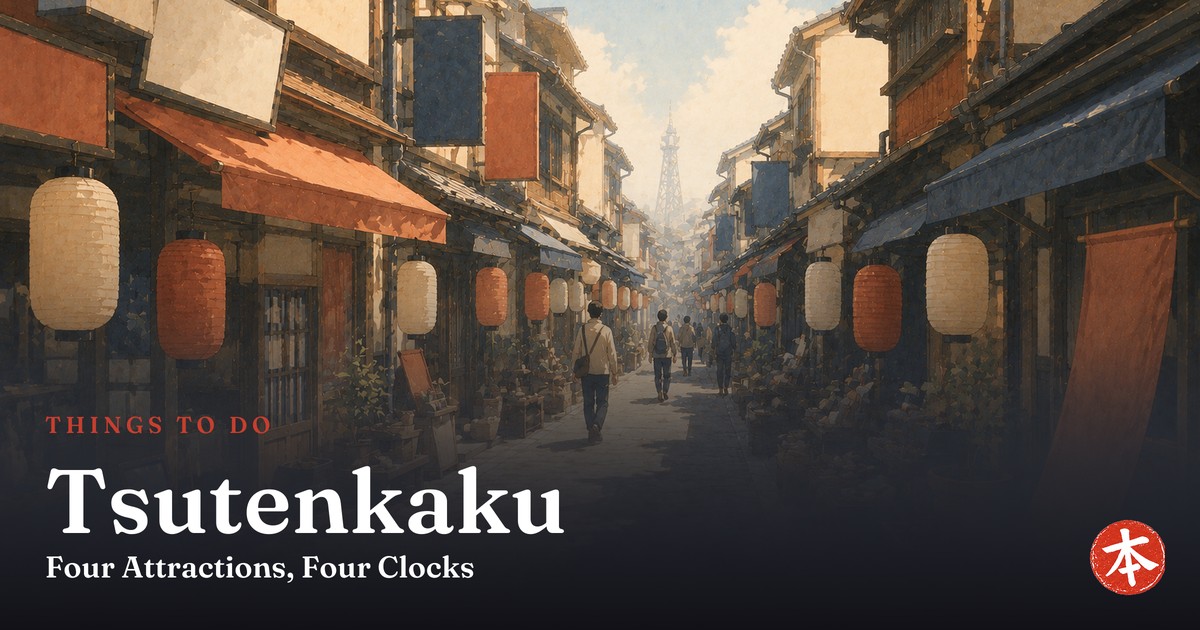
Tsutenkaku looks like a single attraction with a single ticket and a single closing time. It is not. The listing gives four different schedules for four different things in the same tower, and the two that people travel for are the two that close first.
| General observation deck | 09:00–21:45 — last entry 21:15 |
|---|---|
| Special outdoor deck | 09:00–21:45 — last entry 21:35 |
| Dive & Walk | 09:10–19:00 — last admission 18:15 |
| Tower Slider | 10:00–19:30 |
| The trap | Arrive at 20:00 and the tower is open while both thrill attractions are already shut |
| Where it is | The middle of Shinsekai, Osaka |
| Price | Not displayed on the listing when we read it |
Four attractions, four closing times
This is the single most useful thing to know about Tsutenkaku, and it does not appear in most write-ups because most write-ups treat it as an observation deck with a novelty attached.
The general observation deck is the latest one
Open 09:00 to 21:45, with last entry at 21:15. That half hour of difference is the usual pattern — the time it takes to clear a deck — and 21:15 is the number that binds. If the view is all you want, this is a genuinely late attraction by Japanese standards and you can put it after dinner.
The special outdoor deck closes at the same hour, with a later door
The listing gave the outdoor deck the same 09:00 to 21:45 window but a last entry of 21:35 — twenty minutes later than the general deck. We are reporting that as stated rather than explaining it, because we did not verify how the two entrances relate. What it means practically is that the outdoor deck is not the thing you get shut out of first.
Dive & Walk closes hours before everything else
09:10 to 19:00, last admission 18:15. This is the constraint that should shape your day. It is a harnessed activity with staff, equipment and a queue, and the operator stops taking people forty-five minutes before it closes. If Dive and Walk is why you are coming to Tsutenkaku, 18:15 is your real deadline, not 21:15.
The Tower Slider stops at 19:30
Open 10:00 to 19:30 — a later start and an earlier finish than the tower itself. Between 19:30 and 21:45 the tower is fully open and the slide is not, which is a specific and avoidable disappointment for anyone who came for it.
Check Tsutenkaku tickets → Affiliate link — affiliate disclosure.
Dive & Walk: what you are actually signing up for
The name is doing a lot of work. These are two separate things, both on the outside of the building, both in a safety harness.
The Walk
You are hanging outside the 26-meter mid-level observation deck in a harness, and walking. That is the listing’s own description. Twenty-six meters is not the top of the tower — this happens at mid-level — which is worth knowing if you were picturing the very top, and worth knowing if you were dreading it.
The Dive
A jump from about 40 meters down to the 14-meter mid-level deck. The numbers matter here: this is a controlled descent between two known points on the structure, not a free fall to the ground. It is still a jump off a tower, and no amount of engineering description changes what your body will think about that.
How you get to it
The route is specific and the listing spells it out: you climb the stairs of the lift building, cross the seismic isolation bridge from the top floor, and proceed to the tower. Stairs, then a bridge, then the activity. If stairs are a problem for anyone in your group, that is a thing to establish before you book rather than at the bottom of them.
The Tower Slider: 60 meters in about ten seconds
Tsutenkaku made this one themselves, and it carries English, Chinese and Korean subtitles. Two minutes showing exactly how the slide works from the helmet onward — which is worth watching before you buy, because most of the questions people ask at the counter are answered here, and the ride is over in about ten seconds.
This is the attraction that gets photographed and the one people misjudge the timing of, so the numbers are worth having.
| What the listing states | Detail |
|---|---|
| Where it starts | The third floor of the observation deck, about 22 meters above ground |
| Length | 60 meters, wrapping the outer circumference of the lift tower |
| Slope | Approximately 30 degrees |
| Duration | About 10 seconds, ending at basement level |
| The tube | Weather-resistant stainless steel ribs with transparent polycarbonate panels |
Twenty-two meters is not high, and that is the point
This is not a drop tower. It starts partway up the structure and spirals down the outside, which is why it takes ten seconds rather than three. The experience being sold is the wrap and the view through the tube, not the fall.
The ceiling is the part people do not expect
The tube is roofed in transparent, heat-insulating panels, which means that as you go down you are looking up at Tsutenkaku itself. That is a deliberate design decision and it is the reason this reads differently from a slide at a water park. It is also why doing it after dark, when the tower is lit, is a different experience from doing it at noon — though remember the slide closes at 19:30.
Where you end up
Basement level. You do not come out where you went in, which matters if you have left people or bags somewhere. Ten seconds of descent puts you several floors below the group you were standing with, and reuniting takes longer than the ride did.
See ticket options → Affiliate link — affiliate disclosure.
The glass floor at 103 meters, and what we could not pin down
The listing describes walking on a glass floor at a height of 103 meters, with a view straight down onto the streets below.
What is stated, and what is not
The height is stated. What is not clearly stated is which ticket admits you to it — the description sits next to the slider text without being tied to a specific option. We are flagging that rather than resolving it, because guessing at what a ticket includes is how people end up paying twice.
Why this ambiguity is common
Towers with multiple paid activities list them together and price them separately, and reseller pages inherit the operator’s own layout. The result is a page where four things are described in one block and sold in several. The reliable habit is to read the option you are about to buy rather than the description at the top of the page.
Check availability → Affiliate link — affiliate disclosure.
Shinsekai is half of why you came
The listing is unusually direct about this: it calls the district around the tower as famous a destination as the tower itself, and says the atmosphere gets a cry of surprise out of first-time visitors.
The tower is a landmark you look at, not only from
Tsutenkaku is at the center of a grid of streets that were built to face it, so the walk toward it is part of the attraction. Standing underneath it at night, with the shops lit, is a different photograph from anything you take at the top — and it costs nothing.
What else fits in the day
HARUKAS 300 is the other southern Osaka high view and sits close enough to pair, though two towers in one evening is a lot of lift. Dotonbori is the obvious food follow-on, and Osaka Castle works as the daytime half if you want history before neon.
When to skip the tower and keep the district
If you are arriving after 21:15, or after 19:30 and the slide was the point, the honest advice is to skip the ticket and walk Shinsekai instead. For a pure night view the Umeda Sky Building has a later door and an open-air roof, and Kaiyukan is the bay-side option on a different evening.
Deliberately not stated here
| What we are not saying | Why |
|---|---|
| The price | The listing did not display one when we read it, and we did not verify a yen fare from the operator |
| Which ticket includes the glass floor | The 103-meter glass floor is described without being tied to an option. We are not guessing |
| Whether Dive & Walk or the slide are inside admission | Not stated. They have their own schedules, which usually means their own pricing, but we did not verify it |
| Age, height or weight limits | Not stated on the listing. Harness activities normally have them, so check before you travel with children |
| Closing days or seasonal hours | Not stated. The four schedules we quote are the ones shown, not a year-round guarantee |
| The height of the tower | Not verified. We quote only the heights the listing itself gives — 14, 22, 26, 40 and 103 meters |
Tsutenkaku tickets FAQ
What time does Tsutenkaku close?
What is Dive and Walk?
What is the Tower Slider?
Is the glass floor part of the ticket?
How much does it cost?
Is the tower safe in an earthquake?
Is Shinsekai worth time on its own?
When should I arrive?
Check Tsutenkaku tickets → Affiliate link — affiliate disclosure.
Bottom line (2026) — Tsutenkaku runs on four separate schedules: the general deck 09:00–21:45 (last entry 21:15), the special outdoor deck the same hours with a 21:35 door, Dive & Walk 09:10–19:00 with last admission 18:15, and the Tower Slider 10:00–19:30. Work backwards from the earliest thing you want. Dive & Walk means hanging outside the 26-meter deck and dropping from about 40 meters to the 14-meter deck. The slider is 60 meters at about 30 degrees, roughly 10 seconds to basement level, under a transparent roof you look up through. A glass floor at 103 meters is described without being tied to a ticket, and no price was shown — both are things to settle on the booking page. Shinsekai around the base is half the visit.
(For dinner around the tower: our kushikatsu in Osaka guide covers five restaurants, three of them in Shinsekai, where a beef skewer costs 154 yen with tax at Daruma’s main shop.)
Sources
Written on September 2, 2026 from the Klook listing for the Osaka Tsutenkaku Tower ticket: the stated hours for the general observation deck (09:00–21:45, last entry 21:15), the special outdoor observation deck (09:00–21:45, last entry 21:35), Dive & Walk (09:10–19:00, last admission 18:15) and the Tower Slider (10:00–19:30); the description of the Walk as hanging outside the 26-meter mid-level deck in a safety harness and the Dive as a jump from about 40 meters to the 14-meter mid-level deck; the route up the stairs of the lift building and across the seismic isolation bridge, which the listing describes as structurally separated from the tower for safety during earthquakes; the Tower Slider at about 22 meters above ground on the third floor of the observation deck, 60 meters long at roughly 30 degrees, taking about 10 seconds to basement level, with a stainless steel and transparent polycarbonate roof; the glass floor at 103 meters; the description of Shinsekai as as famous as the tower; and a 4.4/5 rating across 704 reviews with 70,000+ bookings. No price was displayed, which is why none appears here. More on how we work: how we research.
Schedules for individual attractions inside a tower change more often than the tower’s own hours do, and thrill activities close for weather and maintenance. This reflects what that source said on September 2, 2026, and the booking page carries the current times for the day you are going.
Tokyo to Osaka, Tokyo to Kyushu, Tokyo to Hokkaido — day by day — plus seven places most visitors never reach.
- 12 pages, 80 photographs, every stop linked to its guide
- Every price and opening hour read from the official page
- Re-issued monthly, so it does not go stale in your inbox
Free. One email a month, plus the rare change that matters. Unsubscribe with one click in any email. By subscribing you agree to our privacy policy.