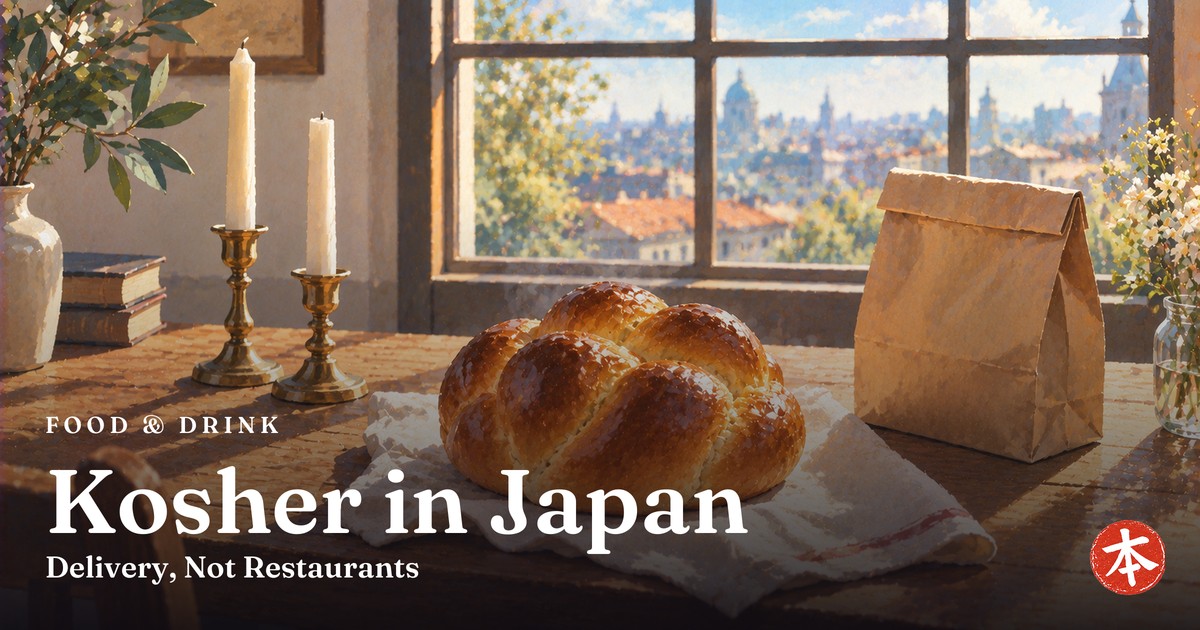
Most guides to kosher in Japan are lists of restaurants, and most of those lists are wrong, because the restaurant is not the unit. The unit is delivery. Since April 2005, kosher food in Japan has run through Kosher Delica, a delivery-only service that Chabad of Tokyo describes as the first kosher catering in the country, and which its pages say now delivers to all cities in Japan. You order it three days ahead. It arrives at your hotel.
Around that core there are exactly three other things: Shabbat meals at the Chabad houses in Tokyo and Kyoto, a single Kyoto kaiseki house that has served a certified kosher course since September 2024 with a supervisor sent for each service, and a certification company, Kosher Japan, founded in 1999 as the first in the country, which has put its mark on products from soy sauce to the sake brand Dassai.
The rest of this page is what the rabbis themselves publish about eating in Japan: why the bread is a problem, why farmed fish is safer than wild, and which three supermarket chains carry imported kosher goods.
Kosher in Japan at a glance
| What | Where / how | Notice |
|---|---|---|
| Kosher Delica (delivery) | Chabad of Tokyo, since April 2005. Hotels, offices, restaurants, homes. All cities in Japan | 3 days |
| Shabbat meals, Tokyo | Chabad House Tokyo, near JR Omori Station, Keihin-Tohoku Line | Web form; paid |
| Shabbat meals, Kyoto | Chabad of Kyoto, 30-3 Okazaki Tennocho, Sakyo Ward | Web form; food orders 3 days |
| Certified restaurant course | Honke Tankuma Honten, Kyoto kaiseki, since September 2024 | Book via the restaurant |
| Certification body | Kosher Japan Co., Ltd., founded 1999, Sanno, Ota-ku, Tokyo | — |
| Supervision | Rabbi Binyomin Y. Edery, Chabad of Tokyo, for all of the above | — |
Kosher Delica: how the delivery system works
This is the thing to understand first, because it changes how you plan. You do not hunt for a restaurant; you order meals to wherever you are staying. Chabad Tokyo’s page says the service was established in April 2005 as the first kosher catering in Japan, that it “delivers to all cities in Japan, to hotels, business offices, restaurants, and private homes”, and that it caters for groups and events. Business travelers from abroad and tour groups from Israel, the US and Europe are named as the regular users.
How far ahead do I need to order?
At least three days. Both the current Tokyo ordering page and the Kyoto page use the same line: reserve at least three days in advance, and last-minute requests are subject to availability. Order through WhatsApp; the number is on the Chabad pages and we are not reproducing it here because numbers change and the site is the source.
Who supervises it?
All food is described as under the strict rabbinical supervision of Rabbi Binyomin Y. Edery, who Chabad’s own pages call the Chief Rabbi of Japan and who opened the first Chabad house in Tokyo in December 1999. The same rabbi is the chief supervisor of the certification company below, so the supervision chain in Japan is unusually short: one organization, one signature.
Does it reach outside Tokyo?
The pages say yes, all cities. In practice this is a delivery from Tokyo, so the three-day rule matters more the farther you are. Kyoto has its own Chabad house taking the same orders, which makes the two cities the easy ones.
Shabbat meals at Chabad Tokyo and Chabad Kyoto
Where is the Tokyo house and how do I get there?
Chabad House Tokyo says it is a short walk from Omori Station on the JR Keihin-Tohoku Line. From Shinagawa that is the second stop, about six minutes, from track 4. Chabad’s own airport directions describe the JR local from Narita to Shinagawa as about 90 minutes and 1,450 yen with the Narita Express as the faster, dearer option; we are quoting their guidance rather than a JR fare table, so treat the yen figure as theirs.
What is the Tokyo Shabbat schedule?
| When | What (Chabad Tokyo’s posted schedule) |
|---|---|
| Friday | Mincha 10 minutes after candle lighting; Kabbalat Shabbat and dinner at 6:00 pm in winter (after Sukkot) and 7:00 pm in spring and summer (after Passover) |
| Saturday | Chasidut study and Shacharit at 9:00 and 10:00; Shabbat meal and cholent at 12:30 |
Meals are reserved on a web form and paid, priced in US dollars, with separate adult and child-or-student rates and a line for people who cannot afford the full amount. The form showed two different adult figures when we read it, so we are not printing either.
And Kyoto?
Chabad of Kyoto is at 30-3 Okazaki Tennocho, Sakyo Ward, Kyoto 606-8335, in the Okazaki museum district. Friday: Mincha five minutes after candle lighting, then Kabbalat Shabbat and a meal 30 minutes after lighting. Saturday: Shacharit at 10:00 am followed by the meal. Reservations go through a form linked from the Shabbat page.
The one certified restaurant course: Honke Tankuma Honten, Kyoto
Honke Tankuma Honten’s own short film on its kosher kaiseki course, with the supervising rabbi on camera.
In September 2024 Kosher Japan announced that Honke Tankuma Honten, a Kyoto kaiseki house, had begun serving a certified kosher kaiseki course, calling it a rare thing in the world: a formal, traditional Japanese restaurant operating kosher.
What makes a Japanese restaurant kosher-capable?
The release spells out the two hurdles. First, the flame for cooked food must be lit with the involvement of a religious Jew, down to the rice cooker; a supervisor has to light it. Second, the kitchen needs dedicated kosher equipment and utensils and an operation that keeps non-kosher food from mixing in. Tankuma solved both, and Kosher Japan says it sends staff for each service to light the kitchen and perform the religious washing of vegetables.
How do I book it?
Through the restaurant’s own site, not through Chabad. The release points to Tankuma’s menu page. We have not seen a price on the release and are not stating one.
Kosher Japan: the certification company behind the KJ mark
Kosher Japan Co., Ltd. was founded in 1999 and describes itself as Japan’s first kosher certification body, with Rabbi Edery as chief supervisor. Chabad of Kyoto says plainly that the company is run by them. Its head office is at 1-26-27 Sanno, Ota-ku, Tokyo, which is the same Omori neighborhood as the Chabad house.
What has it certified?
The site lists client companies without a full public product list, but two things are stated in its own words: it certified the sake Dassai, which it says then sold well in Western markets beyond Jewish consumers, and it works with producers of traditional Japanese foods — the Kyoto page says the company “issues kosher certifications for many Japanese traditional foods” and invites you to contact Chabad to buy them. There is also a small online shop.
What are the rules, in the company’s own summary?
Meat and dairy are not used in the same dish. Animals are slaughtered under shechita by a qualified person, inspected afterward with particular attention to the lungs, and all blood and most fat removed. Kitchens need two sets of tools — one for meat and poultry, one for everything else — ideally two sinks, and separate towels and drying racks. Additives are checked for forbidden ingredients. That is the standard Tankuma had to meet.
Keeping kosher in a Japanese supermarket: what Chabad Kyoto says
Which fish is safer, farmed or wild?
Farmed. The concern is parasites, not species. Chabad Kyoto explains that farmed fish, youshoku, carries less risk because the feed is frozen or dry, while wild-caught, tennen, frequently contains parasites. Fish sold fresh for sashimi is lower risk because the cook works to remove anisakis, but fish that was once frozen, tuna for example, may not get that attention because freezing kills the parasite. The page adds a useful translation note: Google Lens tends to render youshoku as “breeding” and tennen as “natural”.
What about knives and boards at the fishmonger?
Chabad’s view is that because fishmongers do not handle hot food, cleaning knives and boards with soap between species is sufficient. That is their ruling, stated on their page; we are relaying it, not issuing it.
Are eggs a problem?
The page simply notes that the basic egg in Japan is the white egg. Nothing further, so nothing further from us.
Where are imported kosher products sold?
Three chains are named: Gyomu Super, Fresco and the liquor shop Yamaya. Convenience stores are not on that list, and our 7-Eleven guide is a guide to Japanese convenience food, not to kosher food; do not read the one into the other. If you are managing a medical diet alongside a religious one, the medication rules are a separate question.
How kosher compares with the other dietary paths in Japan
Japan has a small but real infrastructure for halal, a growing one for vegetarian and vegan eating, and an official labeling regime that helps with gluten. Kosher is the smallest of the four by a wide margin, and it is the only one where the honest answer is “order delivery and eat at the Chabad house” rather than “here are twelve restaurants”.
Is a vegan restaurant a safe fallback?
Not automatically, and we are not going to label one as kosher. Vegan removes the meat-and-dairy problem but not the supervision, equipment or ingredient questions above. Use the delivery service for meals that need to be kosher, and treat everything else as your own call.
What should I do on arrival day?
Have the first delivery already ordered. Three days’ notice means the first meal in Japan has to be booked from home. If you land on a Friday, the Shabbat meal reservation solves dinner, and the Omori location is on the Keihin-Tohoku line that runs straight from Shinagawa.
Kosher in Japan FAQ
Are there kosher restaurants in Japan?
How do I order kosher food in Tokyo?
Can I get kosher food in Kyoto?
Is there kosher sushi or kosher wagyu?
Can I attend a Shabbat meal as a visitor?
Is Japanese bread kosher?
What about raw fish and sashimi?
Where can I buy imported kosher products?
Bottom line (2026). Kosher food in Japan is a delivery service, not a restaurant scene: Chabad’s Kosher Delica, running since April 2005, ordered three days ahead and sent to your hotel in any city. Add Shabbat meals at Chabad Tokyo near Omori Station and at Chabad Kyoto in Okazaki, and one certified kaiseki course at Honke Tankuma Honten in Kyoto since September 2024. In shops, the rabbis’ own warning is about bread, not fish; buy farmed fish over wild; and look for imported kosher goods at Gyomu Super, Fresco and Yamaya.
Sources
The delivery service, its 2005 founding, the three-day rule, the Tokyo Shabbat schedule and the Omori directions were read on Chabad Tokyo’s official site; the Kyoto address, Kyoto Shabbat times and the entire supermarket guidance on bread, fish, eggs and the three named chains were read on Chabad of Kyoto’s official site; the 1999 founding, the Dassai certification, the kosher rules summary and the Honke Tankuma announcement of September 3, 2024 were read on Kosher Japan Co., Ltd.’s official site. All three on September 14, 2026. The Jewish Community of Japan’s site did not resolve on the same day, which is why it is absent from this page rather than described from memory.
Tokyo to Osaka, Tokyo to Kyushu, Tokyo to Hokkaido — day by day — plus seven places most visitors never reach.
- 12 pages, 80 photographs, every stop linked to its guide
- Every price and opening hour read from the official page
- Re-issued monthly, so it does not go stale in your inbox
Free. One email a month, plus the rare change that matters. Unsubscribe with one click in any email. By subscribing you agree to our privacy policy.