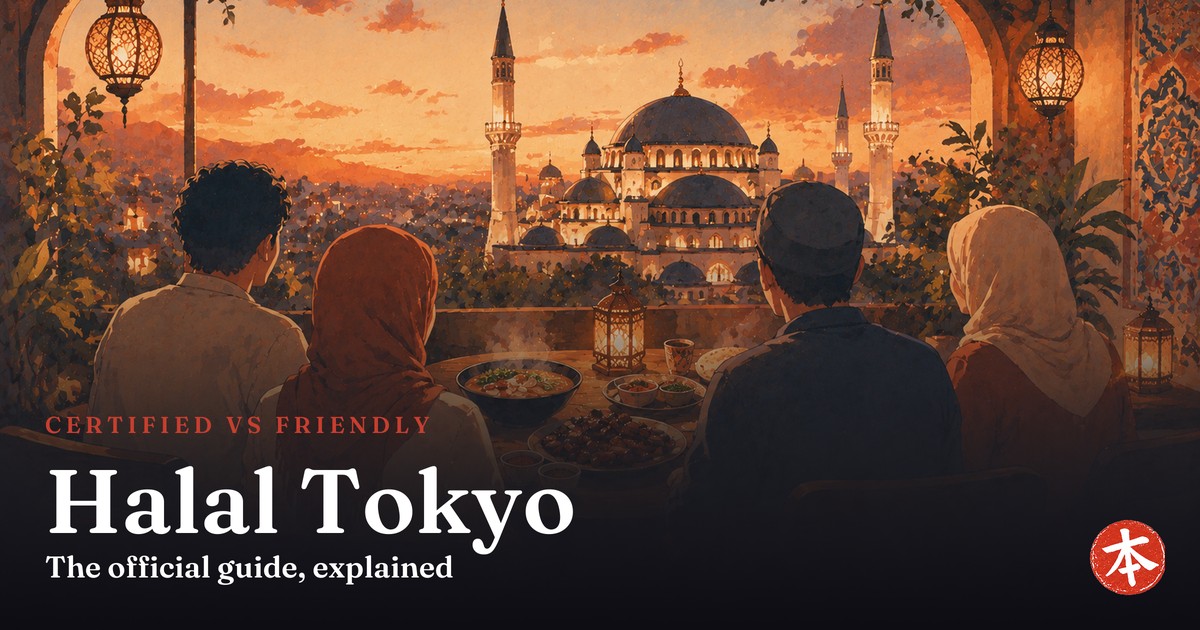
Halal dining in Tokyo is genuinely workable in 2026 — and genuinely misreported. The structural fact that most guides skip comes straight from JNTO, Japan's national tourism organization: there is no central agency for halal accreditation in Japan. Certification is real but plural, self-description is common, and the gap between "halal-certified" and "Muslim-friendly" is one the official Tokyo guide itself marks with separate icons. This guide works the way the official sources do: it tells you who certifies, who self-describes, who publishes nothing — and which famous recommendations dissolve when you check them.
Halal Tokyo at a glance
| Resource | What it officially is |
|---|---|
| TOKYO MUSLIM Travelers' Guide 2026–27 | Free official 60-page guide (GO TOKYO) · icons distinguish certified meat / separate kitchens / no-pork / Muslim-friendly · data as of Nov 2025 |
| Tokyo Camii (Yoyogi-Uehara) | Mosque open daily 10:00–18:00 · tours Sat/Sun/hol 14:30 · headscarf in prayer hall · TC Halal Market on site |
| PANGA (Okachimachi area) · Gyumon (Shibuya) | Self-described halal wagyu yakiniku (+ Gyumon's ramen shop) · no certifier named on their sites |
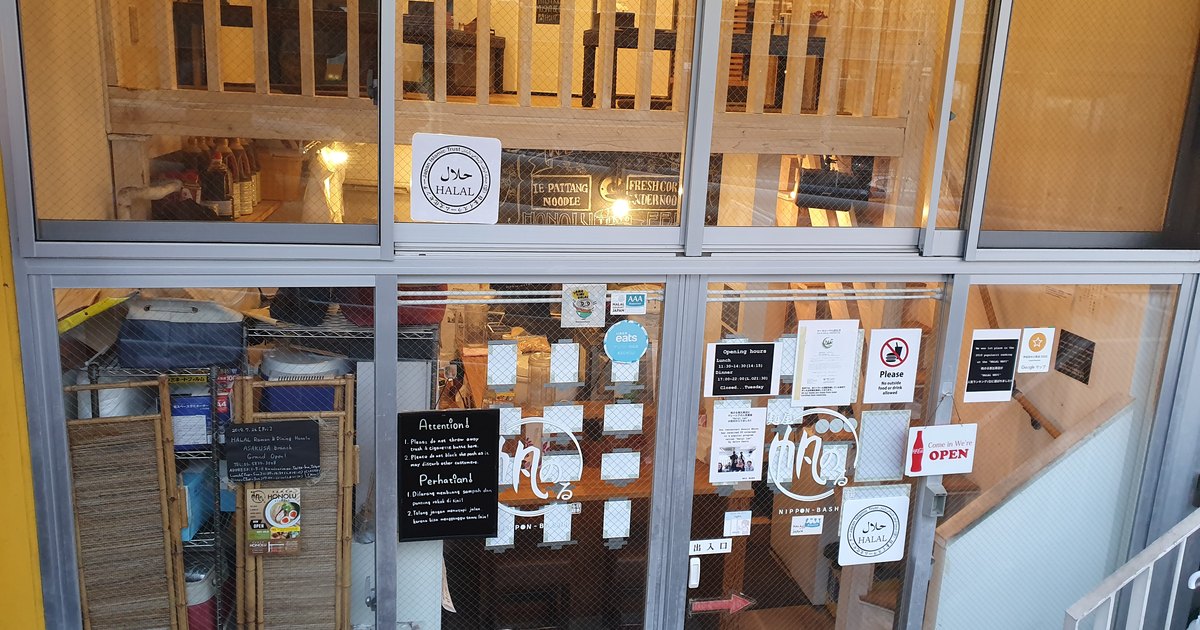
| Honolu (3 shops) · Sankyu (Ueno) | Halal ramen brands listed in the official Tokyo guide's dining pages |
| Halal CoCo Ichibanya, Akihabara | Opened 2017 with NAHA certification (official release) · current status: verify directly |
What eating halal in Tokyo looks like in practice:
Eating out with an allergy or a diet? Our free Japan allergy card shows 29 allergens as Japanese food labels name them, plus vegetarian, vegan and halal, to show at restaurants.
How certification actually works — and why the wording matters
What separates "certified" from "Muslim-friendly"?
Japan's system is decentralized by design: several private organizations certify independently — the official Tokyo guide says exactly that — and one of the established bodies, the Nippon Asia Halal Association (NAHA), maintains mutual recognition with Malaysia's JAKIM, last renewed in March 2023. Because no ministry runs the register, the official materials communicate in gradations instead: the Tokyo guide's icons separately mark halal-certified meat, separate kitchens, dedicated utensils, no-pork menus and Muslim-friendly menus — five different claims that English articles routinely flatten into one word. JNTO's own caution completes the picture: a "halal-friendly" restaurant may still share its kitchen. None of this makes Tokyo hard — it makes precise questions powerful. Ask who certified, and ask about the kitchen; serious restaurants answer both without flinching.
The restaurants: what each one's own pages say
Who claims what, exactly?
Wagyu Yakiniku PANGA (Taito 3-27-9, near Okachimachi; Mon–Sat 11:30–14:00 and 17:00–23:00, Sun/holidays 17:00–22:00) puts HALAL in its name and serves halal wagyu by its own description — its site names no certifying body, so that's the claim we report. Gyumon in Shibuya runs the same play twice: a halal wagyu yakiniku house (12:00–23:00) and a halal ramen shop (12:00–22:00), both self-described. The official Tokyo guide's dining pages add the ramen specialists — Halal Ramen Honolu in Ebisu, Asakusa and Shinjuku-gyoenmae, and Sankyu Halal Ramen in Ueno — under its Muslim-friendly umbrella, with per-shop icons in the PDF. And the pioneer: CoCo Ichibanya's halal curry shop in Akihabara, opened September 2017 with NAHA certification per the company's official release — the one listing here whose current status we ask you to verify directly, because the chain's live locator won't let machines read it. It sits ten minutes from the electronics district covered in our Akihabara map guide.
The recommendations that don't check out
Why do dead halal tips keep circulating?
Two names appear in English halal-Tokyo articles so often they've become canon — and neither survives contact with its own official site. Ippudo: no halal reference for any Tokyo location on the chain's official site; its halal operations in Muslim-majority markets abroad are almost certainly the rumor's source. Kabe no Ana: zero mention of halal anywhere on its current official site, whatever older articles remember. This is how halal misinformation propagates — a real overseas program or a lapsed initiative gets frozen into listicles that outlive it. The fix is the habit this whole guide runs on: if the restaurant's own pages don't say it now, it doesn't count. We log dated rule and status changes across Japan travel on our 2026 tracker for exactly this reason.
Tokyo Camii: the anchor visit
What are the actual visiting rules?
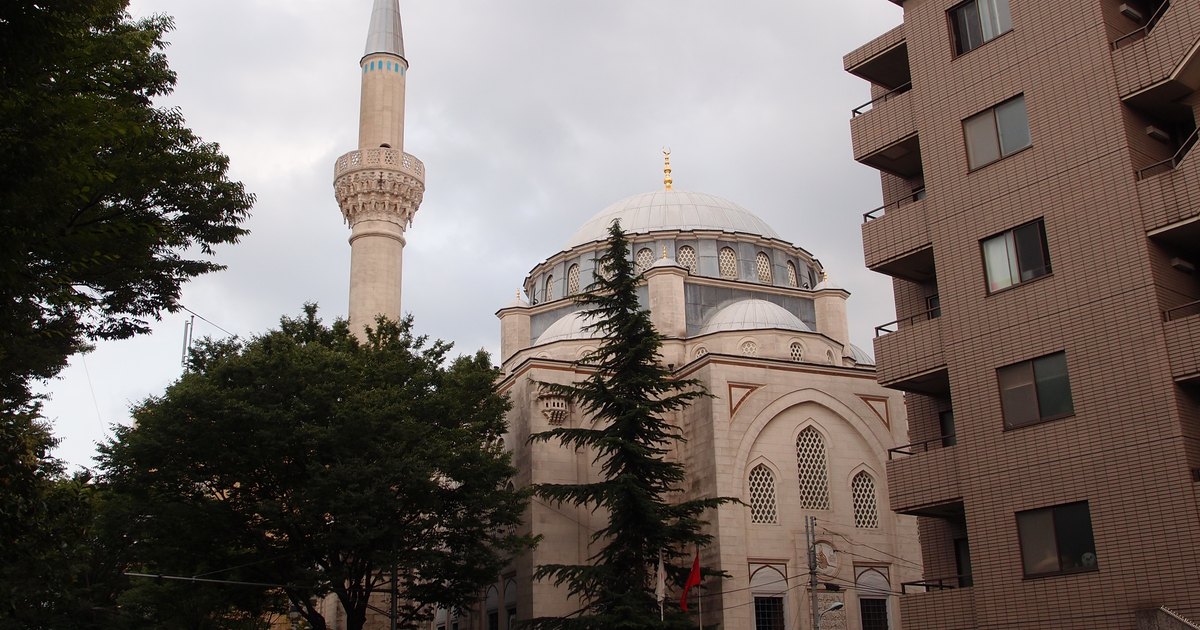
Whatever else your itinerary holds, Japan's grandest mosque earns its slot: open daily 10:00–18:00, individuals and small groups walk in without reservations, and official guided tours run weekends and holidays from 14:30 (45–60 minutes; five-plus people should apply in advance). The dress rule is stated plainly — a headscarf is essential for women inside the prayer hall — and the Ottoman-style building rewards the trip on architecture alone. Practical bonus: the on-site TC Halal Market makes Yoyogi-Uehara the grocery run, and the surrounding neighborhood slots neatly before a Shibuya evening — pair it with the DIY food-tour route and a Gyumon dinner and the halal day plans itself.
(A different religious diet, a very different infrastructure: our kosher in Japan guide explains why the answer is a delivery service ordered three days ahead rather than a list of restaurants.)
FAQ
Is there official halal certification in Japan?
What’s the difference between halal-certified and Muslim-friendly?
Is there an official halal restaurant guide for Tokyo?
Which Tokyo restaurants publish halal information officially?
Is the halal CoCo Ichibanya curry shop still in Akihabara?
Are Ippudo or Kabe no Ana halal in Tokyo?
Can I visit Tokyo Camii — and what are the rules?
Where can I buy halal groceries in Tokyo?
What should I double-check before relying on any halal listing?
Bottom line (2026) — Tokyo has real halal dining, but JNTO itself states there is no central certification agency in Japan – so the official Tokyo guide draws a certified-versus-Muslim-friendly distinction. The TOKYO MUSLIM Travelers’ Guide 2026–2027 (Tokyo Convention & Visitors Bureau, November 2025 data) uses an icon system with a ‘several organizations’ certification note, and NAHA holds mutual recognition with JAKIM.
Sources
No-central-agency statement and halal-friendly kitchen warning: JNTO's official Muslim travelers page. Icon system, certification note ("several organizations"), dining and listing details, and the November 2025 data date: the TOKYO MUSLIM Travelers' Guide 2026–2027 (Tokyo Convention & Visitors Bureau, via the official GO TOKYO site). NAHA–JAKIM mutual recognition: NAHA's official site. CoCo Ichibanya halal Akihabara: the company's official 2017 press release. PANGA and Gyumon details: their official pages. Tokyo Camii hours, tours and dress rule: tokyocamii.org. All read on August 17, 2026. Restaurants whose official pages carry no halal information are identified as such and not recommended. The embedded video is by its creator.
Tokyo to Osaka, Tokyo to Kyushu, Tokyo to Hokkaido — day by day — plus seven places most visitors never reach.
- 12 pages, 80 photographs, every stop linked to its guide
- Every price and opening hour read from the official page
- Re-issued monthly, so it does not go stale in your inbox
Free. One email a month, plus the rare change that matters. Unsubscribe with one click in any email. By subscribing you agree to our privacy policy.