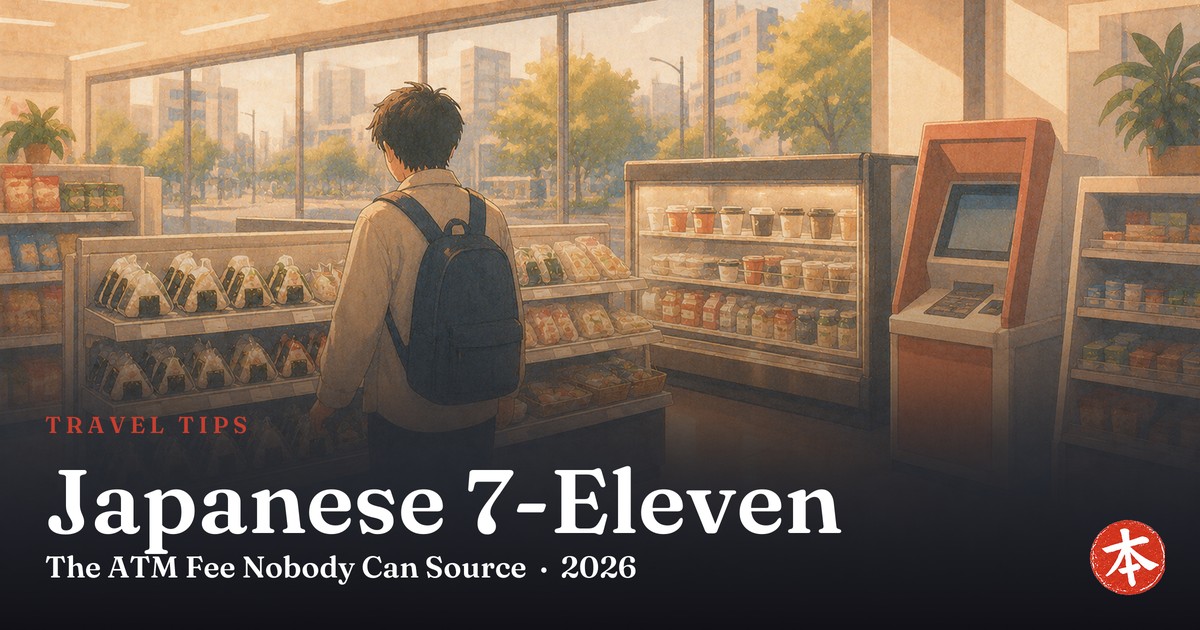
Two things everyone tells you about Japanese 7-Elevens are wrong, and both are the kind of wrong that costs you something. The ATM fee that every guide quotes — 110 yen, 220 yen — appears on no current official page. Seven Bank says only that fees vary by card brand. And there is no free Wi-Fi: the company's own FAQ states that apart from a dedicated connection for the copy machine, none is provided. What follows is the version built from the operator's own pages — including the 10,001-yen contactless cutoff, the fact that the store cannot scan a QR code, and why the price on the shelf changes if you sit down.
7-Eleven Japan at a glance
| Item | Official answer (Aug 2026) |
|---|---|
| Stores | 21,927 in Japan (as of end Feb 2026) |
| 🚨 Open 24h? | A principle, not a guarantee — regulations and store circumstances create exceptions |
| 🚨 ATM fee | Not published. "Fees vary by card brand" is the entire official statement |
| ATM limit | ¥100,000 per withdrawal · ¥30,000 if read by magnetic stripe |
| ATM languages | 12, including Thai, Malay, Indonesian, Vietnamese, Portuguese |
| 🚨 Free Wi-Fi | None for general internet use — official FAQ says so outright |
| 🚨 Contactless | Blocked at ¥10,001 and above · UnionPay excluded from contactless entirely |
| 🚨 Code payment | You present a barcode; the store does not scan QR codes |
| Shelf price | Shown at the 8% takeout rate — eating in costs 10% |
| Tax-free | Consumables ¥5,000–500,000/day/store · general goods from ¥5,000 |
Japanese television on how 7-Eleven is repositioning for foreign visitors, including tax-free:
🚨 Traveling after October 2026? Japan's tax-free system changes on November 1, 2026. Instead of the tax being taken off at the register, you will pay the full price in store and claim the consumption tax back at customs when you leave, within 90 days of purchase — the retailer refunds it after that check. Until October 31, 2026 the system described here still applies. Our tax-free shopping guide has the detail.
🚨 The ATM: the most useful machine in Japan, and the least documented fee
Which cards work, and when?
The machines carry VISA, PLUS, Mastercard, Maestro, Cirrus, UnionPay, American Express, JCB, Discover and Diners Club — with Seven Bank's honest caveat that some cards bearing these marks may still not be accepted. The service window is where it gets specific, because only VISA and Mastercard run a true 00:00–24:00. UnionPay, JCB and Discover run 00:10–23:50; American Express 00:05–23:50; Diners Club 00:05–23:55. ATMs otherwise operate 365 days a year across a network Seven Bank puts at over 28,000 machines.
The practical details
Withdrawal is capped at 100,000 yen per transaction — and at only 30,000 yen if the machine falls back to your magnetic stripe rather than reading the chip. Insert the card magnetic stripe facing down. The screen runs in twelve languages: English, Japanese, simplified and traditional Chinese, Korean, Thai, Malay, Indonesian, Vietnamese, French, German and Portuguese. Since July 2022 the machine also offers dynamic currency conversion — being asked whether to settle in yen or your home currency — but only on Visa and Mastercard; JCB, Discover, UnionPay, American Express and Diners are excluded. The same machines top up transit IC cards in 1,000-yen units, Welcome Suica included — see our Suica guide for what that card does and does not cover.
Paying: three rules that will actually catch you
The 10,001-yen contactless wall
Tap-to-pay stops working at 10,001 yen and above. The Japanese payment page states it plainly, and no English guide we have seen mentions it. Below that threshold you have the full spread: Visa, Mastercard, JCB, American Express, Diners Club, Discover and UnionPay as inserted cards, Apple Pay and Google Pay for contactless, nine transit IC cards, and a long list of barcode payments including WeChat Pay and Alipay+ — which in turn covers Kakao Pay, NAVER Pay, Toss Pay, GCash and TrueMoney.
UnionPay is not a yes-or-no answer
It works at the ATM (00:10–23:50). It works at the register as an inserted card. But the Japanese page carries a one-line exclusion under the contactless section: UnionPay credit cannot be used for tap payment. Guides that say "UnionPay accepted" without that split will have you holding your card against a reader that will not respond.
You present a barcode. The store does not scan a QR code
This is a genuine source of confusion for anyone arriving from a QR-first market. Seven-Eleven's payment page states outright that QR codes cannot be used in store. What happens is the reverse of what you may expect: you open your payment app, display your barcode, and the cashier scans you. Two more edges worth knowing: utility and tax bill payments accept only cash or nanaco — no cards, no apps — and at fully self-service checkouts cash is not accepted at all. And on loyalty, two accrual routes have just closed: ANA miles ended May 31, 2026 and Saison/UC nanaco points ended August 10, 2026.
What to buy, and why the price moves
The 8% shelf, the 10% chair
Every price you see is a base figure plus tax calculated at the reduced 8% takeout rate — the company says so on its product pages, which is why the numbers have decimals. Sit down in the eat-in area and the 10% rate applies instead. So the small Seven Cafe hot coffee listed at 130 yen (140.40 with tax) is a takeaway price; the large is 204 (220.32); a hot cafe latte is 204 (220.32) and iced 250 (270). Food prices carry a second caveat: they are regional. The Kishu plum onigiri runs 182 yen (196.56) across most of the country, while a pork-and-egg onigiri at 340.20 yen exists only in Okinawa. The chain states directly that specifications, prices and release dates differ by region — so treat any single national price, including ours, as indicative.
What the store is actually for
Locals do not go in only to buy things. The multicopy machine handles photocopying (10 yen black and white), photo prints at 40 yen for an L-size, ID photos at 250, printing from your phone, scanning and faxing to A3, government paperwork, and ticket sales — theme parks including Tokyo Disney Resort, and highway buses, though only fully reserved services. Buy a ticket and the machine prints a payment slip you must take to the register within 30 minutes. One absence worth naming: JR train tickets are not on the list. Some branches also host coin laundries, delivery lockers, bike share, battery share and even ecbo cloak luggage storage — all marked store-limited.
Shipping, tax-free and the visitor traps
You can send a parcel. You probably cannot collect one
Sending works and is genuinely useful: Yamato parcels, sizes 60 to 160, up to 25kg, prepaid or cash on delivery. What does not work for visitors is the reverse. Store pickup requires a Kuroneko Members account, and the English visitor FAQ states that delivery to 7-Eleven stores in Japan for pickup is not available. Guides telling you to ship your luggage to a convenience store and collect it are describing something the chain says it does not offer. Also absent: refrigerated shipping and any mention of international shipping. For the alternatives that do work, see our luggage storage guide.
Tax-free, and the thing they don't tell you
The rules follow the national scheme: non-residents who have been in Japan under six months, consumables between 5,000 and 500,000 yen excluding tax per day per store, general goods from 5,000 yen, passport presented at purchase, and consumables sealed in a bag you keep unopened until departure, within 30 days. The gap: the official page never states how many stores participate. Use the store locator rather than assuming. If duty-free is a real part of your trip, our tax-free shopping guide covers the wider rules, and Don Quijote is the other chain worth knowing for it.
Small things that surprise first-timers
Bags are not automatic and not free — they are available on request for a fee that varies by size. Chopsticks, spoons, forks and napkins are given when you ask, not by default. Most stores will microwave your food, though some items cannot be heated. Alcohol and cigarettes are sold with age verification. The currency exchange machine you may spot is SMART EXCHANGE, a third-party service in some branches covering twelve currencies, no coins, and amounts under 100,000 yen — not a 7-Eleven service as such. And the delivery app, 7NOW, runs nationwide from 7:00 to 3:30 with a 1,000-yen minimum — but it has no English page, and the company never states whether it works without a Japanese phone number or card, so we are not going to tell you it does.
(One seasonal aisle worth knowing: our Valentine’s Day in Japan guide covers the chocolate custom, its 1932 Kobe origin and the White Day reply invented in Hakata in 1978.)
(For onigiri made to order rather than taken from the shelf: our onigiri in Tokyo guide covers specialist shops, from 130 yen for a salt omusubi at Omusubi Gonbei.)
FAQ
How much does it cost to withdraw cash at a 7-Eleven ATM?
Can I use my foreign card at all?
Is the ATM really available 24 hours?
Does 7-Eleven have free Wi-Fi?
Why is the price on the shelf not what I pay?
What can I actually pay with?
Is anything cash-only or card-only?
Can I have a parcel delivered to a 7-Eleven to collect?
What is the multicopy machine for?
Can I do tax-free shopping there?
Are all stores open 24 hours?
Do I get a bag and chopsticks automatically?
Bottom line (2026) — Seven Bank does not publish an ATM fee anywhere; the ¥110 / ¥220 figure every guide quotes traces to a VISA-only notice from 2017 at the old tax rate. The official FAQ also says there is no general free Wi-Fi in stores. Treat the popular ATM and Wi-Fi claims as unsourced, and check contactless limits and the QR-versus-barcode distinction before paying.
Sources
Store count, company details, product prices and the tax-display rule, payment methods and their restrictions, multicopy machine functions and fees, parcel service terms, tax-free conditions, the 24-hour policy and the Wi-Fi position: Seven-Eleven Japan's official site and its official FAQ. ATM card brands, service hours by brand, withdrawal limits, screen languages, the dynamic-currency-conversion restriction and the fee wording: Seven Bank's official international-card pages, Japanese and English. All read on August 24, 2026. The embedded video is by its creator.
Some links on this page may be affiliate links, which means we may earn a commission if you book or buy through them — at no extra cost to you. See our affiliate disclosure.
Tokyo to Osaka, Tokyo to Kyushu, Tokyo to Hokkaido — day by day — plus seven places most visitors never reach.
- 12 pages, 80 photographs, every stop linked to its guide
- Every price and opening hour read from the official page
- Re-issued monthly, so it does not go stale in your inbox
Free. One email a month, plus the rare change that matters. Unsubscribe with one click in any email. By subscribing you agree to our privacy policy.