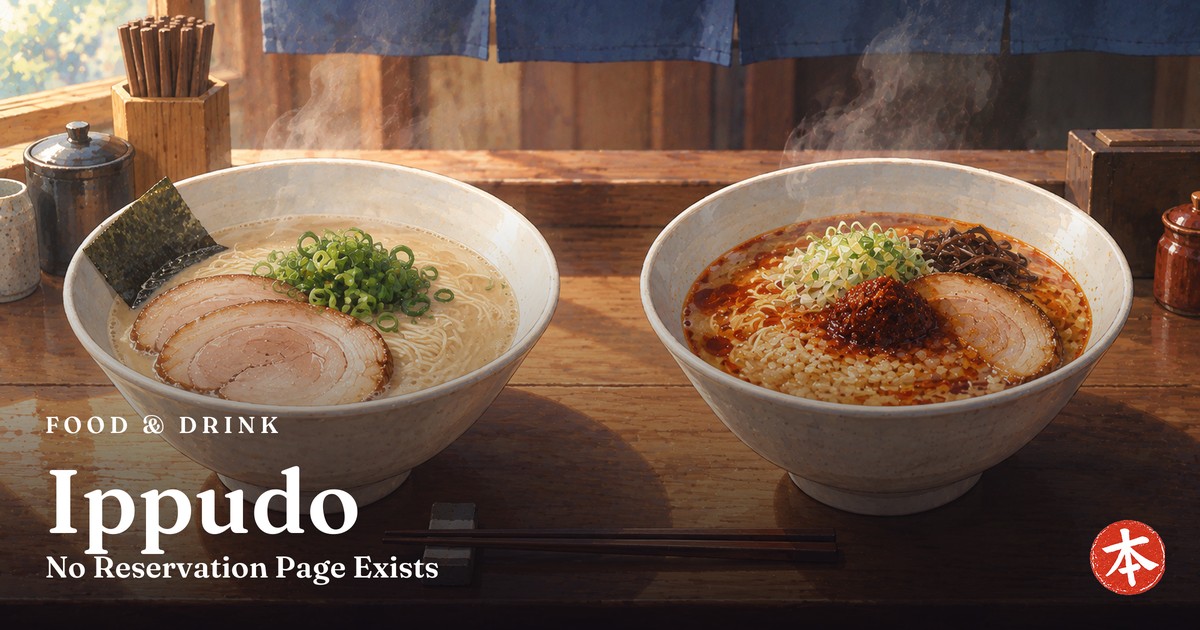
If you came here looking for the Ippudo reservation page, here is the short version: there is not one. We read the official site page by page on September 14, 2026 — menu, company history, app guide, the whole static sitemap — and the word does not appear. The app, which people assume must do it, is a points-and-coupons app with no booking function at all.
What the site does publish is more useful than a booking link anyway. The two signature bowls, Shiromaru Motoaji and Akamaru Shinaji, are made with different flour and different noodle cuts, which is why they eat so differently. Six shops carry a plant-based Akamaru. One shop in Harajuku carries a plant-based Shiromaru. And the chain that exported Hakata ramen to New York in 2008 has been quietly reviving its 1985 soy-sauce bowl at its original shop in Fukuoka.
This is the guide to what Ippudo actually is in 2026, sourced from the company rather than from menu photos on review sites.
Ippudo at a glance
| Item | What the official site says |
|---|---|
| Founded | October 16, 1985, Daimyo, Chuo Ward, Fukuoka City, as Hakata Ippudo |
| The fixed menu | Shiromaru Motoaji (original), Akamaru Shinaji (1996), Karaka-men (spicy) |
| Noodles | Shiromaru cut no. 22, thin and crisp; Akamaru cut no. 20, wheat-forward. Different flour for each |
| Plant-based | Plant Akamaru at six shops; Plant Shiromaru at Harajuku Takeshita-dori only |
| Reservations | No page, no form, no mention on the official site. App has no booking function |
| App | 10 points per 500 yen; coupons for ramen, toppings, kaedama, beer |
| Prices | Not published on the official menu page |
| Overseas | New York first (2008), then 16 more countries and regions listed on the site |
The Ippudo reservation question, answered from the source
Is there a booking page anywhere on the official site?
No. The site’s static pages are the top page, the menu, the company profile, the app guide, the franchise-owners page, a kids page, news, the journal and an Australian section. None of them mention reservations. There is no FAQ page on the Japanese site at all, which is unusual for a chain this size and is itself a signal: the company treats walk-in as the only mode.
Can the app reserve a seat?
No. The app page describes exactly four things it does: earn 10 points per 500 yen of spending, swap points for coupons on ramen, toppings, kaedama and beer, deliver member-only coupons, and push news about new products and campaigns. A coupon you redeem is valid for 24 hours. There is no queue function, no seat function, no time slot. If a third-party site tells you to “book Ippudo through the app”, it is describing an app that does not exist.
So how do I get in?
You walk in and, at busy shops, you queue. The one structural thing worth knowing is that Ippudo runs two shop formats: some shops take your order and payment at a register, others use a ticket machine at the entrance. The app guide gives separate instructions for each. At a ticket-machine shop you choose and pay before you sit down, so decide on your bowl in the queue.
What about groups or private hire?
Not addressed anywhere on the official site. If you are eight people, call the shop you intend to visit and ask; we are not going to invent a policy. The shop locator on the official site is the place to find the number, and it is a JavaScript page, so open it in a normal browser rather than expecting a text list.
Shiromaru vs Akamaru: what Ippudo says is actually different
| Shiromaru Motoaji | Akamaru Shinaji | |
|---|---|---|
| The idea | “The original bowl” | “The innovative bowl”, launched 1996 |
| Broth | Silky tonkotsu | Tonkotsu given depth with a soy-sauce richness, a garlic-scented oil and a house spicy miso |
| Noodle cut | No. 22 — crisp bite, Hakata style | No. 20 — the wheat comes through |
| Flour | Different flour for each bowl, chosen to match its broth | |
| Chashu | Two slices of loin marinated in salt koji, cooked low-temperature | One thick slice |
| Pork | Danish pork, which the site names as “Danish Pork” | |
Which one should a first-timer order?
Shiromaru, if you want to taste what the company calls its origin and what Hakata ramen is supposed to be: a clean pork broth and a thin, firm noodle. Akamaru, if you already know you like your tonkotsu louder. They are not mild-versus-spicy; the spicy bowl is Karaka-men. Akamaru is richer, not hotter.
Why do the noodles feel different between the two?
Because they are different noodles, not the same noodle in a different soup. The site is explicit that Shiromaru and Akamaru use separate flours and separate cutter numbers. A higher number means a thinner strand, so the no. 22 in Shiromaru is the thinner of the two and the no. 20 in Akamaru is slightly broader. That is why Shiromaru reads as “crisp” and Akamaru as “wheaty”.
What is the “kaeshi” the site keeps mentioning?
The seasoning base that gives the broth its depth. Ippudo says Shiromaru layers two kaeshi onto its tonkotsu and Akamaru uses a different one matched to its noodle, both built on several Kyushu soy sauces. The recipe is described as known only to founder Shigemi Kawahara and a handful of “kaeshi keepers”. That is marketing, but it is the company’s own marketing, so we report it as such.
Ippudo’s plant-based bowls, and the six shops that have them
| Bowl | Where (per the official list, dated June 2025) | What it is |
|---|---|---|
| Plant Akamaru | Ginza, Ginza East, Harajuku Takeshita-dori, Asakusa Kaminarimon-dori, Shijo Karasuma (Kyoto), Kanazawa Korinbo | Soy-milk broth with the aromatic oil and spicy-miso accent of the regular Akamaru, no animal ingredients |
| Plant Shiromaru | Harajuku Takeshita-dori only | The silky original re-made plant-based, finished with truffle oil |
| Miraton | Lumine Est Shinjuku only | Three-layer tonkotsu-style soup from soy milk, vegetable bouillon and kombu; potato for body, porcini as the hidden note |
| Daichi Kaoru Shoyu | Lumine Est Shinjuku only | Porcini and shiitake stock with vegetable bouillon and a light soy tare, plus smoked ganmo |
Is the plant-based bowl at every Ippudo?
No, and this is the trap. It is at six named shops for Akamaru and one for Shiromaru. Walk into a random suburban Ippudo and you will find pork. The site also dates the shop-limited list to June 2025 and warns that limited bowls can be capped by quantity or time of day, or pulled without notice. Treat the list as a strong lead, not a guarantee, and check the shop’s own page before you cross town. Our vegetarian Tokyo guide covers what else exists.
Is “plant-based” the same as vegan here?
The site uses the phrase “does not use animal-derived ingredients” and labels the bowls “plant-based”. It does not say vegan, does not discuss shared kitchens or shared cooking water, and publishes allergen information only as a PDF. If strict separation matters to you, ask at the shop; we will not certify it on the company’s behalf.
Shop-limited bowls worth crossing town for
What is on the menu at the original Daimyo shop?
A Hakata soy-sauce ramen that exists only there: a clear pork broth with a local Daimyo soy sauce, described as the latest form of the shoyu ramen the company was serving from its 1985 opening — a rarity in Fukuoka then. The Fukuoka map shows where Daimyo sits relative to Tenjin and Hakata Station.
What are “Genten” and the retro “Akamaru”?
Two bowls at the Asakusabashi Honpo shop in Tokyo. Genten reproduces the method from the founding years: a silky tonkotsu simmered for 12 hours with a tare blended from six Kyushu soy sauces. The retro Akamaru reproduces the taste of the 1996 original, with back fat, spicy miso and the garlic oil. The same shop and the Kameari shop also serve an Edo-style soy ramen with a dried-sardine note.
Are there others?
Yes, more than a dozen, and they change. Hakata Chuka Soba, a seafood-stock soy ramen with yuzu kosho on the side, is listed at a long run of mall shops from Sendai to Kurashiki. Roppongi has a Genryu Shoyu with grilled flying-fish stock. Kawagoe has a bowl made with a local soy brewer. We are not reproducing the whole list because it is explicitly dated and explicitly subject to change; the point is that Ippudo is not the same menu everywhere, and the interesting bowls are the ones a shop is allowed to keep for itself.
Sides, rice and what is not on every menu
The side menu on the site is short: Hakata bite-size gyoza, Hakata fried rice, mentaiko rice, diced-chashu rice and a soft-egg rice. Two notes are printed under it. The gyoza is not served at every shop, and sides generally vary by shop, so the site tells you to ask in advance. The rice is stated to be 100 percent domestic.
Is the mentaiko rice a real thing or a meme?
The company itself leans into it: the menu describes it as the dish people mean when they say “if you go to Ippudo, it is ramen and mentaiko rice”. Whether that is customer wisdom or copywriting, it is the side the chain wants you to order.
How a visit actually goes
Ticket machine or register?
Either, depending on the shop. The app guide describes both flows. Register shop: eat, pay, then scan the QR on the receipt for points. Ticket-machine shop: press “issue ticket”, then let the machine read your member QR. If you plan to use an app coupon at a machine, you have to tap “discounts and coupons” before selecting your food.
Is it cash only?
The site does not say, and we are not going to assert it. Ticket machines in Japanese ramen shops range from cash-only to fully cashless, and this chain publishes no policy. Carry cash for the first visit.
How does it compare to Ichiran?
Different systems rather than better or worse. Ichiran is built around solo booths and a written order sheet; Ippudo is a normal restaurant with a short menu and a growing set of shop-only bowls. If you are in Tokyo and want to try several tonkotsu styles in one walk, Tokyo Ramen Street under Tokyo Station puts a few side by side.
The company, briefly, because it explains the menu
| Year | Milestone (official timeline) |
|---|---|
| 1985 | Hakata Ippudo opens in Daimyo, Fukuoka, on October 16 |
| 1994 | First Kanto shop, inside the Shin-Yokohama Ramen Museum |
| 1995 | First Tokyo shop, Ebisu |
| 1996 | Shiromaru Motoaji and Akamaru Shinaji go on sale |
| 2008 | First overseas shop, New York |
| 2015 | 30th anniversary; both signature bowls renewed |
| 2023 | Shiromaru, Akamaru and Karaka-men renewed again, October 16 |
| 2024 | Returns to the Shin-Yokohama Ramen Museum, February 9 |
Why does the founding date matter to what I eat?
Because the signature bowls you are ordering were reformulated in 2023, and the shop-limited “Genten” and retro Akamaru exist precisely so the company can show you what they were before. The founder, Shigemi Kawahara, born 1952 in Fukuoka, is credited on the site with three straight wins on a Japanese TV ramen championship in the late 1990s and with taking tonkotsu national via the Ramen Museum in 1994. The New York shop was listed in the Michelin guide for six consecutive years from the 2009 edition, per the same page.
Ippudo FAQ
Can I make a reservation at Ippudo?
What is the difference between Shiromaru Motoaji and Akamaru Shinaji?
Does Ippudo have a vegan or plant-based ramen?
Is the spicy one actually spicy?
How much does a bowl cost?
Is Ippudo the same as Ichiran?
Where did Ippudo start, and when?
Does the app help me get in faster?
Bottom line (2026). No reservation channel exists on Ippudo’s official site or app, so plan to walk in. Order Shiromaru for the original and Akamaru for the richer 1996 bowl; they use different flour and different noodle cuts, so they are not one soup in two colors. Plant-based Akamaru is at six named shops and plant Shiromaru at one, on a list the company itself dates to June 2025. The app earns 10 points per 500 yen and cannot book a seat. Prices are not published, so neither are ours.
Sources
The menu descriptions, noodle cutter numbers, flour and chashu details, the plant-based list and its June 2025 date, the shop-limited bowls, the side menu notes, the app mechanics and the company timeline were all read off Ippudo’s official Japanese website on September 14, 2026. The site renders in the browser only, which is why third-party summaries of it are often stale. The absence of a reservation page is our own observation of the site’s complete static sitemap on the same day. Prices are not on the official menu page and we have not taken them from anywhere else.
Some links on this page may be affiliate links, which means we may earn a commission if you book or buy through them — at no extra cost to you. See our affiliate disclosure.
Tokyo to Osaka, Tokyo to Kyushu, Tokyo to Hokkaido — day by day — plus seven places most visitors never reach.
- 12 pages, 80 photographs, every stop linked to its guide
- Every price and opening hour read from the official page
- Re-issued monthly, so it does not go stale in your inbox
Free. One email a month, plus the rare change that matters. Unsubscribe with one click in any email. By subscribing you agree to our privacy policy.