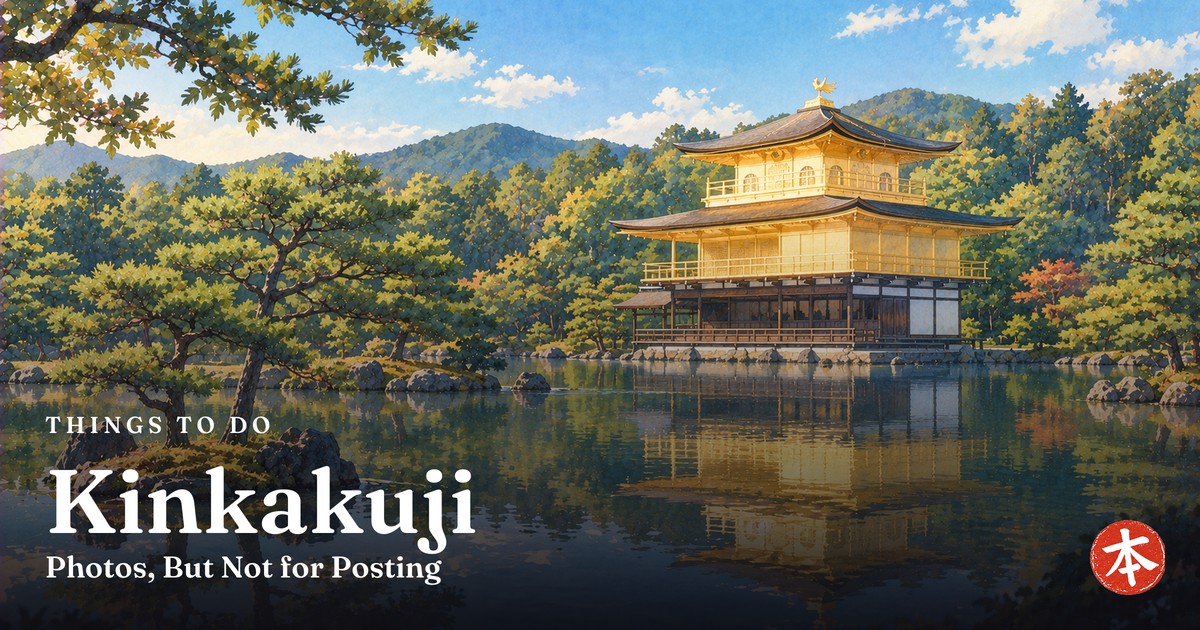
The most photographed building in Kyoto asks you not to publish your photographs of it.
That is not a provocation, it is what the temple writes on its own FAQ page. Photography at Kinkakuji is permitted “as snapshots with a small camera, within the range of personal enjoyment” — and shooting for the purpose of publishing to third parties, social media included, is declined. So is anything commercial, along with group photos, video streaming and drones. Nobody is confiscating your phone at the gate. But the policy exists, it is stated in plain Japanese, and almost no English guide mentions it.
This guide is the rest of what is written down and rarely translated: the fee that has no group discount, the car park that opens twenty minutes before the temple does, the pet rule that bans holding your dog, and the step-free route that ends in a staircase.
Kinkakuji tickets, hours and the discount that does not exist
| Item | Official |
|---|---|
| Adults (high school and above) | 500 yen |
| Elementary and junior high | 300 yen |
| Group discount | None — no reduction by numbers; parties of 30+ enter as a group |
| Hours | 9:00 – 17:00 |
| Closed | Never — open all year |
| Reduced admission | Disability or rehabilitation certificate holders; show the original on the day, or apply in advance by reply-paid postcard |
| Special viewings | Hours and fees may differ |
Why does 30 people matter if there is no discount?
Because it is an entry instruction, not a price. The temple says in one place that there is no discount based on numbers, and in another that groups of 30 or more should come in as a group. Both are true at once: you pay 500 yen each either way, and the temple simply wants a large party moving through one channel rather than thirty individuals at the counter. If you booked a tour expecting a group rate, there is not one.
What is the reduced-admission process?
Holders of a disability certificate or rehabilitation certificate can have the fee reduced. You either show the original document on the day, or apply ahead by reply-paid postcard — and the temple lists nine items the application must carry, from the school or facility seal down to the number of accompanying staff. It is a paper process in 2026, and for school groups the temple says the postcard makes reception noticeably smoother.
The Kinkakuji photography rule almost nobody translates
So is my holiday photo against the rules?
A snapshot you keep is explicitly fine — that is the case the policy is written to allow. What the temple declines is shooting in order to publish. The distinction it draws is about purpose rather than equipment, which is why a phone in your pocket is not the issue and a planned shoot is. Whether you feel bound by that is your call; our job is to tell you it is written down, because the number of English pages that repeat “great photo spot” without mentioning it is remarkable.
What is definitely not allowed?
Drones. Video streaming. Group photographs. And, separately, interviewing visitors inside the grounds — the temple has a whole FAQ entry declining that, which tells you it has happened enough to need one. Photographers accompanying school trips are the one exception, and they must apply in advance by posting a form to the temple.
Does this change how I should plan the visit?
Only in that it reframes what the visit is for. Kinkakuji is small, the route is one-way and short, and the pavilion is visible across a pond from a fixed set of angles. Once you stop planning it as a photo shoot, an hour is plenty, and it fits neatly into a wider day — see our guide to how many days Kyoto needs for where it sits in a realistic itinerary.
Getting to Kinkakuji, and the car park hours nobody checks
Which bus do I take?
Kyoto City Bus to Kinkakuji-michi. The temple lists routes 12, 59, 205 and M1, plus two specific transfers it evidently gets asked about: from Ginkakuji, take route 204 from Ginkakuji-michi; from Shokokuji, route 59 from Karasuma-Imadegawa or Doshisha-mae. Note what is missing from that list — a train station. Kinkakuji is a bus destination, and the official access page treats it as one.
What does parking cost?
| Vehicle | First 60 min | Each 30 min after |
|---|---|---|
| Car | 400 yen | 200 yen |
| Microbus / jumbo taxi | 600 yen | 300 yen |
| Coach | 1,300 yen | 650 yen |
| Motorbike | 200 yen | 100 yen |
There are 250 spaces across three car parks, and the hours are the detail worth holding on to: 8:40 to 17:10. That is twenty minutes wider than the temple at both ends, deliberately, so that a car arriving for opening and a car leaving at closing both work. Staff on the approach road direct you to whichever car park is taking vehicles.
Can I check the weather before I go?
You can check something better than a forecast: the temple runs a live camera that publishes an image of Kinkakuji every three minutes. It exists because people kept asking when the snow settles, and the temple’s answer is essentially “we are not a weather service, but here is the actual view right now.” For the one shot people travel to Kyoto in January hoping for — gold under fresh snow — a three-minute-old photograph of the real thing beats any forecast.
Is it worth driving at all?
For most visitors, no — Kyoto is a city where the bus network beats a car and the parking maths above shows why. Two hours in a car park is 800 yen, which is more than two adult admissions. If you are moving between Kyoto and elsewhere, our Tokyo to Kyoto guide covers the routes in, and Kurama is the counterexample: a part of Kyoto where getting out of the center genuinely pays.
Accessibility, pets and luggage at Kinkakuji
How far can a wheelchair go?
All the way to right beside the golden pavilion, without any significant step. That is further than most people assume, and the temple states it plainly. What it also states, just as plainly, is that the garden has no barrier-free provision, because it is roughly 600 years old and is being preserved as it is.
Can I bring a pet?
Service dogs come in with you, no conditions attached. Beyond that the rule is narrow and specific: only small dogs and cats, only in a cage or carrier, with the head and body kept inside. Carrying the animal in your arms or in a sling is not accepted, and the temple pre-empts the obvious workaround by saying you may not lift it out briefly for a photograph either. Anything bigger, or anything that is not a dog or a cat, cannot come in.
Where do I put my bag?
Nowhere. The temple states there is no luggage storage and no lockers, and directs you to station facilities instead. In the same breath it adds that there is nowhere in the garden to eat a packed lunch. Kyoto Station and the larger subway stations have coin lockers; arriving at Kinkakuji with a suitcase is a planning error rather than a problem the temple will solve. If you are visiting in a rented kimono, our kimono rental guide covers where the shops hold your things while you are out.
What you are actually looking at
Thirty minutes of Japanese commentary on one building sounds excessive until you realise how much of Kinkakuji is invisible from the viewing path. This walk-through goes through the three floors, the phoenix and Yoshimitsu’s reasons for building it — useful before you go, because from where visitors stand you can see the gold but not the joins.
What is the pavilion made of?
The second and third floors are covered in genuine gold leaf laid over lacquer. The roof is kokera-buki — thin sawara cypress shingles layered many deep — and a phoenix stands on top. Each floor is a different architectural style: the first is shinden-zukuri and called Hossui-in, the second is buke-zukuri and called Choon-do, and the third is Chinese-style Zen hall architecture, called Kukkyocho. The current gold and lacquer date from the restoration of autumn 1987, which also restored the ceiling paintings and the statue of Yoshimitsu.
How big is the garden?
The grounds run to about 132,000 square meters, of which 92,400 are designated both a Special Historic Site and a Special Place of Scenic Beauty. The pond at the center, Kyokochi, is around 6,600 square meters and holds islands including Ashiharajima along with named rocks placed deliberately. The famous reflection is a designed effect, not a happy accident.
What is worth stopping for besides the gold?
The Ryumon waterfall, a 2.3-meter single drop with a carp stone set at an angle in the basin, referencing the Chinese story of the carp that climbs the falls and becomes a dragon. Sekkatei, a three-mat tea house built by the tea master Kanamori Sowa, named for the fact that the pavilion looks best in the evening light. And an ichiigashi oak designated a Kyoto City natural monument on June 1, 1983 — rare enough around Kyoto now to be protected individually.
What is the kuri, and why does it matter?
The kuri is the temple kitchen and living quarters, built in the style particular to Zen temples, and the temple dates the building to the Meio and Bunki eras, 1492 to 1504. It is also where the sutra-copying hall sits — which is why the plain-looking structure most visitors walk straight past is the one building here you can actually go inside and use. The bell tower is older still: the temple says the bell came from the Saionji family and is held to have been cast in the Kamakura period, tuned to a pitch used as a reference note.
Is there anything to do rather than look at?
Yes: the sutra-copying hall inside the kuri reopened in April 2023. You choose from three different sutra texts, copy it out, and the finished sheet is dedicated to the temple, where it is prayed over. The temple notes it may close at short notice for services. It is the one part of a Kinkakuji visit that is not spectating — and if you want more of that register, a matcha experience in Kyoto is the natural pairing.
Kinkakuji FAQ
How much does Kinkakuji cost?
What are the opening hours?
Can I post photos of Kinkakuji on social media?
Is Kinkakuji wheelchair accessible?
Can I bring my dog?
Is there parking, and what does it cost?
Can I leave my bags somewhere?
How do I get there by bus?
Bottom line (as of September 8, 2026) — Kinkakuji is 500 yen for adults, 300 for younger students, 9:00 to 17:00, open every day, with no group discount. Parking runs 8:40 to 17:10 at 400 yen for the first hour. There is no luggage storage, the step-free route ends at a staircase and turns back, and the temple permits photography for personal enjoyment only — publishing to third parties, social media included, is declined.
Sources & what we deliberately did not state
Fees, hours, bus routes, parking rates and capacity, the pet and photography policies, the accessibility route and the luggage answer all come from the official Rokuonji (Kinkakuji) website — the access page, the FAQ, the grounds guide and the temple notices — read on September 8, 2026. The temple warns that hours and fees may differ during special viewing periods, so check before an unusual date.
Deliberately not stated: the dates and prices of special viewings, because the temple gives none; the quietest time to visit and how long a visit takes, because the temple publishes nothing on either and we will not invent it; the cost of a goshuin seal, because we confirmed only that the seal office exists; and whether the pavilion itself carries National Treasure designation, because the designations we verified were those covering the garden.
Tokyo to Osaka, Tokyo to Kyushu, Tokyo to Hokkaido — day by day — plus seven places most visitors never reach.
- 12 pages, 80 photographs, every stop linked to its guide
- Every price and opening hour read from the official page
- Re-issued monthly, so it does not go stale in your inbox
Free. One email a month, plus the rare change that matters. Unsubscribe with one click in any email. By subscribing you agree to our privacy policy.