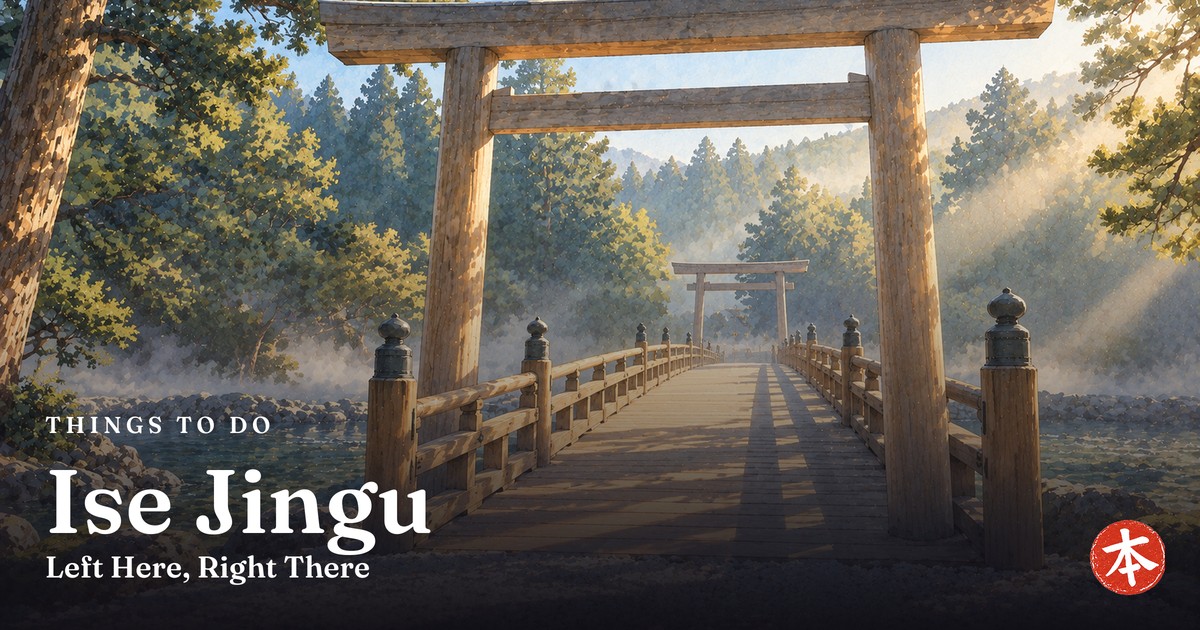
There is a line on the official site of Ise Jingu that reads, in full: please keep to the left at the Outer Shrine, and to the right at the Inner Shrine.
Two shrines, one institution, one paragraph — and opposite instructions. No reason is given. There is nothing in the layout that would let you work it out. You either arrive knowing, or you spend the visit drifting into people coming the other way. It is the single most useful sentence about this place that English guides almost never carry, and it is representative of the rest: Ise Jingu publishes precise, unglamorous instructions, and hardly any of them get translated.
Here is the rest of that list — the gates that open at five in the morning every day of the year, the closing time that moves three times across the calendar, the guard post that will hold your dog, and the rebuilding cycle that has been running since the year 690.
Ise Jingu opening hours, and the September trap
| Months | Hours |
|---|---|
| January, February, March, April, September | 5:00 – 18:00 |
| May, June, July, August | 5:00 – 19:00 |
| October, November, December | 5:00 – 17:00 |
The same hours apply to the Inner Shrine, the Outer Shrine and the auxiliary shrines. The shrine notes that times change over the New Year period.
Why does 5am matter?
Because it is every day of the year, and because almost nothing else in Japan does it. A five in the morning opening at a site this significant is a genuine option rather than a technicality — the shrine is a forest, the paths are gravel, and the hour before the coach parties arrive is not a thing you have to fight anyone for. It is the one piece of scheduling advantage at Ise Jingu that costs nothing but getting up.
What is the September trap?
How busy does it get?
The Inner and Outer Shrines together take more than seven million visitors a year, which is the shrine’s own figure. It also runs a congestion forecast calendar and a live view of the surrounding roads, which tells you that traffic rather than the paths is the pinch point. We are not going to tell you which days are quiet — the shrine publishes a tool for exactly that, and it will be more current than anything written here.
The Ise Jingu rules that catch visitors out
Left or right?
Left at the Outer Shrine. Right at the Inner Shrine. That is the whole rule, stated by the shrine, with no explanation offered. Treat it as two different buildings with two different conventions rather than as something you can reason your way to, because you cannot. If you visit both in a day — which most people do — you have to consciously switch.
What about pets?
You cannot take one into the sacred grounds. What makes this worth knowing rather than merely restrictive is the second half of the instruction: anyone arriving with a pet is asked to leave it at the guard post at the entrance. It is a staffed handover, not a dead end. That is a more workable arrangement than most sites of this rank offer, and it is far better to know before you drive four hours with a dog in the car.
Can I eat, drink or smoke?
Eating and drinking inside the sacred grounds are things the shrine asks you to refrain from, with rest areas provided for hydration — which matters more than it sounds in an Ise August, when the grounds are large, wooded and humid. Smoking is prohibited in the grounds outright, with designated smoking areas outside them. The distinction in wording is the shrine’s own: one is a request, the other is a prohibition.
Why are the rules stated so plainly?
Because they are addressed to people who have traveled a long way to get there, and the shrine has been receiving them for centuries. There is a folk song from the Edo period, quoted on the shrine’s own site, whose refrain runs roughly: I want to go to Ise, I want to see the road to Ise, if only once in a lifetime. That is the audience the visitor requests are written for — first-timers, in numbers, who will not come back to correct a mistake. A four-line list covering walking side, smoking, eating and pets is what you write when almost everyone in front of you is here for the first time.
Is there an accessible route?
The shrine publishes precinct maps for both the Inner and Outer Shrines that include barrier-free routes — not a note saying accessibility is limited, but mapped routes you can look at before you travel. Given the size of the grounds and the gravel underfoot, that is the thing to open first if wheels are involved.
How to pray at Ise Jingu without guessing
Five minutes, made by someone local, showing the route and the form of worship rather than describing them. It is in Japanese, but the hands and the bows are the content — and watching the sequence once is worth more than reading it three times, particularly the part where the ladle never touches anyone’s mouth.
What happens at the water basin?
Five movements, in order. Take the ladle in your right hand, fill it generously, and rinse your left hand. Move the ladle to your left hand and rinse your right. Take it back in your right hand, pour water into your cupped left hand, and rinse your mouth from that hand — the shrine says explicitly never put the ladle to your lips. Rinse the left hand again. Finally, tip what is left down the handle to clean it, and set the ladle back. The shrine describes this as a simplified form of ritual ablution.
And at the sanctuary itself?
Two bows, two claps, one bow. The bows are deep — back flat, body folded to ninety degrees. Bring the palms together at chest height with the right fingertips slid slightly lower than the left, open the hands to shoulder width, clap twice, then return the fingertips to level before the final deep bow. The offset fingertips are the part visitors invariably skip, and they are in the shrine’s own instructions.
Does this apply at other shrines?
The two bows, two claps, one bow pattern is the standard form at Shinto shrines generally, so it travels — it is the same sequence you would use at Meiji Jingu in Tokyo. What does not travel is the walking side, which is specific to these two shrines. And note that a Buddhist temple such as Sensoji is a different tradition with different conduct: you do not clap at a temple.
The 125 shrines and the rebuilding that never stops
Why is it called just Jingu?
Because that is its name. “Ise Jingu” is how everyone refers to it, and the shrine uses that too, but formally it is simply Jingu — and colloquially O-Ise-san or Daijingu-san. The name covers far more than the two famous sites: it is 125 shrines in total.
| Category | Count |
|---|---|
| Inner Shrine (Kotai Jingu) and Outer Shrine (Toyouke Daijingu) | 2 |
| Betsugu — auxiliary shrines | 14 |
| Sessha — subordinate shrines | 43 |
| Massha — lesser shrines | 24 |
| Shokansha — affiliated shrines | 42 |
| Total | 125 |
Five of the 14 auxiliary shrines sit outside the two main precincts — three within Ise city and two outside it. Visiting all 125 is a recognized undertaking with its own name, and it is not a day trip.
What are the Inner and Outer Shrines for?
The Inner Shrine, Kotai Jingu, enshrines Amaterasu Omikami, revered as the ancestral deity of the imperial house. The Outer Shrine, Toyouke Daijingu, enshrines Toyouke no Omikami — described by the shrine as the deity of food and provision for Amaterasu. The relationship between the two is not hierarchy in the ordinary sense; it is a household.
What is the Shikinen Sengu, in practical terms?
Every 20 years the buildings and the sacred treasures are made anew and the deity is moved into the new sanctuary. The mechanism is the part worth picturing: both the Inner and Outer Shrines hold two plots of identical size, east and west, and the shrine alternates between them. So there is always a full-sized empty plot beside the standing shrine, waiting. It has been done since the fourth year of Empress Jito, 690 — over 1,300 years. The 62nd was carried out in 2013. The 63rd is being conducted over a span of some eight years from 2025, which means it is happening now.
Where does the timber come from?
From the shrine’s own forest. The wooded land around the precincts is managed as what the shrine calls an eternal forest — grown explicitly to carry the rebuilding cycle forward into the future rather than merely to look like scenery. That is the detail that reframes the walk in: the trees you are passing under are not a backdrop to the shrine, they are part of its maintenance schedule, on a timescale measured in centuries rather than in the twenty years between rebuildings.
Where can I see the treasures?
Two museums, both run by the shrine. The Chokokan and Nogyokan hold works presented by leading craftsmen in support of the Shikinen Sengu, alongside historical material. The Sengukan exists specifically to explain what the rebuilding means and to carry that explanation forward. If the cycle is the thing that interests you and you cannot see the ceremonies themselves, that is where the actual objects are.
Does that change what I would see?
It changes what is going on around you rather than what you can enter. The shrine frames the current cycle as a reason to come, and the rebuilding is funded by public subscription — formerly by the state, now by donation, which the kagura halls at both shrines accept alongside prayers, charms and goshuin seals. If you are building a route through central Japan, our seven-day itinerary and the Osaka to Kyoto guide cover the corridor Ise sits south of, and Tokyo to Nara covers the other end of it.
Ise Jingu FAQ
What are Ise Jingu’s opening hours?
Why does September close earlier than August?
Which side of the path do I walk on?
Can I bring my dog?
Can I eat or drink inside?
How many shrines is Ise Jingu, exactly?
What is the Shikinen Sengu?
How do I pray correctly?
Bottom line (as of September 8, 2026) — Ise Jingu opens at 5:00 every day of the year and closes at 19:00 May to August, 18:00 January to April and September, 17:00 October to December. Keep left at the Outer Shrine and right at the Inner Shrine. Pets go to the guard post at the entrance; eating, drinking and smoking stay outside the sacred grounds. It is 125 shrines, and the 63rd rebuilding is under way over some eight years from 2025.
Sources & what we deliberately did not state
Hours, the visitor requests, the etiquette sequences, the 125-shrine breakdown and the Shikinen Sengu details all come from the official Jingu website — the visit page, the about page, the etiquette page and the Shikinen Sengu section — read on September 8, 2026. The shrine notes that hours change over the New Year period, so check before a January 1 visit.
Deliberately not stated: an admission price, because we saw no fee published and will not claim entry is free without a source; the offering amounts for formal prayers, because we did not open that page; the exact date of the next transfer ceremony, because the shrine gives only a span of years and we will not narrow it ourselves; whether the Outer Shrine should be visited before the Inner, because we found no official instruction to that effect; and the shops and food streets outside the gates, which are not part of the shrine and not covered by anything we verified.
Tokyo to Osaka, Tokyo to Kyushu, Tokyo to Hokkaido — day by day — plus seven places most visitors never reach.
- 12 pages, 80 photographs, every stop linked to its guide
- Every price and opening hour read from the official page
- Re-issued monthly, so it does not go stale in your inbox
Free. One email a month, plus the rare change that matters. Unsubscribe with one click in any email. By subscribing you agree to our privacy policy.