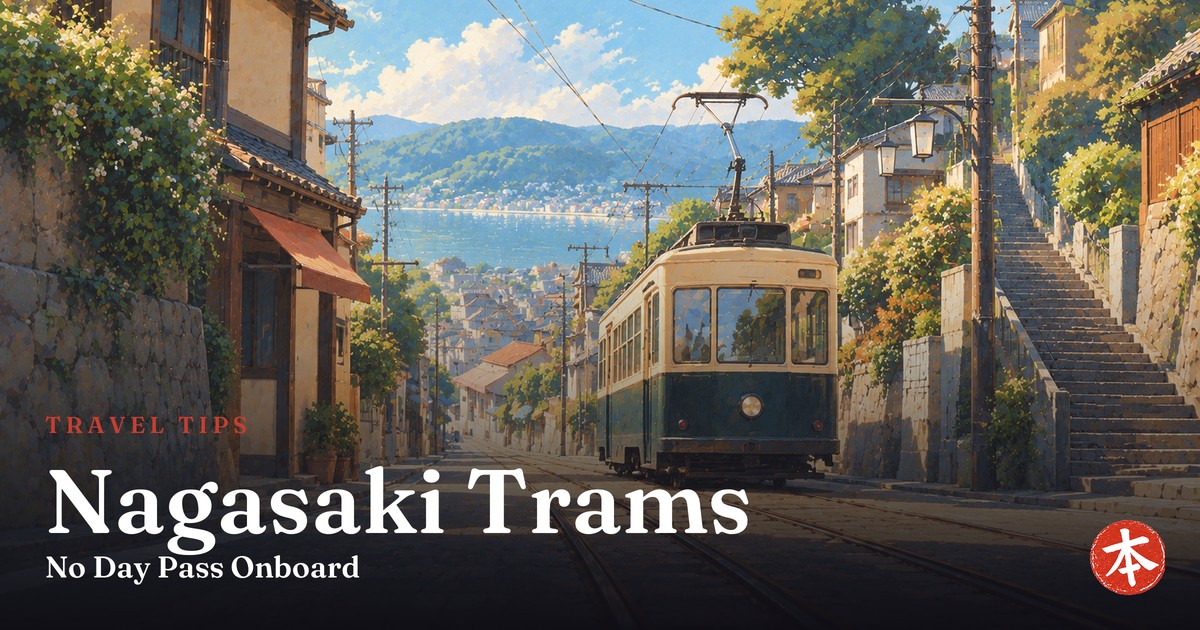
Nagasaki is a tram city, and the tram is ¥150 to anywhere. Flat fare, no zones to calculate, no ticket machine to decipher — one stop or the whole line costs the same. That single fact makes the city unusually easy to move around for a first-time visitor.
There is a ¥600 day pass, and it is worth having if you are moving a lot. But you cannot buy it on the tram, and most people discover that while standing on one. Below are the official fares, the discount that only works if you pay electronically, the Sunday each month when children ride free, and the arithmetic on when the pass actually pays.
Nagasaki tram fares: the whole table
| Who / what | Fare |
|---|---|
| Adult (junior high and above), flat fare | ¥150 |
| Child (elementary) | ¥80 |
| Two-zone hop, paid electronically | ¥110 adult / ¥60 child |
| Disability certificate / carer | ¥40 |
| Group rate | ¥130 adult / ¥70 child |
| Infant (under 1) | Free |
| Preschooler | One free per paying passenger, then ¥80 |
| Day pass | ¥600 adult / ¥300 child — not sold on board |
Why does a flat fare matter so much here?
Because it removes the thing that makes Japanese transit intimidating. There is no fare table to read, no zone to guess at, no adjustment machine at the end. You board, you ride as far as you like, you pay ¥150 getting off. For a city where the sights are spread from the Peace Park in the north to the harbor in the south, that is a genuine convenience rather than a technicality. It also changes how you plan a day here. In a city with distance-based fares you batch your movements to avoid paying twice; in Nagasaki you can double back on a whim for the price of a vending machine coffee, which is why the day pass conversation is about how many times you board rather than how far you go.
The Nagasaki day pass, and the trap in buying it
When does the pass actually pay?
From the fifth ride. Four adult rides at ¥150 come to exactly ¥600 — the same as the pass — so four boardings is a wash and five is where you start saving. That is our arithmetic on the operator’s published fares, not a claim the company makes. If you plan to use the two-zone discount at ¥110, the break-even moves out to the sixth ride.
Where do I buy it?
Is there a catch with the hotel front desks?
One, and the operator flags it: if you are not staying at the hotel, call ahead, because stock is limited. It is a small courtesy note that tells you these are real paper tickets held in small quantities rather than printed on demand.
What if I buy the wrong one?
You can get a refund, but only before the day of use, and there is a ¥50 handling fee per ticket. Worth knowing before you buy four of them for a family.
Paying: the discount that only exists if you go cashless
What is the two-zone fare?
If your ride stays within two zones and you pay by IC card or contactless credit card, the adult fare drops from ¥150 to ¥110, and the child fare from ¥80 to ¥60. Pay in cash for the same journey and you pay the full flat fare. This is one of the few places in Japan where cash actively costs you money.
Will my card from home work?
The trams take the nationwide mutually compatible transport IC cards — so a Suica, Pasmo or Icoca picked up anywhere in Japan works here, as does the local nimoca. They also take contactless credit cards carrying the contactless symbol, which means a card from your own country can work without buying anything locally. Our IC card guide covers which to get if you are still deciding.
So should I bother with the day pass at all?
If most of your rides are short hops between neighboring stops, the cashless fare at ¥110 is close enough to the pass that the pass only wins on a busy day. If you are crossing the city repeatedly — Peace Park in the morning, harbor in the afternoon, Mount Inasa in the evening — the pass wins easily. Decide by counting boardings, not distance. One more thing the pass buys you that the fare does not: some businesses along the line give a discount on presentation of a day pass. The operator publishes a list of participating shops, so if you are holding one it is worth asking rather than assuming.
Traveling with children on the Nagasaki tram
Is there a day when children ride free?
Yes: the third Sunday of every month, when elementary school children and younger ride free across the whole network. The operator raises this specifically as a warning — if you buy a children’s day pass for that Sunday, you have wasted ¥300.
How do preschoolers work?
One free preschooler per paying passenger, then ¥80 each after that. The operator publishes two worked examples that make it concrete. One adult with two preschoolers is ¥230 — ¥150 for the adult, one child free, ¥80 for the second. One adult, one elementary child and three preschoolers is ¥310: two of the preschoolers ride free against the two paying passengers, and the third pays ¥80.
Can I transfer between lines?
Yes, within limits. The operator runs what it calls a ride-through system and permits some transfers — but the transfer discount, like the two-zone fare, is cashless only. Pay with an IC card or a contactless credit card and the connection is handled; pay cash and you are buying a second fare. The pattern is consistent across this network: every discount it offers requires electronic payment.
And babies?
Infants under one year travel free, without counting against the preschooler allowance. Taken together the rules are more generous than they first look. Two adults with three preschoolers pay ¥380: ¥150 each for the adults, two children riding free against the two paying passengers, and ¥80 for the third — that is our arithmetic on the operator’s rule, applied to a case it does not publish. Work out who is covering whom before you tap, because the fare box will not do it for you.
Reading a Nagasaki map: what the tram tells you about the city
Why is the tram the best map of Nagasaki?
Because the city is long and narrow, wedged between hills and harbor, and the tram runs along the flat parts where everything is. Stops are the practical unit of navigation here in a way that districts are not. If you can name the stop, you can get there for ¥150.
What is Stadium City?
A new destination, and you can see it in the stop list: the network now includes Stadium City North and Stadium City South. When a tram operator adds two stops named after one development, that development is worth knowing about — though we have not read its official pages, so we are not going to describe what is in it.
Can I see where the trams are?
Yes. The operator runs a live vehicle location service on its own site, showing where each tram is in real time. For a network with a published notice about reduced services, that is more useful than a timetable — it tells you what is actually running rather than what is scheduled to. It is the first thing to open if a tram has not arrived when you expected.
How does Nagasaki fit with the rest of Kyushu?
It works as a stop on a Kyushu run rather than a destination on its own, and the usual entry point is Fukuoka — our Fukuoka guide covers how that city is laid out. If you are coming from the Hiroshima side, our Hiroshima guide is the other end of that stretch, and the ten-day itinerary shows where a western Japan leg fits at all. For another city built around a tram, see our Sendai guide.
Is anything disrupted right now?
Two notices are live and both are worth two minutes before you travel. The tram operator has posted an announcement about reduced services caused by a driver shortage, and Nagasaki City’s tourism site has posted that the Inasayama slope car is suspended for construction. We are telling you they exist rather than what they say, because we confirmed the headlines and not the text.
Does Nagasaki charge a visitor tax?
The city runs an accommodation tax, and says so in an unusually direct place: its official tourism website states that part of the site’s running costs are funded by it. We are not going to quote you a rate, because we read that statement rather than the tax ordinance. But it is worth knowing that a line on your hotel bill in this city is a municipal tax rather than a service charge. It is also a small window into how the city funds its own tourism: the website you would use to plan this trip is paid for, in part, by the people who came before you and paid that line on their bill.
Nagasaki tram FAQ
How much is the tram in Nagasaki?
Is the 600-yen day pass worth buying?
Can I buy the day pass on the tram?
What is the two-zone discount?
Can I use my Suica or a contactless credit card?
Do children ride free at any point?
How do the fares work if I have small children?
Is there anything running differently at the moment?
Bottom line (2026) — The Nagasaki tram is a flat ¥150 for adults, ¥80 for elementary children. The ¥600 day pass breaks even on the fourth ride and cannot be bought on board — get it at a tourist office, a hotel front desk on the line, or as a mobile ticket. Paying by IC card or contactless credit card within two zones drops the fare to ¥110. On the third Sunday of each month, elementary children and younger ride free.
Sources & what we deliberately did not state
Fares, the day pass terms, the two-zone discount, the free-children Sunday and the worked family examples all come from Nagasaki Electric Tramway’s official fare and day pass pages, read on September 8, 2026. The slope car notice comes from Nagasaki City’s official tourism site, read the same day. The only figure here that is ours rather than the operator’s is the break-even calculation, and we have labeled it where it appears.
Deliberately not stated: what the reduced-service notice and the slope car suspension actually say, because we saw the headlines and not the text and will not paraphrase an operational notice we have not read; walking times from tram stops to sights, which the operator does not publish; and which route number serves which destination, because we did not read the timetable pages. Check the operator’s site for anything time-sensitive.
Tokyo to Osaka, Tokyo to Kyushu, Tokyo to Hokkaido — day by day — plus seven places most visitors never reach.
- 12 pages, 80 photographs, every stop linked to its guide
- Every price and opening hour read from the official page
- Re-issued monthly, so it does not go stale in your inbox
Free. One email a month, plus the rare change that matters. Unsubscribe with one click in any email. By subscribing you agree to our privacy policy.