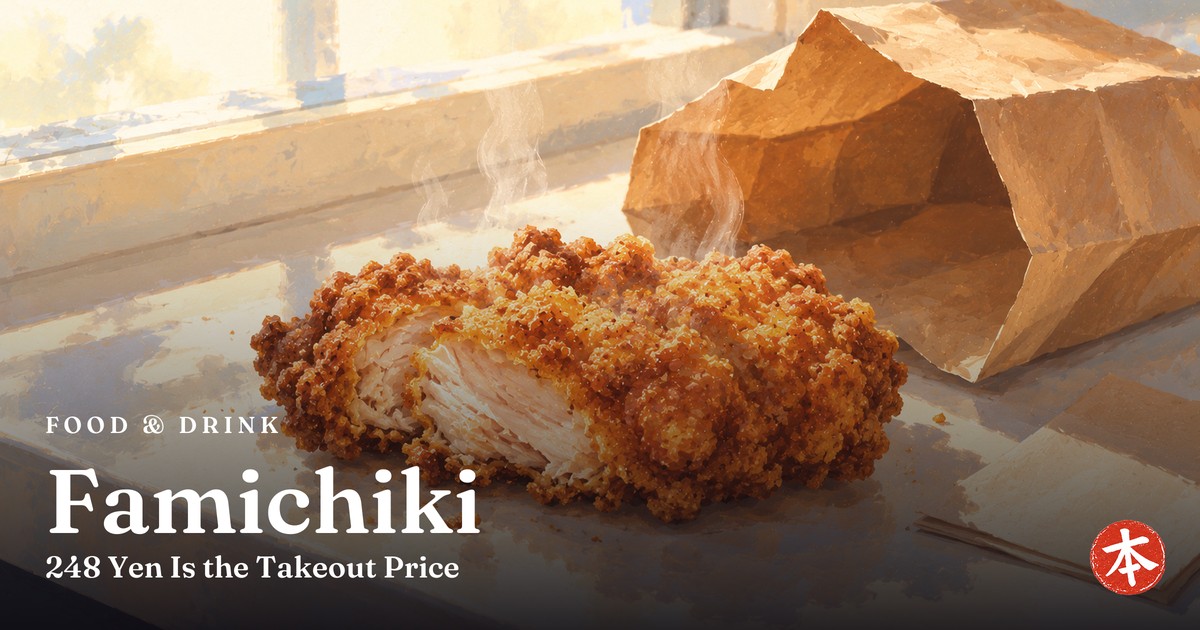
Famichiki is 230 yen before tax and 248 with it — and FamilyMart tells you, in a footnote most people scroll past, exactly which tax that is. The company states that the prices on its product pages are at the reduced 8 percent rate. In Japan that is the takeout rate for food. The standard rate is 10 percent, and it applies when you eat on the premises.
So the number FamilyMart publishes is the number you pay walking out with it. That is what almost everyone does with a Famichiki, which is why the distinction almost never comes up — and why it catches people out in the stores with seating. Below is the official price of every item on the hot counter, how to actually order one, and the two things on that counter that are not sold nationwide.
Famichiki and the whole hot counter: the official prices
| Item | Before tax | With tax (8%) |
|---|---|---|
| Famichiki | ¥230 | ¥248 |
| Famichiki (Red) | ¥239 | ¥258 |
| Famichiki, Ebara yakiniku sauce (45th anniversary) | ¥239 | ¥258 |
| Spicy chicken | ¥204 | ¥220 |
| Crispy chicken (plain) | ¥184 | ¥198 |
| Jumbo frankfurter | ¥184 | ¥198 |
| Chicken tsukune skewer | ¥175 | ¥189 |
| Korojaga (salted potato) | ¥213 | ¥230 |
| American corn dog | ¥139 | ¥150 |
| Charcoal yakitori (4 kinds) | ¥139 | ¥150 |
| Hash brown | ¥135 | ¥145 |
| Famicoro (beef croquette) | ¥112 | ¥120 |
| Famichiki-kara, per piece | ¥100 | ¥108 |
What is the cheapest way to eat here?
Famichiki-kara at ¥108, sold by the single piece in soy sauce or salt. Two of them cost ¥216 — less than one Famichiki at ¥248 — and give you the same fried chicken in smaller units. It is the most useful line on this table and the one no English guide bothers to print. The trade-off is that karaage is boneless offcuts rather than a single fillet, so it is easier to share and less satisfying to hold. If you are buying for two, the karaage is the obvious choice; if you want the thing Japan actually queues for, pay the ¥248.
Why the Famichiki price on the website may not be what you pay
What does the 8 percent note actually mean?
Does the price change depending on where I am?
It can. FamilyMart states directly that prices may differ by region. It also warns that some stores do not carry a given item at all. Neither caveat is unusual for a chain this size, but both mean the same practical thing: the shelf edge beats the website. If they disagree, the store is right.
Is this the same tax rule as everywhere else?
Yes, and it is worth understanding once because it applies across your whole trip — the same split appears at convenience stores, bakeries and takeaway counters everywhere. Our guide to Japanese convenience stores works through how it plays out at the register, and our tax-free shopping guide covers the separate question of consumption tax exemption for visitors, which does not apply to a hot snack you eat that afternoon.
How to order Famichiki without saying much
Where is it? Can I pick it up myself?
No. Famichiki lives in a heated glass case at the register, and staff serve it. This trips up visitors used to self-service counters — you do not take a tray, and there are no tongs. You order it as part of paying for everything else.
What do I actually say?
The product name and a number. “Famichiki hitotsu” — one Famichiki — is enough, and pointing at the case works just as well. It arrives in a paper sleeve rather than a box, which is the format for eating it while walking, and is the reason the takeout rate is the one that normally applies.
Can I pay with a card or IC card?
Yes — cards, transport IC and QR payments are all standard. The caveats FamilyMart publishes are about its own systems: some stores do not handle FamiPay, the company app, and some do not run every point program. For a foreign card or a transport IC card, a hot snack at the counter is about the simplest payment you will make in Japan.
The Famichiki family, and what else is worth ordering
How many versions are there?
Three on the counter as of September 7, 2026. The standard at ¥230 before tax, Red at ¥239 for a spiced version, and a 45th-anniversary collaboration flavored with Ebara yakiniku sauce, also ¥239. The anniversary version is a limited run by nature — anniversary products do not stay on the counter — so treat it as something to try if it is there rather than to plan around.
Is there a second hot counter I should know about?
Yes, and FamilyMart treats it as a separate business. Nikuman — the steamed buns — are not filed under hot snacks on the corporate site at all. They have their own product category, alongside rice balls and bento rather than alongside the fryer. In practice that means a second heated case near the register, usually appearing as the weather turns and gone again by spring. If you are in Japan in winter and only ever look at the fried counter, you are missing the other half of what is warm at that register.
Is Famichiki the best thing on the counter?
It is the famous one. Whether it is the best depends on what you want: spicy chicken at ¥204 is cheaper and hotter, the tsukune skewer at ¥175 is the only thing here that tastes like an izakaya rather than a fryer, and korojaga at ¥213 is potato rather than chicken. The jumbo frankfurter at ¥184 is the one people underestimate.
What would the whole counter cost?
Adding up the thirteen lines in the table above at their tax-included prices comes to ¥2,472 — that is our arithmetic on FamilyMart’s published figures, not a set the company sells. The spread runs from ¥108 to ¥258, which is a factor of roughly 2.4 between the cheapest and the most expensive thing in the same heated case. For a counter that looks like one price point, that is a wider range than it appears, and it means the difference between a snack and a meal here is a couple of hundred yen rather than a decision about where to eat.
What goes with it?
Practically, a rice ball and a canned drink from the same shop turn it into a meal for under ¥500. It is the same logic as a Japanese breakfast assembled from a convenience store — our breakfast guide covers the sit-down version of that idea, and our conveyor belt sushi guide the other end of cheap eating in Japan.
The two items on the counter that are not nationwide
Which ones, and where?
The charcoal-grilled chicken skin skewers — kawa, in both sauce and salt. Their listed sales area covers Hokkaido through Kyushu but leaves Okinawa off, unlike everything else on this counter. The salt version carries a further note: Miyazaki and Kagoshima do not stock it.
How regional does FamilyMart actually get?
Enough that the corporate site is built around it. Every product carries a sales area drawn from nine regions — Hokkaido, Tohoku, Kanto, Tokai, Hokuriku, Kansai, Chugoku-Shikoku, Kyushu and Okinawa — and the new-product section is not one page but three: a national list, a separate list for Kagoshima and Miyazaki, and another for Okinawa. Those two areas get their own release calendar, published weekly, apart from the rest of the country.
Why does that matter to a visitor?
Because it is a small, verifiable example of something bigger. A Japanese chain’s menu is not one menu — it is a set of regional ones, and the company publishes the differences rather than hiding them. If you are traveling between regions and looking for something you had before, the answer to “why is it not here” is often printed on the official page. It also means the reverse is worth checking: a region that loses one item usually gains others that never reach Tokyo. The Kagoshima, Miyazaki and Okinawa release lists exist precisely because those areas get products the national calendar does not carry, and reading the local list is the fastest way to find something you cannot buy anywhere else in the country.
Reading the small print on a Famichiki price
FamilyMart’s footnotes are unusually specific, and each one answers a question a visitor would otherwise have to guess at.
How do sales and discounts work here?
Discounts come off the tax-included regular price, not the pre-tax figure. For an item launched during a promotion, the reference point is the price it will sell at after the sale ends — so a new product on sale is discounted against its future normal price rather than an inflated one. That is a fairer construction than most retail promotions and it is written down.
Why does the site say the photo is an image?
Because hot snack appearance varies by fry and by store, and the company is covering itself rather than warning you off. Practically it means the piece you get will not match the photograph exactly — the size of a Famichiki fillet is not standardized the way a packaged product is. It is a fried chicken thigh, not a manufactured shape.
So what should I actually check in the store?
Three things, in this order: the price on the shelf edge rather than any website; whether the store stocks the item at all, since FamilyMart says some do not; and whether you intend to eat in or take away, because that decides which tax rate applies. None of these takes more than a glance, and together they cover every caveat the company publishes about its own prices.
Famichiki FAQ
How much does Famichiki cost?
Why do I sometimes see a different price?
What is the difference between Famichiki and Famichiki Red?
What is the cheapest thing on the hot counter?
How do I order Famichiki? Do I take it myself?
Can I pay by card or IC card?
Is Famichiki sold all over Japan?
Is there anything else worth trying on the same counter?
Bottom line (2026) — FamilyMart lists Famichiki at ¥230 before tax and ¥248 with it, and states its published food prices use the reduced 8 percent rate, which is the takeout rate. Famichiki Red is ¥239 / ¥258. The cheapest item on the counter is Famichiki-kara at ¥108 a piece. Prices can differ by region, and the charcoal chicken skin skewers are not sold in Okinawa.
Sources & what we deliberately did not state
Every price and sales-area note above comes from FamilyMart’s official product page for hot snacks and prepared foods, read on September 7, 2026, together with the company’s own footnotes about the reduced tax rate, regional pricing and stocking. Convenience store lineups change constantly — check the shelf, which is always current.
Deliberately not stated: calories and nutrition, because we could not retrieve the table from the official allergen and nutrition page and will not estimate them; the year Famichiki launched, because it is not on the pages we read; and what the equivalent item costs at other chains, because we did not read their official pages today. The one number here that is ours rather than FamilyMart’s is the ¥253 eat-in figure, and we have labeled it as our arithmetic where it appears.
Tokyo to Osaka, Tokyo to Kyushu, Tokyo to Hokkaido — day by day — plus seven places most visitors never reach.
- 12 pages, 80 photographs, every stop linked to its guide
- Every price and opening hour read from the official page
- Re-issued monthly, so it does not go stale in your inbox
Free. One email a month, plus the rare change that matters. Unsubscribe with one click in any email. By subscribing you agree to our privacy policy.