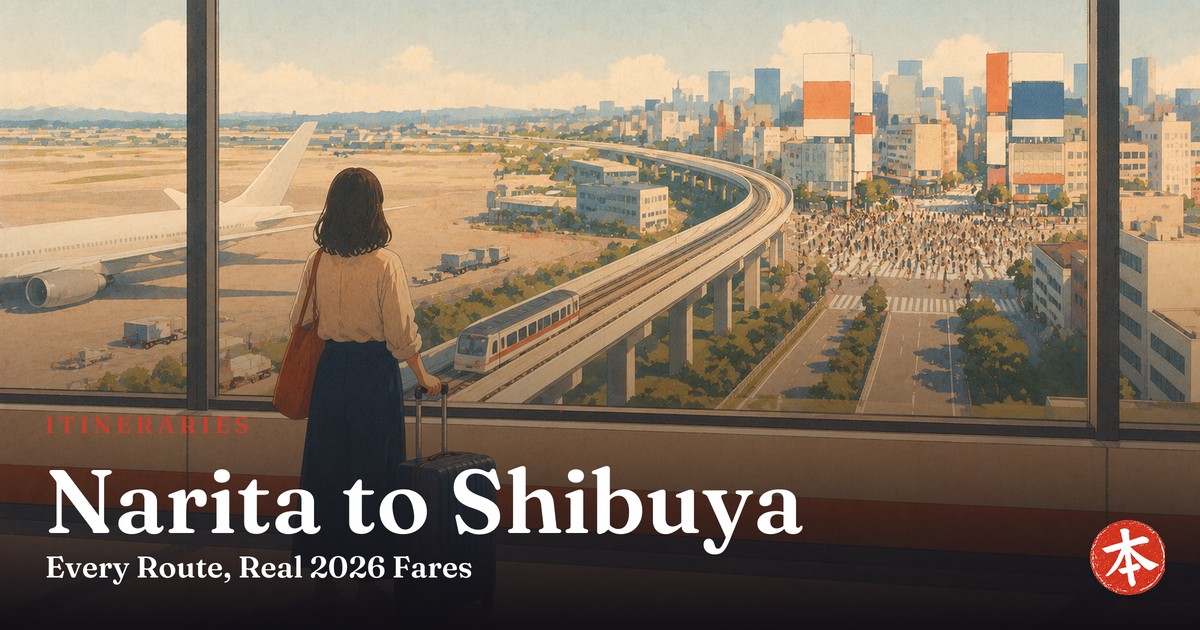
Short version: almost every English guide to this route quotes fares that no longer exist. The direct Narita Express to Shibuya is ¥3,330, on a JR East page stamped "Last Updated: March 14, 2026". The Skyliner is ¥2,580 to Nippori, plus a short JR hop. Those two numbers should be everywhere. They are not.
Two failures collided. On March 14, 2026, JR East revised every fare it charges and merged the cheap "inside the Yamanote loop" fare band into the standard trunk-line category — abolished it, in effect. Every JR figure published before that date is wrong. And Keisei, which runs the Skyliner, contradicts itself: its official English page for Shibuya still prints "64 min. / ¥2,670", a pre-2024 fare. Guides copy the operator's own English page, because copying the operator is supposed to be safe. Here it is not.
So this guide puts the stale figure next to the current one, and covers what nobody writes down: the N'EX splits at Tokyo Station and only one half reaches Shibuya, there are two different buses to Shibuya at ¥3,600 and ¥2,500, and the last free shuttle out of Terminal 3 runs after the last train.
Narita to Shibuya at a glance: every option, current 2026 prices
Six ways out of the airport, and the right one depends almost entirely on what time you clear customs. One-way adult prices.
| Option | Adult one way | To Shibuya | Frequency / last from T1 |
|---|---|---|---|
| Narita Express (direct) | ¥3,330 (Green ¥4,100) | ~75–88 min | 26 weekday departures reach Shibuya; last 21:44 |
| Skyliner + JR at Nippori | ¥2,580 + JR leg | 64 min per Keisei, transfer excluded | Roughly every 20 min; last 23:00 |
| Access Express / Keisei Main Line + JR | ~¥1,280 / ~¥1,060 + JR leg (see note) | Not published officially | Last departure not verified |
| Airport Limousine bus | ¥3,600 | ~95–100 min | Six a day; last 19:50 |
| Tokyu Bus LCB | ¥2,500 | ~110 min | One a day, 10:20 |
| TYO-NRT bus (Tokyo Station only) | ¥1,500 / ¥3,000 night | Does not serve Shibuya | Last 01:45 |
| Official fixed-fare taxi | ¥31,500 / ¥32,500 + tolls | Door to door | 24 hours |
Not sure which IC card to get? Our Japan IC card guide asks for your phone, your airport and how long you are staying, and tells you whether Welcome Suica Mobile, Welcome Suica, TOURIST PASMO, Suica or ICOCA fits.
Why almost every English guide has the wrong price
What actually changed on March 14, 2026?
JR East revised fares network-wide and merged the "inside the Yamanote Line" fare category into the standard trunk-line category — the category that made short hops in central Tokyo unusually cheap, now abolished. It also stopped selling round-trip and continuous-journey tickets. A guide written in 2025 is not slightly stale here; its fare structure has been deleted.
Why does Keisei's own English page still say ¥2,670?
Because it was never updated. Keisei's Skyliner subsite has an English page dedicated to routing you to Shibuya, and it states 64 min. and ¥2,670, with the IC fare given as 2,465 yen and the Yamanote leg as 194 yen. Keisei's own ticket pages give ¥2,580. The same subsite carries stale fare tables for the Access Express and the Main Line too.
| What guides print | Where it comes from | Current official figure |
|---|---|---|
| Skyliner ¥2,670 (or ¥2,470 / ¥2,570) | Keisei's own English Shibuya page; 2024 interim revision | ¥2,580 |
| Skyliner IC ¥2,465 | Same English page | IC ¥2,567 (¥1,267 + ¥1,300) |
| Yamanote, Nippori to Shibuya, ¥194 | Same English page | Fare band abolished 2026-03-14; no static official figure |
| N'EX to Shibuya ¥3,250 | Any pre-March-2026 source | ¥3,330 (Green ¥4,100) |
| Round Trip Ticket ¥5,000 | Any pre-March-2026 source | ¥5,200, still on sale |
| Limousine ¥3,200, all services suspended | Tokyu Bus's own page, still carrying a COVID-era banner | ¥3,600, running, six a day |
| Access Express ¥1,240 to Nippori | Keisei's own stale fare table | ~¥1,280 (fare aggregator, not Keisei) |
The operators are not unreliable — their English layer lags their Japanese one, and the guide industry reads only the English layer.
The Narita Express: the only direct train to Shibuya
The N'EX runs from beneath the terminals straight through to Shibuya with no transfer, at ¥3,330 ordinary and ¥4,100 Green Car, and JR East notes the price is the same throughout the year. Children aged six to eleven pay half, but a child in the Green Car pays the adult price, which catches families out.
How long does it really take to Shibuya?
JR East publishes a headline 53 minutes to Tokyo Station but no headline figure for Shibuya. Read off the official line timetable, a weekday run from Terminal 1 takes 75 to 96 minutes, typically about 80. Anyone quoting a single precise Shibuya time is deriving it, not citing it.
Which half of the train do I need to be on?
JR East runs the N'EX as a 12-car train to Tokyo Station, where it splits into two six-car halves — one to Ofuna, one to Shinjuku. Shibuya is on the Shinjuku half. Your seat reservation puts you in the right half automatically, so the rule is simple: sit in your reserved seat, and check the platform display against your ticket. If you moved seats to spread out, move back before Tokyo.
For the deeper comparison against rail passes and discount tickets, see our Narita Express and JR Pass guide.
Is the N'EX TOKYO Round Trip Ticket worth it?
Flying in and out of Narita and staying in Shibuya, the arithmetic is good: ¥5,200 adult and ¥2,600 child against ¥6,660 for two normal one-way tickets, so you save ¥1,460. It rose from ¥5,000 with the March 2026 revision and — despite what several English pages claim — has not been discontinued.
Who can buy it, and where do I pick it up?
You must be a foreign national holding a passport issued by a country other than Japan, and present the original passport in person. Nobody can buy it for you, family included. Note what JR East does not say: it sets no visa-status condition, so ignore guides adding a "Temporary Visitor stamp required" rule. Collection is only at Narita Airport Terminal 1 or Terminal 2·3 Station, where the ticket windows and passport-reader machines run 6:30–21:45.
Can I use it like a rail pass?
No, and this is where people lose it. It can only be used twice: once from Narita into the Tokyo area, once for the return, and the airport-outbound trip must come first. You may change onto other JR lines and alight anywhere in the covered area, but it becomes invalid if you exit the ticket gates mid-journey. Validity is 14 days. One mercy: miss your booked train and it stays valid for later trains the same day, in any available seat. Weighing it against a nationwide pass? Our JR Pass guide covers when a pass earns its price.
The Skyliner route: cheaper than the N'EX, faster on rails
The Skyliner runs on a dedicated high-speed line at up to 160 km/h, and Keisei's own figure is as little as 36 minutes to Nippori. For Shibuya the only official end-to-end figure Keisei publishes is 64 minutes — on the same stale English page that misprices the trip, and it excludes transfer time.
What does ¥2,580 actually buy?
Keisei's fare breakdown splits it cleanly: a base fare of ¥1,280 on paper (¥1,267 on an IC card) plus a liner charge of ¥1,300. Paper is ¥2,580, IC is ¥2,567, children ¥1,290. That is ¥750 less than the N'EX before the JR leg from Nippori — the piece nobody can currently quote officially.
What happens if I board without a Skyliner ticket?
Keisei's own walkthrough of the Skyliner e-ticket with Face Check in Go. It is in Japanese but entirely visual: watch the gate sequence and you will know what to do at Narita without understanding a word. Video by Keisei Movies, the official Keisei Electric Railway channel.
Nippori or Keisei-Ueno for Shibuya?
Nippori. The Skyliner continues to Keisei-Ueno, but that is a separate building from JR Ueno and a walk you do not need. Nippori is a straightforward change onto the JR Yamanote Line, which is why Keisei's own routing to Shibuya is built on it. Take the outer loop by way of Ikebukuro and Shinjuku, not the direction going around through Ueno — both reach Shibuya, one takes twice as long. First Skyliner from Terminal 1 is 07:23 on weekdays, last is 23:00, roughly every 20 minutes between.
The cheap rail option: Access Express and the Keisei Main Line
Keisei runs two ordinary services from Narita that carry no limited express surcharge at all. The Access Express uses the same fast Narita Sky Access line as the Skyliner; the Keisei Main Line limited expresses take the older route by way of Keisei-Funabashi. Both call at Nippori, and on both an IC card is all you need — tap and go.
Why do two Keisei trains to the same airport cost different amounts?
Different lines, different fare structures, and Keisei warns about it itself: the fare differs depending on whether you travel by the Narita Sky Access line or the Keisei Main Line. The catch is that Keisei's published tables for both are the stale pre-2024 ones — ¥1,240 and ¥1,030 to Nippori. Aggregators show about ¥1,280 and ¥1,060, but those are not Keisei figures. Check the machine at the airport.
Two honest gaps: Keisei publishes no journey time for either service, and neither last departure could be read from a primary source. Confirm on Keisei's own timetable search before relying on a late Access Express.
Buses to Shibuya: there are two, and guides confuse them constantly
There are two separate bus services from Narita to Shibuya, under different brands, at different prices, from different bays. Guides quote the cheap fare and the frequent timetable — they belong to different buses.
| Airport Limousine | Tokyu Bus LCB | |
|---|---|---|
| Adult fare | ¥3,600 (child ¥1,800) | ¥2,500 (child ¥1,250) |
| Departures per day | Six | One |
| From Terminal 1 | 09:20, 14:50, 16:20, 17:50, 18:50, 19:50 | 10:20 only |
| Shibuya stops | Shibuya Fukuras, Cerulean Tower Tokyu Hotel, Shibuya Excel Hotel Tokyu (Mark City) | Shibuya Fukuras, bay 9 |
| Journey time | ~95–100 min | ~110 min |
| Buying at Narita | Counter (cash, credit card, IC card) or same-day vending machine | The low-cost bus ticket counter |
Both serve Shibuya Fukuras, but the low-cost bus uses bay 9 while the ¥3,600 limousine also reaches the Cerulean Tower Tokyu Hotel and Mark City. At Terminal 1 the limousine leaves from bay 10, the low-cost buses from bay 3.
Is the Shibuya limousine bus suspended? (No.)
You will find sources saying it is. Tokyu Bus's own page still carries a COVID-era banner announcing that all services are suspended, plus a stale ¥3,200 fare. Only the Futako-tamagawa section is genuinely suspended; the Shibuya service runs, jointly operated by Tokyu Bus and Tokyo Airport Transport, whose page is the live one.
Landed late? The night bus is the only thing left
What happened to the Tokyo Shuttle and THE Access Narita?
They merged. Since February 1, 2020 the two have been a single operation, AIRPORT BUS TYO-NRT, run jointly by JR Bus Kanto, the Bee-Trans group and the Keisei group. Both old names are dead, and any guide still using them is six years stale. The fare is ¥1,500 one way to Tokyo Station, about 68 minutes scheduled from Terminal 1. Overnight and early-morning services are double: ¥3,000.
The first bus to Tokyo Station leaves Terminal 1 at 07:35 — the 06:55 goes to a depot and the 07:25 to Ginza, so read the destination markers rather than taking the first row. Then the night services: 23:05, 23:45, 00:15, 00:45 and a final bus at 01:45. Two rules matter at that hour: the service is seat-capacity only, no standing, so a full bus leaves you behind; and on the last bus from Narita credit cards are not accepted at all — you pay onboard in cash or with an IC card.
The taxi: what the official fixed fare really costs
Narita runs an official fixed-fare taxi scheme and Shibuya is in Zone D: ¥31,500 by way of the Keiyo Road or ¥32,500 by way of the Wangan expressway, a zone that also covers Shinjuku, Nakano, Meguro and most of Minato. Any guide saying a Narita taxi to Shibuya is "about ¥20,000" is not quoting the official scheme.
The conditions matter as much as the number. Tolls are extra and paid by you, the late-night surcharge from 22:00 to 05:00 is extra, and the fixed fare assumes expressway use — ask for ordinary roads and the meter applies instead. No reservation is needed: go to the rank and tell the driver. Ranks are at bay 15 at Terminal 1 and bays 28 and 31-A at Terminal 2.
Which terminal are you in? Terminal 3 has no station
Narita has three terminals and two railway stations. Terminal 1 has Narita Airport Station, a 5-minute walk; Terminal 2 has Narita Airport Terminal 2·3 Station, also 5 minutes; and Terminal 3, the low-cost carrier terminal, has no station of its own.
How do I get from Terminal 3 to a train?
Two ways, and the airport publishes two official numbers because they measure different things. Its train page gives a 10-minute walk; its walking page gives about 13 minutes from the station ticket gate to the Terminal 3 information counter, excluding the walk on to check-in. Use 13 if you are carrying the bags. The alternative is the free inter-terminal shuttle, about 3 minutes from Terminal 3 to Terminal 2, running from 05:08 every 3 to 6 minutes.
For the flight home, our Narita Airport duty-free guide covers the shopping side of the building, and Haneda to Tokyo Station is a shorter problem entirely.
Tickets, IC cards, and actually paying for this at Narita
Can I just tap my Suica?
It depends which train, and the answer is the opposite of what most people assume. On the N'EX an IC card covers the base fare only — it is all-reserved with no unreserved cars whatsoever, so a reserved limited express ticket is mandatory. On the Skyliner, IC again covers the base fare only and boarding without the liner ticket adds ¥300. On the Access Express and Keisei Main Line there is no surcharge and tapping through really is all there is.
Can I still buy a normal Suica in 2026?
Yes. Unregistered Suica and PASMO went back on sale on March 1, 2025 after the chip shortage, which makes a lot of English advice eighteen months out of date. A regular Suica carries a ¥500 deposit, refundable with the balance minus a ¥220 handling fee, and stops working only if it goes unused for 10 years. A Suica issued by JR East can be returned only at JR East stations. Welcome Suica has no deposit but lasts 28 days and is non-refundable. Both are cash top-up only. Our Suica and IC card guide covers which to pick.
Do foreign credit cards work at Narita?
Mostly, with limits. Keisei states Skyliner tickets can be bought with a major credit card at machines and counter, though its brand list is logo images with no text, so we will not name brands we cannot read. JR East's reserved-seat machines accept credit cards but publish no brand list either. On the Airport Limousine, cards work only at the Narita counter, never onboard — and on the last TYO-NRT bus of the night, credit cards are not accepted at all.
What is the fastest way through ticketing at Narita?
Buy before you land. JR East's own warning is the most useful line in the official material: its machines and ticket windows at Narita Airport Station get extremely crowded, and on some days the wait runs to about 30 minutes. Buy a ticketless limited express ticket through Ekinet in advance and you simply touch your IC card at the gate, with that portion discounted up to 35% off on seat-limited tickets. One caution: no official JR East or Keisei page names any online travel agency as an authorized channel — third-party sites can be convenient, but nobody should tell you they are official.
The last departure from Narita, by option
| Option | Last from T1 | Last from T2·3 | Arrives | Fare |
|---|---|---|---|---|
| N'EX (direct to Shibuya) | 21:44 | 21:47 | Shibuya 23:06 | ¥3,330 |
| Skyliner then JR | 23:00 | 23:03 | Nippori 23:43, then JR (last Yamanote not verified) | ¥2,580 + JR |
| Airport Limousine to Shibuya | 19:50 | 19:45 (T3 19:40) | Shibuya Fukuras 21:20 | ¥3,600 |
| Tokyu Bus LCB to Shibuya | 10:20 (only bus) | 10:15 (T3 10:10) | Shibuya Fukuras 11:55 | ¥2,500 |
| TYO-NRT to Tokyo Station | 01:45 | see timetable | Tokyo Station only | ¥1,500 / ¥3,000 night |
| Fixed-fare taxi | 24 hours | 24 hours | Door to door | ¥31,500–32,500 + tolls |
The blanks are deliberate: we could not verify the last Access Express or Keisei Main Line departure, or the last Yamanote train from Nippori, from a primary source, and we would rather say so than publish a plausible-looking time.
So which one should you actually take?
Before about 19:00: the Skyliner, changing at Nippori — fastest on rails and ¥750 cheaper than the N'EX before the JR leg. Same time, but three suitcases or small children: the N'EX at ¥3,330, or ¥5,200 round trip if you fly home from Narita too. Between 21:47 and 23:03: the Skyliner is your last train. After 23:03: the TYO-NRT night bus at ¥3,000 plus a taxi, or the fixed-fare taxi at ¥31,500 to ¥32,500 plus tolls.
(If you land late and would rather stay by the airport: our Hotel Nikko Narita guide covers the free shuttle from Terminals 1 and 2 and a breakfast buffet that opens at 5:30.)
(For a stay at one of those Shibuya stops: our Cerulean Tower Tokyu Hotel guide notes that the limousine bus from Narita runs direct to the hotel in about 85 minutes, and that for the trip back to Narita you must book and pay for the bus online in advance.)
FAQ
How much does it cost to get from Narita to Shibuya in 2026?
Why do so many websites say the Skyliner to Shibuya is ¥2,670?
Does the Narita Express actually go to Shibuya?
What is the last train from Narita to Shibuya?
Is the N’EX TOKYO Round Trip Ticket worth buying?
Can I just tap my Suica and get on the Skyliner or the Narita Express?
Is there a cheap bus from Narita to Shibuya?
Terminal 3 has no train station – how do I reach one?
Bottom line (2026) — The direct Narita Express to Shibuya is ¥3,330 and takes about 80 minutes; the Skyliner plus a JR transfer at Nippori is ¥2,580 and is faster on the rail leg. Keisei's own English Shibuya page still prints the pre-2024 ¥2,670, and JR East's March 14, 2026 revision reset every JR fare, so most English guides quote dead numbers. The two Shibuya buses differ: ¥3,600 six times a day, or ¥2,500 once.
Sources
N'EX fares and seating, the Tokyo Station split, the Ofuna-only 17:45, the September 2026 suspension, the ¥5,200 round trip ticket, the March 14 2026 fare revision, the Ekinet discount and the Suica and Welcome Suica terms: JR East (jreast.co.jp, its own timetables, JRE Media, and the joint JR East / PASMO Council release). Skyliner fares, the ¥300 no-ticket penalty, the 36-minute and 64-minute figures, the stale ¥2,670 English page and the first and last departures: Keisei Electric Railway (keisei.co.jp). Terminal walks, the free shuttle timetable, low-cost bus fares, bay numbers and the fixed-fare taxi zones: Narita International Airport Corporation (narita-airport.jp). Shibuya bus fares and timetables: Tokyo Airport Transport and Tokyu Bus. The 2020 merger and the night timetable: AIRPORT BUS TYO-NRT. All read August 27, 2026; fares and timetables change, so confirm on the operators' own sites before you travel. The embedded video is by Keisei Movies, the official Keisei Electric Railway channel.
Some links on this page may be affiliate links, which means we may earn a commission if you book or buy through them — at no extra cost to you. See our affiliate disclosure.
Tokyo to Osaka, Tokyo to Kyushu, Tokyo to Hokkaido — day by day — plus seven places most visitors never reach.
- 12 pages, 80 photographs, every stop linked to its guide
- Every price and opening hour read from the official page
- Re-issued monthly, so it does not go stale in your inbox
Free. One email a month, plus the rare change that matters. Unsubscribe with one click in any email. By subscribing you agree to our privacy policy.