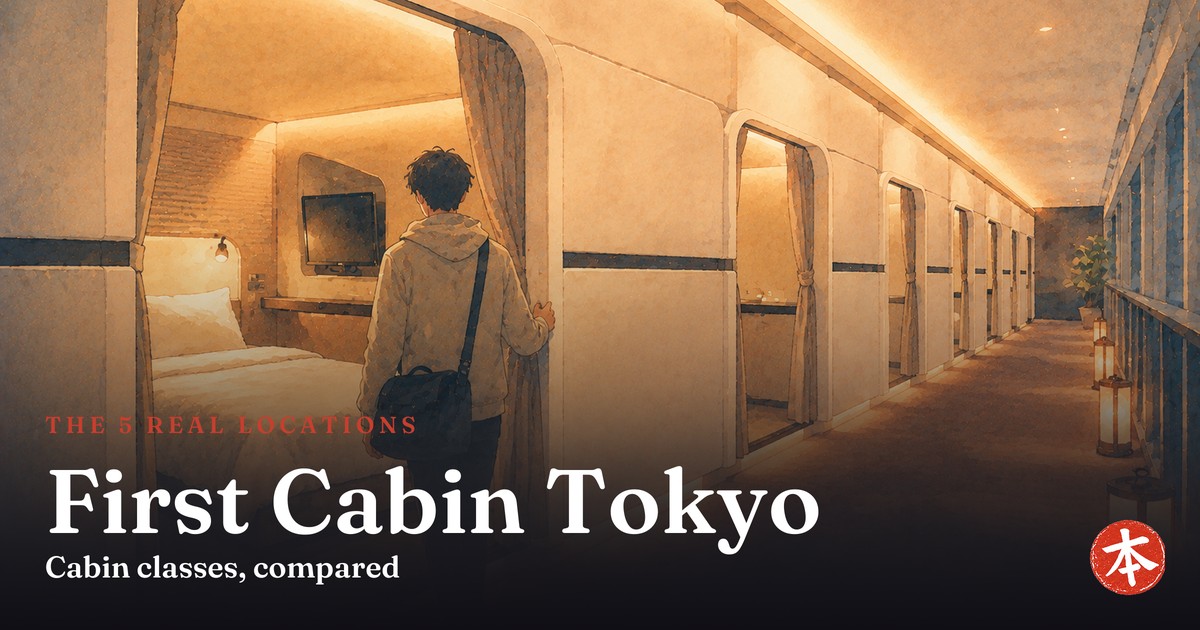
First Cabin sells the most seductive pitch in budget Tokyo lodging: an "airline first class" cabin — 2.1 meters square, tall enough to stand in, real semi-double bed — at capsule-adjacent prices. The pitch is real. What's unreliable is the map: the chain has shrunk, and the Tsukiji, Kyobashi and Nihonbashi branches still recommended across the English internet no longer appear on the official hotel list. Five Tokyo locations exist in 2026. Here they are, with the cabin-class math, the check-in times nobody expects, and the legal quirk that explains the curtains — all from the official pages.
First Cabin Tokyo at a glance (the 2026 reality)
| Branch | Check-in / out | Large bath | Note |
|---|---|---|---|
| Atagoyama (Shimbashi/Toranomon) | 17:00 / 10:00 | Yes (cleaning closures 10:00–15:00) | Business-district quiet |
| Akasaka | 17:00 (last 28:00) / 10:00 | Yes | 30 sec from Akasaka Sta. · 123 cabins (72M/51F) |
| Haneda Terminal 1 | 19:00 / 10:00 | Yes | Inside T1 · short-stay from ¥2,000/2h · night door near bus stop 8 |
| Ichigaya | 14:00 / 10:00 | Yes | Only Tokyo branch with lie-down Premium Economy cabins |
| Akihabara | 14:00 / 10:00 | Not listed officially | 4 min from JR Akihabara |
| 🚨 Tsukiji · Kyobashi · Nihonbashi-Yokoyamacho: not on the official list — closed, whatever old articles say | |||
What three days in a First Class cabin actually feels like:
The cabin classes: what 4.4 square meters buys
Is First Class worth it over Business?
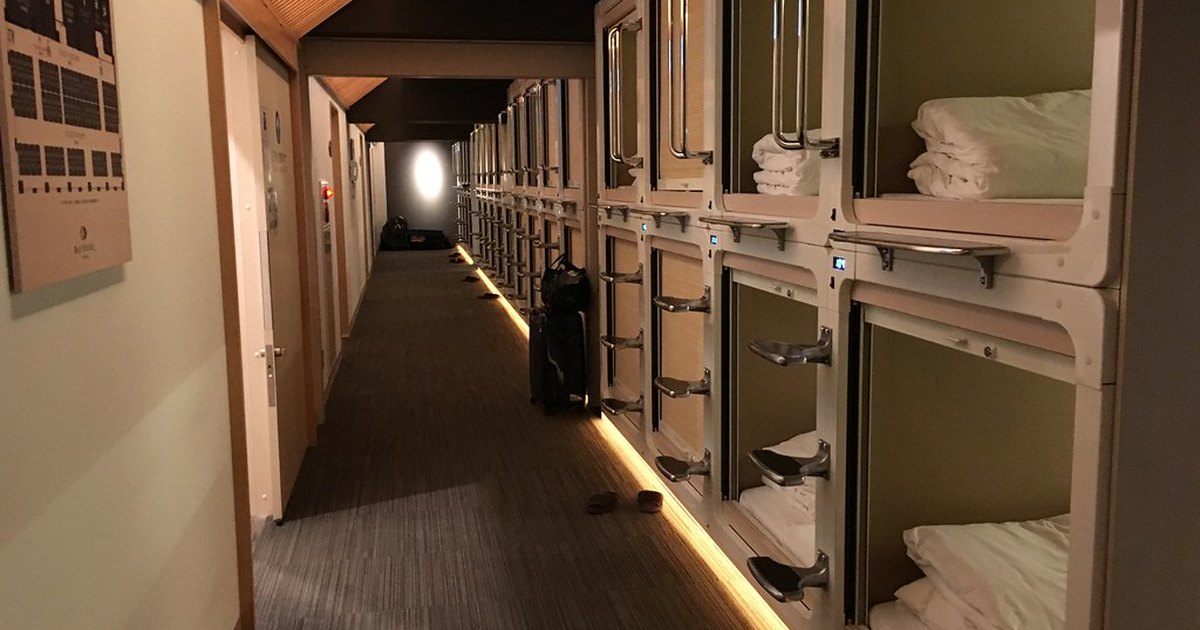
The official dimensions tell the story cleanly. First Class is a 2.1m × 2.1m × 2.1m cube — 4.4 square meters around a 120cm semi-double bed, with a 32-inch TV and a lockable safety box big enough for a laptop bag. Business Class keeps the standing height but narrows to 1.2 meters — a 100cm bed with a walkway. The difference matters most for luggage: a First cabin swallows a suitcase beside the bed; a Business cabin makes you live vertically. Ichigaya's third type, Premium Economy, has a 1.0-meter ceiling — a bed pod, honestly closer to a classic capsule than anything else the chain runs in Tokyo. The lockable multi-person Premium Class rooms exist only outside Tokyo, so don't hunt for them here. Where cabins sit in the wider budget field: our budget hotels guide runs the four-layer comparison.
The rules that surprise people — and the law behind the curtain
Why can't anything lock?
Because of its license. The official FAQ explains that First Cabin operates as simple lodging under Japan's Hotel Business Act, which legally prevents lockable cabin entrances — hence the curtain, the all-cabin safety boxes, and the free earplugs at the desk (the FAQ is upfront that neighboring sound carries). The other house rules from the official pages: floors split by gender, every cabin strictly single-occupancy, no guests 12 or under, and minors 13–17 traveling alone need a guardian's consent form. There's no curfew anywhere — with the one delightful exception that Haneda's terminal building closes 0:30–4:45, so night owls use the dedicated entrance by bus stop 8 downstairs. Multi-night stays are saner than capsule veterans expect: checkout applies to the final morning only, though Akasaka notes housekeeping owns the building 10:00–16:00.
Check-in times: the trap in the fine print
No two branches agree, and the spread is enormous: Ichigaya and Akihabara open at 14:00, Atagoyama and Akasaka at 17:00, Haneda at 19:00 — checkout is 10:00 across the board. That 19:00 at Haneda sounds hostile until you realize the product: it's a sleep-before-a-flight machine, not an afternoon base, and its daytime hours sell as the official short stay (First Class ¥3,000 per two hours, Business ¥2,000, reception 5:00–16:00) — the best nap-and-shower deal in the terminal. Nightly rates are officially dynamic with a best-price guarantee on first-cabin.jp, so we quote none; check the engine. Location logic: Akasaka for nightlife access, Atagoyama for quiet, Akihabara to fall asleep twenty meters from the Electric Town circuit, and Haneda to make a 7 a.m. departure humane — where it competes directly with the Villa Fontaine complex at Terminal 3 reviewed earlier today. For the full lodging landscape, start at the where-to-stay hub.
A packing strategy for a cabin night
What do you actually do with a big suitcase?
The system assumes you'll separate sleeping from storing. Big luggage lives at the cloakroom (officially same-day only — and at Haneda, not at all after checkout, per airport security rules); into the cabin you carry a day bag with the overnight kit. The safety boxes are generously long but shallow — First Class boxes run 86cm wide but 17cm tall, sized for electronics and documents rather than bags — so passports, camera and laptop go in the box, everything else stays zipped in the suitcase downstairs. Wear the provided loungewear to the bath, keep the earplugs from the desk, and charge everything overnight: the cabin has outlets, and the morning rush for powder-room mirrors starts early. It's a system, and like most Japanese systems it works beautifully once you stop fighting it.
(The classic pod tier — Nine Hours' sleep machine and Anshin Oyado's 200-freebie capsule resort, plus why nothing locks by law — is covered in our Tokyo capsule hotel guide.)
(How this compares: our late arrival deadlines table notes that First Cabin’s terms set the deadline at your stated arrival time itself, while the most common deadline in the table is 8 p.m., in 29 of 53 terms.)
FAQ
Which First Cabin locations actually exist in Tokyo?
What’s the difference between First Class and Business Class cabins?
Why don’t the cabins lock?
Is First Cabin a capsule hotel?
What time is check-in — and why is it so late?
How much does a night cost?
Can couples or kids stay?
Do the Tokyo branches have baths?
Is there a curfew — and does Haneda’s terminal closure matter?
Who is First Cabin actually right for?
Bottom line (2026) — First Cabin operates exactly five Tokyo locations – Atagoyama, Akasaka, Haneda Terminal 1, Ichigaya and Akihabara – while closed branches like Tsukiji linger in outdated guides and booking mirrors. Cabins do not lock (Japan’s simple-lodging law), and the official pages cover First vs Business cabin dimensions, gender-floor and age policies, curfews and Haneda’s night-entrance and short-stay pricing.
Sources
Current hotel list, branch pages (check-in/out times, cabin counts, facilities), cabin dimensions and classes, the simple-lodging legal explanation, safety-box sizes, gender-floor and age policies, curfew and Haneda night-entrance details, consecutive-stay checkout policy, luggage rules and Haneda short-stay prices: first-cabin.jp official pages and FAQ, read on August 18, 2026. Nightly rates are dynamic and not quoted. Closed branches are identified by their absence from the official hotel list. The embedded video is by its creator.
Some links on this page may be affiliate links, which means we may earn a commission if you book or buy through them — at no extra cost to you. See our affiliate disclosure.
Tokyo to Osaka, Tokyo to Kyushu, Tokyo to Hokkaido — day by day — plus seven places most visitors never reach.
- 12 pages, 80 photographs, every stop linked to its guide
- Every price and opening hour read from the official page
- Re-issued monthly, so it does not go stale in your inbox
Free. One email a month, plus the rare change that matters. Unsubscribe with one click in any email. By subscribing you agree to our privacy policy.