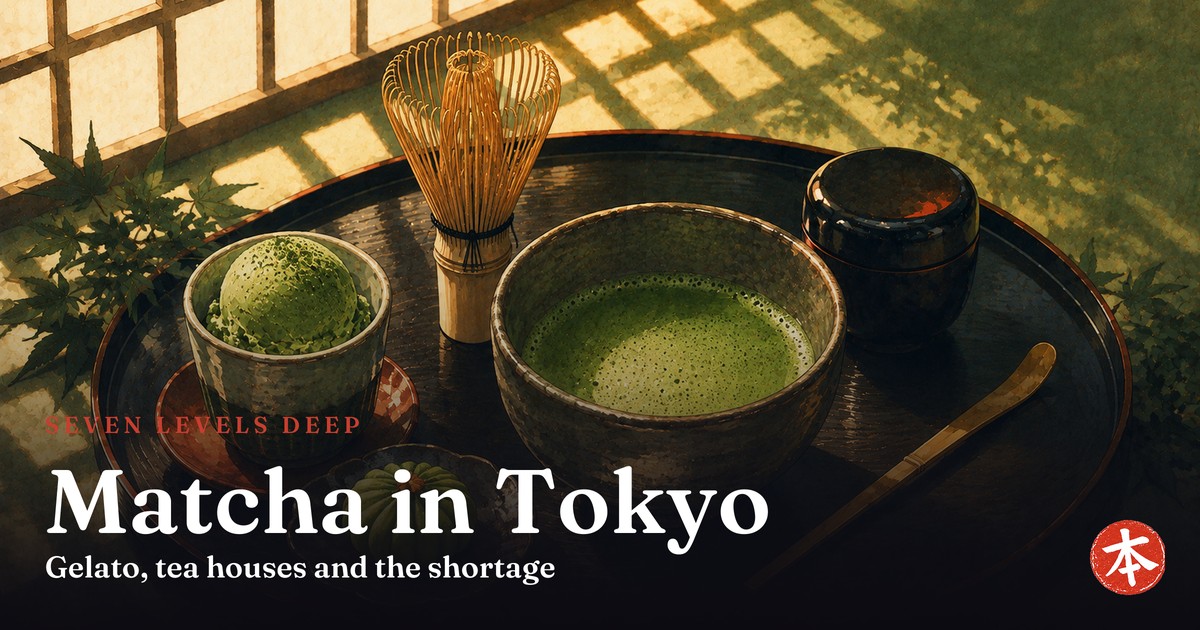
The world is drinking Japan's matcha faster than Japan can grind it — the shortage is official, as we'll show — which makes Tokyo the best place on earth to taste the real spectrum while you can: a seven-strength gelato ladder in Asakusa, Kyoto's tea dynasties holding court in Ginza, and a hotel tea room where you whisk your own bowl. This guide maps it from official sources, corrects the blog canon's favorite errors, and explains why "ceremonial grade" means less than you think.
Matcha in Tokyo at a glance
| The icon | Suzukien, Asakusa — 7-strength matcha gelato · official hours 11:00–17:00 (🚨 not 10:00), irregular closures |
|---|---|
| Kyoto in Tokyo | Nakamura Tokichi @ GINZA SIX (full café) & Azabudai Hills (to-go) · Saryo Tsujiri @ Daimaru Tokyo · Gion Tsujiri @ Solamachi |
| The purist stop | Ippodo — Aoyama shop with tearoom (Mon closed) · Marunouchi = takeout only (🚨 the "Kaboku Marunouchi" era is over) |
| Whisk it yourself | Okura Tokyo, Chosho-an — ¥3,000 served / ¥5,000 hands-on · Tue·Thu·Sat 12:00–16:00, book by the day before |
| Modern café chain | THE MATCHA TOKYO — 6 Tokyo shops · 🚨 Omotesando & Harajuku are cashless-only |
| 🚨 The shortage | Real and official — Ippodo's main tins largely sold out online with order limits; Ito En raised prices citing raw-material shortage |
What the Asakusa gelato ritual actually looks like, level by level:
Suzukien: the seven-level ladder, fact-checked
The Asakusa gelato shop every matcha pilgrim knows belongs to a tea wholesaler with 150-plus years of history, and the concept is exactly as advertised: gelato in seven matcha strengths, No.1 for beginners, No.7 for people who think tea should fight back. Facts worth having straight: official hours are 11:00–17:00 with irregular closures — the 10:00 opening printed across the English internet is wrong, and matters if you're sequencing a Senso-ji morning (our street-food guide covers the surrounding snack crawl). The "world's richest" superlative isn't on the official pages, so we won't claim it — but the official retail chocolate version publishes the actual concentration ladder (1.2% to 29.1% matcha across seven pieces, ¥1,710, same Fujieda matcha as the gelato), which is better than a superlative: it's a spec sheet, and the nerdiest souvenir in this article.
Kyoto's tea dynasties, without the shinkansen
Nakamura Tokichi and the Tsujiri family
Uji's Nakamura Tokichi (est. 1854) runs a full café and shop on GINZA SIX's 4th floor — matcha jelly and parfaits at a marble counter, officially 10:30–20:30 (last order 19:30) — plus an Azabudai Hills branch that's officially store-and-takeout, no full café, whatever the queue implies. The Kyoto Tsujiri family holds two Tokyo positions: the Saryo Tsujiri dessert salon on Daimaru Tokyo's 10th floor (10:00–20:00 — directly above Tokyo Station, the best shinkansen-wait dessert in the city) and a Gion Tsujiri shop in Solamachi (11:00–22:00) under the Skytree. If Uji itself is on your route, our Kyoto matcha guide is the home-turf companion to this page.
Ippodo, and the tearoom that moved
Kyoto's Ippodo (est. 1717) is the purist's tin, and its Tokyo geography changed in a way English articles haven't caught: the Marunouchi shop (Shin-Marunouchi Building B1, 11:00–21:00) is officially retail and takeout with no tearoom — the beloved "Kaboku" tearoom exists officially only at the Kyoto flagship now. Tokyo's sit-down Ippodo is the Aoyama shop (10:00–18:00, closed Mondays), whose 21-seat tearoom officially takes reservations and will walk you through whisking temperature like it's a wine service. An Isetan Shinjuku counter rounds out the trio.
The shortage: what the official record shows
How bad is it, really?
The global matcha boom hit supply, and you can read it straight off the official pages: when we checked Ippodo's online store, nearly every principal matcha was marked sold out — the ¥2,376 entry tin through the ¥10,800 Kanza — with an order-limit system built into the shop's code. Ito En's official July 2025 release raised prices on 19 matcha products citing, verbatim, worldwide demand growth, inbound tourism's pull on supply and "raw-material shortages" making stable supply difficult. What this means at street level: per-person limits at famous shops, empty shelves for top tins, and prices a tier above the old guides. Buy when you see stock; the shortage is not a marketing story.
"Ceremonial grade": the label Japan never issued
Japan's agriculture ministry defines matcha in one sentence: shade-grown leaves, steamed, dried without rolling, de-stemmed — that's tencha — then stone-ground. That's it. No grades exist in the official definition — "ceremonial" and "culinary" are English-market labels, not Japanese standards, exactly as we found researching the Kyoto side of this story. What real shops use instead is house hierarchies: Ippodo's ladder from ¥2,376 to ¥10,800 per 20g tin is the grading system, expressed in prices. Judge tins by the house and the tier, and let anyone selling "authentic Japanese ceremonial grade" explain which authority certified it.
Whisking your own: the Okura tea room
The most reliably bookable tea-ceremony experience in central Tokyo is official and surprisingly reasonable: Chosho-an, the tea room on The Okura Tokyo's Heritage Wing 4th floor, serves a 30-minute matcha-and-sweet session at ¥3,000 or a 60-minute experience where you whisk your own bowl at ¥5,000 (both tax-and-service inclusive), officially Tuesdays, Thursdays and Saturdays 12:00–16:00, booked by the previous day via TableCheck — and not restricted to hotel guests. The Imperial Hotel keeps its own tea room (Toko-an), but its current visitor program isn't published, so the Okura is the one to plan around. Cheaper hands-on routes exist through the tea-adjacent workshops in our experience-class guide.
(Tea's oldest companion has its own guide now — Tokyo's historic mochi and dango shops, sellout clocks included.)
(For something sweet with your tea: our wagashi in Tokyo guide notes that Toraya in Akasaka and Funawa in Asakusa have their own cafes, and lists how long each shop’s sweets keep.)
FAQ
Where is the famous seven-level matcha gelato in Tokyo?
Do the Kyoto tea houses have Tokyo branches?
Can I drink Ippodo tea in Tokyo — what happened to the Kaboku tearoom?
Is the matcha shortage real?
What does ‘ceremonial grade’ matcha actually mean in Japan?
Where can I whisk my own matcha in Tokyo?
Where’s the best modern matcha café in Tokyo?
Is Asakusa or Ginza better for a matcha afternoon?
What matcha should I take home?
Bottom line (2026) — Tokyo’s serious matcha lives at a handful of official addresses: Asakusa’s Suzukien gelato (opens 11:00, not 10:00) with its 1.2–29.1% seven-level ladder using shared Fujieda matcha; Kyoto dynasties Nakamura Tokichi, Tsujiri and Ippodo at GINZA SIX and Marunouchi; and the Hotel Okura tea room where you whisk your own bowl for ¥5,000. Japan’s agriculture ministry never issued a “ceremonial grade” label.
Sources
Suzukien: the official company page (address, 11:00–17:00 hours, irregular closures, founding era) and the official online store's Tea Chocolate Matcha 7 listing (the 1.2–29.1% seven-level ladder and shared Fujieda matcha, quoted verbatim). Nakamura Tokichi, Saryo Tsujiri / Gion Tsujiri: official store pages (locations, hours, the no-full-café-at-Azabudai detail). Ippodo: the official store locator and store pages (the Marunouchi no-tearoom reality, Aoyama's tearoom and Monday closure), the official online-store stock status and order-limit implementation, and the official news feed. Ito En: the official July 31, 2025 price-revision release, quoted verbatim on the shortage. The matcha definition: Japan's Ministry of Agriculture, Forestry and Fisheries official explainer (tencha, stone-ground, no grades). Okura: the official Chosho-an experience page (prices, days, booking rule). THE MATCHA TOKYO: the official café list (six Tokyo shops, hours, the cashless-only notes). All read August 10, 2026. Marukyu Koyamaen's site blocked automated reading and is deliberately uncited. The embedded video is by its creator.
Some links on this page may be affiliate links, which means we may earn a commission if you book or buy through them — at no extra cost to you. See our affiliate disclosure.
Tokyo to Osaka, Tokyo to Kyushu, Tokyo to Hokkaido — day by day — plus seven places most visitors never reach.
- 12 pages, 80 photographs, every stop linked to its guide
- Every price and opening hour read from the official page
- Re-issued monthly, so it does not go stale in your inbox
Free. One email a month, plus the rare change that matters. Unsubscribe with one click in any email. By subscribing you agree to our privacy policy.