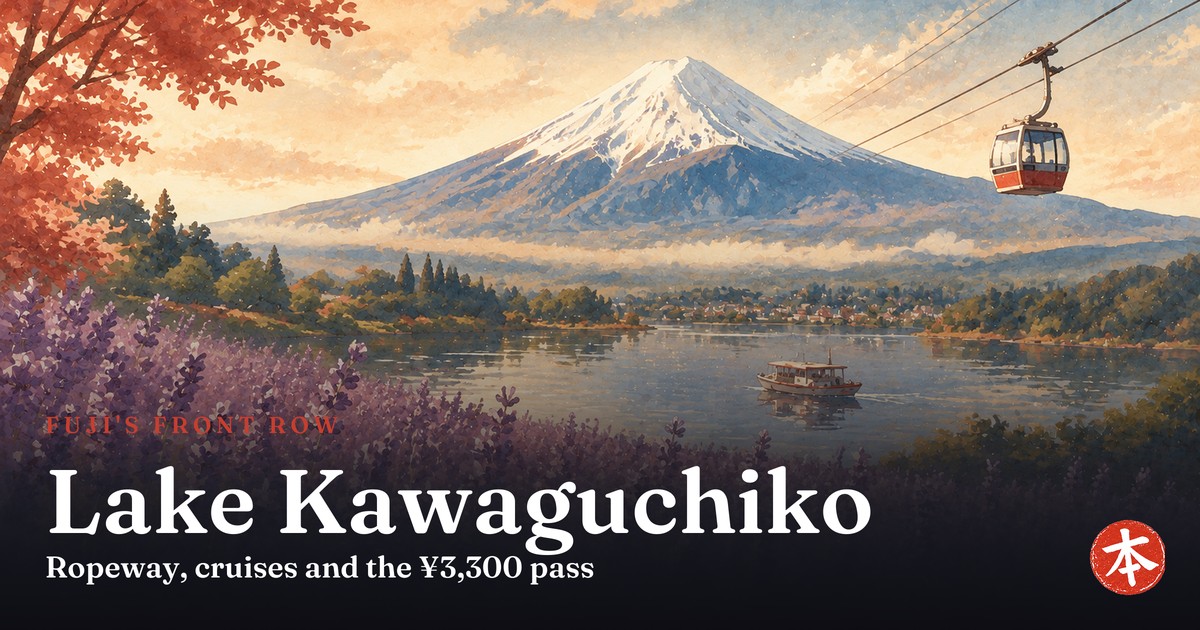
Kawaguchiko is where Mt. Fuji poses — the most accessible of the Fuji Five Lakes, 105 minutes from Shinjuku by an officially ¥2,200 bus. It's also where guidebook facts quietly expired this year: the famous ropeway now carries a new official name, a new boat line launched in July 2026, and the lavender festival is officially over (the lavender, happily, is not). Here's the lake sorted with current official prices — and the ¥3,300 pass that bundles the best of it.
Kawaguchiko at a glance
| Thing | Official price / hours (Aug 2026) |
|---|---|
| Getting there | Shinjuku highway bus ¥2,200 / ~1h45m · Fuji Excursion express: 4 direct round trips daily |
| Mt. Fuji Panorama Ropeway (ex–Kachi Kachi Yama) | RT ¥1,000 · 8:30–17:00 (to 18:00 Jul 20–Aug 31) |
| Lake cruises | Appare circuit ¥1,000 · 🆕 Oishi Park Line "Ensoleillé" (from Jul 17, 2026) ¥1,000 |
| Itchiku Kubota Art Museum | ¥1,500 · 10:00–17:00 (Apr–Nov) · irregular closures |
| Music Forest Museum | 🚨 3-tier: ¥1,800 weekday / ¥2,100 weekend / ¥2,300 high season |
| Oishi Park & Hanaterasu | Free · Red Line bus ~20–30 min or the new boat |
| Passes | Retro bus 1-day ¥1,500 / 2-day ¥2,000 · Sightseeing Pass ¥3,300 = ropeway RT + cruise + 2-day bus |
The lake, the ropeway and the dawn view — what a well-paced visit looks like:
Getting there: bus beats train, usually
The highway bus from Busta Shinjuku is the sensible default: officially ¥2,200 one way (children ¥1,100), about 1 hour 45 minutes, bookable in English on Fujikyu's official reservation site, arriving at Kawaguchiko Station in the middle of everything. The rail romantic's option is the Fuji Excursion limited express — four direct round trips daily from Shinjuku, per Fujikyu Railway's official page. On its price we're precise about what we know: the Fujikyu segment (Otsuki to Kawaguchiko) is officially ¥1,170 plus ¥400 express charge; the JR segment's post-March-2026 fare wasn't verifiable on an official page, so total it on JR East's own channels. Book the train early either way — four departures sell out.
The big three: ropeway, boats, and the pass that bundles them
What's the ropeway called now?
Officially the ~Kawaguchiko~ Mt. Fuji Panorama Ropeway — the Kachi Kachi Yama nickname (from the tanuki folktale set on this mountain) survives in conversation, but the old name and old website are retired. Current official terms: ¥1,000 round trip, ¥600 one way, running 8:30–17:00 with the last descent at 17:20 — extended to 18:00 through August 31. The three-minute ride buys the lake-and-Fuji panorama that anchors every Kawaguchiko photo set.
Which boat should I ride?
Now a real choice. The Appare — a Sengoku-warship-styled cruiser — does the classic 20-ish-minute circuit at ¥1,000, sailing 9:00–16:30 in regular season (to 17:30 in high summer, from 9:30 in winter), with about ten scattered Tuesday closures on the official 2026 calendar. The newcomer: the Oishi Park Line "Ensoleillé," launched July 17, 2026, linking the station side with Oishi Park for the same ¥1,000 — officially pitched as the traffic-free way to the flower park, and honestly the smarter ticket in flower season. Doing ropeway plus a boat plus buses? The official Kawaguchiko Sightseeing Pass (¥3,300, valid 2 days) bundles all three and undercuts the à-la-carte total.
The museums: kimonos, music boxes, and honest pricing
Which museum for which weather?
Two headliners on the north shore, both officially priced with quirks. The Itchiku Kubota Art Museum — part gallery, part Gaudí-adjacent architecture — shows the late master's dyed-kimono cosmos for ¥1,500 (students ¥900, children ¥400), 10:00–17:00 April through November; its closure days exist only as an official PDF calendar, so check before committing the bus ride. The Kawaguchiko Music Forest — automatic instruments in European-style gardens with Fuji looming — prices by demand, officially: ¥1,800 weekdays, ¥2,100 weekends, ¥2,300 high season, 10:00–17:30. Neither is filler; on a cloudy afternoon they're the best hours on the lake — Fuji hides, the kimonos don't. If the sky is clear, invert the order: mountain first, art after lunch, when the summit typically clouds over anyway.
For a cloudy-day option beyond the museums, The Manduls’ How To Spend A Day At Lake Kawaguchiko found the quiet, mossy Asama Shrine one of their favorite experiences in the area on an overcast day, and after their own afternoon visit they suggest doing Chureito Pagoda first thing in the morning instead.
Flowers, foliage and the festival that ended
Set expectations to 2026: the Herb Festival is officially finished — its final edition was 2025 — but Oishi Park still runs its free, always-open show of lavender (early summer) and blazing kokia (autumn) with Fuji as backdrop, reachable by the Red Line bus (about 20–30 minutes) or the new boat, with the free Hanaterasu shopping-garden complex next door. Autumn's headline act is official and dated: the Momiji Festival, November 7–29, 2026, with the maple corridor illuminated from sunset to 21:00. For where this day fits in a bigger route, our 7-day and two-week itineraries slot Kawaguchiko as the Fuji day, and the Kusatsu guide covers the other classic overnight escape in the same mountains-north-of-Tokyo genre.
(Kawaguchiko is the Fuji pick — the day-trips hub lines it up against the other nine great escapes.)
(For a stay above the lake: our HOSHINOYA Fuji guide covers a glamping resort of 40 cabins on a wooded hillside above Lake Kawaguchiko, and notes that there is no station shuttle.)
FAQ
How do I get to Lake Kawaguchiko from Tokyo?
What happened to the Kachi Kachi Yama Ropeway?
Is the lake cruise worth it — and what’s the new boat?
What’s the deal with the Itchiku Kubota Art Museum?
Why does the Music Forest museum have three prices?
Where’s the best free Mt. Fuji view?
Is the retro sightseeing bus pass worth buying?
Is the lavender festival still on?
Can I see Mt. Fuji reliably?
Is one day enough for Kawaguchiko?
Bottom line (2026) — Kawaguchiko is Mt. Fuji’s front-row seat, freshly reshuffled: the Mt. Fuji Panorama Ropeway runs ¥1,000, the Appare cruise runs ¥1,000, and Fujigoko Kisen’s new Ensoleillé boat launched July 17, 2026. Access is a Fujikyu highway bus, the Fuji Excursion, or the Fujikyu line at ¥1,170 + ¥400.
Sources
Highway-bus fare and time: Fujikyu's official English reservation site. Fuji Excursion frequency and Fujikyu-line fares (¥1,170 + ¥400): Fujikyu Railway's official express and fare pages. Ropeway name, hours, summer extension and fares: the Mt. Fuji Panorama Ropeway official site. Appare cruise fares, seasonal hours, 2026 closure days and the July 17, 2026 Ensoleillé launch: Fujigoko Kisen's official site. Museum prices and hours: the Itchiku Kubota Art Museum and Kawaguchiko Music Forest official pages. Oishi Park's free access and bus timing, the Momiji Festival dates and the herb festival's official discontinuation: the Fujikawaguchiko Tourism Federation's official site and notices. Bus passes and the ¥3,300 Sightseeing Pass: Fujikyu Bus's official sightseeing-bus page (cross-checked against the ropeway site). The Motosu boat suspension: Fujigoko Kisen's official notice. All read on August 12, 2026. The embedded video is by its creator.
Some links on this page may be affiliate links, which means we may earn a commission if you book or buy through them — at no extra cost to you. See our affiliate disclosure.
Tokyo to Osaka, Tokyo to Kyushu, Tokyo to Hokkaido — day by day — plus seven places most visitors never reach.
- 12 pages, 80 photographs, every stop linked to its guide
- Every price and opening hour read from the official page
- Re-issued monthly, so it does not go stale in your inbox
Free. One email a month, plus the rare change that matters. Unsubscribe with one click in any email. By subscribing you agree to our privacy policy.