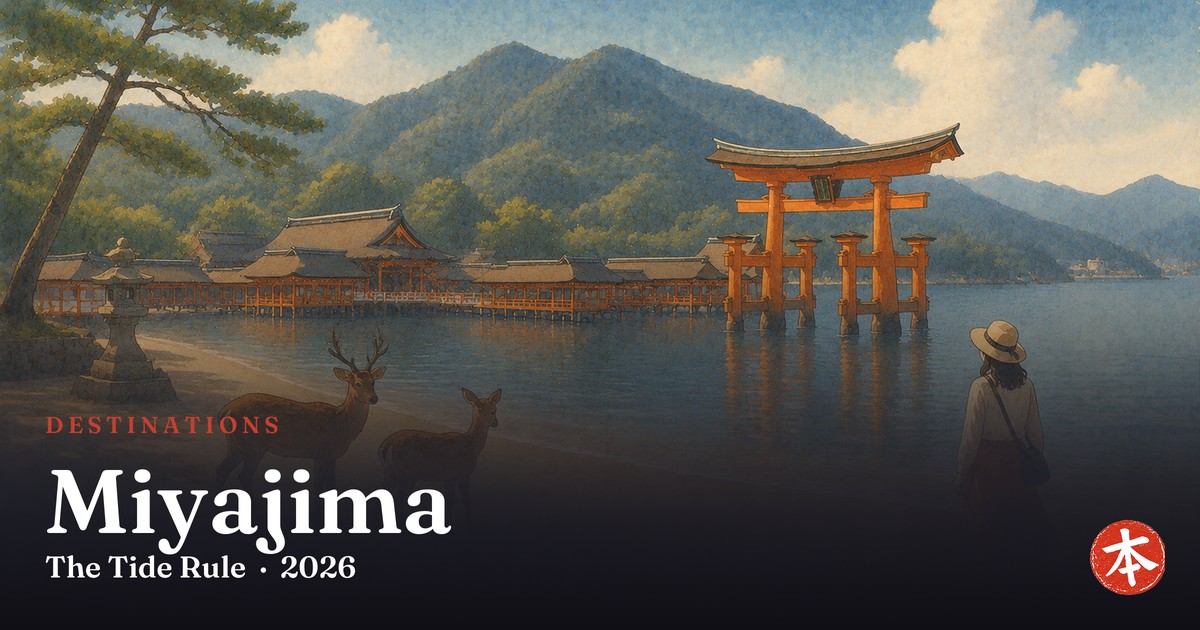
Miyajima's own tourism association prints two sentences that demolish most of what is written about the island in English: "high tide equals the floating shrine" is incorrect information, and "low tide equals walking to the great torii" is incorrect information. The real rule is numeric — below 100cm you can walk out; above 250cm it floats — and there is a wide middle band where you get neither. Some days have zero walkable minutes. There is also something no English guide has caught up with: the hall housing Mount Misen's eternal flame burned down on May 20, 2026. Here is the island as its own official sources describe it, in August 2026.
Miyajima at a glance
| Item | Official answer (Aug 2026) |
|---|---|
| 🚨 Walk to the torii | Tide height below 100cm — not "at low tide" |
| 🚨 Shrine appears to float | Tide height above 250cm — not "at high tide" |
| Ferry | 200 yen each way · about 10 min · every ~15 min · two operators, same price |
| 🚨 Visitor tax | 100 yen per person, on entry only — added to your ferry ticket automatically |
| Shrine | Adults 300 yen · 6:30–18:00 (Mar 1–Oct 14) · open year-round |
| Shrine + treasure hall | Combined ticket 500 yen |
| Ropeway | 2,000 yen return · last ascent 16:00, last descent 16:30 |
| Illumination | From 30 minutes after sunset until 11pm · torii, shrine, pagoda, treasure pagoda |
| Last boat off the island | JR 22:14 · Matsudai 20:15 · Peace Park boat 17:30 |
| Typical stay | The association says 2–3 hours is the most common |
A Japanese day-trip from Hiroshima, costs and timings included:
The tide rule, properly explained
Why is "high tide / low tide" the wrong frame?
Because tides are not binary and the island's two famous views have different thresholds. The association's own explainer is unusually direct about this — it says that thinking in terms of high tide, low tide, spring tide and the rest is exactly what confuses people, and that the only thing you need is the number. Under 100cm, the seabed is exposed and you can walk out to the gate. Over 250cm, the water is deep enough that the shrine and gate appear to sit on the sea. Between 100 and 250 you are looking at wet sand and a gate standing in shallow water — the view that disappoints people who arrived at "low tide" expecting one thing or the other.
How do you actually plan around it?
Open the association's English tide page rather than the Japanese one. The Japanese version gives you hourly heights in centimeters; the English version does the arithmetic for you and prints the time windows for "Torii Walk" and "Floating Shrine" on each date. Its own wording: you can walk right down to the great torii during the time indicated, and the shrine looks as if floating during the time indicated. The reason this matters more than any other planning step: on the day we tested it, the walk window was blank — the page returned "No Torii Walk hour today." If you have one shot at the island, check the date before you book the train, not after.
What is the gate actually made of?
The current gate is the ninth in a line going back to the Heian period, rebuilt in 1875. The association publishes the numbers: 16.6 meters tall, a 24.2-meter ridge, main pillars 9.9 meters around, total weight about 60 tons. It stands by mass alone, not foundations — and the crossbeam is built as a box holding roughly four tons of small stones for ballast. The main pillars are camphor, the auxiliary ones cedar.
Mount Misen: what changed in 2026
Is the mountain still worth going up?
Yes — the observatory is intact and, per the association, was completed in December 2013 with a cedar-clad roof deck giving a 360-degree panorama that reaches the mountains of Shikoku on a clear day. Misen itself is 535 meters. Misen Hondo, the main hall, is described as founded by Kukai in 806. Just build the day around the ropeway's clock rather than the shrine's: last ascent 16:00.
Something genuinely new, if your dates line up
For five days only — October 19 to 23, 2026 — the ropeway is running a night operation to mark 30 years since the shrine's World Heritage listing. Departures from the Momijidani station start at 17:50 with the last car at 18:23, at 5,000 yen per pair including a paired votive tablet. The restrictions are firm: pairs only, 19 and over, ten pairs per day, applications from September 1 to 15 with a lottery drawn on September 18. As far as we can tell this exists only on the Japanese page, which means nobody writing in English has flagged it yet — and it also means you should confirm whether the application process can be handled without Japanese before you count on it.
Getting there, and the timetable that actually constrains you
Which route from Hiroshima?
Three, and they are not interchangeable. By tram: Hiroden runs to Hiroden-Miyajimaguchi at a flat 240 yen — note that Hiroden abolished its zone fares on February 1, 2025, so any guide quoting a higher Miyajima-line fare is out of date. By JR: the San-yo Line toward Iwakuni reaches Miyajimaguchi in about 28 minutes per JR West Miyajima Ferry's own access page — we are not quoting a fare, because JR's fare tool would not give us one we could verify. By boat from the Peace Park: about 45 minutes, and by far the nicest, at the cost of an early last departure. For how these pieces fit together across the city, see our Hiroshima map guide, and pair the island with the Peace Memorial Park — the two are the standard one-day combination. If you are running a rail pass, our JR Pass guide covers what it does and doesn't cover.
The four "last boats" — don't mix them up
This is where day-trippers get stranded, because every operator has a different final departure and guides quote whichever one they happened to find. From the island: JR 22:14. Matsudai 20:15. Peace Park boat 17:30. Hiroshima Port boat 17:00. That is a five-hour spread. If you came by the Peace Park boat and stay for the illumination, you are not going back the way you came — you will be taking a ferry to Miyajimaguchi and a tram or train from there.
What does a minimum day actually cost?
From Hiroshima Station by tram, with the shrine: 240 yen each way on Hiroden, 200 yen each way on the ferry, 100 yen visitor tax, and 300 yen to enter Itsukushima Shrine — 1,280 yen all in. Add 500 yen instead of 300 if you want the treasure hall on the combined ticket, and 2,000 yen if you take the ropeway both ways. Note what is not in that figure: we have deliberately left the JR fare out rather than guess it.
On the island: hours, closures and the deer
When is the shrine actually open?
It never closes for a day — Itsukushima Shrine is open year-round — but the closing time moves six times a year. March 1 to October 14: 6:30 to 18:00. October 16 to November 30 and January 4 to the end of February: 6:30 to 17:30. December: 6:30 to 17:00. New Year is its own thing, and here the shrine and the tourism association's printed table disagree with each other, so if you are visiting in the first days of January, check the shrine's own page. The treasure hall runs 8:00 to 17:00 year-round; Senjokaku, the great unfinished hall, 8:30 to 16:30 at 100 yen. Note the timing trap in the evening: the illumination starts 30 minutes after sunset and runs to 11pm, but you cannot be inside the shrine then — the lit view is from outside.
One closure that will wreck a winter itinerary
Miyajima Aquarium is closed from December 1, 2026 through March 31, 2027. This appears on the aquarium's own site and not on the tourism association's price and timetable sheet, which is the document most people would check. Normal operation is 9:00 to 17:00 with last entry at 16:00, 1,420 yen for adults. If you are planning a winter trip with children, that is the closure to know about.
How should you behave around the deer?
The association's request is direct: do not casually feed the deer, and take your trash home. The reasoning it publishes is worth reading before you hand over a pamphlet as a joke — modern paper is chemically treated and genuinely dangerous to them, and deer also eat plastic and clothing, which cannot be digested and hardens in the stomach like a stone, leading to malnutrition and death. One honest note on how this is usually written up: we found no ordinance imposing a fine on either the city's or the prefecture's pages. It is a strongly worded official request, not a penalty — and the request is the part that matters.
What can you actually leave your bags in?
Not much, and not with a published price. The association names three coin-locker locations in total — JR Miyajimaguchi Station, the Miyajimaguchi ferry terminal, and the Miyajima pier, which is the only one on the island itself — but publishes no rates, no sizes and no operating hours for any of them, so we can't tell you whether a large case fits. What does have a published price is the Yamato counter at JR Miyajimaguchi Station: open daily 9:00 to 18:00, roughly 500 to 700 yen per bag. Payment methods and public Wi-Fi on the island are, likewise, not documented on any official page we read.
(Working out how to get here: our Hiroshima to Miyajima guide covers the 100-yen visitor tax that no rail pass covers, and the boat that runs door to door for 2,400 yen.)
(For a night on the island: our Iwaso Ryokan guide covers a ryokan founded in 1854, a 3-minute walk from Itsukushima Shrine, where a booking is automatically canceled if the ryokan hears nothing from you by 8:00 pm.)
FAQ
Is it true that high tide makes the shrine float and low tide lets you walk to the torii?
So how do I check before I go?
What happened to the eternal flame on Mount Misen?
How much is the visitor tax, and do I have to do anything?
Which ferry should I take?
Can I get to Miyajima directly from the Peace Memorial Park?
What time do I have to leave if I want to go up Mount Misen?
How long is the walk from the ropeway to the summit?
Is it true you can’t eat while walking on Miyajima?
Is the great torii still covered in scaffolding?
Bottom line (2026) — Miyajima’s own tourism association states in capitals that high tide does not mean the shrine floats and low tide does not mean you can walk to the torii; the real thresholds are 100cm and 250cm, and some days offer neither. The eternal flame hall on Mount Misen burned down on May 20, 2026. Check the official tide table for your date, and expect the Misen hall to be gone.
Sources
Tide thresholds, the annual and English tide tables, the great torii's dimensions and history, illumination hours, deer guidance, coin-locker locations and the typical length of stay: the Miyajima Tourist Association. Worship hours, admission fees, the completed 2022 torii repair and the current pagoda and corridor works: Itsukushima Shrine. The Miyajima Visitor Tax, its exemptions and collection method: Hatsukaichi City. The Reikado fire: Hatsukaichi City Fire Department's interim report of June 29, 2026. Fares, timetables and the Great Torii service: JR West Miyajima Ferry, Miyajima Matsudai Kisen, Aqua Net Hiroshima and Setonaikai Kisen. Tram fares and the February 2025 flat-fare change: Hiroshima Electric Railway. Ropeway fares, hours, the shuttle bus and the October night operation: Miyajima Ropeway. Winter closure and admission: Miyajima Aquarium. All read on August 21, 2026. The embedded video is by its creator.
Some links on this page may be affiliate links, which means we may earn a commission if you book or buy through them — at no extra cost to you. See our affiliate disclosure.
Tokyo to Osaka, Tokyo to Kyushu, Tokyo to Hokkaido — day by day — plus seven places most visitors never reach.
- 12 pages, 80 photographs, every stop linked to its guide
- Every price and opening hour read from the official page
- Re-issued monthly, so it does not go stale in your inbox
Free. One email a month, plus the rare change that matters. Unsubscribe with one click in any email. By subscribing you agree to our privacy policy.