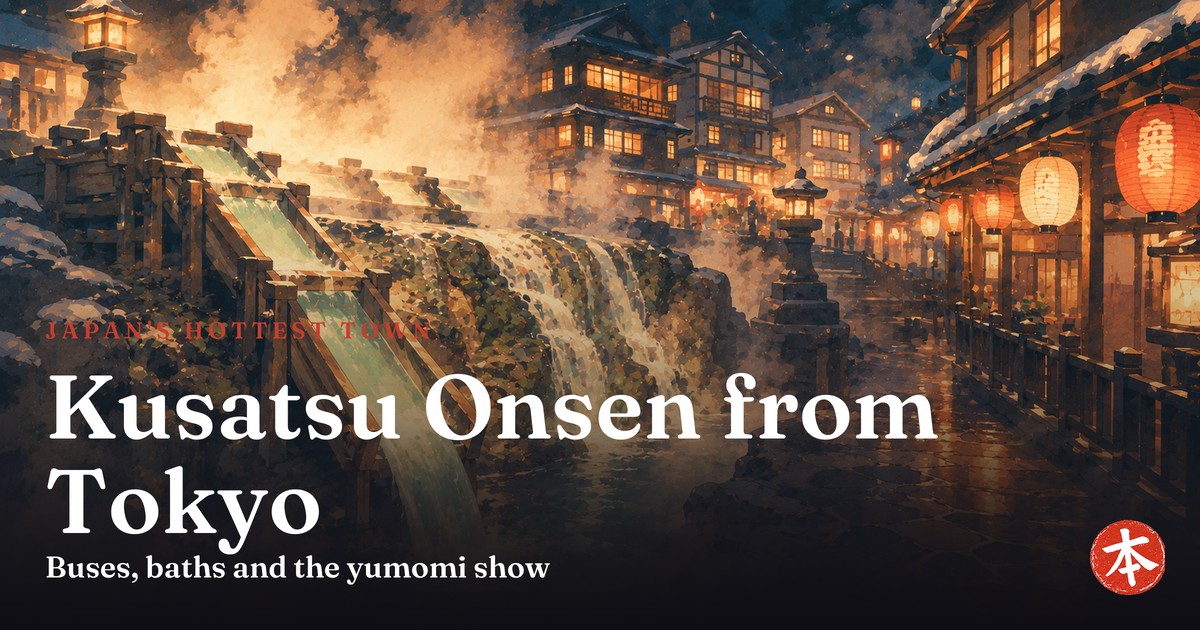
Kusatsu is the onsen Japan itself ranks first — a mountain town built around the Yubatake, a steaming cascade moving an official 4,000 liters of spring water a minute. Getting there from Tokyo takes about four hours, and this August the route map actually changed: the Karuizawa direct bus suspended service on August 1, 2026. Here's what works now — the ¥3,700–4,000 direct highway bus, the express-train combo with its ¥780 final leg — plus the yumomi show schedule and the three free baths, all from the official pages.
Kusatsu from Tokyo at a glance
| Route | Time | Official price (Aug 2026) |
|---|---|---|
| Direct highway bus (Busta Shinjuku / Tokyo Sta → Kusatsu BT) | ~3h55m–4h05m · 9/day | ¥3,700–4,000 by departure · onboard ¥4,100 · web deals from ¥2,720 · all reserved |
| Ltd. express Kusatsu-Shima + JR bus (Ueno → Naganohara → town) | ~2h33m + 22–25 min bus | Bus leg ¥780 (IC ok) · 🚨 train fare: check official JR East |
| Shinkansen via Karuizawa + local bus | ~70 min + bus | Bus ¥2,240 listed · 🚨 DirectLine suspended from Aug 1, 2026 — only ~5 local buses/day |
The town, the Yubatake and the baths — what four hours of travel buys:
Route 1: the direct bus — simplest and usually cheapest
How does the variable fare actually work?
The Joshu Yumeguri and Tokyo Yumeguri buses (JR Bus Kanto, two departures operated by Chichibu Railway) run nine times a day from Busta Shinjuku (first bus 8:05, last 18:05) and Tokyo Station straight to Kusatsu's terminal in about four hours. The official fare table — current from August 1, 2026 — is departure-based: ¥3,700, ¥3,800 or ¥4,000 depending on which bus you pick, ¥4,100 if bought on board, with web-purchase discounts dropping as low as ¥2,720. Every seat is reserved, so buy ahead on the official Kousoku Bus Net (sales open one month and a day before travel, from 10:00). Four hours is real, but it's stationless simplicity: you board in Shinjuku and step off at the Yubatake's doorstep.
Route 2: the train combo — fastest rails, honest gaps
Why won't we print the train fare?
The limited express Kusatsu-Shima leaves Ueno and reaches Naganohara-Kusatsuguchi in about 2 hours 33 minutes (the tourism association's official figure), where the JR Kanto local bus completes the climb: 22–25 minutes, ¥780, paid on board with cash or IC card, roughly 15-plus runs a day timed around the trains. The missing number is deliberate: JR East's pages block automated reading and fares were revised in March 2026, so we couldn't verify the current express fare against an official source — and the figures on older blogs predate the revision. Check it on JR East's official site or app when you book. The combo suits rail romantics and JR Pass holders; the bus suits everyone else.
Route 3: Karuizawa — the scenic route that just got harder
What exactly stopped running in August 2026?
On paper it's elegant: Hokuriku Shinkansen to Karuizawa in about 70 minutes, then a bus over the highlands to Kusatsu. In practice, 2026 has thinned it out. The dedicated Kusakaru DirectLine suspended service from August 1, 2026 — the operator's official notice cites driver shortage — leaving the ordinary Kusakaru local bus, about five departures a day at an officially listed ¥2,240 (a fare table dated 2019, so confirm on the day). Seibu's alternative via Manza is also officially suspended on the Manza–Kusatsu section. Verdict: still lovely if a Karuizawa stop was already in your plan; otherwise the direct bus wins on every axis right now. If the highlands crossing is the appeal, do it in the Kusatsu-to-Karuizawa direction on your way out — a missed connection matters far less when the shinkansen, not the last mountain bus, is the next leg.
When you arrive: the Yubatake playbook
What's actually free, and what costs ¥700?
The town center is the attraction and most of it is open-air: the Yubatake itself — 4,000 liters a minute through wooden cooling channels, a national Place of Scenic Beauty since 2017, lit beautifully after dark — costs nothing to stand beside. The ticketed icon is the yumomi show at Netsu-no-yu: ¥700 (children ¥350), morning shows at 9:30/10:00/10:30 and afternoon at 15:30/16:00/16:30, with extra 9:00 and 15:00 performances on the summer calendar; tickets sell from 30 minutes before, and a hands-on paddling session runs midday at ¥300. Then the deep cut most visitors miss: three free public baths — Shirahata-no-yu (8:00–23:00), Chiyo-no-yu (6:00–23:00), Jizo-no-yu (8:00–22:00) — real neighborhood tubs on the source water, with the official warnings that there are no lockable lockers and mornings bring cleaning closures. For the wider genre of Tokyo-escapes, our Snow Monkey Park guide covers the other great Nagano-area winter pilgrimage, the Nara guide the westbound equivalent of this journey, and the two-week itinerary where an onsen night like this one slots in.
For a first-hand account of an overnight stay — the yumomi show, the Yubatake lit up at night and the free footbaths — see Nele van Hout’s The Perfect Kusatsu Onsen Itinerary on The Navigatio.
(Weighing Kusatsu against the alternatives? The day-trips hub compares all the classic escapes in one place.)
(For the far-north version of this pilgrimage — gas lamps, snow and a Taisho-era street — see Ginzan Onsen from Tokyo.)
(One of the group's onsen ryokan opened here in 2026 — our Hoshino Resorts guide explains the brands and the tattoo policy.)
FAQ
What’s the easiest way from Tokyo to Kusatsu Onsen?
How does the train route work?
Is the Karuizawa shinkansen route still worth it?
How much is the yumomi show?
Are there really free baths in Kusatsu?
What is the Yubatake exactly?
Can I do Kusatsu as a day trip from Tokyo?
Does the winter volcano bus affect getting there?
Kusatsu or Hakone — which onsen trip should I pick?
Bottom line (2026) — Kusatsu is about four hours from Tokyo, and the map just changed: the Karuizawa direct bus suspended itself on August 1, 2026. What works is JR Bus Kanto’s direct highway bus — 9 daily departures at ¥3,700/¥3,800/¥4,000 (onboard ¥4,100) — or the express train plus the ¥780 Naganohara–Kusatsu bus (22–25 minutes, IC accepted).
Sources
Direct-bus schedule, the nine daily departures, variable fares (¥3,700/¥3,800/¥4,000, onboard ¥4,100, discounts) and reservation rules: JR Bus Kanto's official digital timetable (December 2025 revision) and its fare table effective August 1, 2026. The Naganohara–Kusatsu bus (22–25 minutes, ¥780, IC accepted): JR Bus Kanto's official timetable and its April 2025 fare-table PDF. The 2h33m Ueno–Naganohara figure and the Karuizawa route outline: the Kusatsu Onsen Tourism Association's official access pages. The Kusakaru DirectLine suspension from August 1, 2026, the ~5 daily local buses and the ¥2,240 listed fare: Kusakaru Kotsu's official notices, timetable and fare PDFs. The Seibu Manza–Kusatsu suspension: Seibu Bus's official route page. Yubatake figures and 2017 designation: Kusatsu Town's official page. Yumomi prices and showtimes and the three free baths with their hours and caveats: the tourism association's official pages. All read on August 12, 2026. JR train fares were not verifiable officially and are not quoted. The embedded video is by its creator.
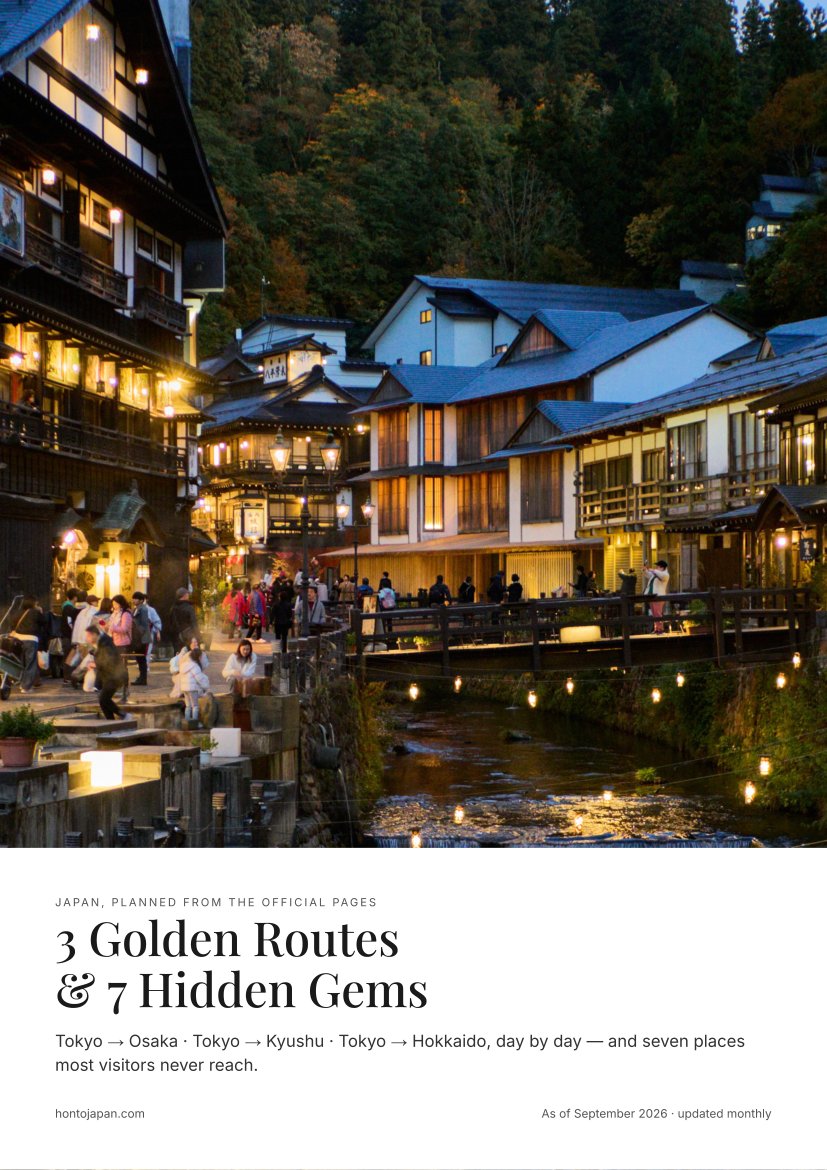
Tokyo to Osaka, Tokyo to Kyushu, Tokyo to Hokkaido — day by day — plus seven places most visitors never reach.
- 12 pages, 80 photographs, every stop linked to its guide
- Every price and opening hour read from the official page
- Re-issued monthly, so it does not go stale in your inbox
Free. One email a month, plus the rare change that matters. Unsubscribe with one click in any email. By subscribing you agree to our privacy policy.