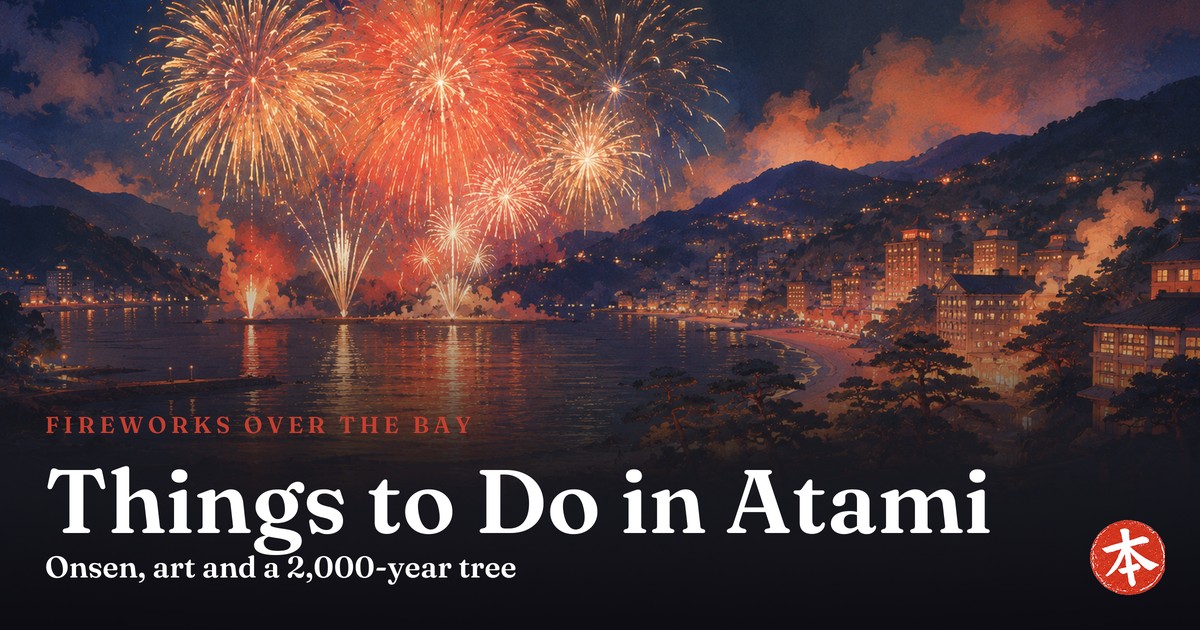
Atami was Japan's honeymoon capital before Hawaii was affordable, and its comeback is built on the same three assets: hot water, a bay made for fireworks, and a shinkansen stop about 50 minutes from Tokyo. The 2026 version adds precision — 14 official fireworks dates a year, a clifftop museum with National Treasures, a shrine tree officially over 2,000 years old — and two honest gaps where this guide refuses to guess: the castle's just-revised admission and JR's post-revision fares.
Atami at a glance
| Thing | Official facts (Aug 2026) |
|---|---|
| Getting there | Kodama shinkansen ~50 min (Hikari ~37) · fares: check official JR |
| Sea fireworks | 14 dates/year · remaining 2026: Aug 18 & 24, Sep 13, Oct 12 & 25, Nov 8 & 23, Dec 6 & 25 · rain or shine |
| MOA Museum of Art | ¥2,000 · 9:30–16:30 · closed Thu |
| Kinomiya Shrine's Great Camphor | 2,000+ years · trunk ~24m · free · 9:00–17:00 |
| Atami Castle | 9:00–17:00, no closing days · 🚨 admission recently revised — check on site |
| Sun Beach | Swimming Jul 11–Aug 30 (9:00–16:00) · nightly light-up to 22:00 |
| Hatsushima island | 30-min ferry · RT ¥2,900 |
| Day-use onsen | Marine Spa ¥1,360 (10:00–19:00) · Ekimae sento (closed Wed) |
The town, the bay and the baths in motion:
The fireworks calendar: Atami's unfair advantage
Why does a small town have fireworks 14 times a year?
Because the bay is a natural amphitheater — mountains on three sides, sound bouncing off the water — and the town long ago decided fireworks were infrastructure, not festival. The official 2026 calendar spreads 14 dates across all four seasons; from mid-August the remaining shows fall on August 18 and 24, September 13, October 12 and 25, November 8 and 23, and December 6 and 25, held rain or shine over the bay, starting in the 20:15–20:20 band for a compact 20-odd minutes (verify times on the association's official page before traveling). The strategic consequence writes itself: match your visit to a fireworks date and stay the night — the show starts after the last comfortable day-trip return.
The big three sights: tree, museum, castle
What's actually old here — and what isn't?
Genuinely ancient: the Great Camphor at Kinomiya Shrine, officially dated over 2,000 years with a trunk circumference around 24 meters — a national Natural Monument ranked among Japan's largest trees, with the shrine's own promise that one lap around it adds a year to your life (9:00–17:00, free, five minutes' walk from Kinomiya Station). Genuinely world-class: the MOA Museum of Art on the clifftop — National Treasures, ocean light, and that famous kaleidoscope escalator hall — officially ¥2,000, 9:30–16:30, closed Thursdays. Genuinely 1959: Atami Castle, a postwar leisure castle whose value is the 360-degree bay panorama, open 9:00–17:00 without closing days; its admission was apparently revised in July 2026 and is published only as an image, so — uniquely in this guide — we tell you to read the price at the gate rather than trust the internet's stale numbers.
Sea level: the beach, the statue, the island
What can I do by the water after dark?
Sun Beach carries the town's resort DNA: official swimming season July 11–August 30 (9:00–16:00), palms, and a nightly illumination from sunset to 22:00 that the city calls Japan's first — which turns the post-dinner stroll into an event even on non-fireworks nights. The promenade passes Omiya's Pine and the Kanichi-Omiya statue, the melodramatic beach-kick scene from the Meiji novel Konjiki Yasha cast in bronze — Japan's most photographed literary breakup. Offshore, Hatsushima is the 30-minute ferry escape (officially ¥2,900 round trip; the port is a 15-minute bus from the station): seafood shacks, gardens, an island bath — best as an overnight's second morning rather than a day-trip squeeze.
The onsen part, without a ryokan booking
Atami's water is the point, and you don't need a ¥40,000 inn to touch it. Marine Spa Atami, the seafront complex, officially runs 10:00–19:00 (last entry 18:30) at ¥1,360 adults / ¥680 children, with discounted after-15:00 tickets — the practical day-trip soak. The local-life versions sit on the tourism association's official list: the Ekimae Onsen bathhouse steps from the station (closed Wednesdays) and the neighborhood Yamada-yu — coins, tattoos-of-grandmothers atmosphere, real spring water. Plan the rest of the escape-from-Tokyo genre with our Yokohama guide (the 30-minute version of this idea), the Kawaguchiko guide (the mountain version), or the 7-day itinerary where a night in Atami slots neatly between Tokyo and points west.
FAQ
How far is Atami from Tokyo?
When are the Atami fireworks in 2026?
What is the giant tree at Kinomiya Shrine?
Is the MOA Museum of Art worth the trip up the hill?
How much is Atami Castle?
What’s the beach like — can you swim?
Is Hatsushima worth the ferry?
Where can I bathe without staying overnight?
When do the plum blossoms happen?
Day trip or overnight?
Bottom line (2026) — Atami is under an hour from Tokyo by Kodama, with fireworks over the bay on 14 dates a year (rain-or-shine per the city’s tourism association). The MOA Museum closes Thursdays; Atami Castle has no closing days; and the Great Camphor at Kinomiya Shrine is a designated Natural Monument. You don’t need a ryokan booking to touch the water.
Sources
Fireworks dates and rain-or-shine policy: the Atami City Tourism Association's official event calendar. MOA Museum hours, Thursday closures and admission tiers: the museum's official English pages. The Great Camphor's age, girth, Natural Monument status, the one-lap legend and shrine hours: Kinomiya Shrine's official pages. Atami Castle's hours, no-closing-days policy and parking (and the image-only, apparently July-2026-revised admission we therefore decline to quote): the castle's official site. Sun Beach swimming season and the nightly illumination, the Baien garden's tree counts, festival seasons and free-except-festival admission, the Konjiki Yasha statue history, and the day-use bath list: the tourism association's official spot pages. Hatsushima ferry times and round-trip fares, and the ~37/50-minute shinkansen timings: the Hatsushima resort line's official access page (timings are the operator's guidance, not JR's). Marine Spa hours and prices: its official site. All read on August 12, 2026. JR fares were not verifiable officially and are not quoted. The embedded video is by its creator.
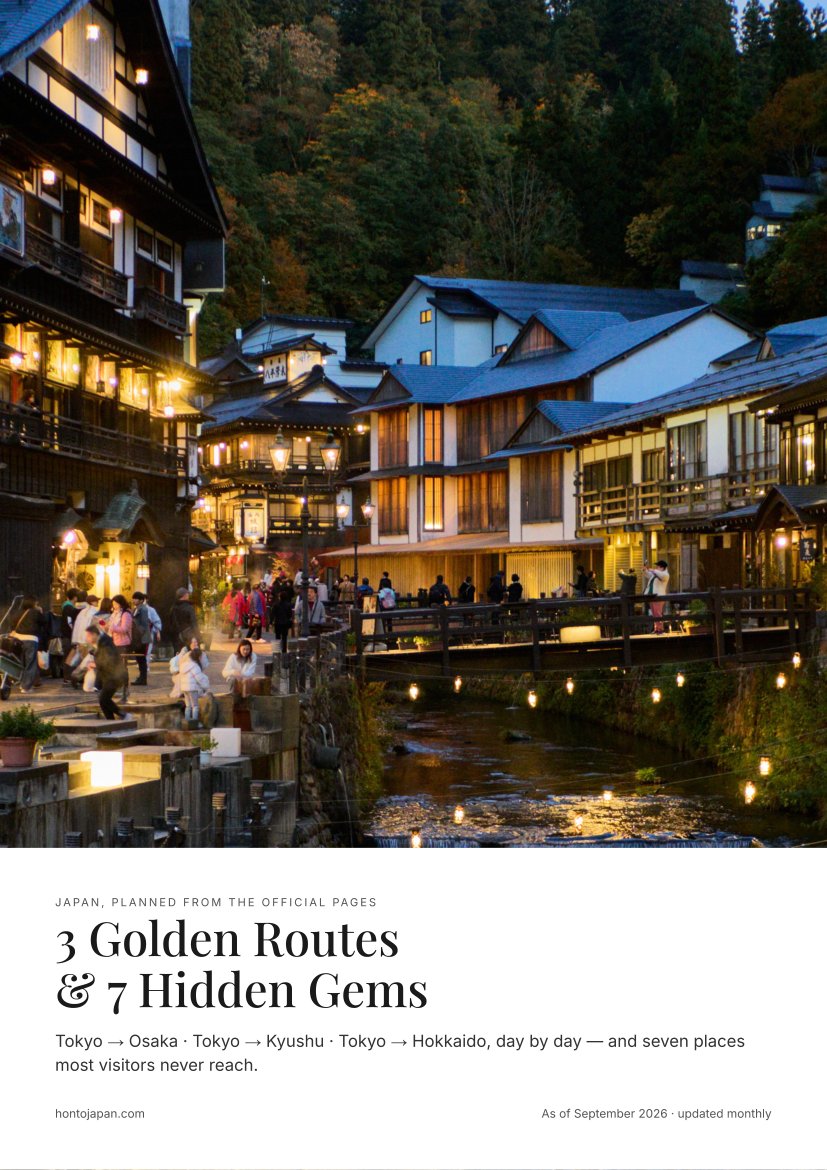
Tokyo to Osaka, Tokyo to Kyushu, Tokyo to Hokkaido — day by day — plus seven places most visitors never reach.
- 12 pages, 80 photographs, every stop linked to its guide
- Every price and opening hour read from the official page
- Re-issued monthly, so it does not go stale in your inbox
Free. One email a month, plus the rare change that matters. Unsubscribe with one click in any email. By subscribing you agree to our privacy policy.